How Much Does Car Maintenance Cost Per Year?
Many drivers should set aside about $1,000 to $2,500 a year for car maintenance, including scheduled service, wear items, and a repair reserve. Older or high-mileage vehicles often land above that. Skip it, and routine service can turn into overdue repairs, shorter part life, and surprise bills that break a monthly budget. This guide breaks the yearly total into scheduled maintenance, tires and brakes, fluids and filters, and money for unexpected fixes.
Typical cost range
For a typical vehicle, annual car maintenance runs between $800 and $1,500, which works out to roughly $65 to $125 a month. That is a starting point, not a personal quote. Age, mileage, vehicle type, and where you are in the ownership cycle can move the total well above or below that band.
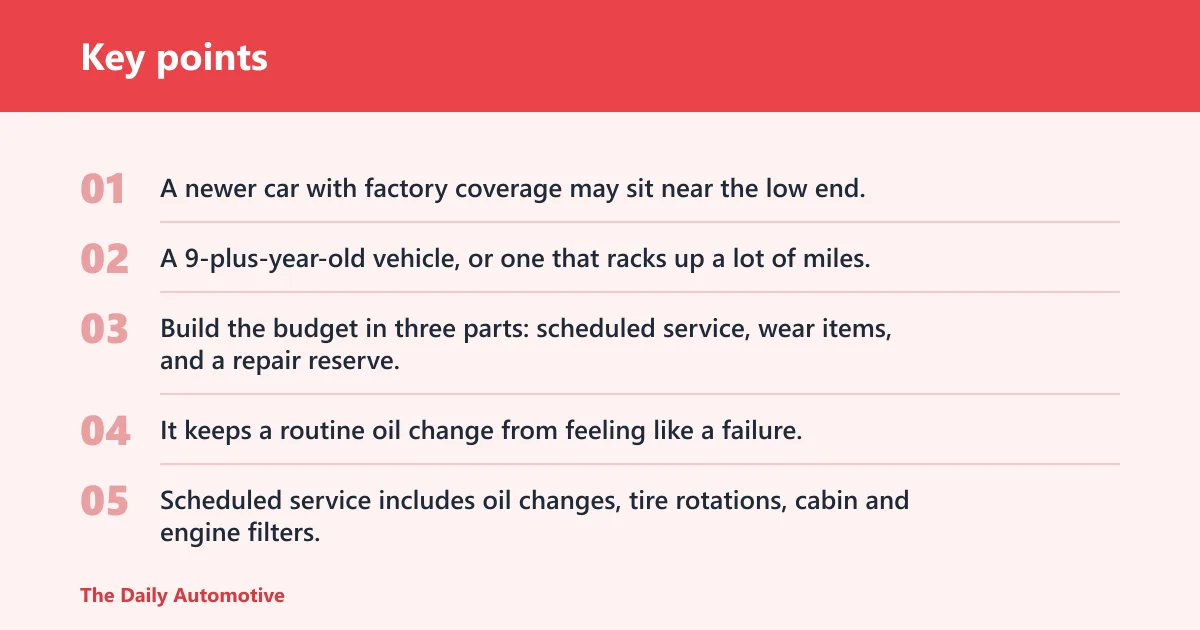
A newer car with factory coverage may sit near the low end. A 9-plus-year-old vehicle, or one that racks up a lot of miles, can land much higher because wear items and repairs show up more often.
What goes into a yearly car budget?
Build the budget in three parts: scheduled service, wear items, and a repair reserve. Those buckets behave differently. Scheduled service is predictable. Wear items are partly predictable. Repairs are the part most owners underfund.
That split matters. It keeps a routine oil change from feeling like a failure, and it keeps one bad repair from wiping out the whole year’s maintenance money.
Scheduled service
Scheduled service includes oil changes, tire rotations, cabin and engine filters, brake inspections, fluid checks, and alignment checks when needed. ConsumerAffairs lists oil changes at every 7,500 to 10,000 miles or every year. If your driving is closer to 12,000 to 15,000 miles a year, you may hit mileage-based service before time-based service, especially with commuter use.
Wear items
Wear items are the parts that fade with use: tires, brake pads, batteries, fluids, and some suspension components. The same source lists brake pad replacement at every 30,000 to 50,000 miles, battery replacement every 4 to 5 years, and battery replacement averaging $456 to $493. Rotor replacement averages $574 to $698.
Repair reserve
The repair reserve is the money you set aside for the items that do not follow a neat schedule. Sensors fail. Hoses age. A wheel bearing or alternator may quit early. A reserve keeps those bills off a credit card because the maintenance budget was spent on oil changes and tires.
Car maintenance budget worksheet
Use this worksheet to estimate a yearly set-aside instead of leaning on one national average. The numbers below assume common U.S. ownership patterns and a mix of scheduled service, wear items, and repair reserve. Actual costs still depend on make, model, and how hard the vehicle works.
| Owner profile | Routine service | Wear items | Repair reserve | Total per year | Monthly set-aside |
|---|---|---|---|---|---|
| Low-mileage owner | $300 | $250 | $250 | $800 | $67 |
| Average-driver owner | $500 | $500 | $500 | $1,500 | $125 |
| High-mileage commuter | $700 | $900 | $700 | $2,300 | $192 |
These profiles are built around different mileage burdens, not just vehicle age. A low-mileage owner may need fewer oil changes and see slower tire and brake wear. A commuter who drives a lot can burn through service intervals faster, even in a newer car.
Say your sedan sees 6,000 miles a year and spends most of its time on short errand trips. The oil change interval may still be time-based, and the battery may age faster than the odometer suggests. A low-mileage budget still needs a repair reserve, because age can move parts faster than mileage alone.
Why do age and mileage change costs?
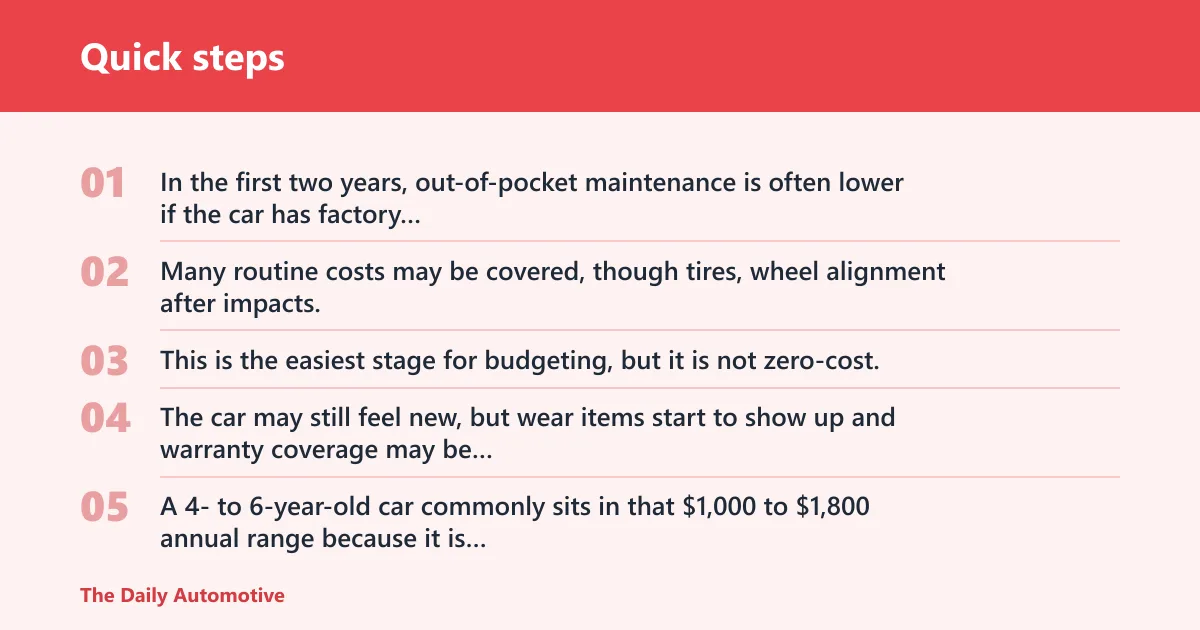
Age and mileage raise maintenance costs because parts wear, fluids age, and service items come due more often. A 4- to 6-year-old car commonly lands in the $1,000 to $1,800 annual range, while a 9-plus-year-old car can cost $1,500 to $3,000+ per year to maintain. Mileage pushes those numbers up faster when you drive a lot.
0–2 years
In the first two years, out-of-pocket maintenance is often lower if the car has factory warranty coverage or complimentary maintenance. Many routine costs may be covered, though tires, wheel alignment after impacts, and damage-related items usually are not. This is the easiest stage for budgeting, but it is not zero-cost.
3–5 years
This is often the middle ground. The car may still feel new, but wear items start to show up and warranty coverage may be thinner.
6–8 years
Once a vehicle passes the midpoint of its life, maintenance becomes less predictable. Suspension parts, belts, fluids, and electrical issues become more likely, and some owners start planning for larger repair bills. The budget should shift away from only routine service and toward a larger reserve.
9+ years
Rubber parts harden, batteries age out, and bigger repairs become more common. This is where the repair reserve matters most, because a single failure can exceed a year of routine service.
A common first-timer mistake is budgeting only for oil changes on an older SUV. Then the tires age out, the brake pads are close, and a battery replacement lands in the same year. The total feels sudden, but the costs were building separately for months.
How do vehicle type and fuel type change costs?
Vehicle type changes maintenance cost because weight, tire size, load, and parts pricing are different. Economy sedans usually cost less to maintain than SUVs, luxury vehicles, and trucks. EVs usually cost less than gas vehicles on routine service, but they still need tires, brakes, alignment checks, suspension parts, and fluid service where applicable.
Economy sedan
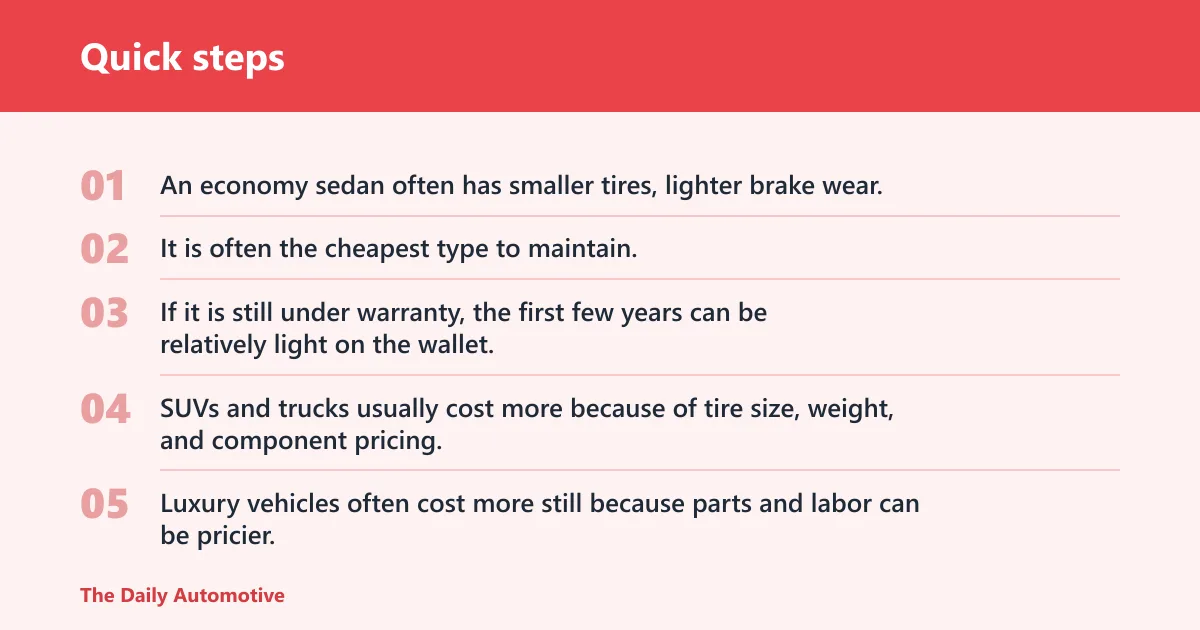
An economy sedan often has smaller tires, lighter brake wear, and simpler routine service bills. It is often the cheapest type to maintain, especially if it uses common parts and sees steady highway driving. If it is still under warranty, the first few years can be relatively light on the wallet.
SUV, luxury vehicle, and truck
SUVs and trucks usually cost more because of tire size, weight, and component pricing. Luxury vehicles often cost more still because parts and labor can be pricier, and some models need more specialized service items. Extra weight can also raise brake and tire wear, especially in city driving.
EV maintenance differences
EV maintenance often costs less because EVs do not need oil changes, exhaust service, or timing belt replacements. The article’s mileage estimate places EV maintenance at about 6 cents per mile, versus about 10 cents per mile for gas-powered vehicles. That difference comes from fewer fluid changes and less engine-related service, not from skipping tires or brakes.
EVs still need rotation, brake inspections, cabin filters, alignment, and tire replacement. Because many EVs are heavy, tires can wear faster than some drivers expect. So the budget drops in some categories and stays alive in others.
How should you budget for maintenance and repairs?
Use the owner’s manual first, then convert the schedule into a monthly sinking fund. The manual tells you whether service is time-based, mileage-based, or both. If the car still has factory warranty coverage or complimentary maintenance, list those covered items separately so you do not double-count them in your budget.
- List the services in your owner’s manual by time and mileage.
- Separate routine service from wear items like tires and brakes.
- Add a repair reserve for parts that fail outside the schedule.
- Divide the yearly total by 12 for your monthly set-aside.
- Adjust upward if you drive above 12,000 to 15,000 miles a year.
Suppose a 5-year-old crossover is driven 18,000 miles a year. That car may need oil changes sooner, tires sooner, and brake work sooner than the same model used for a 7,000-mile suburban commute. The manual still sets the floor, but the mileage pattern raises the total.
What should you budget for each year?
Budget for the items that actually hit cash flow: oil changes and filters, tires, brakes, battery work, alignment, fluids, and a repair cushion. The exact mix depends on the vehicle’s age, mileage, and type. The goal is to make each year’s likely costs visible before they arrive.
Oil changes and filters
Oil changes are a recurring line item on gas cars, and filter replacement usually rides along with them. The same source lists oil changes at every 7,500 to 10,000 miles or every year. Filters and fluid checks should sit in the routine-service bucket, not in the repair reserve.
Tires, brakes, battery, alignment, and fluids
Tires and brakes are the biggest wear items for many owners. Alignment and fluid service can move from “routine check” to “needed now” after potholes, curb impacts, or long service intervals.
Unexpected repairs
Keep a separate reserve for unexpected repairs because no service schedule catches everything. A dead alternator, leaking water pump, or electrical fault can show up well before a major service interval. A reserve equal to several months of maintenance spending gives you room to absorb those hits without scrambling.
Frequently asked questions
How much should car maintenance cost per year?
Older cars, heavier vehicles, and high-mileage commutes can push the total higher, especially once tires, brakes, and repair reserves are included.
How much does it cost to maintain a car annually?
A practical annual budget is usually $1,000 to $2,500 for scheduled service, wear items, and a repair reserve. That range is broader than a single average because driving style, age, mileage, and vehicle type change the bill from one owner to the next.
What is average car maintenance cost per year?
The same source says average car maintenance costs range from around $400 to $1,200 per year. A broader typical-vehicle estimate is $800 to $1,500 a year. Both numbers can be useful, but neither should replace a budget built around your own mileage and vehicle age.
Why does my older car cost more to maintain?
Older cars cost more because wear items stack up and age-related failures become more likely. By 9-plus years, batteries, tires, brakes, suspension parts, fluids, and other components may all be due around the same time, so the annual total rises fast.
Do EVs cost less to maintain than gas cars?
Usually yes. EVs avoid oil changes, exhaust work, and timing belt replacements, and the article’s estimate puts EV maintenance at about 6 cents per mile versus about 10 cents per mile for gas vehicles. Even so, tires, brakes, alignment, and suspension still belong in the budget.
Which maintenance items should I budget for every year?
Budget for oil changes, filters, tire rotations, brake inspections, tire replacement, battery replacement when due, alignment, and fluids. Then add a repair reserve. That mix covers the predictable work and gives you a cushion for the parts that fail outside the schedule.
Products related to this article
Sponsored / affiliate links. As an Amazon Associate I earn from qualifying purchases. I may earn additional commission from eligible campaigns.