Best Car Finance Deal for No Money Down: How to Choose
The best car finance deal with no money down is usually the one with the lowest total amount payable, not the lowest monthly payment. If APR is similar, a small deposit or part-exchange often costs less than true zero-deposit finance. Pick the wrong deal and you can pay more interest, build negative equity fast, or stretch the term longer than the car is worth. This guide compares zero deposit, small deposit, part-exchange, and promo APR offers so you can choose the cheapest low-cash option.
This guide is part of our Car buying, financing, and selling guide series.
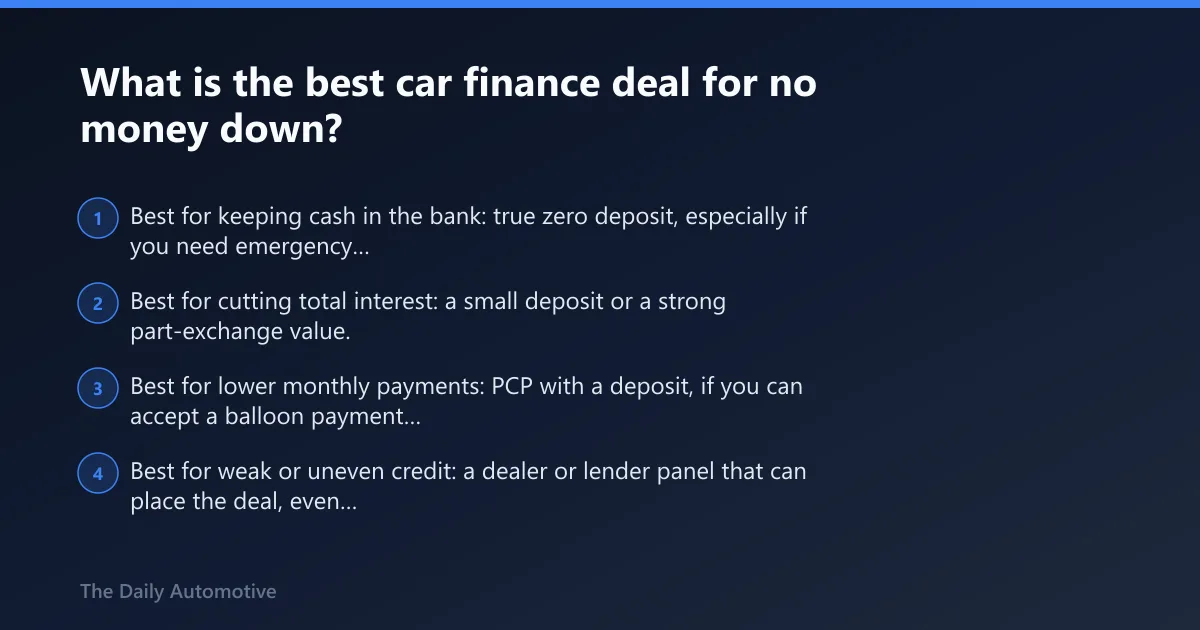
What is the best car finance deal for no money down?
The best no-money-down deal depends on your credit file, the car you want, and how tightly you need to protect cash. I see zero deposit work well for buyers who need the car now and need savings untouched. A small deposit or part-exchange often cuts the total cost enough to justify paying something up front.
Quick picks by budget and credit
- Best for keeping cash in the bank: true zero deposit, especially if you need emergency savings untouched.
- Best for cutting total interest: a small deposit or a strong part-exchange value.
- Best for lower monthly payments: PCP with a deposit, if you can accept a balloon payment later.
- Best for weak or uneven credit: a dealer or lender panel that can place the deal, even if APR is higher.
The headline payment is only half the story. A deal that looks affordable each month can still be the most expensive route over the full term, especially when the deposit is zero and the loan runs for several years.
When no cash down is the better short-term choice
No deposit can make sense when cash is tight, the car is needed now, and preserving savings matters more than shaving every pound off interest. That logic is strongest if the vehicle is reliable, the term is short enough to keep total interest under control, and the finance paperwork is clean.
When paying something upfront is the cheaper move overall
If a buyer can put down even a modest sum, the financed balance drops immediately. That usually cuts interest, softens monthly pressure, and reduces the chance of owing more than the car is worth if resale value falls faster than planned.
According to cars.usnews.com — U.S. News cites an average 60-month car loan rate of 6.94%.
Can you get car finance with no money down?
Yes, many lenders will approve car finance with no money down, but approval depends on credit, affordability, and the dealer’s lender panel. Zero deposit does not mean zero cost at signing, because first payments, admin charges, and other fees can still appear on the order form.
How lenders treat deposit, first payment, and admin charges
A deposit is the upfront cash put into the deal, and no-deposit finance means putting down little or nothing upfront. Even then, some agreements still ask for the first monthly payment at handover, plus document fees, option-to-purchase charges, or administration costs that reduce the cash-saving benefit.
HP and PCP options that can be approved with zero deposit
Both Hire Purchase and Personal Contract Purchase can be written with zero deposit. HP gives fixed monthly payments and ownership at the end after all instalments. PCP usually brings lower monthly payments than HP in many cases, but a balloon payment sits at the end.
Why eligibility changes by lender panel and dealer stock
One dealer may place a no-deposit application easily while another cannot. Approval depends on the lender panel, the car’s age and mileage, the buyer’s income stability, and the stock being sold. A strong file can still be declined if the vehicle or term falls outside policy.
Zero deposit vs small deposit: what really changes?
Dropping the deposit to zero usually raises the monthly payment and the total cost of credit. Over a common 60-month term, even a modest deposit can reduce the amount financed enough to make the whole agreement materially cheaper, especially when APR is unchanged.
Monthly payment impact over a typical 60-month term
U.S. News says some 0% financing offers can last 60 months, but those offers are typically limited to buyers with great credit scores. U.S. News also cites an average 60-month car loan rate of 6.94%, which shows how much the rate itself can affect affordability even before deposit is considered.
How total interest rises when the deposit drops to zero
ChooseMyCar’s representative example borrows £9,000 over 60 months at a representative APR of 21.9%, with a £0.00 deposit, £238.28 per month, total cost of credit of £5,296.80, and total amount payable of £14,296.80. That is the kind of uplift buyers feel when the balance stays high.
When a small deposit beats a no-deposit offer by a wide margin
If the same car is available with a modest deposit and the APR stays similar, the savings compound across the term. The borrower pays interest on less money, the account starts with a lower balance, and there is less chance of the agreement ending with uncomfortable equity or refinance pressure.
How do HP and PCP compare with no deposit?
HP and PCP both work with no deposit, but they solve different problems. HP suits buyers who want to own the car at the end. PCP suits buyers who want lower monthly payments and are willing to accept a balloon payment, return the car, or refinance later.
HP with no deposit: fixed payments and ownership at the end
HP is straightforward. The buyer pays fixed monthly instalments until the balance is cleared, then owns the car outright. With no deposit, the payment is higher than the same deal with a deposit, but there is no large final payment to plan for.
PCP with no deposit: lower payments, balloon payment risk, and exit choices
PCP can lower the monthly payment because part of the car’s value is deferred to the balloon payment at the end. That final lump sum can be manageable if the car is worth more than the balloon, but it creates risk if the market value falls short or refinance rates rise.
Which structure fits buyers who want to keep, swap, or return the car
Buyers who want to own the vehicle should lean toward HP. Buyers who may change cars every few years often prefer PCP, but only if they understand the exit maths. If the end-of-term plan is unclear, zero-deposit PCP can become expensive fast.
Decision table: no deposit, part-exchange, or promo APR

The cheapest route is not always the one with the lowest monthly payment. This table shows the trade-off between cash kept today and the risks carried to the end of the agreement.
| Funding path | Upfront cash needed | Monthly payment pressure | Total interest risk | End-of-term risk |
|---|---|---|---|---|
| Pure zero deposit | £0 or $0 upfront, though first payment and fees may still apply | Highest of the four in most cases | High, because the full balance is financed | HP: low; PCP: balloon stress and refinance risk |
| Small deposit | Low cash outlay, often enough to reduce the finance balance | Moderate | Lower than zero deposit if APR is similar | Lower negative-equity risk than zero deposit |
| Part-exchange | Can act like a deposit substitute if the trade-in value is real | Moderate to lower, depending on equity | Lower if the trade-in reduces the borrowed amount | Depends on whether the trade-in settles old finance cleanly |
| Promo APR | May still need a deposit, or may be paired with bonus cash | Can be strong if the rate is genuinely low | Often the lowest, but only if eligibility is good | Still depends on HP or PCP structure |
U.S. News says the 2026 Nissan Frontier has 0% financing for 60 months, the 2026 Kia EV9 includes $5,000 bonus cash with 0% financing, and the 2026 Hyundai Santa Fe Hybrid offers $1,500 bonus cash with 0% financing. Those offers matter because promo APR can beat a standard low-deposit loan when the buyer qualifies.
What credit score do you need for no-deposit car finance?
There is no single score that guarantees approval, but great credit usually opens the best APR bands and the strongest zero-deposit offers. Average credit can still get approved, though the rate, fees, or car choice may be less attractive. Poor credit often means higher cost or stricter lender criteria.
Great-credit deals and the best APR bands
Strong applicants are more likely to access promotional APR, including 0% deals. U.S. News notes these offers are typically limited to buyers with great credit scores. That matters because low APR can save more than a small deposit on a standard-rate agreement.
Average-credit approvals and the trade-offs that come with them
Average-credit buyers may be approved with zero deposit, but the rate can move the deal from manageable to expensive. At that point, the smart comparison is not monthly payment versus zero cash down; it is total cost of credit versus the alternatives the buyer can actually qualify for.
Bad-credit cases: what is realistic, and where the extra cost lands
Bad-credit applicants often face smaller lender choice, tighter car limits, and higher APR. Some can still get approved through a dealer panel, but the extra cost usually lands in the monthly payment, fees, or both. A longer term may hide that cost without removing it.
Can I use a part-exchange instead of a deposit?
Yes, a part-exchange can function like a deposit substitute if its value is applied to the new deal. That can reduce the amount financed without taking cash out of savings. The key is to value the trade-in separately so the finance offer does not mask a weak vehicle price.
When part-exchange works best
Part-exchange works best when the old car has clear equity, the valuation is competitive, and the finance offer is priced transparently. It is useful for buyers who want to reduce monthly pressure without writing a cheque, especially when the old car would otherwise sit idle.
When it should be checked against a cash offer
If the trade-in figure is opaque, the buyer should compare it against a separate cash valuation. Dealers sometimes blend the figures together, which makes the finance look better than it is. A clean comparison keeps the car price, trade value, and finance terms distinct.
Are there hidden fees in no money down car finance?
Yes, and they matter because they can erase the advantage of putting nothing down. Dealer fees, document fees, option-to-purchase charges, warranties, insurance products, and admin costs can all raise the real cost even when the deposit is £0 or $0.
Fees that often get missed
- Dealer or document fees added at signing
- Option-to-purchase charges on some agreements
- Admin costs folded into the finance file
- Warranties sold as finance add-ons
- Insurance products that increase the total payable
How fees change the real deal
A deal can look like no-money-down finance and still require cash on day one. If fees are rolled into the borrowed amount, the buyer pays interest on them too. If they are paid upfront, they reduce the cash benefit of choosing zero deposit in the first place.
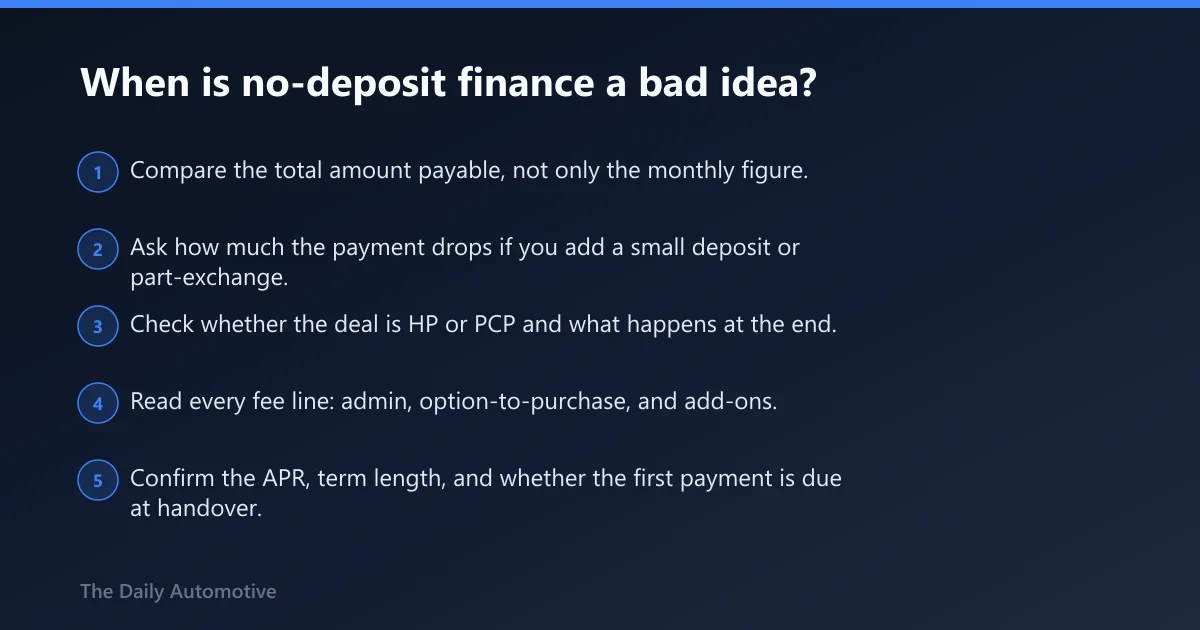
When is no-deposit finance a bad idea?
No-deposit finance is a bad idea when the buyer needs room for repairs, expects the car’s value to fall quickly, or is already stretching the budget. It is also risky when the deal depends on a balloon payment the buyer may not be able to clear or refinance.
Negative equity and inflated affordability
When the deposit is zero, the loan starts larger and negative equity can build faster. That matters if the car is sold early, written off, or traded before the agreement matures. A payment that looks affordable can still be too tight once fuel, insurance, and maintenance are added.
Balloon-payment shock and refinance risk
PCP buyers face a particular issue at the end of term: the balloon payment. If the car is worth less than expected, the buyer may need to pay cash, refinance, or hand the car back. That risk deserves more attention than the monthly headline.
- Compare the total amount payable, not only the monthly figure.
- Ask how much the payment drops if you add a small deposit or part-exchange.
- Check whether the deal is HP or PCP and what happens at the end.
- Read every fee line: admin, option-to-purchase, and add-ons.
- Confirm the APR, term length, and whether the first payment is due at handover.
The best low-cash deal is the one that leaves the buyer with manageable monthly pressure, acceptable total interest, and no ugly surprise at the end. If two offers look close, compare the total amount payable, the deposit you can spare, and the exit terms before you sign. Buyers should compare several written quotes before signing.
Frequently asked questions
Is zero deposit car finance more expensive overall?
Usually, yes. Financing the full amount means interest is charged on a larger balance, so the total cost of credit often rises compared with a small deposit or part-exchange. The monthly payment may still fit the budget, but the full-term cost is commonly higher.
Should I choose HP or PCP with no deposit?
Choose HP if you want straightforward ownership at the end and no balloon payment. Choose PCP if you want lower monthly payments and are comfortable with a final lump sum, returning the car, or refinancing. The better option depends on how long you plan to keep the vehicle.
Products related to this article
Sponsored / affiliate links. As an Amazon Associate I earn from qualifying purchases. I may earn additional commission from eligible campaigns.