Car Buying, Financing, and Selling Guide That Saves
By the Gear Answers Auto Team
Author note: I have bought, financed, traded in, and sold my own vehicles over the years, and I rewrote this guide around the same order of operations I use in real deals: budget first, financing second, purchase price third, and exit strategy for the current car last. We also pressure-tested the worksheet below against common scenarios buyers face at franchised dealers, credit unions, and private-party used-car sales.
Use a simple car buying, financing, and selling guide: set a total monthly car budget before you shop, pull your credit and bring at least one written preapproval with APR, term, and max amount before you step onto a lot, and run the numbers on trade-in versus private-sale net proceeds before you negotiate. Miss the order and you can overpay on the car, overborrow on the loan, and give away money on your current one. This guide lays out the budget math, loan-cost formulas, used-car inspection checks, and the trade-in-versus-private-sale decision sequence that changes your bargaining power.
Start with the decision order, not the car



Why sequence changes total cost and negotiating power
Most buyers start with the vehicle. That is backwards. The lower-cost path is to set the budget, line up financing, negotiate the purchase, then choose the exit path for the current car.
Each step changes the next one. A bigger down payment cuts the amount financed. A stronger credit profile can lower APR. Selling the current car first can strip away trade-in noise and make the purchase quote easier to compare. Rolling negative equity into the next loan does the opposite by inflating the amount financed before the new car even enters the picture.
AAA advises shoppers to compare MSRP, invoice price, market value, and additional costs. That only works if those numbers stay separate long enough to compare them cleanly.
The four buyer paths
The sequence shifts by buyer type:
- Cash buyer: set the total budget, negotiate out-the-door price, then decide whether to sell or trade the current car based on net proceeds and timing.
- Pre-approved buyer: secure outside financing first, negotiate the vehicle next, then let the dealer try to beat the pre-approval.
- Trade-in with equity: confirm payoff and market value early, but keep trade discussion separate until the vehicle price is set.
- Trade-in with negative equity: calculate the shortfall first, decide whether to pay it down, wait, or sell privately before replacing the vehicle.
The three deal buckets to keep separate
There are only three buckets that matter: purchase price, financing terms, and current car value. Dealers often blend them because a high trade allowance can hide a weak selling price, and a low monthly payment can hide a stretched loan term or expensive add-ons.
Keep one worksheet with three lines: out-the-door price, amount financed with APR and term, and trade-in or private-sale net proceeds. If a quote does not break those out, it is not ready for comparison. If you want a deeper breakdown, pair this article with our car buying guide and auto loan preapproval guide.
Important: broad “average car price” and “average payment” figures change frequently and can be misleading without context. I do not use them to set a budget. Use your own all-in monthly limit, local insurance quote, and written finance offers instead.
How much car can I afford before I start shopping?
Set the ceiling before looking at listings: use a monthly cap that comfortably fits your take-home pay, then build that cap from payment, insurance, fuel, taxes, registration, maintenance, and a repair reserve. I use a conservative rule of thumb and then stress-test it; if the full monthly number feels tight under a job or rate shock, the car is too expensive.
Build the real monthly cap
Consumer.gov says buyers should think about sales tax and car insurance in addition to price. That is the right starting point, but the budget needs a wider view. The monthly cap should include:
- Loan or lease payment
- Insurance
- Fuel or charging
- Registration and taxes, averaged monthly
- Routine maintenance
- Emergency repair reserve
Instead of relying on national average payments, I build the cap from real quotes: the dealer’s out-the-door figure, a lender’s APR and term, and an insurance estimate on the exact VIN or trim. That avoids the trap where the payment looks manageable until insurance, fuel, and repairs crowd out the rest of the budget. If you are rebuilding credit, our guide to how credit scores affect auto loans can help you model the range.
Set the down payment and emergency reserve
A down payment does four jobs at once. It reduces the amount financed, lowers the payment, improves approval odds, and leaves less risk of going upside down if the car is replaced early.
Keep the down payment separate from the emergency reserve. I have seen buyers empty the savings account to make the deal work, then get clipped by the first tire set, deductible, or surprise repair. For used cars, that matters even more because repair risk rises as warranty coverage fades.
Stress-test the budget before shopping
Run a simple test. If insurance comes in higher than expected, if fuel rises, or if income dips for a month or two, does the payment still work without carrying balances elsewhere? That matters because the monthly note is only one slice of ownership cost. AAA’s ownership-cost framework and Consumer.gov’s buyer checklist both support treating taxes, insurance, and ongoing operating costs as part of the purchase decision, not as afterthoughts.
How to structure a car loan for the lowest monthly payment
The most effective way to lower your monthly car payment is combining at least a 20% down payment with the shortest loan term you can comfortably afford and the lowest APR available to you. Stretching a loan over 72 or 84 months reduces the monthly bill but significantly increases total interest paid, often leaving you underwater on the vehicle’s value.
Credit score directly determines your pricing, and lender choice—bank versus dealership—shifts the final rate. Understanding these variables prevents expensive mistakes when prioritizing cash flow. Our breakdown of low monthly car payments covers how term length, credit tiers, and lender types interact so you can build a financing plan that protects both your budget and long-term equity.
How to pick the right short-term auto loan length
A 36-month auto loan typically offers the best balance between total interest paid and a manageable monthly payment. Keeping your car payment between 10% and 15% of your take-home pay prevents budget strain while ensuring you pay off the vehicle quickly. Shorter 24-month terms often push payments too high for average buyers, while 48- or 60-month loans accumulate significantly more interest over time.
Choosing the correct term depends on your income stability, lender options, and the specific vehicle price. This breakdown compares 24-, 36-, 48-, and 60-month loans by monthly-payment thresholds, total interest costs, and which lender types suit each buyer profile. Use this framework to evaluate short loan term options before finalizing your financing agreement at the dealership.
When refinancing your current auto loan actually saves money
A strong car refinance lowers your APR by one to two percentage points without extending your remaining term. Stretching the loan to reduce your monthly payment often increases total interest, meaning a smaller bill today can cost more over the life of the loan.
Evaluating offers requires comparing break-even math, lender fees, and whether a direct lender or aggregator fits your credit profile. This breakdown of car refinancing deal comparisons walks through savings worksheets and application strategies so you can secure a lower rate without accidentally paying more overall.
Choosing car finance when you are self-employed
Self-employed buyers face irregular income, which makes hire purchase (HP) the safest default. HP spreads the full cost across fixed monthly payments with no large balloon payment at the end, reducing the risk of losing the car or facing an unaffordable refinance bill when work slows.
Personal contract purchase (PCP) only works if your earnings stay steady enough to cover that final lump sum. For seasonal or commission-led incomes, a larger deposit and shorter term protect against cash-flow gaps. This guide breaks down how SA302s, deposits, APRs, and credit profiles shape approval odds, helping you match the right agreement to your specific earning pattern. Compare these options in detail for self-employed car finance.
Matching finance type to your used-car ownership plan
The best used-car finance option depends entirely on how long you intend to keep the vehicle. Cash typically offers the lowest total cost, Hire Purchase suits buyers seeking full ownership without balloon payments, and PCP only makes sense if you plan to swap cars at term end and can manage final payment risks.
Selecting the wrong product often means low monthly costs mask higher interest or mileage penalties. This guide compares used car finance options across total cost, ownership horizon, and end-of-term risk to help you avoid expensive mismatches.
Evaluating Carvana Financing for Your Used Car Purchase
Carvana financing offers a streamlined way to bundle your car purchase and loan together, but convenience often comes at a financial cost. Before moving forward with platform financing, it is critical to compare their rates against outside lenders. You can examine a detailed breakdown of approval hurdles, term lengths, and overall value in this Carvana auto loan review.
If the offered APR exceeds what you can secure through a local credit union or traditional bank, accepting Carvana’s terms can add thousands of dollars in unnecessary interest over the life of the loan. Always secure pre-approved outside financing first to establish a baseline rate before shopping.
Evaluating PenFed Credit Union for Purchase and Refinancing
Credit unions often provide competitive financing terms compared to traditional banks, making them a strong contender for both new vehicle purchases and debt refinancing. A comprehensive PenFed auto loan review details how this specific lender handles interest rates, repayment terms, and membership requirements. Analyzing these factors helps you determine if their financing options align with your financial profile before you apply.
The evaluation covers the complete borrowing process, including their partnership with TrueCar and how their loan structures compare against other major lenders. Reviewing these details ensures you select the right financing path and avoid unexpected roadblocks during your vehicle purchase or refinance.
How Navy Federal credit union membership changes your auto loan process
Navy Federal’s auto loan options suit military members and eligible households, but the lender’s strict membership verification and documentation steps can slow approval. A pending status often signals a delay in validating your ties to the service, not a final denial. Understanding these workflow nuances prevents wasted time and ensures you capture competitive rates on new, used, or refinance vehicles only when the lower interest outweighs the administrative friction. The full breakdown of approval messages and specific rate structures is detailed in the Navy Federal loan review.
Prequalifying with Capital One Auto Navigator
Before negotiating, use a soft-check lender to establish your credit baseline. Capital One Auto Navigator allows you to prequalify for financing without affecting your credit score, giving you a concrete figure for what you can borrow before visiting a dealership.
This step matters because it removes guesswork from the table. Knowing your approved amount and rate in advance helps you distinguish between a dealer’s initial offer and a fair deal, while the review highlights specific document requirements and processing times to prepare for the underwriting phase.
How should I line up financing before I negotiate?

Line up financing before discussing payment at the dealership. Pull your credit first, then get at least one outside preapproval from a bank, credit union, or online lender that states the APR, maximum amount financed, loan term, and any fees, compare it with dealer and captive-lender offers, and focus on APR, term, amount financed, and total interest. Monthly payment alone is a weak filter because a dealer can lower it by stretching the loan, increasing the down payment, or burying costs in a different structure.
What credit score changes in approval and pricing
Credit profile drives approval odds and pricing. The Consumer Financial Protection Bureau and major lenders both emphasize that stronger credit generally expands lender options and lowers borrowing cost. In practice, I have seen even modest score improvement change the available APRs, required down payment, and whether a buyer qualifies with a credit union instead of a higher-cost lender.
Rather than promise a single “good credit APR,” compare offers from at least two s on the same structure. Manufacturer-subsidized financing can be excellent on some models, while older used cars and weaker credit files often bring tighter terms and higher rates. If you have time before shopping, our improve your credit before buying a car guide is worth reading first.
Compare direct lending, dealer financing, credit unions, and captive lenders
AAA recommends comparing direct lending versus dealer financing. That is the right move because pre-approval is a benchmark, not a final answer. Dealer-arranged financing can beat an outside approval, especially when a captive lender is using subsidized APR to move inventory. It can also be worse.
Use the outside approval to establish the amount financed, APR, term, and any prepayment rule. Then ask the dealer to beat that exact structure. If the dealer changes more than one variable at a time, the quote becomes harder to judge. For a step-by-step process, see our dealer financing vs. bank financing comparison.
Loan term math: 48, 60, 72, and 84 months
Longer terms lower the payment and raise total interest. They also keep the loan balance high for longer, which raises negative equity risk if the vehicle is totaled, sold early, or traded before payoff.
| Loan term | Best use | Main advantage | Main risk |
|---|---|---|---|
| 48 months | Strong monthly cash flow, wants lower total interest | Lower interest cost and faster equity build | Higher monthly payment |
| 60 months | Balanced buyer | More manageable payment without extreme term stretch | More interest than 48 months |
| 72 months | Needs payment relief on a newer vehicle | Lower payment | Higher total interest and slower equity growth |
| 84 months | Only for very specific cases with strong discounts and long ownership horizon | Lowest payment | Highest interest exposure and greatest rollover risk |
Dealer finance traps that make a low payment expensive
Watch for payment packing, long-term stretching, add-ons folded into the loan, and conditional approvals. A deal can look comfortable on the payment sheet while hiding a weak selling price, a costly service contract, GAP that was not requested, or approval terms that change later.
Always ask for these numbers on one page: out-the-door price, down payment, trade allowance, payoff, amount financed, APR, loan term, total of payments, and whether there is any prepayment penalty. If the discussion keeps returning to “What payment do you want,” pause the process.
Pricing out LightStream for private sales and refinances
LightStream serves as a direct lender for private-party purchases, refinancing, lease buyouts, and vehicles up to ten years old, targeting borrowers with strong credit who value speed over dealer-subsidized rates. The review details minimum loan amounts, term lengths, and funding timelines, helping you verify if the offered APR beats your current rate before switching. LightStream auto loan review breaks down specific borrower scenarios where this platform outperforms banks and dealer financing, identifying exactly when subsidy deals make other options cheaper.
Choosing the right lender as a first-time buyer
A pre-approved auto loan from a credit union or bank typically offers first-time buyers the lowest APR and clearest terms. Securing this approval before visiting a dealership prevents you from overpaying through higher dealer markups or mismatched loan lengths that strain your monthly budget.
The supporting guide compares credit unions, banks, online lenders, and dealership financing side by side. It explains how your credit score, down payment amount, and chosen term length directly alter the total cost of the vehicle. Reviewing these variables helps you select the first-time buyer financing structure that fits your specific situation before you sign any paperwork.
Should I buy new, used, or certified pre-owned?
Choose based on ownership horizon, repair tolerance, financing rate, and depreciation risk. New cars bring full warranty coverage and cleaner history but lose value fastest early on. Used cars cut entry price but carry more repair risk. Certified pre-owned can fit the middle if the premium is smaller than the added warranty value.
New versus used in total-cost terms
New vehicles usually take their steepest depreciation hit early, which is the strongest argument against buying new if the buyer expects to replace the car quickly or is putting little down. It is a weaker argument for someone planning to keep the vehicle well past the early depreciation years.
New also means current safety tech, full factory warranty, and easier financing. Used means a lower purchase price and often lower insurance cost, but lenders may price older vehicles more aggressively and limit term length. That can narrow the apparent monthly savings. If you are comparing older inventory, our used car inspection checklist can help you screen candidates faster.
When certified pre-owned earns the premium
Certified pre-owned, or CPO, often makes sense when the car is a few years old, has already taken the first depreciation hit, and includes manufacturer-backed warranty coverage. It earns its premium when the price spread versus a similar non-certified car is smaller than the value of added coverage and inspection standards.
It does not always earn that premium. If the CPO price approaches a discounted new-car transaction price, the buyer needs to compare out-the-door totals and financing offers side by side rather than assume certification is the better value.
What price should I negotiate, and which numbers matter?
Negotiate the out-the-door price first and treat MSRP, invoice price, incentives, financing, and trade value as supporting data. MSRP is a reference, invoice is a dealer cost baseline before holdback and incentives, and neither is the real target. The real target is the full amount due with taxes and fees included.
MSRP, invoice price, and market reality
MSRP means manufacturer suggested retail price. It is not the final market price. It helps compare trims and gauge discounts, but real transaction value can land above or below it depending on demand, inventory age, and incentives.
Invoice price is the dealer cost baseline before holdback and incentives. Use it as a negotiation reference point, not as the dealer’s actual bottom line. Dealers may have factory support, volume bonuses, finance reserve, or aged inventory pressure that changes the true economics.
Why out-the-door price is the only negotiation number that matters
Out-the-door price includes the vehicle selling price, taxes, registration, and fees. It is the true purchase cost. Buyers who negotiate only the selling price often lose the same money back in documentation fees, accessories, protection packages, or finance-office products.
Ask for the out-the-door figure in writing before discussing monthly payment, trade-in, or financing products. That keeps the purchase side clean. Our out-the-door price explained guide shows how to read the line items.
Incentives, rebates, and subsidized APR offers
Rebates can help, but they do not automatically create a good deal. A rebate can sit beside a weak selling price. Subsidized APR can also be less valuable than a larger cash discount if the buyer is paying in cash or already has strong outside financing.
Timing matters when inventory is aging, at model-year changeover, or when a manufacturer is supporting sales with APR or cash. Calendar myths matter less than the structure of the actual offer in front of the buyer.
How to negotiate price before trade and finance discussion
- Choose the exact vehicle or trim.
- Request a written out-the-door quote.
- Compare MSRP, invoice price, market value, and fees.
- Settle the purchase price and out-the-door total first.
- Only then discuss financing options against the pre-approval.
- Only after that reveal the trade-in, if there is one.
What should I check before buying a used car?
Check the paper trail first, then the hardware. Get a vehicle history report, verify recalls and title status, inspect service records, and pay for an independent mechanic inspection. A clean-looking used car can still hide flood damage, collision repair, deferred maintenance, or an expensive drivetrain issue.
Vehicle history report, Buyers Guide, and recall checks
Consumer.gov recommends a vehicle history report before buying. Use Carfax or AutoCheck to look for ownership count, title brands, reported accidents, odometer issues, and gaps that suggest missing history.
Consumer.gov says dealers must display a Buyers Guide in every used car they sell. Read it. It will show whether the vehicle is being sold as-is or with a warranty. Also check for open recalls before signing because unresolved safety work can alter the value of the deal. If you want a more detailed walkthrough, see our vehicle history report guide.
Independent mechanic inspection
Consumer.gov recommends an inspection by a trusted mechanic. I treat that inspection as part of the purchase cost because it can save far more than it costs when it catches pending brake work, tire replacement, fluid leaks, suspension wear, or signs of previous collision repair that did not show clearly on the report. (consumer.gov)
Skip the inspection only if the car is effectively new and still under full factory coverage with enough history to support that call. For ordinary used cars, the inspection is part of the purchase cost.
On-lot checks that catch expensive neglect
- Tires: uneven wear can point to alignment, suspension, or crash repair issues.
- Brakes: lip on the rotor, pulsing, or noise can mean immediate work.
- Fluids: burnt smell, sludge, or low level suggests neglect.
- Body and paint: mismatched panels, overspray, or wavy reflections can signal repair.
- Interior dampness: water smell, silt, or corrosion under seats can suggest flood exposure.
- Cold start and road test: rough idle, smoke, hard shifts, vibration, or warning lights are reasons to slow down.
When to walk away
Walk if the seller resists an inspection, the title status is unclear, the history report conflicts with the vehicle condition, or the deal only works if major unknowns are ignored. Cheap cars get expensive fast when the first month brings tires, brakes, and a transmission problem.
Is it better to trade in my car or sell it privately?
Trade in when speed, tax treatment, and payoff simplicity outweigh the extra money from a private sale. Sell privately when the net proceeds, after reconditioning, time, title work, payoff handling, and temporary transportation, still beat the trade value by enough to matter for your next loan or down payment.
Trade-in value versus private-sale net proceeds
Trade-in value is the dealer offer for the current vehicle. It is usually lower than a private sale because the dealer has to recondition the car, carry inventory risk, and resell it.
Private sale can bring more money, but the raw price gap is not the whole story. I would price out detailing, tires, small repairs, payoff coordination, safe meeting logistics, and any days without the car, then compare that net number with the dealer offer and any sales-tax credit before I talk trade numbers with the store. In some states, tax credit rules on a trade can narrow the difference further. If you are preparing to exit your current vehicle, our how to sell your car privately and trade-in vs. private sale calculator guide can help.
Handling payoff, title, and lien release
With a trade, the dealer usually pays off the existing lien and applies any equity to the next deal. That is simple, but verify the payoff amount and confirm how overages or shortages are handled.
With a private sale, a lien means more work. The seller may need to meet the buyer at the lender, satisfy the payoff, and wait for title release or use the lender’s transfer process. Payment method matters. Verified bank transfer or cashier’s-check procedures at the issuing bank are safer than informal methods.
When selling before buying improves your next deal
Selling first often improves clarity. The next purchase becomes a straight buy deal with no trade variable, which makes out-the-door comparison easier. It can also create a larger down payment, cut the amount financed, and lower the chance of rolling old debt into the next loan.
It can backfire if the household needs continuous transportation, if the title or payoff timing is slow, or if renting or borrowing a stopgap vehicle wipes out the gain.
Negative equity math and rollover debt
Negative equity is simple math: current payoff minus real market value. If the payoff is higher, the shortfall has to be paid in cash or rolled into the next loan.
That rollover raises the amount financed on the next car from day one. It also makes long terms dangerous because the buyer can carry old debt into another steep depreciation cycle. If the shortfall is large, paying it down first, keeping the current car longer, or selling privately may be the lower-cost move. Our negative equity on a car guide goes deeper on rollover risk.
Should I lease or buy a car?
Lease when low upfront cost and shorter-term use matter more than ownership, and when expected mileage and wear fit the contract. Buy when the vehicle will stay in service beyond the warranty years, mileage is high, or the buyer wants equity and the freedom to sell without end-of-term charges.
Break-even logic for leasing versus buying
AAA frames leasing versus buying as a core decision point. The right answer turns on miles driven, wear exposure, ownership length, and cash flow. Leasing can reduce the monthly payment, but it also creates mileage caps, wear charges, and another decision at lease end.
Buying usually wins for longer ownership horizons because the loan ends while the vehicle can keep running. Leasing can fit buyers who prefer changing vehicles often and who stay comfortably within mileage terms. Compare total spend over the planned ownership period, not just the monthly figure.
Use the decision-sequence worksheet before you commit
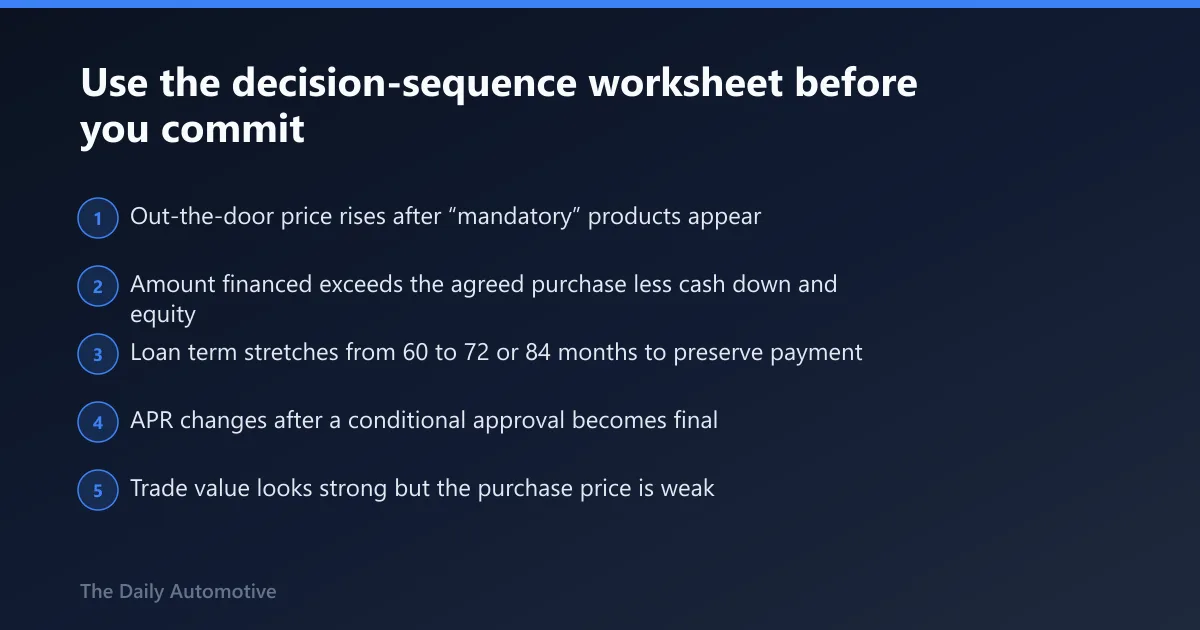
Decision-sequence worksheet
| Buyer scenario | Best order of actions | Main risks to avoid | Most important numbers to compare |
|---|---|---|---|
| Cash buyer | Set all-in budget, choose vehicle, negotiate out-the-door price, then decide trade-in or private sale | Overpaying because financing pressure is absent; ignoring taxes, fees, and ownership cost | Out-the-door price, insurance, taxes, registration, 5-year ownership cost, private-sale net proceeds |
| Pre-approved buyer | Check credit, secure outside approval, negotiate out-the-door price, let dealer try to beat financing, then handle current car | Letting the dealer reset term length or amount financed to fake a lower payment | APR, loan term, amount financed, total interest, prepayment rules, out-the-door price |
| Trade-in with equity | Confirm payoff and market value, negotiate purchase first, then compare trade allowance against private-sale net | Using trade equity to hide a weak purchase deal | Trade-in value, payoff, equity amount, tax effect of trade, out-the-door price, amount financed after equity |
| Trade-in with negative equity | Calculate shortfall first, decide whether to pay down, wait, or sell privately, then negotiate purchase and financing separately | Rolling debt into a longer loan, stretching to 72 or 84 months, buying by payment only | Payoff, real market value, negative equity amount, down payment, amount financed including rollover, APR, term |
The order of actions that fits each scenario best
The worksheet is meant to stop cross-contamination. Buyers should not judge a deal by monthly payment until the out-the-door total is fixed and the current car’s value is measured separately. That sequence keeps every concession visible.
The red-flag numbers to compare before signing
- Out-the-door price rises after “mandatory” products appear
- Amount financed exceeds the agreed purchase less cash down and equity
- Loan term stretches from 60 to 72 or 84 months to preserve payment
- APR changes after a conditional approval becomes final
- Trade value looks strong but the purchase price is weak
- Negative equity is present but not shown clearly as a separate line
Methodology for the worksheet and comparison math
I built the worksheet to force every offer into the same format. The comparison math is:
- Out-the-door price = vehicle selling price + taxes + title/registration + documentation fee + required dealer fees
- Amount financed = out-the-door price + financed add-ons + negative equity rolled in – cash down – trade equity
- Trade equity = trade allowance – payoff
- Private-sale net proceeds = sale price – payoff – reconditioning – listing/transaction costs – temporary transportation costs
- Total loan cost = total of payments + down payment + upfront fees not financed
For testing, I ran the worksheet on four common cases: a cash purchase, an outside preapproval, a positive-equity trade, and a negative-equity rollover scenario. The goal was not to forecast market-wide averages. It was to make sure one buyer can compare two real offers on equal terms without hiding cost in the trade or the monthly payment.
What documents, fees, and final checks should I expect at signing?
Expect to bring identification, proof of insurance, payment method, title or payoff details for your current car, and any lender paperwork tied to a pre-approval. Expect taxes, registration, and documentation fees. Before signing, match the contract to the negotiated out-the-door total, APR, term, and amount financed.
Documents to bring
- Driver’s license or other government ID
- Proof of insurance
- Pre-approval or lender contact details, if any
- Title, registration, and payoff information for a trade or sale
- Proof of address if requested by lender
- Down payment funds in the form the dealer or lender accepts
Common fees and products
Expect sales tax, registration, title fee, documentation fee, and possibly inspection or emissions fees depending on location. Add-on products deserve a pause. Service contracts, tire-and-wheel plans, GAP, and appearance products should be priced one by one, never hidden inside the payment.
Final review before signing
Check these line by line: agreed out-the-door price, trade allowance, payoff, cash down, amount financed, APR, loan term, total of payments, and any add-on product. If one number moved, ask why before signing anything. Our car buying paperwork checklist can help you verify the final contract.
Sources
- AAA car-buying guidance and vehicle cost-of-ownership resources, used here for decision sequence, shopping comparisons, and lease-vs-buy framing.
- Consumer.gov car-buying guidance, including advice on taxes, insurance, Buyers Guides, and independent inspections. See consumer.gov.
- Consumer Financial Protection Bureau resources on auto loans and credit, used for financing and credit-impact claims.
- Experian’s State of the Automotive Finance Market, used as a market-reference source for how loan terms, credit tiers, and payment pressure vary over time. Specific averages were intentionally omitted here because they move frequently.
- Federal Trade Commission Buyers Guide rules for used-car sales at dealerships.
- NHTSA recall lookup guidance for checking open safety recalls before purchase.
Frequently asked questions
What is the best way to finance a car?
The best path is to secure an outside pre-approval, then compare that benchmark with the dealer’s best real offer using APR, term, amount financed, and total interest. AAA recommends comparing direct lending versus dealer financing. The winner is the lower total-cost structure, not the lowest advertised payment.
How do I negotiate the out-the-door price?
Ask for a written out-the-door quote before discussing trade-in, payment, or financing products. That number includes taxes and fees, so it reflects the real purchase cost. Use MSRP, invoice price, incentives, and market value as references, but judge the deal by the final out-the-door total only.
How do I avoid dealer financing traps?
Refuse to negotiate by payment alone. Ask for the full deal sheet with out-the-door price, amount financed, APR, term, total of payments, add-ons, trade allowance, and payoff shown separately. Watch for stretched terms, packed products, conditional approvals, and trade figures used to mask a weak purchase price.
When does selling a car privately make more sense than trading it in?
Private sale makes more sense when the extra net proceeds still exceed the value of your time, reconditioning, payoff handling, title transfer work, and temporary transportation. It matters most when the added cash becomes a larger down payment or prevents negative equity from rolling into the next loan.
What documents and costs should I expect when buying a car?
Bring ID, proof of insurance, down payment funds, and any title or payoff paperwork for your current car. Expect taxes, registration, title fees, documentation fee, and sometimes inspection or emissions charges. Review every add-on separately so the amount financed does not climb without a clear reason.
Should I get a pre-purchase inspection on a used car from a dealer?
Yes, in most cases. A dealer inspection is not the same as an independent inspection working for you. If the car is an ordinary used vehicle rather than effectively new with full factory warranty coverage, I would still pay for my own mechanic or inspection service.
Is it better to reveal my trade-in at the start of the deal?
Usually no. I prefer to settle the purchase price first, then compare the trade offer separately against private-sale net proceeds. That keeps the three deal buckets separate and makes it harder to hide a weak selling price behind a strong trade allowance.
What is the biggest mistake buyers make at the dealership?
The most expensive mistake is shopping by monthly payment before the out-the-door price and financing structure are fixed. That lets a dealer stretch the term, add products, or move numbers between the trade and the loan while the payment still looks acceptable.
Products related to this article
Sponsored / affiliate links. As an Amazon Associate I earn from qualifying purchases. I may earn additional commission from eligible campaigns.