Front-Wheel Drive vs All-Wheel Drive: Which to Choose
Front-wheel drive with proper winter tires beats all-wheel drive for most commuters. AWD may be worth the extra cost if you regularly deal with hills, snow, or roads that are not well cleared. Pick wrong and you pay more for fuel, tires, and repairs without getting better stopping or cornering in the conditions you actually drive in. This guide weighs traction, price, winter use, and daily-driving tradeoffs so you can pick the setup that fits your roads.
This guide is part of our Car ownership essentials series.
Front-wheel drive vs all-wheel drive: the real trade-off
The choice is plain. FWD is usually the cheaper, lighter, more efficient way to cover normal pavement, while AWD adds traction when the surface turns loose or slippery. That extra grip tends to help most when starting from a stop or climbing a grade, rather than when braking on icy surfaces.
| Decision factor | Front-Wheel Drive | All-Wheel Drive | Winner |
|---|---|---|---|
| Purchase price | Usually lower | Usually higher | Front-Wheel Drive |
| Fuel economy | Usually better | Usually worse | Front-Wheel Drive |
| Snow and slush traction | Good with winter tires | Better for getting moving | All-Wheel Drive |
| Maintenance complexity | Simpler | More complex | Front-Wheel Drive |
| Cargo and cabin packaging | Usually more efficient | Can cost space | Front-Wheel Drive |
Purchase price
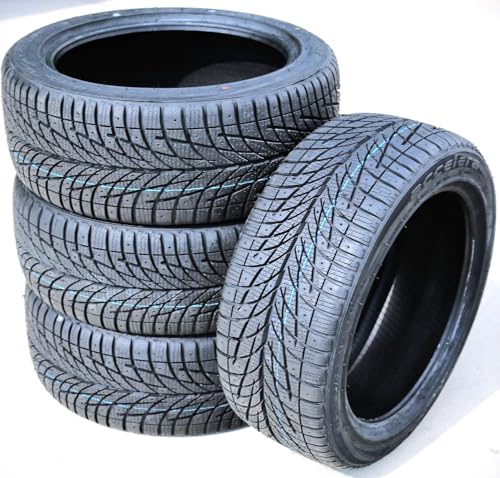
Front-wheel drive is usually the cheapest option and is typically best for everyday driving. AWD often adds cost at purchase, and that money could buy a full set of winter tires plus a second set of wheels in some cases.
Fuel economy
FWD usually has the edge because it carries less drivetrain weight and fewer moving parts. MotorTrend notes front-drive is the sensible-shoes choice, and that fits daily commuting: plain, efficient, and easy to live with.
Packaging and space
FWD layouts can free up cabin and cargo space because the engine and driven axle are often packaged together more tightly. Some AWD versions lose usable room; the Nissan Kicks AWD version has less cargo space than the FWD version.
How each drivetrain puts power to the road
Front-wheel drive: front wheels steer and drive
In FWD, power goes to the front wheels, and those same wheels also handle steering. That setup is common in compact cars, sedans, hatchbacks, minivans, and many crossovers because it is efficient and space-friendly.
All-wheel drive: automatic power split to all four wheels
AWD can send power to all four wheels and often shifts torque automatically when slip is detected. Many AWD cars are FWD-based and send most traction to the front wheels, so the system is often an on-demand helper rather than a permanent four-corner drive setup.
What traction control can do, and what it cannot
Traction control works with modern drivetrains to manage slip by reducing power or braking individual wheels. It helps keep the car pointed and moving, but it does not replace proper tires, and it cannot turn bald all-seasons into winter rubber.
front wheel drive vs all wheel drive in snow
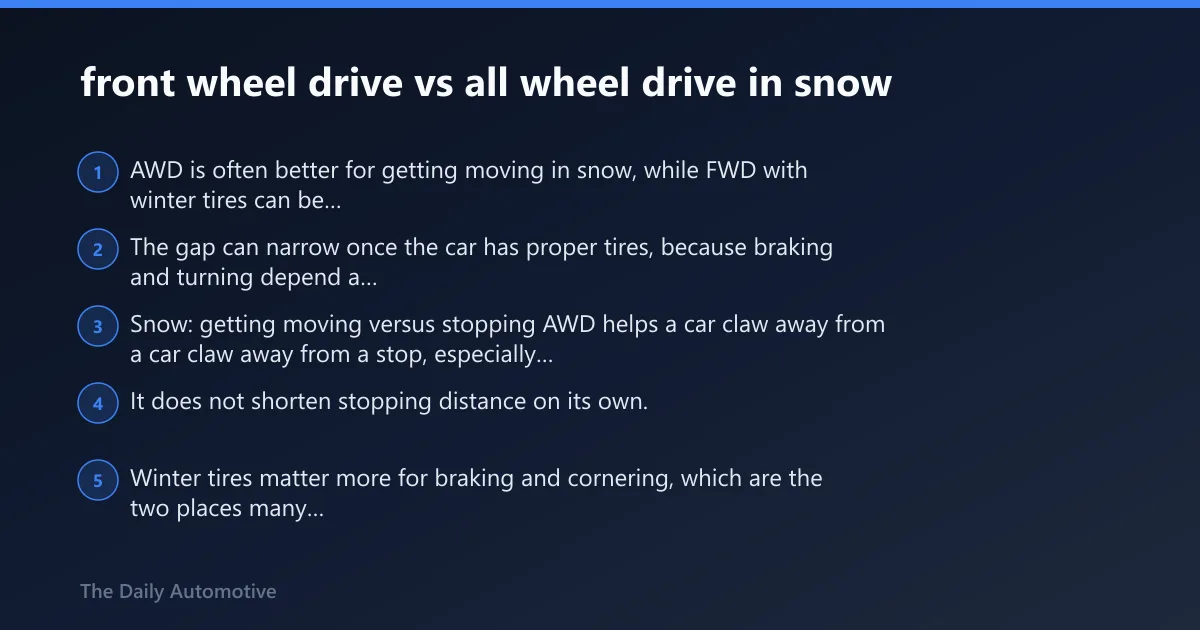
AWD is often better for getting moving in snow, while FWD with winter tires can be sufficient for many commuters in other winter conditions. The gap can narrow once the car has proper tires, because braking and turning depend a lot on tire grip as well as which wheels are driven.
Snow: getting moving versus stopping
AWD helps a car claw away from a stop, especially on packed snow or at the bottom of a hill. It does not shorten stopping distance on its own. Winter tires matter more for braking and cornering, which are the two places many drivers actually get into trouble.
Ice: why tires matter more than driven wheels
On ice, the limiting factor is grip at the contact patch. AWD can distribute torque, but it cannot create traction when traction is very limited. A FWD car on winter tires can stop and turn more predictably than an AWD car on worn all-seasons.
Rain and slush: where all-wheel drive helps and where it does not
In rain and slush, AWD helps when pulling away from lights, merging, or climbing wet ramps. It does little for emergency stopping on slick pavement, and it cannot fix hydroplaning if the tires are poor or the tread is worn out.
What the ownership costs really look like
Purchase price and trim availability
AWD often appears on higher trims or as an added option package, so the drivetrain change can drag in extra features you did not want. FWD is usually the simpler path for buyers who want the least expensive version of a car.
Fuel economy and drivetrain weight
FWD is typically more fuel-efficient, and TireGrades notes FWD is typically more fuel-efficient and lower maintenance. AWD brings extra parts and weight, which can cut into mpg over years of commuting.
Maintenance and tire-replacement costs
AWD may boost resale value but can also require more maintenance. Tire matching matters more here, too: if one tire is badly worn or replaced alone, many AWD systems are less forgiving of mismatch than a plain FWD layout.
is front wheel drive or all wheel drive better in snow
All-wheel drive is better in snow when the road is frequently deep, slick, or unplowed, but front-wheel drive with winter tires is the smarter buy for many city and suburban drivers. The answer changes less with snowfall totals than with road clearing, hills, and tire choice.
Why winter tires can beat all-wheel drive on packed snow
Winter tires improve traction more than drivetrain alone, especially for braking and turning. On a paved commute where streets are plowed, a FWD car on winter tires can feel calmer and more controlled than an AWD car on all-seasons.
Understeer and torque steer in front-wheel drive
FWD can push wide in slippery corners, which is understeer. It can also show torque steer under hard acceleration, where steering tug appears because the driven front wheels are doing too much at once.
Urban commuting, moderate snowfall, and paved roads
For urban commuters, FWD often makes the best case when roads get plowed and parking lots are paved. Add winter tires, and the car is usually ready for the kind of weather most people actually see, not the worst storm of the decade.
Decision table for choosing FWD or AWD
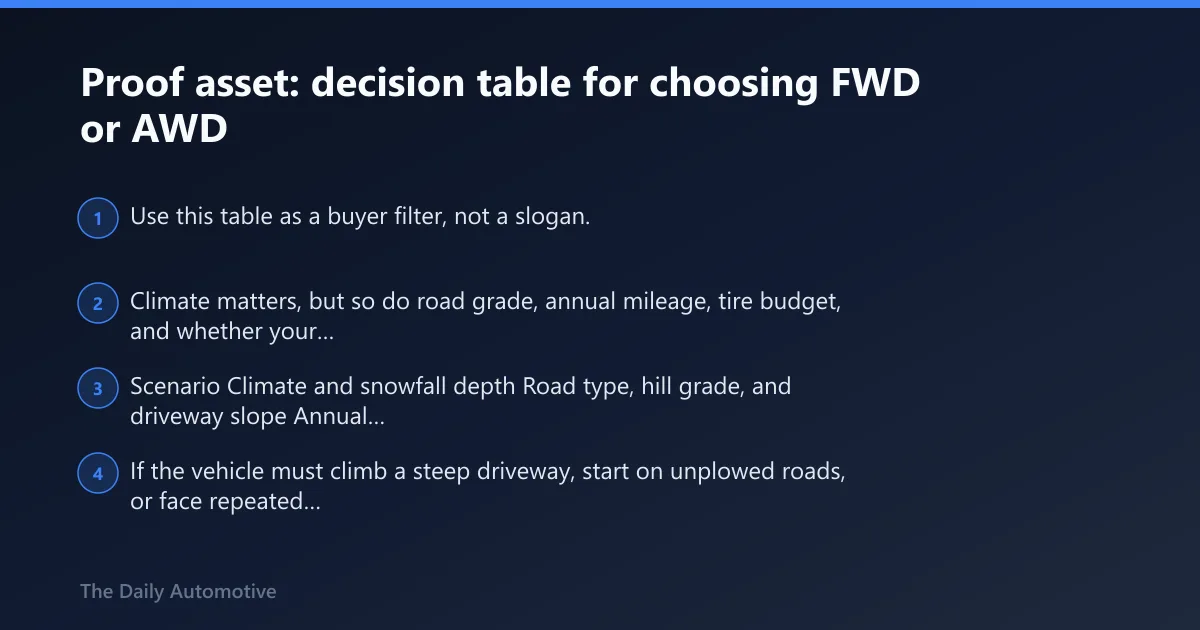
Use this table as a buyer filter, not a slogan. Climate matters, but so do road grade, annual mileage, tire budget, and whether your driveway turns into a ramp every cold morning.
| Scenario | Climate and snowfall depth | Road type, hill grade, and driveway slope | Annual mileage and tire budget | Recommendation |
|---|---|---|---|---|
| Urban commuter | Light to moderate snow | Plowed city streets, gentle grade, flat driveway | High mileage, budget for winter tires | Stay FWD + winter tires |
| Suburban driver with winter storms | Moderate snow and slush | Mixed roads, one or two hills, modest driveway slope | Average mileage, can afford seasonal tire swap | Stay FWD + winter tires |
| Rural commuter | Frequent deep snow | Unplowed roads, steep hill, uphill driveway | Average mileage, tire budget is flexible | Buy AWD |
| Mountain-town resident | Long winter season, ice and snow often | Steep grades, shaded roads, driveway slope is severe | Moderate mileage, can support higher upkeep | Buy AWD |
| Warm-climate driver with occasional storms | Rare snow | Mostly flat roads, paved parking, flat driveway | Any mileage, limited tire budget | Stay FWD + winter tires |
How to read the table
If the car spends most of its life on cleared pavement, FWD plus winter tires usually wins on cost and simplicity. If the vehicle must climb a steep driveway, start on unplowed roads, or face repeated winter grip loss, AWD earns its keep.
front wheel drive vs all wheel drive which is better
Neither drivetrain is the universal winner. FWD is the better all-around value for most commuters, while AWD is the better traction tool for drivers who regularly deal with poor road clearing, steep grades, or frequent snow and slush.
Choose front-wheel drive if you want lower cost and simpler ownership
Choose FWD if you want lower purchase price, better fuel economy, and less maintenance complexity. It is also the better fit when you plan to buy winter tires and your roads are usually plowed before you leave for work.
Choose all-wheel drive if your roads, weather, or driveway keep punishing traction
Choose AWD if you routinely start on steep grades, drive unplowed roads, or need more confidence in frequent snow and slush. It is also sensible when resale value matters and you accept the extra cost up front and over time.
Where crossovers, sedans, and minivans usually land
Crossovers often tempt buyers into AWD, but many are FWD-based and use the front axle most of the time. Sedans and minivans often make even more sense in FWD because the packaging, fuel economy, and price advantages are easier to feel every day.
front wheel drive vs all wheel drive pros and cons
FWD gives you lower cost, simpler hardware, and usually better mpg. AWD gives you better pull-away traction and more confidence on slippery roads, but it adds price, weight, and maintenance, and it can create false confidence if the tires are poor.
Front-wheel drive pros and cons
FWD’s strengths are easy to see in daily use. The downsides show up under hard throttle or on slick grades, where understeer and torque steer can appear and where wheelspin can arrive sooner than many drivers expect.
All-wheel drive pros and cons
AWD shines when traction is patchy and one or more wheels keep slipping. Its weakness is ownership cost: more parts, more complication, and sometimes less cargo space. The Nissan Kicks AWD version having less cargo space than the FWD version is a good reminder that the trade-off is not abstract.
front wheel drive vs four wheel drive
AWD and 4WD are not the same. AWD is usually a traction system for on-road use, while 4WD is more often built for off-roading, may include low-range gearing, and can behave differently on dry pavement than many shoppers expect.
Why the distinction matters
MotorTrend distinguishes 4WD from AWD by low- and high-range gearing. Popular Mechanics says 4WD is for off-roading, while AWD suits snowy commuting, and says 4WD requires a slippery surface to avoid binding. That is why the buyer should not use the two terms interchangeably. (motortrend.com)
Buyer rule for crossovers versus off-road SUVs
If the vehicle is a crossover or sedan, AWD is the relevant comparison. If the vehicle is a truck-based SUV meant for trails, mud, or low-speed crawling, 4WD is usually the system being judged instead.
front wheel drive vs rear wheel drive for snow
Front-wheel drive is usually the easier winter choice than rear-wheel drive because the driven wheels carry more of the engine’s weight and also steer the car. RWD can do fine with the right tires and driver skill, but it tends to be less forgiving on slick climbs and starts.
Why shoppers often move from RWD to FWD or AWD
RWD can feel lively in dry weather, but snow exposes its weakness sooner. For shoppers focused on winter commuting, FWD is often the simpler compromise; AWD is the pricier answer when extra traction is needed often enough to justify it.
Frequently asked questions
what is front wheel drive vs all wheel drive
Front-wheel drive sends power to the front wheels only, and those wheels also steer. All-wheel drive can send power to all four wheels, usually shifting torque automatically when slip appears. FWD is simpler and cheaper; AWD is built for extra traction.
is front wheel drive and all wheel drive the same
No. They are different drivetrains with different jobs. FWD drives the front axle only, while AWD can drive more than one axle at once. Many AWD systems are FWD-based and still send most traction to the front wheels most of the time.
is front wheel drive or all wheel drive better on ice
Neither is magic on ice, because tires matter more than drivetrain. AWD may help the car start moving, but winter tires do more for braking and turning. A FWD car on winter tires can often feel safer than AWD on worn all-seasons.
is front wheel drive or all wheel drive better in rain
AWD is better if you are trying to pull away on soaked pavement or climb a wet hill. For ordinary rain driving, FWD is usually enough, because the main safety limit is tire grip, not whether power reaches two wheels or four.
Products related to this article
Sponsored / affiliate links. As an Amazon Associate I earn from qualifying purchases. I may earn additional commission from eligible campaigns.