Best Car Finance Deal for Low Monthly Payments Tips
The best car finance deal for low monthly payments is usually the shortest term you can afford, with at least 20% down and the lowest APR you can qualify for.
This guide is part of our Car buying, financing, and selling guide series.
Pursuing the smallest payment by stretching the term can leave the borrower paying far more interest, owing more than the car is worth, and stuck with costly rollover debt.
This guide shows how to cut the payment without hiding term costs, fees, or resale risk.
Best car finance deal for low monthly payments: what to aim for first
The top pick for most shoppers is a loan with the lowest APR available from a bank or credit union, a term no longer than needed, and a down payment that keeps the amount financed modest. The monthly payment should fit cash flow, but the total repayment should still stay reasonable.
The simple rule for a low payment
A low payment helps only when the loan does not turn expensive in the background. APR, term length, credit score, and down payment all move the payment. APR often changes total cost more than shoppers expect, especially when a lender stretches the term to make the quote look affordable.
Quick picks by borrower profile and budget
- Best for good credit and a tight payment target: Credit union prequalification before any showroom visit.
- Best for fair credit: Bank or credit union quote first, then compare dealer financing against that benchmark.
- Best for poor or no credit: Delay the purchase if possible, or use the shortest term that still fits the budget.
- Best for shoppers in a rush: Line up written bank, credit union, and dealer offers side by side before signing.
How much does loan term length change the monthly payment?

Longer terms cut the monthly bill, sometimes sharply, because the balance is spread over more payments. That does not make the deal cheaper. It usually means more finance charge, slower equity buildup, and more time spent owing more than the car is worth.
36, 48, 60, 72, and 84 month terms: what gets cheaper each month
Use the same vehicle price and APR band to compare term length, not just the payment. For example, on a $30,000 loan at 6% APR, a 36-month term is roughly $900 per month and around $1,800 in total interest, while a 72-month term is roughly $500 per month and around $5,800 in total interest. The payment drops. The cost rises.
| Term | Monthly payment at 6% APR on $30,000 | Total interest | Payoff risk |
|---|---|---|---|
| 36 months | About $912 | About $1,839 | Lower risk of negative equity |
| 48 months | About $704 | About $3,789 | Moderate equity risk |
| 60 months | About $580 | About $4,794 | Common length, still stretches cost |
| 72 months | About $497 | About $5,812 | Higher chance of owing more than value |
| 84 months | About $446 | About $7,477 | Highest break-even risk in this set |
Why longer terms usually mean more total interest
Interest accrues over time on the remaining balance. A longer term keeps that balance alive longer, so the lender collects more finance charge even when the monthly payment feels easier. Common 60, 72, and 84 month loans can look harmless on a worksheet and still be expensive over the full schedule.
Break-even risk: when the lower payment stops being a real saving
Break-even risk is the point where the lower monthly payment does not offset the slower equity buildup and larger interest bill. If the car depreciates faster than the loan balance falls, the borrower can be underwater for most of the term. That matters if the car is totaled, traded early, or needs a refinance.
Which lender type usually gives the best payment?
The lowest payment often comes from the lowest APR, but lender type affects more than rate. Bank and credit union financing can give a direct loan benchmark. Dealer financing is sometimes competitive, but it is often brokered through lending partners and may carry extra markup or fees.
Bank financing: why it is a useful benchmark
A bank quote gives the shopper a clear baseline for APR, term, and payment. It is a direct loan, so the rate is easier to compare against dealer offers. A bank quote also helps expose payment packing, add-on charges, or inflated dealer financing terms that would otherwise hide inside a single number.
Credit union financing: why it often beats dealer pricing
Credit unions often price loans aggressively for members, especially borrowers with solid credit and modest loan amounts. They are often a good first stop because they may prequalify you with a soft credit check, and that kind of check generally does not affect the score. That makes them useful before a dealership visit.
Dealer financing: when it can help and when it can add cost
Dealer financing can help when a manufacturer-backed promotion beats outside quotes or when a buyer needs quick approval. It can also cost more. Dealer financing through a lending option it brokers is often higher priced, and dealerships may add a fee for serving as the middleman.
How dealer markups and fees change the quote
A low payment can be built from a higher amount financed, a longer term, a marked-up APR, or add-ons rolled into the loan. Ask for the out-the-door price, the APR, the term, the total repay amount, and every fee listed separately. If those items are not written, the payment alone is not trustworthy.
How credit score changes car loan pricing
Credit score is a key pricing factor, but not the only one. Good credit usually gets better rates. Fair credit can still qualify for reasonable offers. Poor credit and no credit often push borrowers into subprime pricing, where the APR and monthly cost rise fast.
Good credit versus fair credit versus poor credit
Good credit usually opens the door to lower APRs and shorter terms with manageable payments. Fair credit often sits in the middle, where careful shopping can still find acceptable pricing. Poor credit or no credit can be treated as subprime risk, and that can raise the payment enough to distort the whole deal.
Why no credit can be priced like subprime risk
Some lenders price no-credit borrowers cautiously because they have less repayment history to judge. That does not mean approval is impossible. It means the quote may resemble subprime pricing even without missed payments on record. About one-third of all car loans were taken by subprime or near-prime borrowers, so this is not a niche issue.
How APR moves the payment more than many shoppers expect
APR is the direct driver of monthly payment and total finance charge. A small rate change can shift the payment enough to matter, especially on a long term. High loan rates are tied to higher default risk, which is why weak credit, short income history, or a small down payment can make a loan much more expensive.
What should I do if I have bad credit?
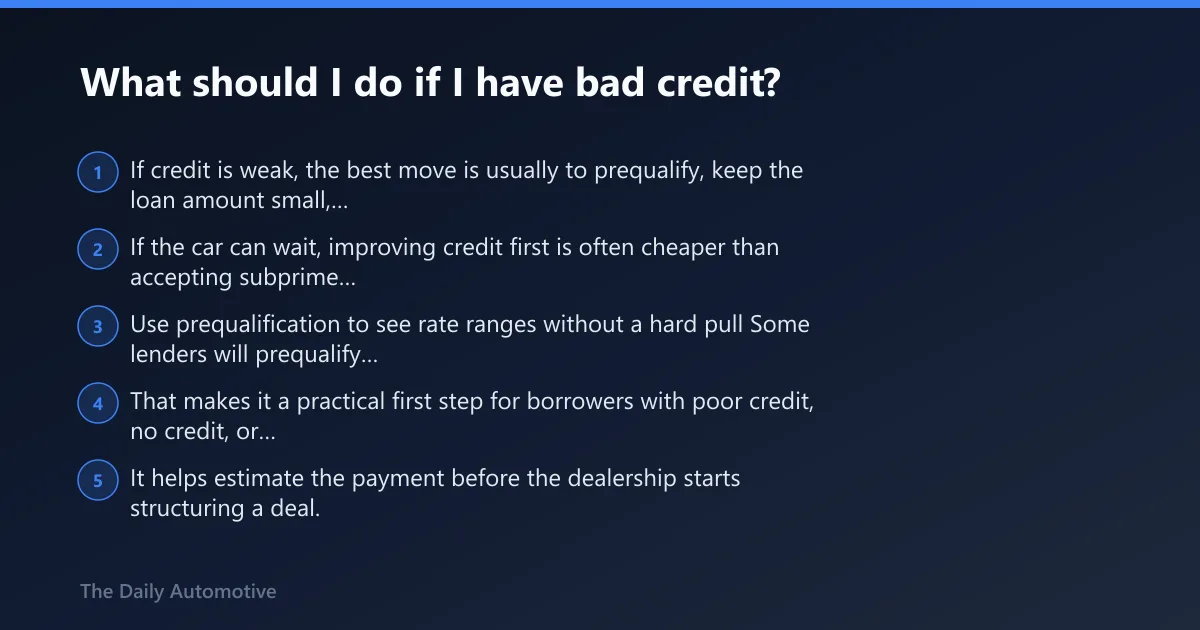
If credit is weak, the best move is usually to prequalify, keep the loan amount small, and avoid stretching the term just to force the payment down. If the car can wait, improving credit first is often cheaper than accepting subprime pricing now.
Use prequalification to see rate ranges without a hard pull
Some lenders will prequalify with a soft credit check, and a soft credit check won’t hurt your credit score. That makes it a practical first step for borrowers with poor credit, no credit, or uncertain approval odds. It helps estimate the payment before the dealership starts structuring a deal. (consumerreports.org)
Consider a smaller loan amount, bigger down payment, or shorter term
Lowering the amount financed is one of the most reliable ways to cut both payment and interest. A bigger down payment can do that. So can choosing a less expensive vehicle or accepting a shorter term. A shorter term may raise the payment, but it usually reduces the finance charge and the chance of negative equity.
Know when waiting to improve credit is the smarter move
Waiting makes sense when the borrower can delay without harming transportation needs. If a few months of on-time payments, lower card balances, or corrected report errors could move the score out of a poor-credit band, the future APR may be much better. That can save more than a shorter-term discount ever would.
Watch for subprime pricing that makes the payment look manageable but the loan expensive
Subprime pricing can make a monthly payment seem workable while the total repay amount climbs sharply. That is where dealer urgency can be dangerous. A quote with a low payment, a long term, and fees rolled in may still be a costly loan. Ask for the final amount financed and the full finance charge before agreeing.
How can I get the lowest monthly car payment?
Start by lowering the amount financed, then compare APRs from a bank, a credit union, and the dealer. Get written quotes from each one. A larger down payment, a lower-priced vehicle, and a shorter term can all help. The lowest monthly payment that still keeps total cost reasonable is the target, not the payment alone.
How down payment, term, and APR work together
Down payment reduces the principal. APR controls how much the lender charges to carry that principal. Term length decides how long interest keeps accruing. A buyer can get a low payment by stretching the term, but that usually increases total interest. A lower APR and larger down payment usually do more useful work.
Decision table: payment, total interest, and payoff risk by term
The table below uses one vehicle price to show how term length changes payment and finance charge. It also shows how risk rises when the loan lasts longer than the useful life of the vehicle’s early-value years. Read it as a cash-flow test, not a shopping list.
| APR band | 36 months | 48 months | 60 months | 72 months | 84 months |
|---|---|---|---|---|---|
| 6% on $30,000 | $912 / $1,839 interest / lower risk | $704 / $3,789 interest / moderate risk | $580 / $4,794 interest / moderate risk | $497 / $5,812 interest / higher risk | $446 / $7,477 interest / highest risk |
| 12% on $30,000 | $996 / $5,850 interest / lower risk | $790 / $7,981 interest / moderate risk | $667 / $10,038 interest / moderate risk | $596 / $12,500 interest / higher risk | $533 / $15,764 interest / highest risk |
How to read the table before signing
If the payment drops only a little when the term jumps from 60 to 72 or 84 months, the loan is usually too expensive for the benefit gained. The longer terms are the warning zone because they magnify total interest and leave less room to sell or trade the car without a loss.
What increases the total cost of a low-payment car loan?
Anything that raises the amount financed, APR, or term length raises total cost. Dealer fees, add-ons, rolled-in service plans, negative equity from a trade-in, and subprime pricing can all make a low payment far more expensive than it first appears.
Fees and add-ons that inflate the loan amount
Dealerships may add a fee for serving as the middleman, and optional products can be folded into the loan. That makes the payment look smaller than the real cash outflow because the extra cost is hidden inside the balance. Ask for every itemized charge in writing before agreeing to finance.
Payment packing and term stretching
Payment packing means the dealer builds the deal around a target monthly number instead of the true price. The payment may look attractive, but the term can be extended and the APR can be adjusted so the lender earns more. A buyer should compare the full repayment amount, not just the monthly note.
Why written offers matter more than verbal promises
Written offers make APR, term, fees, and total repay amount easier to compare. Verbal promises do not. If the lender, dealer, or finance office changes the rate, term, or add-ons at the last minute, the paper trail shows what changed. That matters even more when the goal is the best car finance deal for low monthly payments.
Should I get car financing from my bank or the dealer?
Bank or credit union financing is usually the safer first benchmark because it gives a direct loan quote you can compare against the dealer. Dealer financing can still win on rate in some cases, but it should be tested against outside preapproval before anyone treats it as the best option.
Why compare outside offers before the showroom
Getting quotes before the dealership visit gives the buyer a ceiling on acceptable APR and payment. It also limits pressure to accept a rushed quote. Bank and credit union loans are direct loans, which makes them a clean comparison against dealer-brokered financing.
When dealer financing can still make sense
Dealer financing can make sense when a special rate is better than the outside quotes or when the buyer needs speed and convenience. It can also work if the borrower has a narrow credit profile and the dealer has access to a lender willing to approve the deal. The key is proof, not assumption.
Does prequalification hurt my credit score?
Usually not. Prequalification often uses a soft credit check, and that soft credit check won’t hurt your credit score. It is a useful first step because it can estimate the likely rate and payment before a hard application or dealership financing decision.
Soft pull versus hard pull
A soft pull is a review that does not count like a formal loan application on the credit report. A hard pull can affect the score and stays visible to lenders. For a shopper who needs to compare payments safely, soft-pull prequalification is the better starting point.
Should I wait to improve my credit before financing a car?
If transportation can wait, yes. Waiting is often the cheaper move when the likely current offer is subprime pricing and the score could improve with time. If the car is needed now, the goal shifts to limiting damage with a short term, bigger down payment, and a lender quote you can verify.
When waiting usually makes sense
Waiting makes sense when the borrower can lower balances, fix report errors, or add a few months of positive history. A shift from poor to fair credit can change APR enough to reduce both monthly payment and total finance charge. That is often worth more than taking the first available offer.
When financing now may still be the better choice
Financing now may be reasonable when the vehicle is needed for work or family logistics and delaying would create a larger cost elsewhere. In that case, protect the deal by comparing bank, credit union, and dealer quotes, avoiding long terms unless necessary, and keeping add-ons out of the loan when possible.
How to spot low-payment traps in dealer quotes
Low-payment traps hide cost in the APR, term length, add-ons, or the amount financed. They are common enough that every quote should be treated like a math problem. The payment is the last number to trust, not the first.
Checklist for comparing dealer quotes
- Ask for the out-the-door price before discussing payment.
- Compare the APR, not only the monthly note.
- Check the term in months and reject unnecessary stretching.
- Confirm the total amount financed after fees and add-ons.
- Ask for the total repay amount over the life of the loan.
- Compare the dealer quote against a bank and a credit union offer.
- Watch for payment packing, trade-in equity shifts, and hidden warranty products.
- Get every promise in writing before signing.
Why discrimination and uneven pricing matter
Discrimination is a real financing issue. Black and Hispanic consumers can face higher auto loan rates due to bias, and that can change both the monthly payment and the finance charge. Compare written offers carefully, because fair treatment is easier to verify when the price details are on paper.
Frequently asked questions
Is a longer car loan always cheaper per month?
Usually yes, but only on the monthly line item. A longer term spreads the balance out and lowers the payment, yet it usually raises total interest and increases the chance of owing more than the car is worth. Cheap per month is not the same as cheap overall.
What credit score do I need for the best car loan rate?
There is no single cutoff that applies everywhere, but good credit usually gets better rates than fair credit, and poor or no credit can push a borrower into subprime pricing. Lenders also look at income, down payment, debt, and the vehicle itself, so score is only one piece.
How do I lower my car payment if I have bad credit?
Use prequalification to see likely ranges, then reduce the loan amount with a bigger down payment or cheaper vehicle. If possible, choose the shortest term that still fits the budget. If the current offer is steep, waiting to improve credit may save far more than forcing a deal now.
Products related to this article
Sponsored / affiliate links. As an Amazon Associate I earn from qualifying purchases. I may earn additional commission from eligible campaigns.
 Biugaaufai 2 Pack Black Car Ramps, Low Profile Car Service Ramp for Vehicle Maintenance, Heavy Duty Car Ramps for Oil Changes, Trucks & Cars
![Tack GPS [Lowest Monthly fee| 30 Days Battery Life| FCC Certified] -Child, Kids, Pet, Dog, Cat, Elderly, Alzheimer, Car, Vehicle, Bike, Personal Tracking Device. GPS +WiFi +Cellular](https://m.media-amazon.com/images/I/416OvJhFmeL._SL500_.jpg) Tack GPS [Lowest Monthly fee| 30 Days Battery Life| FCC Certified] -Child, Kids, Pet, Dog, Cat, Elderly, Alzheimer, Car, Vehicle, Bike, Personal Tracking Device. GPS +WiFi +Cellular
Tack GPS [Lowest Monthly fee| 30 Days Battery Life| FCC Certified] -Child, Kids, Pet, Dog, Cat, Elderly, Alzheimer, Car, Vehicle, Bike, Personal Tracking Device. GPS +WiFi +Cellular