Most Popular 5 How Did Car Phones Work
Early car phones turned a vehicle into a radio terminal. A handset fed a transceiver, the unit sent voice over VHF channels to a nearby base station, and that station patched the call into the public switched telephone network. If one link failed, or coverage ended, calls dropped, audio turned noisy, and the system could become unusable. This guide lays out the signal path, hardware, service types, and first-use history in plain steps.
How did early car phones work?
Early car phones used a simple radio relay chain. You spoke into a handset in the car, the radio unit sent that audio to a base station on a fixed channel, and the operator or switching equipment connected the call to the public telephone network. Because the system used half duplex, only one side could talk at a time.
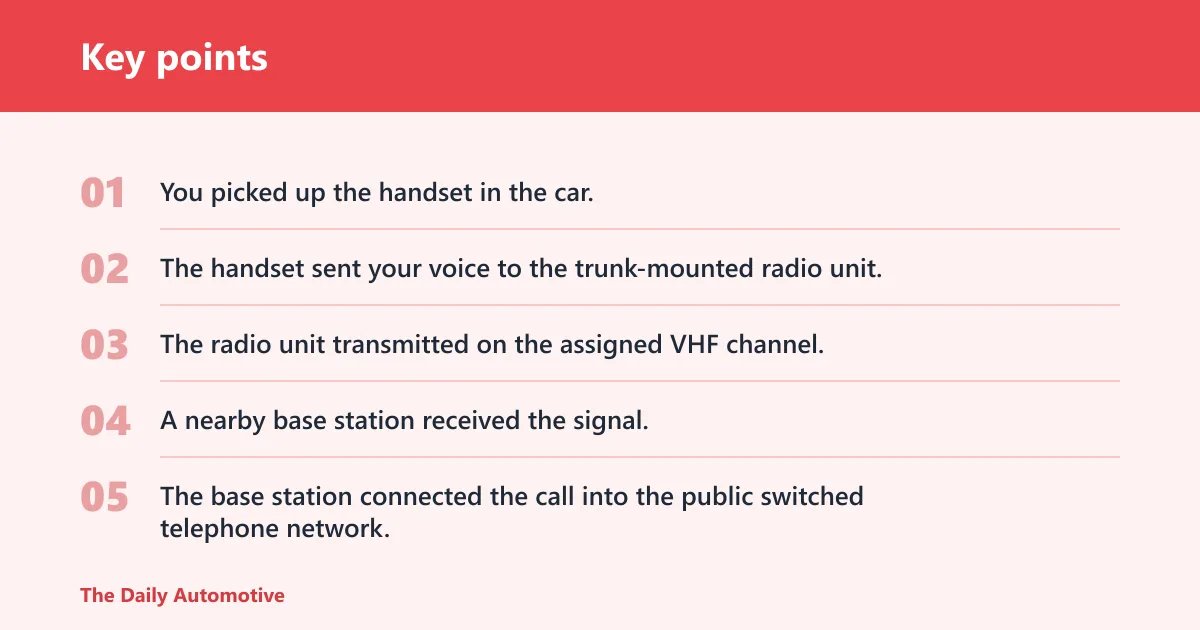
Call path, step by step
- You picked up the handset in the car.
- The handset sent your voice to the trunk-mounted radio unit.
- The radio unit transmitted on the assigned VHF channel.
- A nearby base station received the signal.
- The base station connected the call into the public switched telephone network.
- Voice returned the same way in reverse.
| Call-flow step | What it did and why it mattered |
|---|---|
| Handset | Let the caller speak and listen from inside the vehicle. |
| Trunk radio unit | Handled the radio link and the vehicle’s transmit and receive functions. |
| Selective calling decoder | Matched the incoming call signal and rang the bell in the car so the user knew a call was for that vehicle. |
| Base station | Received the radio signal and connected it to the landline network. |
| Public switched telephone network | Carried the call to and from ordinary telephones. |
What half duplex meant in the car
Half duplex meant the user could not talk and listen at the same time. One person spoke, then stopped, and the other side replied after a pause. That made early car phone calls feel slower than a normal wired call, and it also made interruptions and talk-over much easier.
A common first-time mistake is expecting a modern phone experience from a 1946 system. If you are in a delivery truck on a busy road and the signal fades at the edge of coverage, the call can break up or drop entirely because the base station is the bridge, not the car alone.
What hardware was in the car?
The first Bell System car telephone equipment grew out of Western Electric Type 38 and 39 VHF FM police radio equipment. Bell and Western Electric repurposed that pre-war radio hardware into a mobile telephone platform, then built the early production car-phone sets around a trunk-mounted unit and a control head under the dash.
From police radio to mobile telephone
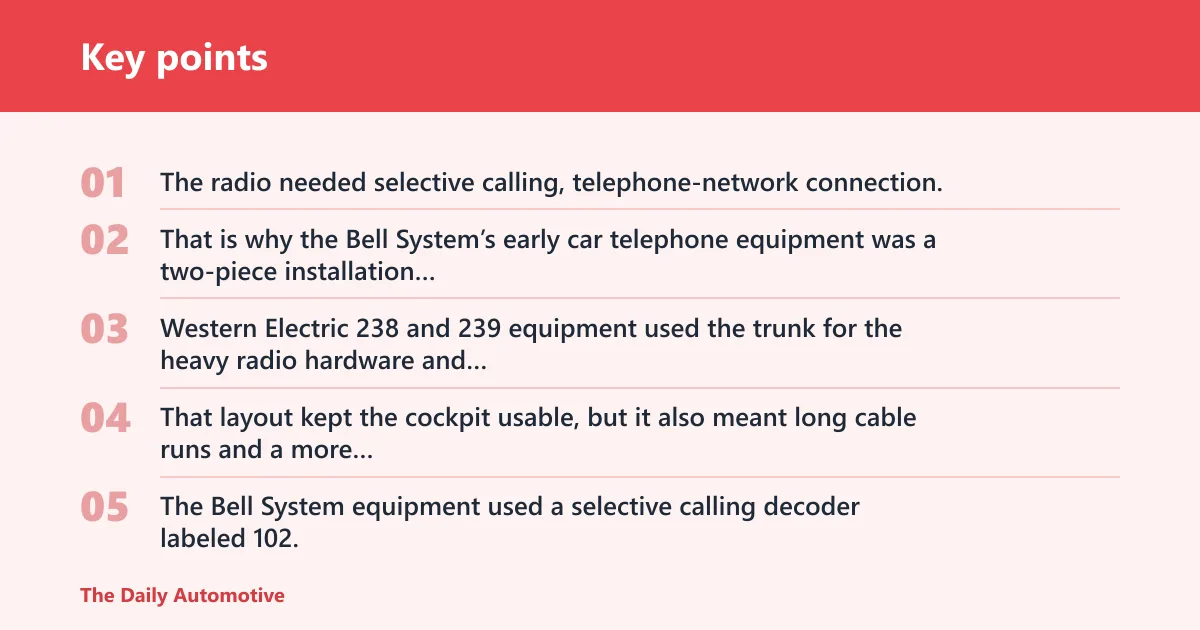
The important shift was not size alone. The radio needed selective calling, telephone-network connection, and a user interface that worked while driving. That is why the Bell System’s early car telephone equipment was a two-piece installation instead of a single dashboard box.
Western Electric 238 and 239 layout
Western Electric 238 and 239 equipment used the trunk for the heavy radio hardware and placed the control head under the dashboard. That layout kept the cockpit usable, but it also meant long cable runs and a more complex installation than a simple portable radio.
Selective calling decoder and bell
The Bell System equipment used a selective calling decoder labeled 102. It used a small wheel in a glass enclosure with pins, and when the correct signal arrived, it rang a bell in the automobile. That mattered because the car needed a way to know that an incoming call was meant for that specific vehicle.
| Hardware piece | What it did and why it mattered |
|---|---|
| Western Electric Type 38/39 basis | Provided the radio hardware foundation that Bell adapted for mobile telephone use. |
| Trunk-mounted radio unit | Held the main radio equipment out of the passenger area and carried the transmit/receive functions. |
| Control head under the dash | Gave the driver a usable interface without taking over the cabin. |
| Selective calling decoder 102 | Identified incoming calls and triggered the in-car bell. |
| Glass wheel with pins | Formed part of the selective calling mechanism that made the system addressable. |
How were early car phones installed? The practical answer was with a lot of labor. The radio section sat in the trunk, the control head went under the dash, and cables had to be routed between them. That took space, time, and a vehicle owner willing to accept a bulky installation.
What were Highway and Urban service?
Highway and Urban were the two early General Mobile Radiotelephone Service concepts announced by AT&T on June 29, 1945. Urban service went on the air first, on June 17, 1946 in Saint Louis. Highway service followed on August 28, 1946 in Green Bay, Wisconsin. They used different channel plans, different frequencies, and different intended users.
Service comparison
| Service | Launch | Channels | Frequencies | Who it was for |
|---|---|---|---|---|
| Urban mobile telephone service | June 17, 1946 | 6 channels | Receive on 152 megacycles; transmit on 158 megacycles | Doctors, delivery trucks, ambulances, and reporters |
| Highway mobile telephone service | August 28, 1946 | 12 channels | Receive on 35 megacycles; transmit on 43 megacycles | Trucks and barges |
Why the split mattered
Highway service used 12 channels in the VHF low band and was aimed at long-distance mobile users. Urban service had an initial FCC allocation of 6 channels and was built for city-based professional users who needed local mobility. The different bands helped separate use cases and manage congestion, but neither system had many channels.
What was the difference between highway and urban car phone service? Highway was built for vehicles moving across larger routes, especially trucks and barges, while Urban was meant for dense city use by service professionals. In practice, both were limited by few channels, local coverage, and the need for a base station to finish the call.
Who built the first car phone system?
The Bell System deployed the first public car telephone service in the United States. AT&T announced the General Mobile Radiotelephone Service on June 29, 1945, and Bell System companies used Western Electric and Bell Labs designs to create the equipment and operating system behind it.
Bell System’s role
Bell System was not a single box maker. It acted as the system operator and equipment ecosystem, with Western Electric hardware and Bell Labs engineering forming the technical base. That combination mattered because the service needed both radios and a way to connect those radios to the landline network.
GMRS and the early service plan
General Mobile Radiotelephone Service, announced by AT&T, set out the early Highway and Urban concepts. Those services were the practical first public car telephone offerings, and they gave Bell a framework for assigning channels, defining users, and tying mobile calls back to the telephone network.
Who invented the car phone? There was no single inventor in the modern sense. The first public system came from Bell System engineering and deployment work, with Western Electric and Bell Labs contributing the hardware and service design that turned vehicle radio into a working mobile telephone service.
Why was early service so limited?
Early service was limited because there were few channels, coverage was local, and the hardware was bulky. A caller could lose the connection at the edge of a service area, and even inside coverage, other users could block access because the airwaves were shared and scarce.
Few channels and busy airwaves
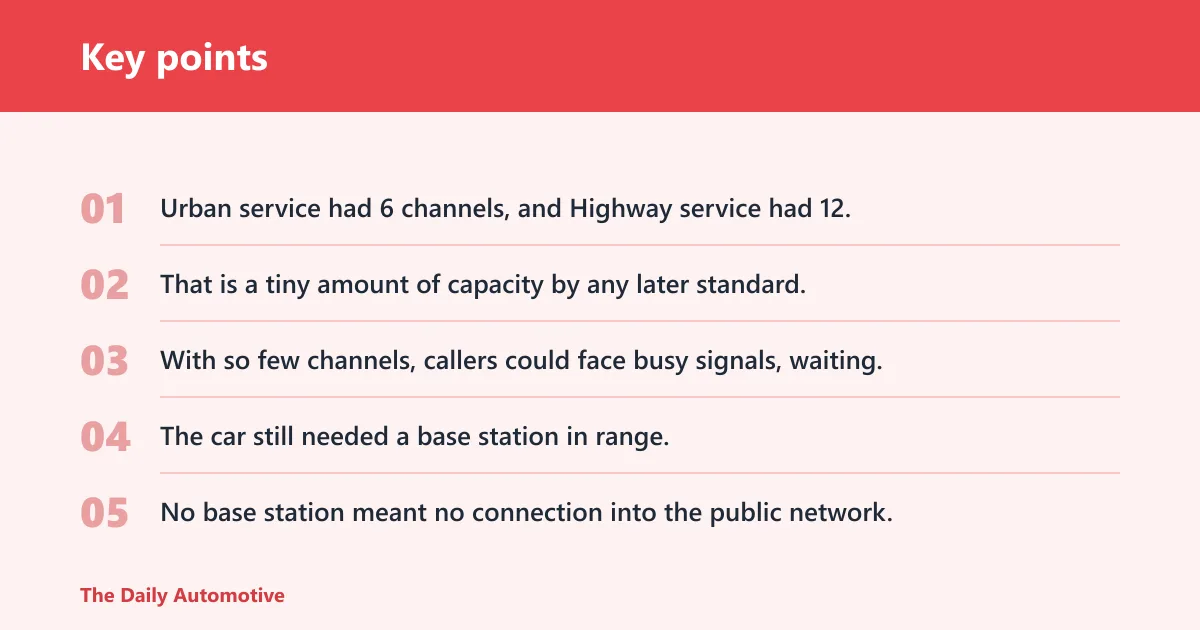
Urban service had 6 channels, and Highway service had 12. That is a tiny amount of capacity by any later standard. With so few channels, callers could face busy signals, waiting, or an inability to place a call when the channel was in use.
Coverage gaps and connection problems
The car still needed a base station in range. No base station meant no connection into the public network. Even when the system was working, half duplex operation and radio noise made the experience less stable than a wired telephone line.
Installation burden and cost
The equipment was expensive and physically awkward. The trunk unit, the under-dash control head, the wiring, and the decoder all added complexity. That is one reason these systems mostly served professionals and commercial users instead of ordinary drivers.
If your sedan has enough trunk space, but the cable routing is cramped and the control head blocks knee room, the phone may still work. The installation has already limited who would want it and which cars could reasonably carry it.
By 1948, Urban service was available in 60 cities in the United States and Canada, with 4,000 mobile subscribers and 117,000 calls per month. Highway service was in place in 85 cities, with about 1,900 mobile subscribers and approximately 36,000 calls per month. Those figures show growth, but they also show how small the user base remained.
When were car phones first used?
The first Urban system went on the air in Saint Louis on June 17, 1946, and the first Highway system went on the air in Green Bay, Wisconsin, on August 28, 1946.
Brief launch timeline
- June 29, 1945: AT&T announced the General Mobile Radiotelephone Service.
- June 17, 1946: Urban mobile telephone service went on the air in Saint Louis.
- August 28, 1946: Highway mobile telephone service went on the air in Green Bay, Wisconsin.
- 1948: Both services had expanded to additional cities and subscribers.
Where early deployments appeared
The first public deployments were urban and highway systems placed in specific cities, not a national consumer rollout. That limited footprint shaped the early user experience: if you were outside the served area, the car phone did nothing for you.
What car had a phone in it? Early car phones appeared in vehicles used by people who needed mobility and immediate contact, especially doctors, delivery trucks, ambulances, and reporters. The system was a professional tool first, and a luxury only in the broadest sense.
Frequently asked questions
How did car phones work?
They worked by sending voice over a vehicle radio link to a base station. The base station then connected the call to the public switched telephone network. The car used a handset, a trunk-mounted radio unit, and a selective calling system so incoming calls could ring the vehicle.
What frequencies did early car phones use?
Highway mobile equipment received on 35 megacycles and transmitted on 43 megacycles. Urban equipment received on 152 megacycles and transmitted on 158 megacycles. Those frequency pairs mattered because they defined the radio path, the band plan, and the service split between highway and city use.
How were early car phones installed?
They were usually installed as a two-piece system. Western Electric 238 and 239 equipment placed the radio hardware in the trunk and the control head under the dash, with cables running between them. That setup made the car usable, but it also made the job more complicated and costly.
What was the difference between highway and urban car phone service?
Highway service launched on August 28, 1946, used 12 VHF low-band channels, and was intended for trucks and barges. Urban service launched on June 17, 1946, had an initial FCC allocation of 6 channels, and served doctors, delivery trucks, ambulances, and reporters in city areas.
When were car phones popular?
They were most visible in the early mobile-radio era, especially after the 1946 launches and through the 1948 expansion of city coverage and subscriber counts. Even then, they remained limited-use equipment for professionals because the systems were expensive, channel capacity was tight, and coverage was local.
Products related to this article
Sponsored / affiliate links. As an Amazon Associate I earn from qualifying purchases. I may earn additional commission from eligible campaigns.