
Best Car Rental Companies for One-Way Trips Reviewed
Enterprise is the best overall pick for most one-way trips because its large North American network keeps drop-off options broad and its usual one-way fees sit in the middle of the pack. The lowest final bill still depends on route, dates, and car class, so the cheapest daily rate can still lose once fees and taxes hit the total.
This guide is part of our Car rental guide: costs, rules, and tips series.
One-way rentals are available, but the best company depends on the route, the drop-off city, and the add-ons attached to the reservation. On many U.S. routes, Budget, Hertz, or Enterprise can win on total cost once fees and taxes are included. Ignore the fee math and a “cheap” quote can cost more than a higher daily rate.
Best car rental companies for one-way trips

Quick picks by trip type
| Need | Best pick | Why it fits | Typical one-way fee band |
|---|---|---|---|
| Cheapest early booking | Budget | Lowest base rates on many routes when booked ahead | $80-$180 |
| Airport-to-city return | Enterprise | Large network and broad drop-off coverage | $100-$200 |
| Families and road trips | Alamo | Good minivan and SUV selection with straightforward pricing | $100-$200 |
| Premium fleet | Avis | BMW, Mercedes, Audi, and Volvo options | $150-$300 |
| Cross-border flexibility | Enterprise or National | Canada-to-US one-way may be allowed at approved branches | $100-$200 |
Top pick for most routes: Enterprise
Enterprise is the safest default for many one-way trips because it combines a large North American network with fee bands that are usually moderate rather than extreme. The guide ranks Enterprise #1 for one-way rentals, and its typical one-way fees of $100-$200 make it a strong first quote on long-distance routes.
Enterprise can also help when the return city is smaller or when a traveler needs flexible pickup options. Some locations offer free pickup service, which can lower the total if the alternative is a costly airport start. That said, a nearby Budget branch can still undercut it on a specific route.
When Budget or Thrifty can cost less
Budget is often the low-cost choice when the booking is made early and the route is common. Its one-way fees are listed at $80-$180, and the best deals usually appear when the reservation is made 2-4 weeks in advance. Thrifty can also be cheap on popular routes, especially for travelers who can accept a more basic service experience.
Thrifty is owned by Hertz, so the fleet and pricing logic can resemble a budget arm of a larger operator. The tradeoff is service consistency. Budget and Thrifty can beat larger brands on total cost, but only if the drop-off city and vehicle class stay within their available inventory.
Best premium choice: Avis
Avis fits travelers who want a higher-end vehicle and are willing to pay for it. Its one-way fees are listed at $150-$300, which is higher than most of the field, but the fleet can include BMW, Mercedes, Audi, and Volvo models. Avis Preferred can also reduce pickup time.
That premium fleet matters most when the trip is long enough that comfort, cargo room, or driver fatigue become part of the decision. If the route is short and the vehicle will spend most of the time parked, the extra cost often brings little value.
According to Best One‑Way Car Rental Companies – Complete Skyscraper Guide — Enterprise is ranked #1 for one-way rentals in the competitor guide.
How one-way rental pricing works
One-way pricing begins with the base daily rate, then adds the one-way fee, airport charges, taxes, and any extras such as young-driver fees, extra-driver charges, toll products, or mileage restrictions. A round trip often costs less because the car returns to the original branch, so the company avoids most repositioning work.
Base rate plus one-way fee
The base rate is only the starting point. The one-way fee compensates the company for returning the car to a different city, and it can vary by route, demand, and branch inventory. A quote with a low daily rate may still lose once the drop fee is added.
Airport charges, taxes, and add-ons
Airport pickups often bring extra surcharges that do not appear in the headline rate. Mileage policy matters too, because a “cheap” one-way can become expensive if the route includes caps or excess-mile charges. Young-driver fees can also change the bill quickly for renters under the qualifying age.
Why round trips often price lower
Round trips are usually easier for the rental company to manage because the car returns to the same area. One-way trips require repositioning, and that cost is usually passed through to the renter. The result is simple: a lower daily rate does not guarantee a lower final bill.

Which company is cheapest for your route?
The cheapest company depends on whether the route is a short hop, a long interstate move, or an airport pickup with a city drop-off. Budget often wins when booked early. Enterprise and National often price well on long routes. Hertz and Thrifty can be strong when inventory is favorable.
Short one-way hops
For short city-to-city moves, the cheapest quote often comes from Budget or Thrifty when the branch pair is common and the car class is basic. Short hops are sensitive to drop-off city rules, so the winner is often the brand that has the cleanest branch coverage rather than the best daily rate.
Long-distance interstate trips
For longer one-way trips, some rental companies can stay competitive because their networks are broad and their fees are often in a moderate range. Hertz can also compete, especially for larger vehicles, but its one-way fees are typically $120-$220, which can push the total above Enterprise on many routes.
Airport pickup with city drop-off
Airport-to-city routes often favor whichever brand has the lowest mix of airport surcharge, drop fee, and drop-off availability. Budget can be strong here if the branch pair is common and booked 2-4 weeks ahead. Avis may lose on price but win if the traveler values a premium car.
Brand-by-brand picks and fee ranges
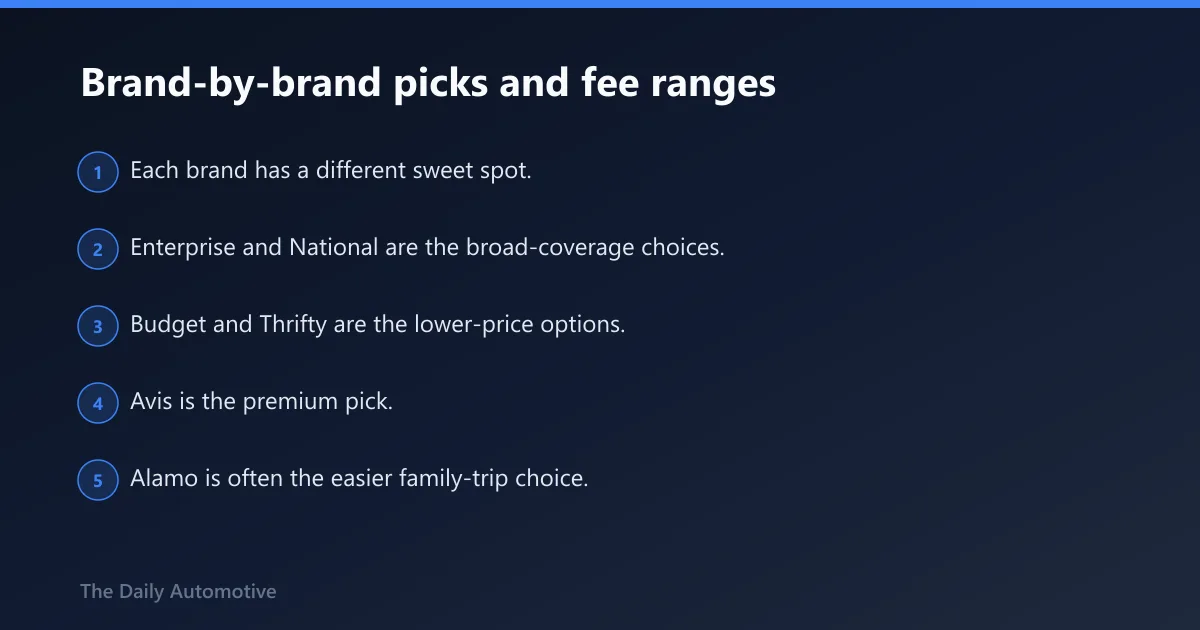
Each brand has a different sweet spot. Enterprise and National are the broad-coverage choices. Budget and Thrifty are the lower-price options. Avis is the premium pick. Alamo is often the easier family-trip choice. Hertz sits in the middle when fleet choice matters.
Enterprise and National
Enterprise is the strongest all-around one-way choice for most travelers, with one-way fees usually around $100-$200. National is owned by Enterprise and has similar one-way fees, also around $100-$200. National’s Emerald Club allows renters to choose any car in the aisle, which helps when flexibility matters.
Enterprise is known for the largest network in North America, and that coverage matters when the start or end city is not a major hub. National can be the better choice for business travelers who want faster pickup and a little more control over vehicle selection.
Hertz and Thrifty
Hertz one-way fees are typically $120-$220, and the brand stands out for a large fleet of SUVs, minivans, and luxury cars. Gold Plus Rewards can speed up pickup. Thrifty, owned by Hertz, often offers low one-way fees on popular routes, but customer service consistency can vary.
These brands can be useful when the route needs a larger vehicle or when another company has poor inventory. Hertz usually makes more sense when the renter wants a better selection. Thrifty usually makes more sense when the goal is a lower bill on a common route.
Budget and Avis
Budget one-way fees are listed at $80-$180, and the brand is often the lowest base-rate option for early bookings. Avis is the premium counterpoint, with one-way fees at $150-$300 and a stronger luxury fleet. Avis Preferred can help reduce time at the counter.
Budget is the better value play for travelers who can book 2-4 weeks in advance and accept a simpler vehicle choice. Avis is better when the trip is long enough that comfort and vehicle class matter more than the cheapest quote.
Alamo for simple family trips
Alamo is a solid family-trip choice with one-way fees around $100-$200 and a good selection of minivans and SUVs. Its pricing is usually straightforward, with fewer surprises than some competitors. That makes it easier to compare against other quotes without sorting through extra line items.
For parents moving luggage, strollers, and kids between cities, Alamo can be a cleaner fit than a premium brand with higher fees or a budget brand with a tighter fleet. The best value still depends on the drop-off city and the vehicle class.
| Brand | Likely one-way fee range | Best booking window | Cross-border status | Ideal trip type |
|---|---|---|---|---|
| Enterprise | $100-$200 | 2-4 weeks ahead or earlier for busy routes | Canada-to-US allowed at some branches, subject to verification | Most routes, airport-to-city returns |
| National | $100-$200 | 2-4 weeks ahead | Canada-to-US allowed at some branches, subject to verification | Frequent renters, aisle selection |
| Hertz | $120-$220 | 2-4 weeks ahead | Canada-to-US allowed at some branches | SUVs, minivans, luxury cars |
| Thrifty | Low on popular routes | Early booking helps most | Branch-dependent | Lowest total on common routes |
| Budget | $80-$180 | 2-4 weeks ahead | Branch-dependent | Lowest base rate, simple trips |
| Avis | $150-$300 | 2-4 weeks ahead | Allowed at some locations | Premium fleet, business travel |
| Alamo | $100-$200 | 2-4 weeks ahead | Branch-dependent | Families, minivans, SUVs |
Can you do a cross-border one-way rental?
Yes, but only when the specific branch and vehicle class allow it. Canada-to-US one-way rentals may be approved by some major rental brands at selected locations. That approval is not universal, so the branch must verify the route before payment and pickup.
Canada to US approval rules
Cross-border one-way travel is usually handled at the branch level, not as a blanket brand policy. A location may allow Canada-to-US travel for one car class and block another. Availability can also depend on the destination city, season, and whether the return branch accepts inbound Canadian-origin rentals.
Why branch verification matters
Location-specific verification matters because the reservation system can accept a booking that the branch later cannot honor. That is most common with one-way cross-border routes, specialty vehicles, and smaller cities. A confirmed phone or counter check is safer than assuming the online quote is final.
When the route is blocked
Some routes are blocked because the return city is restricted, the branch does not support inbound cross-border returns, or the vehicle class is not eligible. After-hours returns can also create problems if the destination branch needs an in-person check-in. If the route is blocked, the quote is not useful.
How can I save money on one-way car rentals?
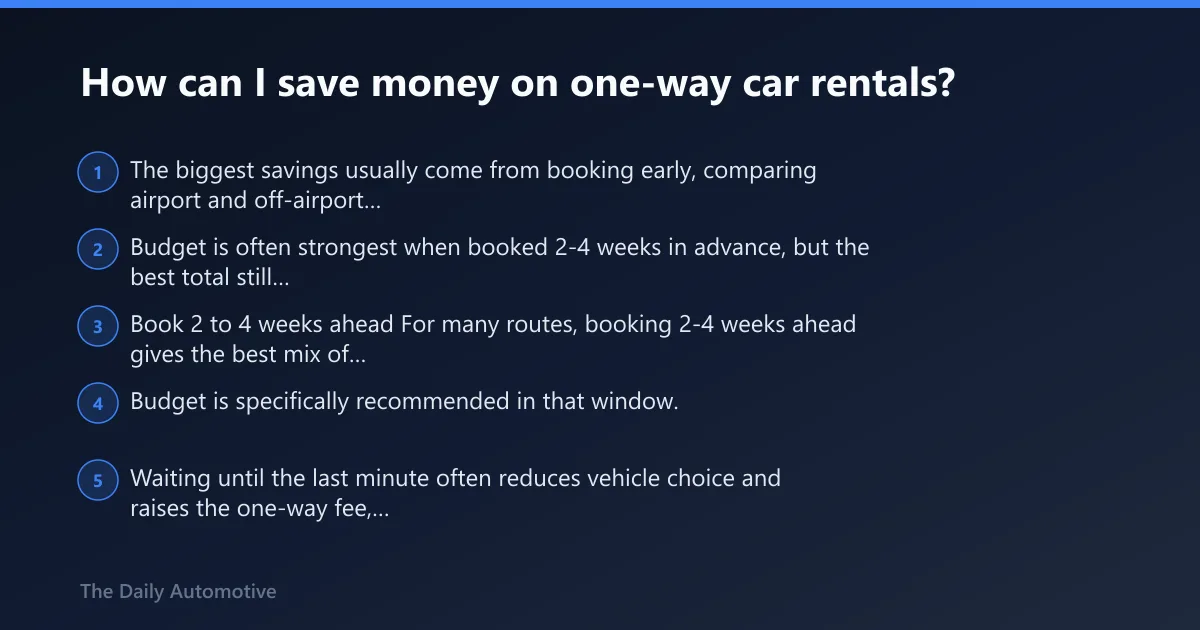
The biggest savings usually come from booking early, comparing airport and off-airport branches, choosing the smallest suitable vehicle, and verifying the drop-off city before paying. Budget is often strongest when booked 2-4 weeks in advance, but the best total still depends on local inventory and route rules.
Book 2 to 4 weeks ahead
For many routes, booking 2-4 weeks ahead gives the best mix of rate and inventory. Budget is specifically recommended in that window. Waiting until the last minute often reduces vehicle choice and raises the one-way fee, especially for airport pickups and busy weekend returns.
Compare airport and off-airport locations
Airport locations are convenient but often carry extra charges. Off-airport branches can lower the total if the shuttle or taxi cost is small enough. The winner is not the branch with the lowest daily rate; it is the branch with the lowest final bill after local charges.
Choose the right vehicle class
Vehicle class changes the total quickly. An economy car may be enough for a solo trip, while a minivan or SUV can make sense for families or long road trips. Hertz and Alamo are useful when cargo space matters, but the larger vehicle should only be chosen if it truly fits the trip.
Check the drop-off city before paying
Some cities are restricted, some branches close early, and some locations do not accept after-hours returns. Those failure points matter because they can make a cheap quote unusable. The safest practice is to confirm the exact return branch, the operating hours, and any one-way restriction before the reservation is finalized.
How do I get cheap one-way car rentals?
Cheap one-way rentals come from matching the route to the brand, not from chasing the lowest headline rate. Budget is often the cheapest when booked ahead. Thrifty can win on popular routes. Enterprise and National can be cheaper once the full route, taxes, and availability are counted.
Use a route-first comparison
Search the exact pickup and drop-off cities first. Then compare the total, not the daily rate. The same brand can be cheap on one route and expensive on another because one-way fees, drop-off rules, and airport surcharges change from city to city.
Watch for hidden add-ons
Young-driver fees, extra-driver charges, toll products, fuel plans, airport taxes, and mileage limits all affect the final bill. A quote that looks low can become the most expensive option once those line items are added. The safe comparison is a fully loaded total, not a base price.
Use the best-fit brand for the route
Budget often works for early planners. Enterprise and National often work for broad networks. Hertz can work for larger vehicles. Avis suits premium needs. Alamo works well for family trips. Thrifty can be the cheapest on common routes, but service quality can be uneven.
Are one-way car rentals more expensive than round trips?
Usually yes, because the rental company must move the car back or replace it elsewhere. The one-way fee is the main reason. A round trip often costs less overall even when the base daily rate looks similar, since the vehicle returns to the original branch without extra repositioning work.
That said, one-way can still be the smarter choice when hotel nights, backtracking fuel, or extra driving time would make a round trip more expensive. The right answer is the full route cost, not the headline rate.
What fees should I expect on a one-way rental?
Expect the base rate, one-way fee, airport surcharge if applicable, taxes, mileage policy effects, and possible add-ons such as a young-driver fee or extra-driver fee. The final bill can change quickly when the route starts at an airport or when the drop-off branch has limited operating hours.
Some one-way quotes also include restrictions on the drop-off city or the vehicle class. Those restrictions matter because a reservation may look available online but fail at pickup if the branch cannot accept the return. Always check the full terms before paying.
How early should I book a one-way rental to save money?
Booking 2-4 weeks ahead is a practical target for lower one-way pricing, especially with Budget. Early booking improves car choice and often reduces the fee band on common routes. Last-minute reservations usually cost more because inventory is tighter and the return branch has less flexibility.
For busy travel periods, booking even earlier can help. The main goal is to avoid being forced into a premium vehicle or a restricted branch just to secure a car. That situation can raise the final bill far more than the daily rate suggests.
Frequently asked questions
Can you rent a car for a one-way trip?
Yes. Most major rental companies offer one-way rentals on selected routes, but the available cities, vehicle classes, and drop-off branches differ. The quote matters less than the final total, so the renter should confirm the one-way fee, taxes, and any location-specific restrictions before booking.
Which car rental company is best for one-way trips?
Enterprise is the best all-around choice for many travelers because of its large network and moderate one-way fee band. Budget is often cheaper on early bookings, Avis fits premium needs, and Alamo works well for families. The best pick still depends on route and drop-off city.
Do car rental companies allow cross-border one-way trips?
Sometimes. Canada-to-US one-way travel can be allowed by Enterprise, Hertz, Avis, National, or other brands at selected branches, but approval is location-specific. The branch must confirm the route, vehicle class, and return city. A general brand policy is not enough on its own.
Which company is cheapest for long-distance one-way travel?
Budget often wins when the reservation is made early, but Enterprise and National can be cheaper on many long routes once the total is counted. Hertz and Thrifty can also compete on selected routes. The answer depends on the exact pickup city, drop-off city, and vehicle class.
Products related to this article
Sponsored / affiliate links. As an Amazon Associate I earn from qualifying purchases. I may earn additional commission from eligible campaigns.
 PartsTo Adjustable Kids Travel Car Seat Headrest Pillow with Lean Support Cushion Sleeping Travel Neck Safeguard Cushion Suitable for Kids Children Teenagers and Adults
 Custom Vinyl Lettering, Vinyl Decals for Vehicles, Custom Car Sticker for Windows, Trucks, Storefront, Cups & Laptop, Die Cut Personalized Lettering, Waterproof Vinyl