Used Car Warranty Cost When Buying From a Dealer
A dealer-sold used-car warranty often adds about $1,000 to $3,000 to the deal, plus a deductible per repair visit of about $0 to $200. If the vehicle already has strong factory or CPO coverage, skipping the add-on is usually the smarter move. Miss the fine print and you can pay for exclusions, repeat deductibles, and markup that never comes back to you.
Where the coverage comes
Dealer sales can include a limited dealer warranty, an as-is sale, a factory-backed CPO warranty, or a third-party service contract sold at the desk. These are different products. The contract source, repair coverage, and cancellation rules can shift the out-the-door cost a lot.
As-is sale versus limited dealer coverage
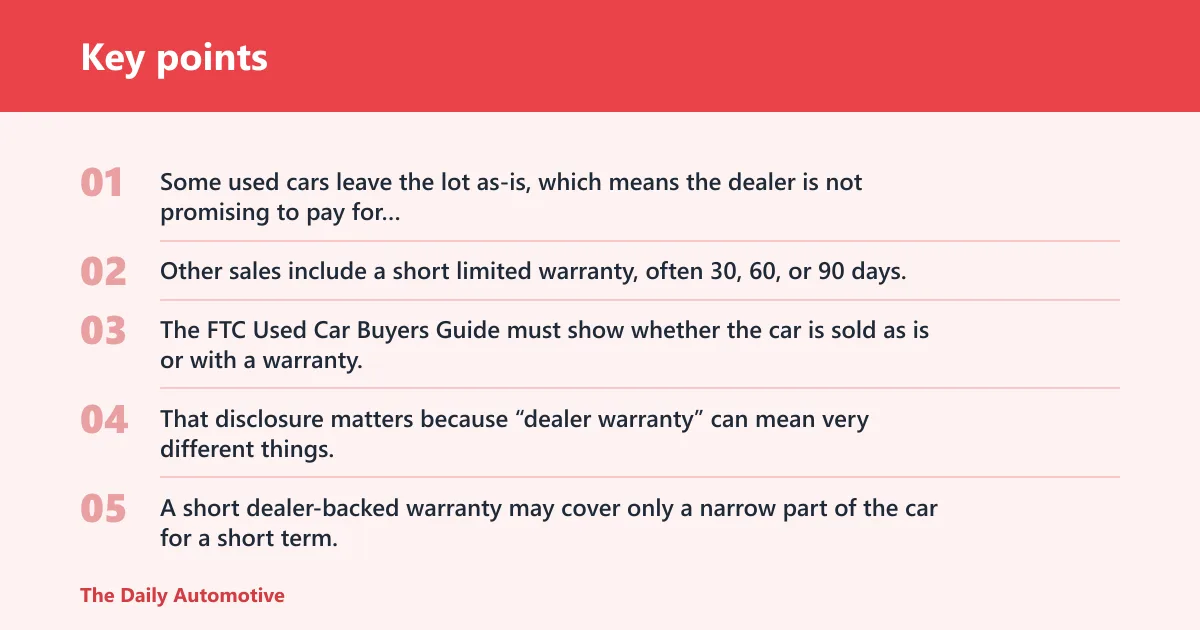
Some used cars leave the lot as-is, which means the dealer is not promising to pay for later repairs. Other sales include a short limited warranty, often 30, 60, or 90 days. The FTC Used Car Buyers Guide must show whether the car is sold as is or with a warranty.
That disclosure matters because “dealer warranty” can mean very different things. A short dealer-backed warranty may cover only a narrow part of the car for a short term. Dealer warranties may be 30-, 60-, or 90-day limited warranties.
Factory-backed CPO coverage versus dealer add-ons
CPO coverage is different from a dealer add-on plan. It is factory-backed, only available on qualifying dealer-sold vehicles, and usually requires dealer inspection and reconditioning before sale. CPO warranties vary by program and may provide limited coverage, powertrain extensions, or other terms, which is why the price structure often differs from a random add-on contract.
That extra screening matters. A CPO plan follows the manufacturer’s standards, while a dealer-sold add-on can be dealer-backed or third-party and may include exclusions that are not obvious from the sticker price alone.
Third-party service contracts sold at the desk
Third-party extended warranty plans, often called service contracts, can be sold by the dealer or bought from an outside provider. Pricing changes widely by vehicle, coverage, and mileage, and repair-shop restrictions can apply. Some plans steer you to approved shops or require preauthorization before work starts.
That restriction can matter more than the monthly payment. A cheaper quote is not a better quote if the contract narrows where you can repair the car or limits what counts as a covered failure.
How much do dealer warranties cost?
Dealer warranty pricing depends on coverage depth, term length, vehicle age, mileage, and deductible. Basic powertrain plans typically cost $300-$800. Broader coverage plans typically cost $1,500-$3,000+. Many used-vehicle warranty plans land around $80 to $200 per month, and total plan cost can run $2,000 to $6,000.
Typical powertrain pricing
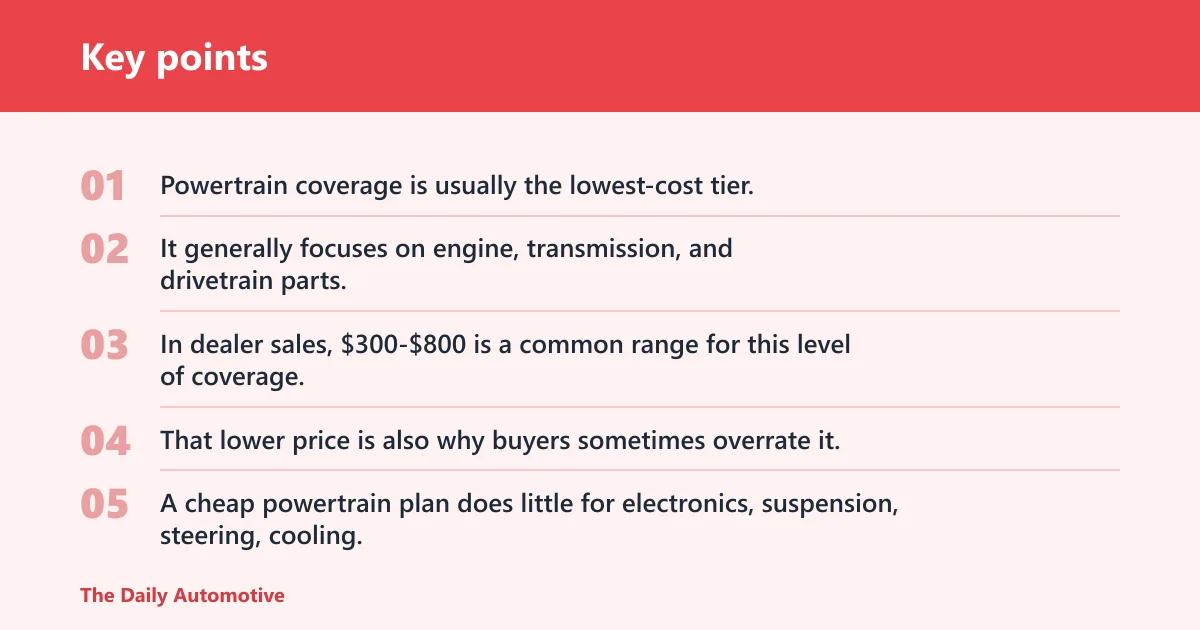
Powertrain coverage is usually the lowest-cost tier. It generally focuses on engine, transmission, and drivetrain parts, so the dealer can price it lower than broader protection. In dealer sales, $300-$800 is a common range for this level of coverage, though the exact quote still depends on age, mileage, term, and deductible.
That lower price is also why buyers sometimes overrate it. A cheap powertrain plan does little for electronics, suspension, steering, cooling, or air conditioning if those systems are excluded.
Typical bumper-to-bumper pricing
Broader coverage is costlier. It may include more systems such as electronics, suspension, steering, cooling, and AC, and dealer pricing commonly starts around $1,500 and can move past $3,000. The larger price reflects the wider claim risk, not a guarantee that every repair is covered.
Say your 5-year-old crossover has 62,000 miles and the dealer offers a 4-year exclusionary plan with a $250 deductible. The quote may look expensive at the desk, but the real question is which expensive components are excluded, how often you would pay the deductible, and whether the same money could cover likely repairs in a fund.
Why age, mileage, and term change the quote
Older cars and higher-mileage cars usually cost more to cover because the claim risk rises. Longer terms also cost more because the contract has to protect the vehicle for more time. A low-mileage car with active factory protection is cheaper to insure than a high-mileage car near the edge of coverage.
Quoted price alone does not tell you much. You need the term, the mileage cap, the deductible, and the list of exclusions before you can compare one dealer offer with another.
What changes the total cost
The sticker price is only part of the bill. Deductibles, dealer markup, tax, diagnostics, exclusions, and cancellation fees can push the real cost above the number on the contract. A higher deductible can lower the overall warranty cost, but it increases what you pay at each claim.
Deductible choices and claim cost
Used-car warranties often come with deductibles from $0 to $500. A $0 deductible raises the upfront price, while a higher deductible lowers the premium but increases the out-of-pocket cost each time you file a claim. The math should be based on likely repairs, not on the lowest monthly payment.
Suppose a dealer offers the same plan at $1,650 with a $0 deductible or $1,350 with a $250 deductible. If you use the plan twice, the lower sticker price can disappear fast. Two claims would cost $500 in deductibles, which changes the total outlay to $1,850.
Markup, tax, diagnostics, and cancellation fees
Dealer markup is easy to miss because it is usually folded into the final contract price. Tax can apply depending on state rules and how the contract is sold. Some plans also exclude diagnostic time, so a failed sensor may be covered while the shop visit to confirm the failure is not.
Cancellation terms matter too. Some contracts refund only a prorated amount, and some keep an administrative fee. If you cancel after a few months, you may not get back the full amount you paid.
Exclusions that shrink the real value
Most plans exclude wear items and routine maintenance, but the bigger issue is system-level exclusions. Check whether the contract excludes electronics, seals and gaskets, cooling, AC, suspension parts, or preexisting conditions. Those exclusions can turn a broad-sounding plan into a narrow repair policy.
A common first-timer mistake is comparing only the premium and ignoring the deductible and exclusions. That makes a cheap-looking plan look better than it is.
Warranty cost worksheet
This worksheet helps you compare the quoted price with the real cost per year and decide whether to keep the warranty or set the money aside in a repair fund. Use the same repair-risk assumptions for every quote so you are comparing like with like.
| Vehicle age/mileage | Warranty type | Term | Deductible | Quoted price | Likely exclusions | Estimated effective cost per year |
|---|---|---|---|---|---|---|
| 3 years / 36,000 miles | CPO bumper-to-bumper | 2 years | $0 | $1,400 | Wear items, maintenance, preexisting damage | $700 |
| 6 years / 72,000 miles | Dealer powertrain | 3 years | $250 | $650 | Electronics, AC, suspension, diagnostics | $216.67 |
| 8 years / 95,000 miles | Third-party exclusionary | 4 years | $500 | $2,800 | Shop restrictions, seals, infotainment limits | $700 |
| 7 years / 80,000 miles | Dealer add-on bumper-to-bumper | 3 years | $200 | $2,100 | Diagnostics, trim, maintenance, cancellation fee | $700 |
| 7 years / 80,000 miles | Repair fund instead of warranty | 3 years | None | $2,100 set aside | No contract exclusions; money stays liquid | $700 per year saved |
The last row is the clean comparison. If the warranty costs $2,100, you can choose to keep the contract or put the same $2,100 into a repair fund. The fund has no deductible, no shop restriction, and no cancellation clause. The warranty may still be worth it because it transfers repair risk and can smooth cash flow, even if you never file a claim.
Is a dealer warranty worth it?

A dealer warranty is worth it when the car is low mileage, the coverage is broad, and the deductible is modest relative to the repair risk. It is usually less compelling when the vehicle already has remaining factory coverage or when the plan price is high for a narrow list of exclusions. Value depends on the car, not the sales pitch.
When low mileage and high coverage can justify the price
If the car is still within a strong factory period, a dealer warranty may only add duplicate coverage. If the car qualifies for CPO coverage, the factory-backed protection and inspection standard may be the better value. That is especially true when the CPO plan adds meaningful coverage beyond the existing factory warranty.
Picture a qualifying sedan with 28,000 miles, a clean history report, and factory coverage still in force. A dealer add-on that mostly repeats what the manufacturer already covers is hard to defend unless it adds meaningful time, broader parts coverage, or a lower deductible.
When a repair fund may be the better deal
A repair fund often makes more sense for older vehicles with simple drivetrains, especially if the dealer quote is high and the exclusions are heavy. Used vehicle warranty plans can total $2,000 to $6,000, and that money may cover a lot of repairs if it stays in your account instead of in the contract.
The break-even point is simple: compare the quoted price plus deductible exposure against the repairs you are likely to face. If the plan only covers a few expensive parts and leaves out the systems most likely to fail, self-insuring is often cleaner.
How to judge value by car age and coverage depth
Start with the vehicle’s age and mileage, then check the exact contract type. A powertrain plan can be a sensible floor on a higher-mileage car if the price is near the low end of $300-$800. A broader plan only starts to make sense when it closes a real coverage gap, not when it copies factory coverage at a markup.
What should you check before signing?
Before signing, verify the Buyers Guide, the VIN history, the remaining factory coverage, the inspection report, and the full list of exclusions. You should also confirm the deductible, the repair-shop rules, and any cancellation terms. A dealer promise is not enough by itself.
FTC Buyers Guide details
The FTC dealer Buyers Guide must show whether the car is sold as is or with a warranty. It also shows whether the dealer is offering warranty coverage and the basic terms. That is the first document to check because it tells you whether you are buying a warranty at all, and if so, what kind.
VIN check and remaining factory coverage
A vehicle history report and VIN check can confirm title issues, past damage, and whether any factory coverage remains. Use that information before you rely on a dealer’s claim about remaining protection. If the car still has manufacturer coverage, you may not need to buy duplicate dealer protection.
Inspection report, exclusions, and shop restrictions
Ask for the inspection report, any reconditioning records, and the complete service contract. Check whether the warranty excludes items such as electronics, air conditioning, suspension, or seals and gaskets. Then verify whether you can use your own repair shop or must go to a network location. Those details change the real value more than the sales price does.
Can you negotiate the warranty price?
Yes. You can negotiate the warranty price, the deductible, the term, and the add-ons that often get bundled into the deal. Ask for the contract before agreeing, compare outside quotes, and push back on coverage you do not need. The first number offered at the desk is rarely the final number.
Ask for the contract before agreeing
Request the actual contract, not just the monthly payment. You need the deductible, exclusions, claim rules, cancellation terms, and repair-shop restrictions in writing. If the dealer will not provide that, you do not have enough information to judge the offer.
- Ask for the warranty contract and Buyers Guide.
- Confirm the exact warranty type: dealer-backed, CPO, or third-party.
- Check the deductible and the maximum covered term or mileage.
- List exclusions, diagnostics rules, and shop restrictions.
- Compare the quote with an outside warranty quote for the same vehicle.
- Ask for a lower price, lower deductible, or shorter term if the plan is overpriced.
Compare dealer pricing with outside quotes
Dealer-sold third-party contracts often compete with outside providers on the same vehicle. That makes price comparison possible. Make sure you compare the same term, the same deductible, and the same coverage type. A cheaper contract with more exclusions is not a better contract.
Push back on bundled add-ons and overpriced term lengths
Dealers sometimes fold the warranty into other add-ons or stretch the term to justify the price. If the quote feels inflated, ask them to strip the package down to the contract itself. Then compare the result with the cost of setting aside the same cash in a repair fund.
Frequently asked questions
How much does a used car warranty cost from a dealer?
Is a dealer warranty on a used car worth it?
It can be, but only when the plan adds coverage you do not already have and the deductible is reasonable. If the car still has strong factory coverage or qualifies for CPO protection, a dealer add-on is often redundant. A repair fund may be the better value on older cars with thin coverage.
What does a dealer used car warranty usually cover?
Coverage depends on the contract. Powertrain plans usually focus on the engine, transmission, and drivetrain. Broader plans can include electronics, suspension, steering, cooling, and AC. Most contracts still exclude wear items, routine maintenance, preexisting issues, and some diagnostics or shop charges.
Can you negotiate a dealer warranty price on a used car?
Yes. You can negotiate the price, deductible, term, and add-ons, especially on dealer-sold service contracts. Ask for the written contract, compare it with outside quotes, and insist on the same coverage level before comparing prices. A dealer’s first offer is not the final offer.
What is the difference between dealer warranty and third-party warranty?
A dealer warranty may be dealer-backed limited coverage, while a third-party warranty is a service contract from an outside provider that the dealer may sell at the desk. Third-party plans often vary more in price and may add repair-shop restrictions, so you need to check where and how claims are paid.
Do all used cars bought from dealers come with a warranty?
No. Many dealer sales are as-is, and the FTC Buyers Guide must say so. Some dealers offer a short limited warranty, and some states require one, often 30 days or 1,000 miles. CPO coverage only applies to qualifying vehicles that meet the manufacturer’s inspection and reconditioning standards.
Products related to this article
Sponsored / affiliate links. As an Amazon Associate I earn from qualifying purchases. I may earn additional commission from eligible campaigns.