Car Payoff Quote Cost
A car payoff quote is the amount needed to close an auto loan on a specific date, and it can change from day to day because of interest, fees, and posting time. Miss that number and you can overpay, underpay, or leave the loan open by a few dollars. This guide explains how payoff quotes work, what changes the cost, and how to time payment, sale, or refinance so you close the loan cleanly.
Car payoff quote worksheet
Use this worksheet to turn a loan balance into a payoff estimate. The key inputs are the current loan balance, the daily interest amount, the date the quote is good through, and the lender’s cutoff time for posting a payment. A payoff quote is a lender-issued closing figure for a specific date, not a static balance.
| Scenario | What to enter | Why it matters |
|---|---|---|
| pay today | __________ | Use the lender’s same-day payoff amount and confirm the posting cutoff before you send funds. |
| pay in 3 days | __________ | Add three days of per-diem interest to the current payoff estimate before any lender fee. |
| sell to private buyer | __________ | Match the quote to the buyer’s closing date and confirm wire or cashier’s check instructions. |
| refinance | __________ | Use the new lender’s funding date, not the application date, to avoid a stale payoff amount. |
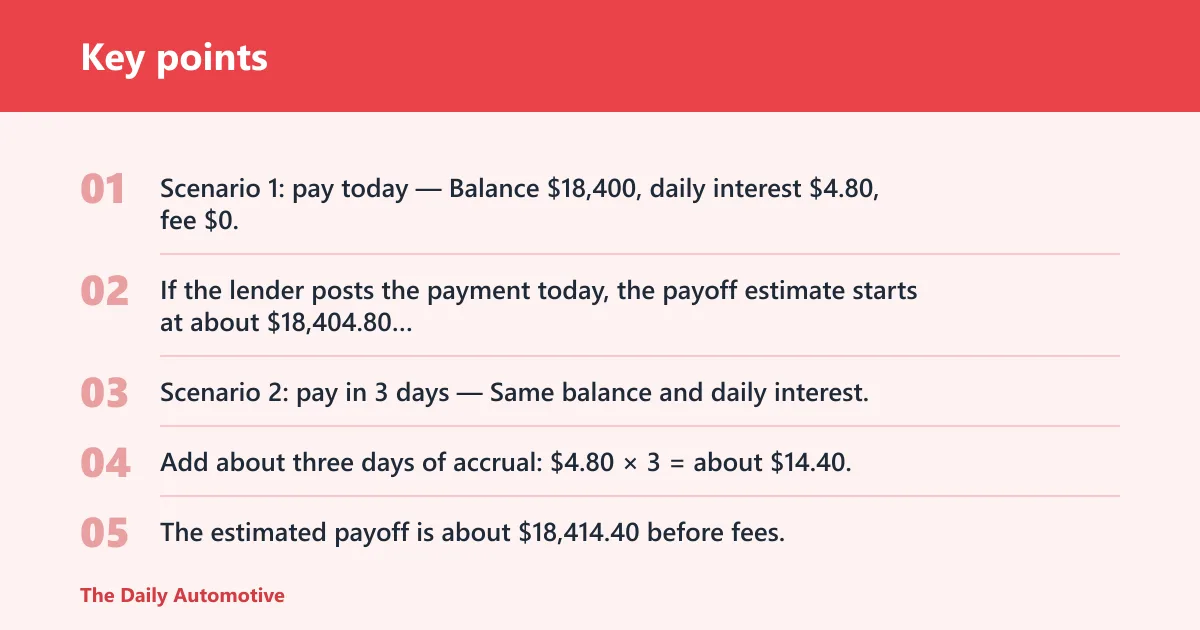
Scenario 1: pay today — Balance $18,400, daily interest $4.80, fee $0. If the lender posts the payment today, the payoff estimate starts at about $18,404.80 before any lender-specific fee.
Scenario 2: pay in 3 days — Same balance and daily interest. Add about three days of accrual: $4.80 × 3 = about $14.40. The estimated payoff is about $18,414.40 before fees.
Scenario 3: sell to a private buyer, If the buyer’s cashier’s check reaches the lender two business days after you request the quote, add two days of interest. You also need the payoff address, account number, and any cutoff time the lender requires for third-party funds.
Scenario 4: refinance, A refinance payoff quote usually needs the lender’s exact payoff date, because the new lender may send funds on a different day than the application date. Add daily interest through the date the old lender expects to receive funds.
What is a car payoff quote?
A car payoff quote is the lender’s amount needed to fully close the auto loan on a specific date. It usually starts with your outstanding principal, then adds accrued interest through that date and any applicable lender fees. It is different from your current loan balance because the balance alone may not include all interest or charges already due. If you are requesting a car payoff quote, ask for the amount tied to a exact date, not just the balance shown in your online account.
How it differs from your current loan balance
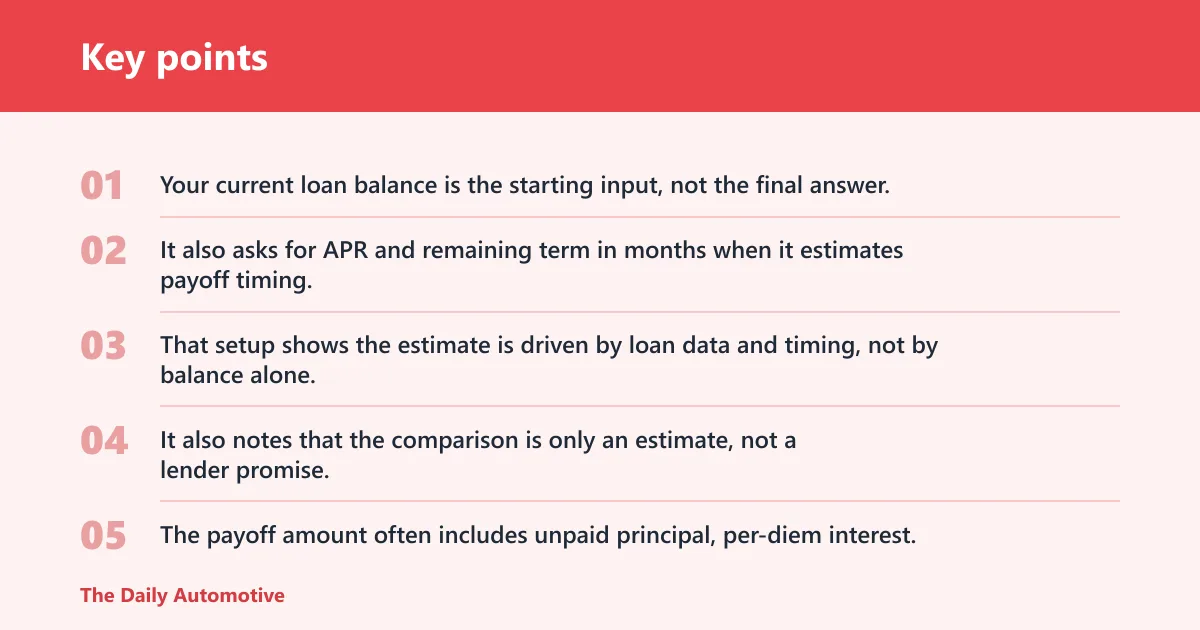
Your current loan balance is the starting input, not the final answer. It also asks for APR and remaining term in months when it estimates payoff timing. That setup shows the estimate is driven by loan data and timing, not by balance alone. It also notes that the comparison is only an estimate, not a lender promise.
What usually goes into the payoff amount
The payoff amount often includes unpaid principal, per-diem interest, and any lender-specific fees that apply. Per-diem interest is the daily amount that accrues until the payoff date. If the lender posts the payment a day later than you expected, the amount can rise by one more day of interest. The linked CFPB guidance notes that payoff quotes can include interest through a specific date and may change if payment is not received by the date shown in the payoff statement. CFPB: What happens when I pay off my auto loan?
Why the quote has a good-through date
The quote is date-sensitive because interest keeps accruing until the lender receives and posts payment. A good-through date tells you how long the figure should hold. After that date, the lender may need to issue a new payoff quote with a higher or lower amount depending on posting timing, fees, and contract terms. The linked FTC article also advises consumers to confirm payoff instructions and amounts with the lender before closing a vehicle loan. FTC: Car loans and lease payments
Why the payoff quote changes by date
The payoff quote changes because the clock keeps running on the loan. Interest accrues each day, and the lender may apply funds only after a cutoff time. Weekend processing, holidays, or a late wire can push the posting date forward and add another day or more of interest.
Per-diem interest and daily accrual
Per-diem interest is the daily charge added to the payoff figure until the loan is closed. If your lender quotes a payoff good through Friday, paying on Monday can increase the amount. That change is normal and usually comes from daily interest, not from a surprise penalty.
Payment posting delays and cutoff times
Posting date matters as much as send date. A wire sent after the lender’s cutoff time may post the next business day. A cashier’s check mailed late in the week can arrive after the quoted date. That is one reason the exact payoff method matters, especially for private sales and refinance closings.
Weekends, holidays, and expired quotes
Nonbusiness days can extend the time before the lender records payment. If the quote expires over a weekend, you may need a fresh payoff letter on Monday. A common first-timer mistake is assuming a Friday quote still works for a Tuesday closing without checking the good-through date first.
Suppose your payoff quote is good through Wednesday and your buyer plans to wire funds Thursday morning. Even if the amount looked correct on Tuesday, the quote can change by Thursday because one extra day of interest may have accrued.
The official payoff quote comes from the lender’s payoff department, not from your monthly payment or the dashboard balance. You can ask for a payoff letter or use online account tools if the lender provides them. The goal is to get the exact amount for the exact date and method of payment.
Contact the lender’s payoff department
Ask for the payoff quote for a specific date. Give the account number, requested payoff date, and payment method. The payoff department can also tell you whether the lender issues a payoff letter and how long the quote stays valid. The lender should be able to provide payoff information that identifies the amount needed to satisfy the loan through a stated date. CFPB: What is a payoff letter?
Use the payoff letter or online account tools
A payoff letter often lists the payoff amount, good-through date, payment instructions, account number, and payoff address. Check every field carefully. If the letter lists a wire address and a separate mailing address, follow the one tied to your payment method.
Verify the payoff address, account number, and payment method
Before you send money, confirm the payoff address, the exact account number, and the delivery method the lender accepts. If the lender offers a separate payoff department address, use that address rather than the regular customer-service mailing address. A mislabeled envelope can delay posting and add interest.
- Call or log in to the lender’s payoff department.
- Request the payoff amount for a specific date.
- Confirm the good-through date and cutoff time.
- Check the payoff address and account number.
- Ask how the lender wants wire, cashier’s check, or online payments labeled.
- Save the payoff letter before you close the transaction.
What fees can appear in the quote?
Some payoff quotes include more than principal and interest. Late fees, missed-payment charges, or processing fees may appear if your contract allows them and if your account triggered them. The auto loan contract controls the payment rules, so it is the first place to check before disputing a line item.
Late fees and missed-payment charges
If a payment was late or missed, the lender may add the contract’s late fee. That fee can stay in the payoff quote until the account is fully closed. If the lender says a fee is included, ask whether it is already posted or still pending in the account system.
Processing or administrative fees
Some lenders charge a processing or administrative fee for payoff handling. Others do not. Do not assume a fee exists just because the payoff is higher than the balance. Ask the payoff department to identify each charge by name.
What to confirm in your loan contract
Your auto loan contract defines how interest is calculated, whether early payoff is allowed, and what processing rules apply. It may also spell out how payments are applied and whether any fee can be added at closing. If a line item is unclear, the contract and payoff letter should agree on the charge.
What is a payoff quote for car?
It is the lender’s exact amount needed to close the car loan on a stated date. The quote usually includes the current balance, accrued interest through the payoff date, and any fee the lender is allowed to charge. Because it is date-specific, the amount can change from one day to the next.
What changes when you sell or refinance?
Selling or refinancing changes the payoff because the payment source, timing, and closing process change. A private buyer may send a cashier’s check or wire. A refinance lender may coordinate payoff directly with the old lender. In both cases, the quoted amount must line up with the actual date funds arrive.
Private-party sale timing and cashier’s check or wire rules
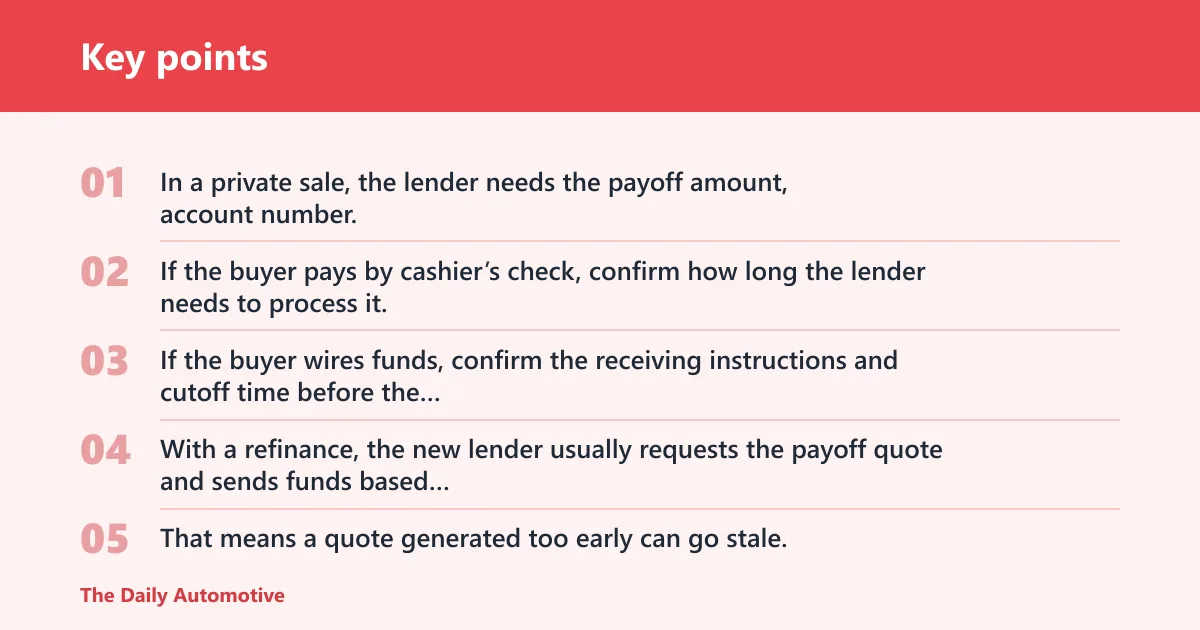
In a private sale, the lender needs the payoff amount, account number, and payoff address to apply the funds correctly. If the buyer pays by cashier’s check, confirm how long the lender needs to process it. If the buyer wires funds, confirm the receiving instructions and cutoff time before the sale closes.
Refinance payoff timing and lien payoff coordination
With a refinance, the new lender usually requests the payoff quote and sends funds based on the closing date. That means a quote generated too early can go stale. Ask the refinance lender which date it will use for payoff so the old loan is closed without a gap in funding.
Title release and gap insurance checks after payoff
After payoff, ask about title release timing so you know when the lien is cleared for sale or transfer. Timing varies by state. In some states, the lienholder mails a paper title or lien release directly to the owner; in others, the electronic title system updates first and the paper title follows later. Some states require the lender to release the lien within a set number of days, while others allow longer processing windows or use an electronic title transfer process that changes the timing. If the vehicle was totaled before payoff, gap insurance may matter because it can affect how the remaining loan is handled after an insurance settlement. Gap coverage typically comes into play when the insurer’s settlement is less than the payoff balance, and the lender may still need to receive and post the insurance funds before any remaining gap claim is resolved. Ask the lender when it will release the lien, whether it sends the title directly to the DMV or to you, and whether your state uses electronic lien release, paper title release, or both.
A common first-timer mistake is selling the car on Saturday, assuming the lender will post the buyer’s wire immediately, and then discovering on Monday that the payoff amount grew because the quote expired over the weekend.
Frequently asked questions
What is a payoff for a car?
A payoff for a car is the amount required to close the auto loan in full on a specific date. It is not the same as the balance shown in your account screen, because interest can still accrue and fees may still apply before the lender posts the final payment.
What is a payoff quote?
A payoff quote is the lender-issued amount you need to pay to close the loan by a specific date. It usually includes principal, accrued interest, and any allowed fees. The quote changes with time, so the date on the payoff letter matters as much as the amount itself.
How do I get a payoff quote for my car?
Request it from the lender’s payoff department, or use the lender’s online tools if they provide a payoff letter. Give the account number, desired payoff date, and payment method. Then verify the payoff address, good-through date, and any cutoff time before you send funds.
Why is my car payoff amount higher than my balance?
The payoff amount can be higher because the balance may not include all accrued interest through the payoff date, and it may not include late fees or processing charges. A day of delay can change the amount by the loan’s daily interest, so the quote is time-sensitive.
Should I pay off my vehicle?
Paying off the vehicle can make sense if the interest saved is worth more than keeping the cash available for emergencies or other higher-priority debts. Compare the payoff quote with your cash reserve and any prepayment terms in the contract. The right choice depends on timing, not on the loan balance alone.
Products related to this article
Sponsored / affiliate links. As an Amazon Associate I earn from qualifying purchases. I may earn additional commission from eligible campaigns.