
Car Rental Guide: Costs, Rules, Tips, and Insurance
Use a car rental guide: compare the all-in total, not just the daily rate; taxes, airport fees, young-driver surcharges, and insurance can roughly double a low quoted price in some cases. I have seen renters miss one policy line, then get hit at pickup or return with denied card coverage, fuel charges, extra-driver fees, mileage caps, or one-way drop penalties that add hundreds. This guide lays out real rental costs, location and age rules, insurance choices, and the booking and return mistakes that change the final bill.
What a rental car really costs



Base rate versus total trip cost
The base rental rate is only the first line on the bill. A real comparison needs the quoted daily or weekly price, then taxes, airport charges, coverage, fuel, deposit hold, toll handling, and add-ons such as an extra driver or child seat.
A low per-day economy rental for three days may look cheap. Add airport concession recovery, customer facility charge, sales tax, a loss damage waiver, and a toll transponder program, and the real spend can land well above the headline rate.
Why daily, weekly, and monthly pricing can flip the best deal
Rental pricing is rarely linear. Three one-day rentals can cost more than one three-day rental. A six-day booking can cost more than a seven-day booking if the company applies a weekly rate after a certain number of days.
Monthly rates can also beat weekly pricing on longer trips, especially in lower-demand periods. I watch for this on relocation trips, temporary car replacement, and extended family visits. Always price the actual trip length, plus one day longer, to see whether a rate break appears.
How season, city, and vehicle class move the number
Rates often rise around spring break, Thanksgiving week, Christmas, and other holiday weekend stretches. I also see sharp swings in shortage markets, for example a beach airport in July or a ski town in January, where the same compact car can cost far more than it does at a suburban branch.
Vehicle class changes the math too. Economy and compact cars usually start with the lowest daily rates, and they can also be a good fit for solo travel and short city runs. SUVs and minivans often make the biggest jump because family demand peaks at the same time fleet supply gets tight. Luxury models and many EVs bring higher rates, larger holds, and tighter coverage rules.
| Vehicle class | Typical pricing pattern | Best fit | Cost watchpoint |
|---|---|---|---|
| Economy | Usually lowest daily rate | Solo traveler, short city trip | Limited luggage space |
| Compact | Slightly above economy | Couple, light highway use | May price close to economy in peak periods |
| SUV | Higher daily and weekly rate | Snow, rough weather, more cargo | Fuel spend rises quickly |
| Minivan | Often expensive in holiday periods | Family vacation | Inventory shortages push price hard |
| Luxury | High rate, higher hold | Special occasion, business image need | Coverage exclusions are more common |
| EV or hybrid | Mixed; hybrids can be moderate, EVs vary widely | Urban use, shorter predictable routes | Charging return terms and time risk |
How no-deposit car rentals actually work
A “no-deposit” rental rarely means zero card authorization. Most companies still place a temporary hold on your payment method, and the size of that hold determines whether you can afford pickup or get stuck declining an upgrade. Understanding the difference between a true no-deposit booking and a smaller preauthorization prevents lost trip cash and surprise charges at the counter.
The guide to no-deposit car rentals breaks down how major brands handle holds, which companies let you pay only at pickup, and how to read the fine print before confirming a reservation. It also includes a brand-by-brand checklist for spotting hidden fees so you can secure a low-hold offer without risking your travel budget.
Fox Car Rental’s hidden costs and when it’s truly cheaper
Fox Car Rental’s advertised rates often understate the final cost after taxes, airport surcharges, and add-on fees. Unlike traditional rentals, Fox’s savings evaporate quickly if the total trip price—including pickup delays and surprise charges—exceeds Hertz or Avis. This review breaks down how Fox’s pricing compares on key factors like final cost, airport convenience, and fee risk, so you can decide if the hassle is worth the potential discount.
For a detailed breakdown of Fox’s fees and how they stack up against competitors, check out the Fox Car Rental review.
When Priceless Car Rental Makes Sense
Priceless Car Rental can undercut mainstream chains, but the savings disappear if pickup fees, large holds, or insurance gaps inflate the final bill. This guide walks through total out-the-door cost, how the shuttle and counter process work, what deposits and coverage rules to expect, and the most common customer complaints. Use it as a quick checklist before booking.
If the quoted price stays close to big brands and you can confirm pickup terms upfront, the rental is worth considering; otherwise, stick with a well-known company. See Priceless Car Rental review for the full breakdown.
When a peer-to-peer rental beats the counter
Turo works best for flexible, non-airport trips and specialty vehicles where traditional agencies charge premium rates or lack inventory. It frequently costs more than Enterprise or Hertz for airport pickups under three days or long, high-mileage drives once platform fees, mileage caps, and insurance add-ons are factored in.
The supporting guide breaks down Turo pricing, insurance coverage, and a decision matrix that matches specific trip profiles to the cheaper option. Choosing the wrong format means paying higher total costs with less on-the-ground support at return. Before booking a peer-to-peer vehicle, review this Turo rental comparison to confirm your itinerary actually favors the platform over a standard counter rental.
How much does it cost to rent a car?
Most rentals land in a wide band because the daily rate is only one layer. Economy and compact cars usually sit at the low end, while SUVs, minivans, luxury cars, and some EVs cost much more after taxes, location fees, coverage, fuel, and trip-specific charges are added.
Typical cost bands by vehicle and trip type
For a short city trip, economy and compact rentals often win because they keep both base rate and fuel cost down. For a long weekend, weekly pricing can beat a three- or four-day rate, especially around holiday demand spikes. For a full week, a midsize car may price close to a compact if that class has more inventory.
Family travel changes the math. A minivan with room for luggage may cost more per day, yet still beat a cheaper compact that forces a second rideshare from the airport or painful baggage compromises. One-way trips are another swing factor because drop fees can outweigh any low base rate.
Worked rental shapes that change the all-in total
A same-city two-day rental usually lives or dies on fixed fees. A weeklong suburban pickup often gives the cleanest value if it includes unlimited miles and full-to-full fuel. A one-way rental, especially between states or from a small market, can add a route-based drop fee that dwarfs the daily rate.
Use the quote as a worksheet, not an ad. If two bookings differ by only $8 a day but one includes unlimited miles and the other has a daily cap with overage charges, the cheaper-looking one can lose badly on a highway trip.
Why airport pickup often costs more
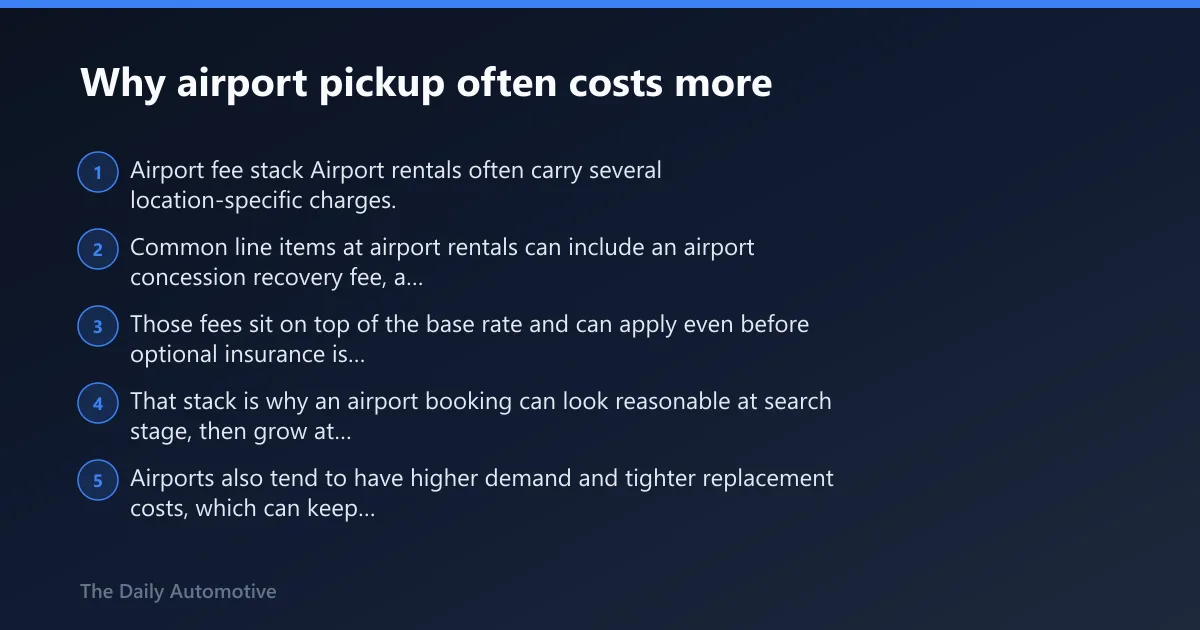
Airport fee stack
Airport rentals often carry several location-specific charges. Common line items at airport rentals can include an airport concession recovery fee, a customer facility charge, and local taxes. Those fees sit on top of the base rate and can apply even before optional insurance is discussed.
That stack is why an airport booking can look reasonable at search stage, then grow at checkout. Airports also tend to have higher demand and tighter replacement costs, which can keep base rates high even before the fee stack lands.
When off-airport pickup is cheaper after transport
Off-airport branches can beat airport pricing, but only when the transfer cost stays low. Add a rideshare cost each way, and some of the savings disappear. Add an hour of time and a forced second trip for luggage, and the practical value can vanish too.
Still, many suburban or downtown locations avoid airport-specific concession charges. On a five- or seven-day rental, I often find those saved fees matter more than booking a week earlier.
Cases where airport pickup still wins
Airport pickup can still be the better total-cost choice when you land after the neighborhood branches close, when the train or bus link is poor, when two rideshares are needed for children and bags, or when the ride into town runs nearly as high as the airport fee stack. Convenience has a price. Sometimes it is still the lower total.
What fees do car rental companies add at pickup?
Pickup fees usually include location-based charges, taxes, optional coverage, and policy-driven extras. The biggest surprise lines are often airport concession fees, customer facility charges, extra-driver fees, young-driver surcharges, toll packages, and large security deposit holds that reduce available credit even though they are not final charges.
Common pickup charges
- Airport concession recovery fee: A charge tied to airport operating agreements.
- Customer facility charge: Often supports rental-car center operations or shuttle systems.
- State and local taxes: Applied to the rental and sometimes to certain fees.
- Young driver fee: Common for renters under 25.
- Extra driver fee: Often charged per day unless a spouse or domestic partner is exempt under local rules.
- Coverage products: Collision damage waiver, supplemental liability, personal accident coverage, roadside products.
- Toll package or transponder enrollment: Useful in some areas, expensive in others.
Charges that appear later
Some costs do not show up until return or after. Examples include fuel service charges, toll administration fees, late-return charges, cleaning fees, smoking fees, pet-related cleaning, and damage claims. A quote with low upfront numbers can still become the expensive choice if its policies are loose or easy to trigger.
What do you need to rent a car?
You usually need a valid driver’s license, a reservation in the renter’s name, a payment card the location accepts, and enough available credit or bank balance for the security hold. Some locations also ask for a second ID, proof of return travel, or an address match when paying with debit.
License, age, identity, and name match
The renter’s license must be valid and current. International travelers may need a passport and, in some places, an international driving permit if the license is not in Roman characters. The reservation name should match the license and payment card exactly to avoid counter delays.
Credit card versus debit card rules
Credit cards are still the easiest path because many locations prefer them for the security hold. Debit cards may be accepted, but often with tighter rules: fewer eligible vehicle classes, higher holds, proof of return travel at airport locations, and longer hold-release times after return.
Do not stop at “debit accepted.” Ask four direct questions: which locations accept it, which classes are excluded, how much the hold is, and what documents are required at pickup.
Security deposit holds and release timing
A hold is not the same as a final charge, but it still reduces available funds. Holds vary by vehicle class, payment method, and location. The release can take days after return, sometimes longer with debit cards because the bank controls posting speed after the rental company closes the contract.
Is it cheaper to book a rental car early or at the airport?
Booking early usually helps, but the bigger savings often come from changing pickup location rather than booking timing alone. An airport rental reserved early can still cost more than an off-airport rental booked later once concession fees, facility charges, and airport taxes are added to the same vehicle class.
When early booking helps
Early booking matters most for holiday periods, family travel, and scarce classes such as minivans and large SUVs. Those categories tighten first. A small timing edge can protect both availability and price.
When location matters more than timing
For ordinary weekdays in large cities, a neighborhood branch can undercut an airport location even if booked closer to the trip. That is especially true on longer rentals, where airport-specific fees repeat across more days or apply to a larger taxable base.
Decision rule
Price the same class in three ways: early airport, early off-airport, and current off-airport. Then add transfer cost, transfer time, and the risk of limited branch hours. The cheapest true option is the one with the lowest all-in total and the least failure risk for the trip.
Can you rent a car if you are under 25?
Yes, many companies rent to drivers under 25, but the total price often rises sharply. Expect a young-driver fee, possible limits on luxury or specialty vehicles, and stricter card rules. The same rental can shift from workable to expensive once age-based charges and exclusions are included.
Minimum age and common restrictions
Minimum age varies by company and location, often with separate rules for airport branches, government travel, or corporate contracts. Under-25 drivers are commonly barred from premium SUVs, luxury cars, large passenger vans, and some specialty vehicles.
How the fee changes the economics
A young-driver surcharge can turn a reasonable compact-car quote into a less attractive deal. On a three-day trip, a daily surcharge stacks quickly. On a weeklong trip, it may be cheaper to rethink the trip plan, share driving with an older renter, or compare public transit plus short-term local rentals.
License and payment issues for younger renters
Younger drivers should also check how long a license must have been held, whether a credit card is required, and whether debit-card use triggers extra screening. Those details vary at the location level and can stop a pickup even when the online reservation looks confirmed.
What insurance do you need for a rental car?
The answer depends on who already covers damage and liability. Collision damage waiver limits what the renter owes for the rental car, liability coverage addresses harm to others, and personal accident coverage deals with injuries. Credit card coverage can help, but many policies exclude certain countries, vehicle classes, and rental lengths.
Collision damage waiver, liability, and personal accident coverage
Collision damage waiver or loss damage waiver is not traditional insurance, but a contractual waiver that can reduce or remove what the renter owes if the rental car is damaged or stolen. Read the exclusions. Tires, glass, underbody, roof, and keys are not always treated the same.
Liability coverage matters for damage or injury caused to others. In some places, basic liability comes with the rental. In others, the included amount may be low, and the counter product fills a real gap.
Personal accident coverage often overlaps with health insurance or travel insurance. It is rarely the first product to buy without checking existing protection.
How credit card coverage works, and where it fails
Some travel cards offer rental collision coverage when the renter pays with that card and declines the rental company’s damage waiver. Some are secondary, meaning they pay after personal auto insurance. Some premium cards are primary. Either way, this usually covers the rental vehicle, not liability to others.
Common failure points include excluded countries, rentals longer than the card’s limit, ineligible vehicle classes, business-use restrictions, and missing documentation. If the renter cannot meet every card condition, counter coverage may be the safer price to accept.
Deductibles and when the counter product makes sense
If a personal auto policy applies to rentals, the renter still carries that deductible risk. For a short trip in an unfamiliar city, paying for the waiver can be rational if it removes a high deductible, avoids a personal policy claim, or covers a class excluded by the card.
Mileage, fuel, and one-way rules that change the bill
Unlimited miles versus caps
Unlimited mileage is common, not universal. Some local rentals, specialty vehicles, and one-way bookings carry daily caps or route restrictions. Go over the cap, and per-mile charges start. On a long highway trip, that single clause can erase the value of a low daily rate.
Fuel policy math
Full-to-full is usually the cleanest choice. Pick up full, return full, keep the receipt, and photograph the gauge near return time. Prepaid fuel only works when the renter expects to bring the car back nearly empty, which many travelers do not manage. Refuel service is usually the worst price because the per-gallon rate is high and the company may also add a service fee.
One-way limits, out-of-state rules, and EV return terms
One-way rentals can include a fixed or route-based drop fee. Some companies limit which states or regions a local-market car can enter. EV rentals add one more variable: return state of charge. Some contracts require a minimum battery level or charge comparable to pickup, and fast charging before return can cost both money and time.
What should you check before driving off the lot?
Check every existing damage mark, the windshield, wheels, lights, fuel level, mileage, warning lights, interior condition, and the rental agreement terms before leaving. Time-stamped photos and a documented walk-around matter because later disputes usually come down to proof, not memory, especially for glass, wheel, and bumper damage.
Pickup inspection checklist
- Photograph all four sides, roofline edges if visible, and close-ups of dents, scratches, wheel rash, and windshield chips.
- Confirm fuel level matches the contract. If the car is electric, note battery percentage and stated return requirement.
- Check odometer and look for warning lights before moving.
- Inspect tires, wheels, mirrors, lights, and wiper condition.
- Open the trunk and check for spare tire or inflator kit if listed.
- Inspect seats, trim, cargo area, and smell for smoke if a smoking fee would matter later.
- Verify authorized drivers, mileage policy, toll program, and late-return grace period on the agreement.
- Get any mismatch corrected before leaving the lot.
Return evidence process
At return, repeat the same photo set. Include fuel or charge proof, dashboard, and a wide shot showing the car at the return location. If staff are not present, keep the time-stamped files until the final receipt closes and any hold has been released.
Total trip-cost worksheet

How to break a quote into real trip cost
This worksheet separates money spent from money temporarily tied up. That matters because a renter can afford the total trip but still fail pickup if the available credit is too low for the deposit hold.
| Cost line | Scenario 1: airport compact, 3 days | Scenario 2: off-airport compact, under 25, debit, 3 days | Scenario 3: one-way minivan, 5 days |
|---|---|---|---|
| Base rental rate | $45/day x 3 = $135 | $42/day x 3 = $126 | $92/day x 5 = $460 |
| Taxes and local fees | $32 | $18 | $74 |
| Airport concession/facility charges | $26 | $0 | $38 |
| Young driver fee | $0 | $25/day x 3 = $75 | $0 |
| Collision damage waiver | $30/day x 3 = $90 | $0 if card or existing coverage applies; otherwise add company rate | $34/day x 5 = $170 |
| Fuel | $24 estimated full-to-full use | $24 estimated full-to-full use | $110 estimated family highway use |
| Likely add-ons | $0 | $0 | Extra driver $15/day x 5 = $75 |
| One-way drop fee | $0 | $0 | $150 |
| Estimated spend | $307 | $243 before optional coverage | $1,077 |
| Deposit hold at pickup | $300 credit hold | $500 debit hold | $400 credit hold |
Scenario reading notes
Scenario 1 shows how an airport compact turns a moderate daily rate into a much larger trip spend once fee layers and waiver pricing are included.
Scenario 2 shows the under-25 effect clearly. The off-airport location trims pickup fees, but the young-driver surcharge and larger debit hold reshape the decision. A renter with limited available funds may fail pickup even though the final spend looks lower than the airport case.
Scenario 3 shows why family and one-way trips need full worksheets. The base rate is only part of the story. Add drop fee, fuel, taxes, and an extra driver, and the van becomes a four-figure trip cost fast.
How to use the worksheet before booking
Build two or three versions of the same trip. Change one variable at a time: airport versus off-airport, compact versus midsize, under-25 driver added or removed, full waiver versus card coverage, one-way versus round trip. The cheapest daily rate often loses once the rest of the sheet is filled in.
Hidden Deposit Risks and Total Cost Analysis
While many travelers chase the lowest daily rate, the final bill often surprises them after taxes, insurance add-ons, and card holds are applied. A detailed review of Ace Car Rental reveals when the “cheap” label actually saves money versus when it creates financial exposure. The analysis breaks down three specific booking scenarios to compare the advertised price against the real out-of-pocket cost, including deposit risks and under-25 penalties. This matters because a misjudged total can turn a budget-friendly trip into a costly inconvenience if the required security hold exceeds your available credit limit or if insurance gaps leave you liable for damage. Understanding these specific cost levers helps you decide if the value proposition holds up before you commit to the reservation.
How to avoid extra car rental charges without choosing the wrong rental
Counter upsells worth pricing
Some extras are easy to refuse. Others deserve math. A larger car can be worth it when luggage fit prevents a second ride. An extra driver can be worth it on a long highway run. Airport pickup can be worth it when off-airport transfer cost and lost time erase the fee savings.
Common traps that create expensive returns
Toll programs deserve special attention. In heavy-toll states, paying the rental company’s toll product may be cheaper than repeated toll administration fees. In lighter-use areas, the program can cost more than the tolls themselves.
Late returns are another trap. Some companies offer a short grace period; others move into hourly or extra-day pricing quickly. Fuel disputes, smoking claims, pet hair cleaning, and missing charge cables for EVs also create ugly after-the-fact bills.
Simple rules that prevent the worst mistakes
- Price the whole trip, not the daily rate.
- Check airport and off-airport quotes side by side.
- Confirm age rules, driver class limits, and card requirements before travel day.
- Read mileage, one-way, fuel, toll, and late-return terms on the actual agreement.
- Photograph pickup and return with timestamps.
- Keep fuel or charging proof until the final receipt closes.
Choosing a rental company for one-way drop-offs
One-way rentals cost more than round trips because companies charge drop fees to reposition vehicles. Enterprise typically offers the best overall value for one-way trips due to its large North American network and mid-range drop-off fees, but the cheapest daily rate does not guarantee the lowest final bill once taxes and route-specific surcharges apply.
Pricing depends heavily on your exact route, travel dates, and car class. Comparing brand-by-brand fee ranges and understanding how cross-border restrictions affect availability prevents unexpected charges at the counter. Evaluating one-way rental companies by total trip cost rather than base rate ensures you pick the most economical option for your specific itinerary.
Choosing a rental company built for long drives
Enterprise leads for long domestic road trips because of its mileage policies and roadside support, with National as a close runner-up. Hertz and Avis become the better option only when you need one-way routing or rely heavily on airport inventory.
Hidden drop-off fees, restrictive mileage caps, and limited vehicle comfort can turn a cheap daily rate into an expensive detour. Evaluating companies by one-way flexibility, pickup ease, and long-haul comfort prevents those surprises. A detailed breakdown of road trip rental companies compares these factors side by side so you can match the right agency to your specific route and car class needs before booking day.
Avis vs Hertz: matching the rental company to your trip
Avis typically offers lower base rates for straightforward rentals, while Hertz provides faster airport pickups through its loyalty tiers. The cheaper daily rate does not always mean a lower total trip cost once fees, wait times, and fuel policies are factored in.
Choosing between them depends on whether you prioritize upfront savings or time efficiency at the counter. Our breakdown of Avis versus Hertz compares real-world pricing, loyalty perks like Avis Preferred and Hertz Gold Plus Rewards, one-way flexibility, and fleet availability across five common traveler profiles so you can match the right company to your specific itinerary.
Frequently asked questions
Can I rent a car if I’m under 25?
Usually yes, but many locations add a young-driver fee and limit certain vehicle classes. That can change the real cost more than the base rate does. Check minimum age, fee amount, excluded classes, and payment-card rules before relying on the reservation confirmation.
How can I avoid extra car rental charges?
Use a worksheet before booking, then verify the agreement at pickup. Full-to-full fuel, proof photos, mileage checks, confirmed authorized drivers, and a clear toll plan prevent most avoidable charges. The goal is not the lowest quoted rate. It is the lowest predictable final bill.
Products related to this article
Sponsored / affiliate links. As an Amazon Associate I earn from qualifying purchases. I may earn additional commission from eligible campaigns.