5 Best Car Stereo Systems for Bass (2026): We Compared
For deep bass, pair a BOSS Audio head unit with a dedicated amplifier and a compact powered or passive subwoofer. If you want real low end, the sub matters more than extra head-unit wattage. Skip the amp or undersize the enclosure, and you get thin bass, clipped output, and wasted money. This guide compares the best BOSS Audio car stereo setups for bass and shows when the head unit, amplifier, or subwoofer should be your first upgrade.
Quick comparison
| Product | Badge | Best for | Price | ||
|---|---|---|---|---|---|
 |
BOSS Audio Systems BCPA9 9 Inch Single DIN No CD CarPlayBOSS Audio Systems | Our pick | 9" · CarPlay/Android Auto · BOSS Audio | $235.99
Price as of 16 Oct 2026
|
View |
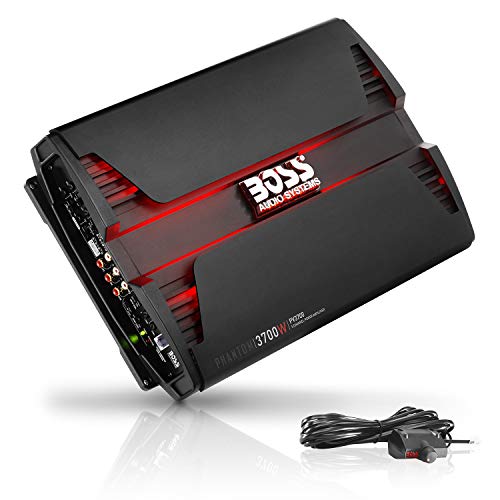 |
BOSS Audio Systems PV3700 3700 High Output 5 Channel CarBOSS Audio Systems | Upgrade pick | 3700W · 5-Channel · BOSS Audio | $171.99
Price as of 16 Oct 2026
|
View |
 |
BOSS Audio Systems P80DVC Dual 4 Ohm 1000 Watt 8 Inch CarBOSS Audio Systems | Budget pick | 8" · 1000W Max · BOSS Audio | $39.99
Price as of 16 Oct 2026
|
View |
 |
Skar Audio SVR-8 D4 8" 800 Watt Max Power Dual 4 Ohm CarSkar Audio | Also great | 8" · 800W Max · Skar Audio | View | |
 |
Alpine X-A90V 4-Channel + Mono Power AmplifierAlpine | Our pick | $799.00
Price as of 30 Oct 2026
|
View |
This quick comparison points you toward the right BOSS Audio part for your cabin size and bass goal. Start with available space and power demand first, then look at source-unit features.
How we chose
The picks below focus on bass-first fit, not peak wattage on paper. We weighed output path, space needs, input flexibility, crossover control, and whether the part fixes a real bottleneck in a daily driver.
We also looked at what each part can and cannot do on its own. A head unit can supply signal and convenience; an amplifier can supply control and power; a subwoofer can move air at low frequencies.
BOSS Audio systems pv3700 3700 high output 5 channel car amplifier: best for powering bass systems
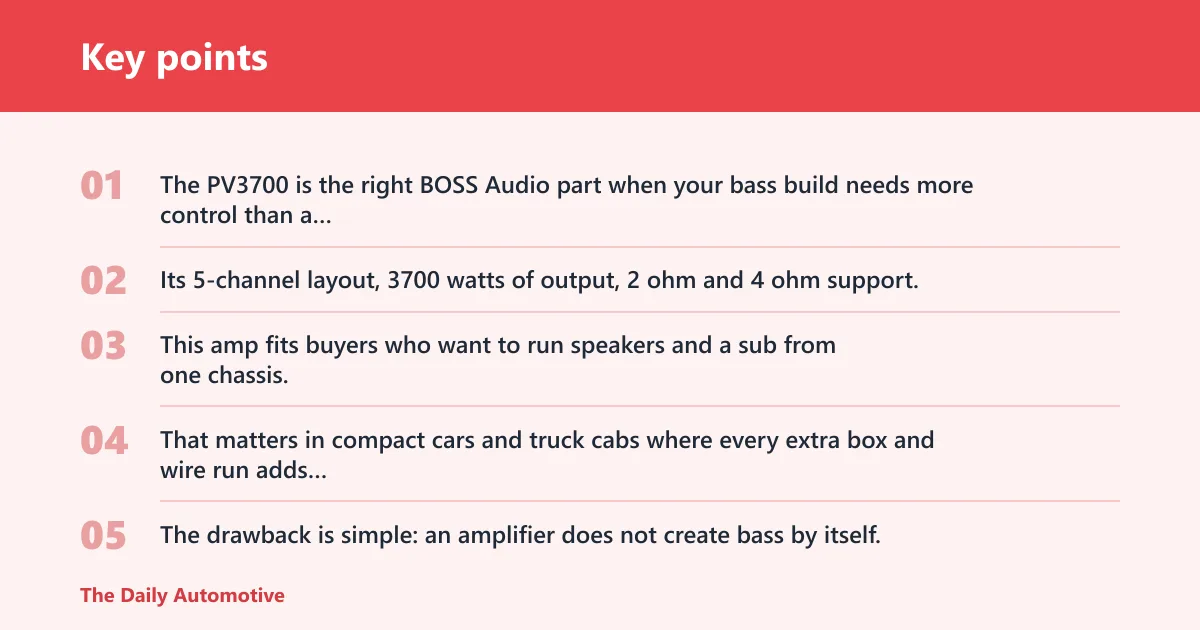
The PV3700 is the right BOSS Audio part when your bass build needs more control than a basic stereo can offer. Its 5-channel layout, 3700 watts of output, 2 ohm and 4 ohm support, low and high level inputs, high/low pass crossover controls, bridgeable design, and full-range capability make it the strongest single piece in this lineup for a bass-focused daily driver.
This amp fits buyers who want to run speakers and a sub from one chassis, or who need bridgeable flexibility for changing plans later. That matters in compact cars and truck cabs where every extra box and wire run adds friction.
The drawback is simple: an amplifier does not create bass by itself. If the sub enclosure is wrong, or if gain is set too high, the result is clipping, hot speakers, and bass that sounds louder than it is clean.
Use this amp when the system already has a subwoofer chosen and the installer wants crossover control, impedance flexibility, and enough channels to keep the front stage active. It makes the most sense when the goal is a complete system, not a head-unit-only swap.
Tuning and wiring notes for the PV3700
Set gain to match the head unit’s clean output, not to chase maximum loudness. Start with the amplifier crossover low-pass for the sub channel and high-pass for full-range speakers so each speaker only plays the band it can handle well.
Bridge only when the load and wiring plan support it. If the impedance drops too low for the setup, bass gets dirty fast, and the amp can shut down or distort before the sub reaches its limit.
BOSS Audio systems 820BRGB car stereo: best for a bass-friendly head unit
The 820BRGB is best for drivers who want a modern source unit with easier everyday control, not a bass fix by itself. It is a double DIN car stereo with Bluetooth connectivity, AM/FM radio, multi-color illumination, a wireless remote control, Aux input, USB port, and no CD/DVD player.
That feature set helps when you want clean signal routing into an amplifier or powered subwoofer and quick source changes from the dash. The double DIN fitment also matters in vehicles that can accept the larger opening without extra adapter drama.
The honest limit is that a head unit does not make deep bass on its own. It can improve convenience, source quality, and signal flexibility, but it cannot replace a dedicated subwoofer or fix a weak enclosure.
If bass is the goal, treat this as the control center. It is useful because it gives you modern media inputs and a straightforward way to feed the rest of the system, not because it adds low-frequency output directly.
Where a double din matters and where it does not
A double DIN stereo can improve dashboard fitment, Bluetooth streaming, and input access. It cannot move enough air to create deep bass without help from an amplifier and subwoofer.
Say your car already has factory speakers but no sub. A new double DIN unit may make music easier to stream, yet the low end still falls off quickly until you add a proper bass driver and tune the crossover.
BOSS Audio systems 800W slim under seat powered car subwoofer kit: best for hidden bass installs
This is the pick for small cabins and space-limited builds that still need real low-frequency support. The 800W output, slim under-seat design, built-in amplifier, compatibility with cars and trucks, high/low-level inputs, and space-saving installation make it the easiest bass upgrade to tuck out of sight.
Powered subs solve a common problem: you want more bass without committing trunk space to a large enclosure and separate amp. In a daily driver, that tradeoff can be the difference between a practical upgrade and a setup that never gets installed.
The drawback is output and enclosure volume. A slim powered sub usually cannot equal a larger sealed or ported box for sheer low-end depth, so it works best as a compact answer rather than a maximum-output answer.
It makes sense when the vehicle is a hatchback with limited cargo room, a sedan where the trunk must stay usable, or a truck cab where under-seat clearance is the main constraint. It is also the simplest way to add bass when you do not want to rebuild the whole system.
Placement and install-risk notes for the under-seat kit
Check seat rails, seat travel, and floor clearance before buying. Heat, loose wiring, and poor ground points can all turn a clean-looking install into a noisy one.
Rattles are common if the enclosure is tight against a thin floor pan or unsecured trim. A powered under-seat sub also needs enough power and signal wiring to avoid turn-on pops and weak output.
BOSS Audio systems p80dvc dual 4 ohm 1000 watt 8 inch car subwoofer: best for a compact passive sub build
This 8-inch passive sub is for buyers who want a compact speaker driver and are willing to build the rest of the bass chain around it. The appeal is simple: it gives you a subwoofer route that can fit smaller boxes while keeping system design flexible.
It can work well in a compact sealed enclosure when paired with the right amplifier and tuned correctly. The drawback is that passive subs demand more planning because you still need an amp, a box, and proper impedance matching.
The dual 4 ohm layout gives wiring options, but it also means the installer must think about final load and amplifier stability. A poorly matched amp or a sloppy box choice will leave you with little more than extra hardware.
Choose this if you want to tune the system yourself and do not mind giving up some simplicity for flexibility. It suits a trunk build better than a stealth under-seat setup.
Enclosure choice matters more than people think
A subwoofer without the right enclosure rarely reaches its potential. Too small, and bass sounds tight but shallow; too large or poorly matched, and it can get loose or muddy.
For a passive sub, enclosure design and amplifier pairing often matter more than the brand label alone. That is why a cheaper driver can beat a pricier one when the box and power match better.
BOSS Audio systems bcpa9 9 inch single din no cd carplay android car stereo: best for source-unit upgrades
This unit fits buyers who want a modern source and phone integration more than a bass-specific deck. Apple CarPlay, Android Auto, a touchscreen interface with voice control, and Bluetooth hands-free calling make it a strong everyday control piece.
For bass builds, the value is in cleaner control and easier access to music apps, not direct low-end output. It can be part of a better signal chain, but it still needs an amplifier and subwoofer to produce deep bass.
The drawback is fitment and system scope. A single DIN chassis with a large screen may need a very specific dash layout, and it still does not replace dedicated bass hardware.
Pick this only when phone integration matters more than traditional AM/FM and simple faceplate controls. If bass is the priority, put more of the budget into the sub and amp first.
Which one should you buy?
If your budget is tight, spend first on the subwoofer path, then on the amplifier, then on the source unit. A better head unit with no sub still leaves the low end weak, while a modest source feeding a matched amp and sub can sound far fuller.
For a small car, the 800W slim under-seat powered sub is usually the smartest first move because it preserves space and gets you bass without a full trunk build. For a truck, the PV3700 makes sense when you want one amp to manage both speakers and sub output with crossover control.
For a trunk-limited sedan, start with the compact powered sub if you need easy fitment. If you can spare cargo space and want deeper extension, the P80DVC with the right enclosure and amp gives more room for tuning.
If the budget allows only one source-unit change, the 820BRGB or BCPA9 should be chosen for usability, not for bass output. If the system already has decent speakers and wiring, the next dollar should usually go to subwoofer placement and amp matching, not more head-unit features.
Best car stereo systems for bass: quick picks
- Best overall bass system path: PV3700 plus a properly sized subwoofer and matched enclosure.
- Best hidden bass: 800W slim under-seat powered subwoofer kit.
- Best source upgrade: 820BRGB for double DIN fitment, Bluetooth, Aux, and USB.
- Best compact passive sub route: P80DVC with an amp sized to the final load.
- Best modern phone-integration head unit: BCPA9 if the dash supports the layout.
Bass build matchup table
| Vehicle type | Space available | Power target by setup | BOSS Audio component to prioritize | Install-risk checklist |
|---|---|---|---|---|
| Small car or coupe | Low trunk room, limited cabin volume | Compact bass with controlled output | 800W slim under-seat powered subwoofer kit | Check seat clearance, ground point quality, and wiring path under trim |
| Sedan with usable trunk | Moderate trunk room | Stronger bass with an external amp | PV3700 plus a passive subwoofer | Verify box size, amp ventilation, and trunk rattle points |
| Truck cab | Cab space is tight; under-seat use matters | Moderate bass without blocking storage | 800W slim under-seat powered subwoofer kit | Measure under-seat depth, seat movement, and power wire protection |
| Trunk-limited daily driver | Space must stay usable | Balanced bass with minimal cargo loss | PV3700 if you want expansion; 800W powered sub for simpler installs | Confirm enclosure shape, amp mounting location, and fuse access |
| Dash upgrade only | No change to cargo space | Signal control, not low-end output | 820BRGB or BCPA9 | Check double DIN or single DIN fitment, harness compatibility, and steering controls if used |
How to choose
Start with vehicle space. If you cannot spare trunk volume, a slim powered sub is usually the cleanest path to audible bass.
Then match output to impedance. The PV3700 supports 2 ohm and 4 ohm setups, which helps when the sub and speaker plan changes later.
Use crossover controls before you chase more gain. A sub low-pass that is too high can make bass sound like midrange; a high-pass set too low on door speakers can make them distort sooner.
Clipping is the failure case that matters most. A loud but dirty signal can make bass seem stronger for a moment, then flatten dynamics and stress the system.
Suppose you want better bass in a sedan with a normal trunk. A powered under-seat unit may fit, but a separate amp and compact sub in a correct enclosure usually go lower and sound fuller if the cargo loss is acceptable.
A common first-timer mistake is buying a flashy head unit and expecting the low end to change. The bass change usually comes from adding the right sub and giving it clean power.
What car stereo system is best for bass?
The best bass system is the one that matches the vehicle and the enclosure, then feeds the sub clean power. For most drivers, that means a head unit for source control, an amplifier for power and crossover control, and a subwoofer chosen around available space.
Do I need a subwoofer for deep bass in my car?
Yes, if deep bass is the goal. Door speakers and a head unit can handle midbass and treble well enough, but the lowest notes need a subwoofer and the enclosure to support it. Without that, the system usually sounds thin.
Which BOSS Audio stereo is best for bass?
The 820BRGB is the best source-unit choice here for bass-focused buyers because it gives you double DIN fitment, Bluetooth, AM/FM, Aux, USB, and a wireless remote. It is still a source unit, though, so its job is control and connectivity rather than low-end output.
How many watts do I need for good bass in a car?
There is no single watt number that guarantees good bass. You need enough clean power for the sub and enclosure, plus stable impedance and proper gain setting. More watts with bad tuning can sound worse than fewer watts with the right box and crossover.
Will a double din stereo improve bass by itself?
No. A double DIN stereo can improve usability, Bluetooth streaming, media inputs, and display features, but it does not create deep bass on its own. Bass comes from the subwoofer, the amplifier, and the enclosure working together.
What is the best under-seat subwoofer for bass in a car?
The 800W slim under-seat powered subwoofer kit is the strongest fit when space is tight. It is made for cars and trucks that cannot spare a large enclosure, but it will not equal a larger box for maximum low-end depth.
What should I check before installing a car stereo amplifier?
Check impedance stability, channel count, crossover controls, bridging options, power wire size, fuse placement, and ventilation. Also verify that your subwoofer and speakers can handle the final load without forcing the amp into clipping or shutdown.
Products related to this article
Sponsored / affiliate links. As an Amazon Associate I earn from qualifying purchases. I may earn additional commission from eligible campaigns.