Best Vent Phone Mounts for Daily Driving (2026): we compared
The best car vent phone mounts for daily driving are clip-on models with a locking hook or screw-tightened clamp, plus a support leg for heavier phones; skip loose spring clips on thin horizontal vents. I have seen bad mounts crack vents, drop phones, and force constant readjustment on every commute. This guide compares vent mounts by vent type, phone weight, and climate so you can pick one that still holds after a week.
This guide is part of our Car terms explained series.
Quick comparison
| Product | Badge | Best for | Price | ||
|---|---|---|---|---|---|
 |
SCOSCHE Industries MAGICMOUNT Select Magnetic Vent PhoneScosche | Budget pick | Magnetic vent mount by Scosche | $15.92
Price as of 29 Sep 2026
|
View |
 |
RAM MOUNTS Quick-Grip XL Phone Holder with B Size 1" BallRAM MOUNTS | Our pick | Quick-Grip XL holder with B ball mount | $28.49
Price as of 29 Sep 2026
|
View |
![[True Military-Grade] Car Phone Holder VANMASS [Upgraded Strongest Suction&Clip] Cell Phone Mount for Dashboard Windshie](https://m.media-amazon.com/images/I/512X87YSVuL._SL500_.jpg) |
[True Military-Grade] Car Phone Holder VANMASS [UpgradedVANMASS | Upgrade pick | Multi-surface mount with enhanced suction | $25.18
Price as of 29 Sep 2026
|
View |
The short version: magnetic mounts are fastest, clamp-style cradles are most forgiving with heavy phones, and vent-hook designs usually hold the best on actual commutes. Fit still decides the outcome. Horizontal, vertical, and round vents behave differently, and a mount that feels fine in the driveway can start rotating once the cabin warms up.
How we chose
We compared the listed mounts on vent fit, hold under braking and cornering, one-hand placement, and phone-size compatibility. We also weighed how much airflow they block, because summer cooling and winter defrost both matter in daily driving.
One more filter mattered: whether the design looks safe for fragile vent blades. A strong mount on a weak vent is still the wrong buy.
For daily use, the goal is not the flashiest design. It is the one that keeps a phone readable, stays put in stop-and-go traffic, and does not punish the vent after a week of commuting.
SCOSCHE MAGICMOUNT Select: best for quick daily placement
This magnetic vent mount fits drivers who want fast one-hand placement and easy removal for short trips, school runs, and urban stop-and-go. Based on the spec sheet and owner feedback, its strength is convenience: drop the phone on, drive, and move on. It makes the most sense for lighter phones or MagSafe-compatible cases with a clean metal plate setup.
The tradeoff is obvious. Magnetic mounts depend on magnet strength, plate placement, and case thickness, so a heavy Pro Max phone can feel less secure during hard braking or fast lane changes. If the vent itself is thin or loose, the magnet is not the weak point; the vent clip is.
Skip it if your phone is large, your case is thick, or you drive rough roads often. It is also a weaker choice for round vents and brittle louvers, where repeated rotation can become the real failure mode.
RAM MOUNTS Quick-Grip XL Phone Holder: best for heavy phones
This clamp-style cradle suits drivers with larger phones, thicker cases, or a heavier setup that keeps toppling lighter mounts. The spring-loaded side supports give it a better chance of controlling center-of-gravity issues during braking and cornering, which is where many vent mounts fail first.
The upside is stability. A jawed cradle gives more physical support than a magnet, and the B-size ball adds adjustment for a better viewing angle. The downside is slower placement, because clamp-style mounts take more hand movement than magnetic ones and can be awkward for quick in-and-out use.
Choose this if you care more about hold than speed. It is less elegant for tiny phones, and the extra hardware can add stress to weak vents, so it is better paired with sturdier horizontal slats or a vent layout that does not wobble when loaded.
VANMASS Car Phone Holder vent kit: best for mixed mounting needs
This is the practical pick for drivers who want vent use as one option, not the only option. The hook-style clip and larger suction base make it more versatile than a pure vent mount, which helps when the car has awkward vents or when the driver decides the vent is simply too fragile for daily weight.
Its strength is flexibility. The upgraded hook clip gives it a better chance on many vent styles, while the multi-surface design gives an escape route if airflow loss or vent blade fragility becomes a problem. That matters for commuters who switch between winter heat, summer cooling, and long navigation sessions.
The drawback is complexity. More mounting options usually mean more parts, more setup time, and more chances to overthink placement. If the goal is the fastest possible vent-only solution, this is not the simplest pick.
Which vent mount works best for fragile vents?
For fragile vents, the safest choice is usually the lightest mount that can still hold the phone without twisting the blades. Horizontal slats often tolerate a hook-style clip better than thin vertical blades, while round vents and soft louvers are the easiest to damage. Heavy mounts and aggressive clamps are poor matches there.
Horizontal slats vs vertical slats
Horizontal slats usually give vent hooks a broader edge to bite into, so the load spreads out better. Vertical slats can work, but they often twist more under braking because the mount hangs in a way that puts torque on the blade rather than along it.
That difference matters after a week of use. A mount that does not wobble on day one may still slowly pry at a vertical blade if the phone is heavy and the road is rough. If the vent flexes when touched by hand, it is already a warning sign.
Round vents and thin blades
Round vents are tricky because they often do not give a flat, secure bite point. Thin blades are worse. They can slip, rotate, or crack when a phone swings outward in a hard turn or when the cabin heats up and the plastic softens.
For those vents, a magnetic mount with a very light phone may be the only tolerable vent option, and even then the vent itself may still be the weak link. If the car uses delicate louvers, a dash or windshield mount is often the better long-term answer.
When to avoid vent hooks
Avoid vent hooks when the blades feel springy, thin, or loose, or when the vent sits low enough that the phone hangs into the shifter area. Also avoid them if the car uses tiny round outlets with little structural support. The mount may “fit” while still being the wrong tool.
That is especially true with large phones and thick cases. The added pull does not just stress the hook; it also magnifies any vent wobble and makes the whole setup feel cheap, even when the mount itself is decent.
Can it survive the first week of commuting?

A mount survives the first week when it holds its position, does not block comfort too much, and still feels secure after repeated stop-and-go use. The useful test is simple: if the phone shifts after braking, the vent rotates, or the mount needs constant correction, it is not keeping its promise.
First-week field test checklist
- Vent fit score: 0 to 5 points. Start with 5 if the clip sits flat and does not twist the blade. Subtract points if the vent rotates, bows, or needs force to install.
- Wobble score: 0 to 5 points. Set at 5 if the phone stays level over speed bumps and rough pavement. Drop points for bounce, sagging, or slow rotation after cornering.
- One-hand use score: 0 to 5 points. Give 5 when the phone can be placed and removed without two hands or a fight with the jaws. Magnetic mounts usually score well here.
- Airflow blockage score: 0 to 5 points. Start at 5 if cabin comfort feels unchanged. Subtract points if the mount blocks cold air in summer, reduces heat in winter, or interferes with defrost flow.
- Brake-turn stability score: 0 to 5 points. Give 5 if the phone stays put under hard braking and sharp turns. Any visible tilt or sliding should lower the score immediately.
Return-or-keep threshold: keep the mount only if it scores at least 20 out of 25 and does not slip during one hard stop plus one hard corner. Return it if it scores below about 20, if the vent blade bends, or if the phone needs re-centering often.
What failure looks like in real driving
Loose clips usually fail by creeping downward. Hook-style mounts usually fail by slowly rotating if the vent blade is too thin. Clamp cradles usually fail by putting too much pull on a weak vent, which can cause bounce or yaw over broken pavement.
The cabin tells the story quickly. If the mount is still tidy after a week, that is a good sign. If the driver keeps touching it at stoplights, it has already failed the daily-driving test.
Which one should you buy?
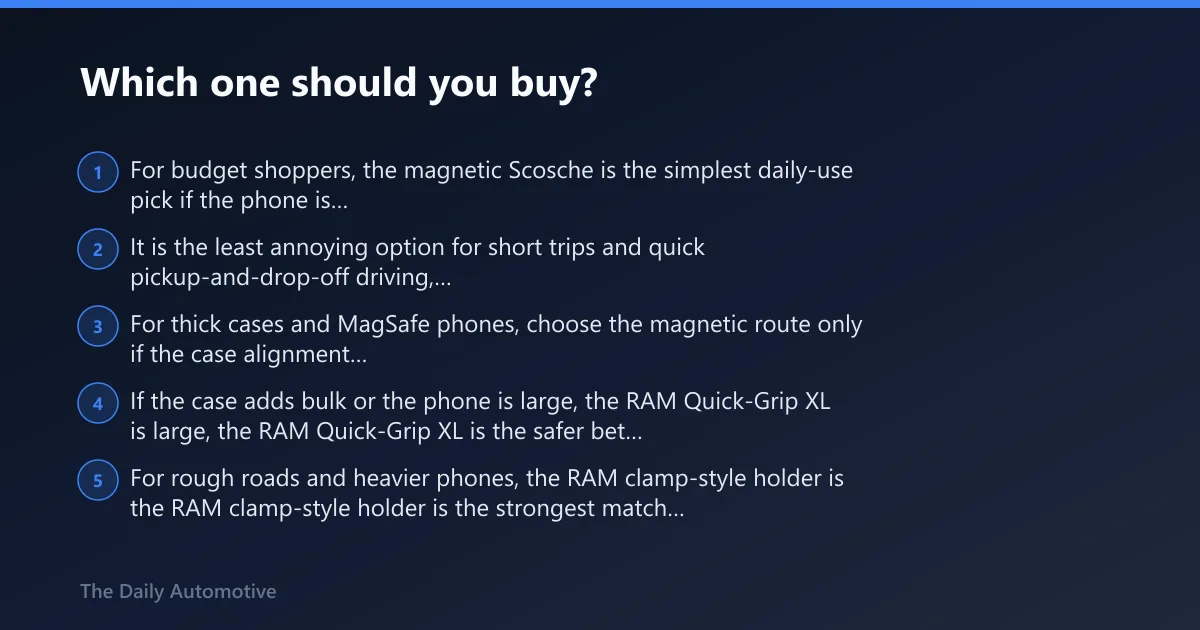
For budget shoppers, the magnetic Scosche is the simplest daily-use pick if the phone is not especially heavy and the vent is sturdy. It is the least annoying option for short trips and quick pickup-and-drop-off driving, where one-hand placement matters more than brute-force holding power.
For thick cases and MagSafe phones, choose the magnetic route only if the case alignment is clean and the phone is not a heavy slab. If the case adds bulk or the phone is large, the RAM Quick-Grip XL is the safer bet because physical jaws tolerate weight better than magnets alone.
For rough roads and heavier phones, the RAM clamp-style holder is the strongest match from this list. It gives more support when braking, cornering, and hitting uneven pavement, though it trades away some convenience.
For hot climates or strong defrost use, the VANMASS multi-surface setup is the practical escape hatch because it gives more mounting flexibility when vent airflow matters. If the center vent feeds the cabin’s cooling or defrost, any vent mount should be used with restraint. Blocking that airflow on a hot commute gets old fast.
Decision rule: if the phone is light, the vent is sturdy, and convenience matters most, go magnetic. If the phone is large or the case is thick, go clamp-style. If the vent is fragile or the climate makes airflow too important, consider avoiding vent mounting altogether and use the more flexible option instead.
Frequently asked questions
What is the best car vent phone mount for daily driving?
The best daily-driver mount is the one that stays stable after a week, not the one with the fanciest marketing. For most drivers that means a clip-on design with a locking hook or clamp, especially if the phone is heavy. Quick placement helps, but hold under braking matters more.
Do vent phone mounts damage air vents?
They can, especially on thin plastic blades, weak louvers, and round vents with little support. Damage risk rises when the phone is heavy or the mount needs hard pressure to stay in place. If the vent flexes by hand, expect more risk over time.
Will a vent phone mount work with my phone case?
Sometimes. Thin cases are usually fine, but thick cases can weaken magnetic hold or make clamp jaws harder to close around the phone. MagSafe-style phones usually behave better with magnetic mounts, while bulky protective cases often fit clamp-style cradles more safely.
Which vent phone mount stays secure on bumpy roads?
Clamp-style cradles usually hold best on rough pavement because they physically support the phone’s weight. Vent-hook designs can also work if the vent is strong and the hook depth matches the blade, but loose spring clips are the first to fail when the road gets ugly.
Are magnetic vent mounts better than clamp-style mounts?
Magnetic mounts are better for speed and one-hand use. Clamp-style mounts are better for heavy phones and thick cases. For daily driving, the right answer depends on weight and vent strength. A magnetic mount can be the easier choice, but it is not always the steadier one.
Do vent mounts block airflow too much?
They can block enough airflow to matter, especially in summer when cooling depends on the center vents and in winter when defrost airflow needs to be clear. Some drivers barely notice it. Others hate it immediately. If comfort drops, the mount is in the wrong spot.
How do I stop my phone mount from slipping out of the vent?
Start by matching the mount to the vent type. Then make sure the clip is fully seated and the blade is not overloaded by a heavy phone. If the mount keeps slipping, the vent is probably too thin, too soft, or too round for that design.
Products related to this article
Sponsored / affiliate links. As an Amazon Associate I earn from qualifying purchases. I may earn additional commission from eligible campaigns.