Chrome Trim vs. Body-Color Trim
Choose chrome trim if you want strong contrast and hard visual edges. Choose body-color trim if you want a quieter, more unified look. Pick the wrong finish, and the car can look mismatched or harder to keep clean. This guide compares appearance, upkeep, resale appeal, and common trim swaps.
Practical considerations for choosing trim
| Criterion | Chrome Trim | Body-Color Trim | Dark Trim | Winner |
|---|---|---|---|---|
| Visual contrast | High contrast; brightwork creates clear edges around the body. | Low contrast; paint-matched panels reduce visual breaks. | Moderate to high contrast, depending on body color and wheel finish. | Chrome Trim |
| Perceived size | Can make a car read busier, especially on compact bodies. | Often makes the body look cleaner and more unified. | Can visually shrink bright details without hiding them fully. | Body-Color Trim |
| Upkeep | Shows water spots and road film quickly on bright surfaces. | Usually blends dirt and mineral marks better. | Hides some grime, but glossy black can show swirls. | Body-Color Trim |
| Repairability | Can be wrapped, refinished, or replaced, but bright parts often need careful matching. | Factory-matched paint can be easier to blend when panels are replaced. | Factory dark parts are cleanest when replaced as OE pieces. | Body-Color Trim |
| Cost to change later | Usually cheaper to darken with vinyl than to repaint or replace parts. | Changing away from body color can mean paint, wrap, or part replacement. | Factory dark parts cost more up front, but they avoid a later delete. | Chrome Trim |
| Compatibility with dark wheels | Can look deliberate, but the contrast is strong. | Works best when the body color is light or mid-tone. | Usually the easiest match for dark wheels. | Dark Trim |
| Lease friendliness | Often easier to return to stock if done with quality vinyl. | Factory finish is safest if the car must go back unchanged. | Factory dark appearance packages are also lease-friendly. | Tie |
| Resale neutrality | Broadly accepted, especially on higher-trim SUVs and luxury cars. | Usually the safest neutral look for mainstream buyers. | Popular, but style-specific on some models. | Body-Color Trim |
Visual contrast
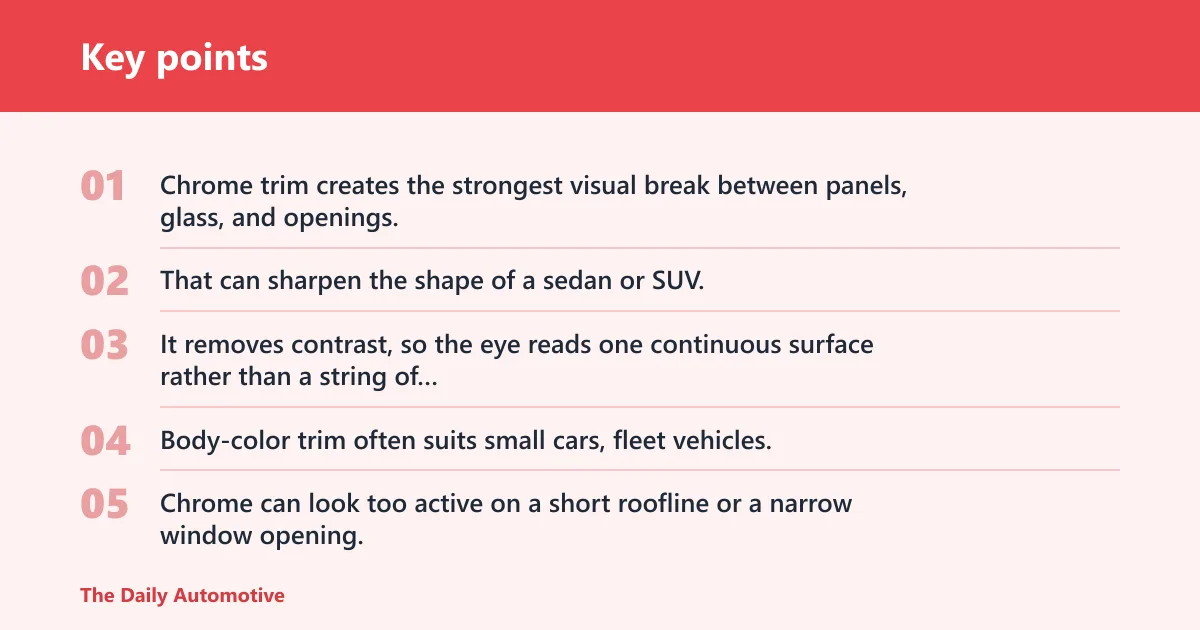
Chrome trim creates the strongest visual break between panels, glass, and openings. That can sharpen the shape of a sedan or SUV, but it can also make a small car feel busier than its sheetmetal deserves.
Body-color trim does the opposite. It removes contrast, so the eye reads one continuous surface rather than a string of separate details.
Perceived size
Body-color trim often suits small cars, fleet vehicles, and body-colored SUVs because it calms the exterior and makes the shape read as one piece. Chrome can look too active on a short roofline or a narrow window opening, especially when the grille, handles, and mirror caps all stay bright.
Dark trim sits between those poles. It keeps some edge definition while removing the strongest flash.
Upkeep
Body-color trim is usually easier to keep looking uniform because dust and water marks disappear into the painted surface. Chrome needs more regular attention if you want it to stay bright, especially on front-end pieces that see road film and winter residue.
Dark trim can hide grime better than chrome, but glossy black can show swirl marks and wash marring. Finish choice matters as much as color.
What chrome trim does to a car’s look
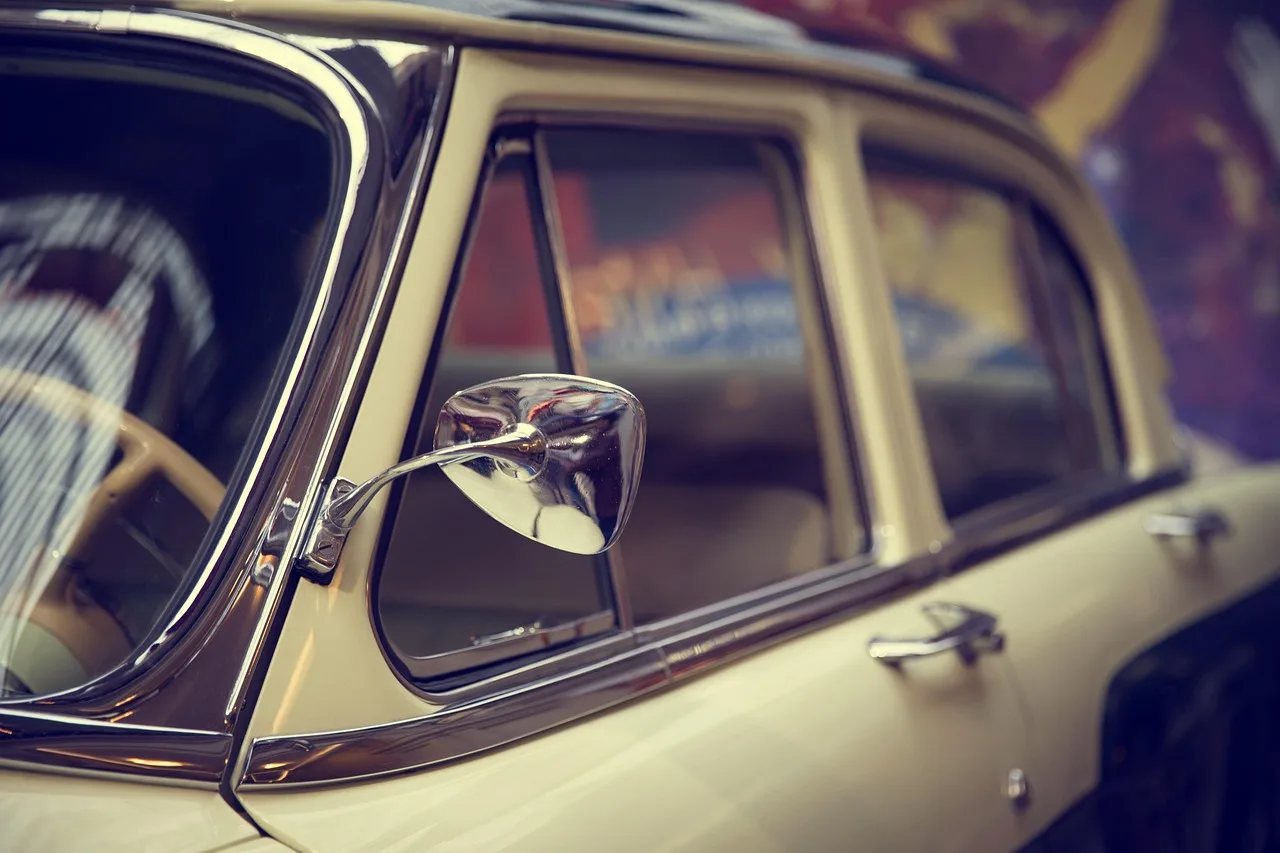
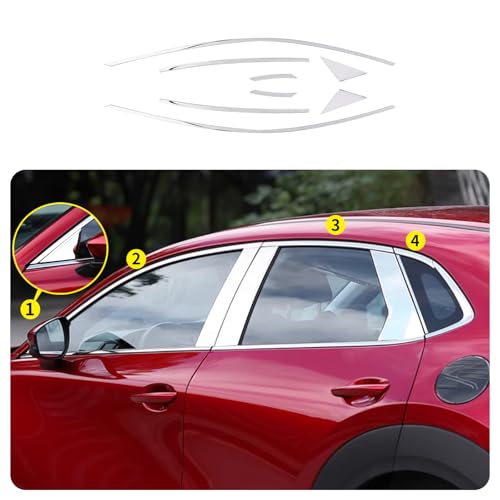
Chrome trim is exterior brightwork on window surrounds, grille surrounds, mirror caps, badges, and door handles. It adds contrast and creates visual breakpoints, which can make body lines stand out more sharply.
Where chrome appears
Most chrome delete jobs start with window trim, grille bars, badges, mirror caps, and sometimes exhaust finishers. Those parts are small individually, but they define how the car reads from ten feet away.
Why chrome can feel busy
Bright trim can help a large SUV look formal and finished. On a compact hatchback or sedan, the same brightwork can break up the body into too many separate shapes.
Daylight versus shade
In daylight, chrome pops hard against paint and glass. In shade, it still draws the eye because reflections hold more visual weight than a painted surround.
Say your sedan has dark wheels, tinted glass, and bright chrome around every window. The car may look visually split into three different themes. A body-color or dark trim treatment pulls those elements into one design language.
What body-color trim changes
Body-color trim is paint-matched exterior trim that creates a monochrome look and reduces visual contrast. It can make a car look cleaner and, on the right body shape, larger and more cohesive.
When it looks cleaner
Body-color trim works well on small cars because it removes the hard visual edge that chrome creates. It also suits fleet vehicles and body-colored SUVs, where a plain, unified appearance often reads as more deliberate than mixed finishes.
When it can look flat
Some vehicles need a bit of contrast to keep their lines from disappearing. If the body color is pale and the trim disappears completely, the car can lose definition around the greenhouse, grille, and lower fascias.
Factory body color versus aftermarket matching
Factory body-color trim usually looks the cleanest because the pieces were designed to match the paint and panel gaps from the start. Aftermarket paint-match work can be close, but the difference often shows up when trim pieces are small, curved, or mounted near weather seals.
How do you black out chrome trim?
The most common method is vinyl wrap film, and chrome delete usually means covering or refinishing every piece of exterior bright trim. Quality cast vinyl is the standard reversible route; paint and powder coat are more permanent, and factory dark replacement parts are the cleanest long-term option.
Vinyl wrap film
Vinyl is the usual answer because it can be applied over trim and removed later. A quality cast vinyl, such as 3M Wrap Film Series 2080, is described as a cast, adhesive-backed wrap film, and that type is preferred over cheaper films for curved trim.
Legacy Graphic Solutions says chrome delete most often uses gloss black, satin black, or matte black vinyl film. Those finishes change the tone more than the method does.
Painted trim
Painted trim is a more permanent finish that needs prep before color goes on. It can look factory when done well, but it can chip on front-end pieces that take constant road impact.
Powder coat
Powder coat is a durable coating best suited to metal pieces. It is a common working default for heavy-duty steel bumpers and can also suit some trim parts, but it is not the easiest route for every exterior piece.
Factory dark trim and replacement parts
A factory dark appearance package is the simplest way to get the look with OE fit. BMW Shadowline exterior trim, for example, includes black high-gloss exterior details on the 3 Series. If your model offers a black appearance package, that is often the cleanest path.
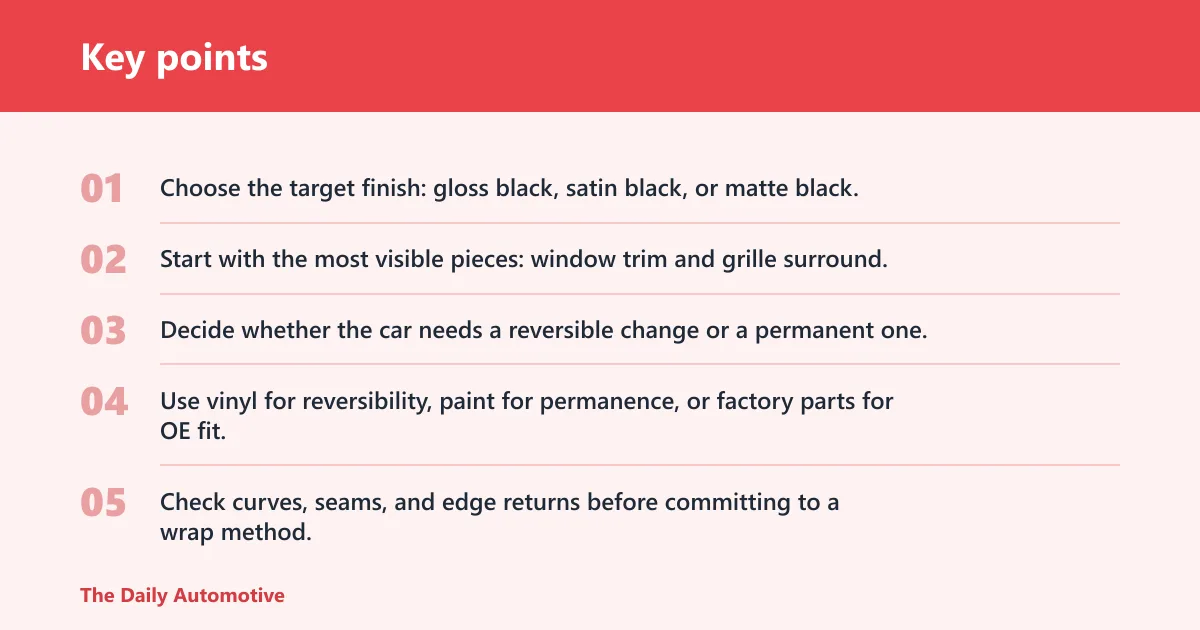
- Choose the target finish: gloss black, satin black, or matte black.
- Start with the most visible pieces: window trim and grille surround.
- Decide whether the car needs a reversible change or a permanent one.
- Use vinyl for reversibility, paint for permanence, or factory parts for OE fit.
- Check curves, seams, and edge returns before committing to a wrap method.
Which trim pieces matter most?
Window trim and beltline molding are often among the highest-impact areas because they run long, sit at eye level, and can be among the fiddlier parts to wrap. Grille slats, mirror caps, and badges matter too, but they usually cost less in labor and change the look faster.
Window trim and beltline molding
This is where labor rises quickly. The parts are long, narrow, and full of corners, so a clean finish depends on careful stretching and edge control.
A common first-timer mistake is to focus on the hood badge and overlook the window surrounds. The result is a half-finished look because the brightest line on the car still stays chrome.
Grille slats and surround
The grille is front and center, so it is one of the highest-visibility blackout targets. A dark grille can change the whole face of the car even if the rest of the trim stays bright.
Mirror caps, badges, and emblems
Mirror caps are small, but they have a big effect because they sit high and catch the eye in profile. Badges and emblems can be wrapped, replaced, or deleted if the owner wants a cleaner nose or tail.
Chrome trim decision matrix
The right choice depends on how much contrast you want, how long you plan to keep the car, and whether the trim should match dark wheels, tint, or a black grille. This table compares the three most common directions.
| Criterion | Chrome Trim | Body-Color Trim | Dark Trim | Recommendation |
|---|---|---|---|---|
| Visual contrast | Strongest contrast. | Least contrast. | Middle ground. | Chrome Trim |
| Perceived size | Can add visual clutter. | Often looks cleaner on smaller bodies. | Calmer than chrome without going full monochrome. | Body-Color Trim |
| Upkeep | More visible grime. | Usually easiest to live with. | Depends on gloss level. | Body-Color Trim |
| Repairability | Good if you can replace the part or wrap it again. | Best when the vehicle already has factory-matched panels. | Best with factory dark parts. | Body-Color Trim |
| Cost to change later | Often the cheapest to black out with wrap film. | Usually costs more to move away from later. | May cost more up front, less later. | Chrome Trim |
| Compatibility with dark wheels | Can look contrast-heavy. | Depends on body color. | Most coordinated. | Dark Trim |
| Lease friendliness | Good if wrapped well and removed cleanly. | Best if left factory stock. | Also strong if factory-installed. | Tie |
| Resale neutrality | Safe on some trims, less neutral on others. | Usually the safest mainstream choice. | Can be popular or polarizing by model. | Body-Color Trim |
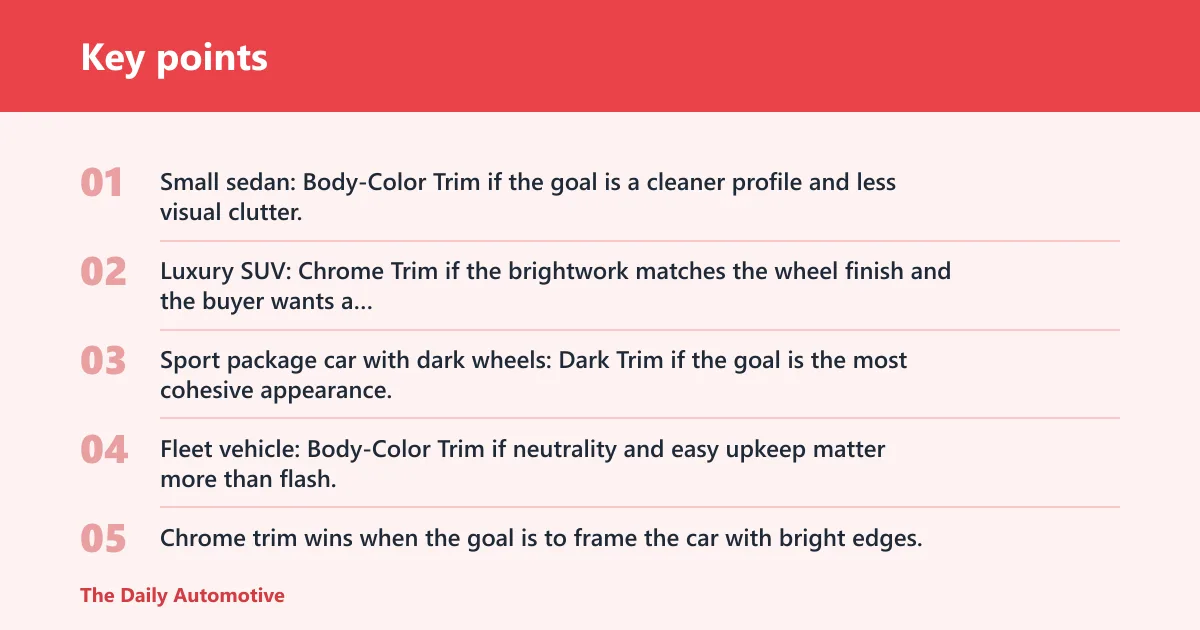
Small sedan: Body-Color Trim if the goal is a cleaner profile and less visual clutter.
Luxury SUV: Chrome Trim if the brightwork matches the wheel finish and the buyer wants a formal look.
Sport package car with dark wheels: Dark Trim if the goal is the most cohesive appearance.
Fleet vehicle: Body-Color Trim if neutrality and easy upkeep matter more than flash.
Visual contrast: chrome trim wins
Chrome trim wins when the goal is to frame the car with bright edges. Body-color trim wins when the goal is to quiet the exterior and reduce the number of visual breaks.
Perceived size: body-color trim usually makes
Body-color trim usually makes a vehicle read as one continuous form, which helps smaller cars and plain fleet bodies. Chrome can exaggerate separate openings and window sections, which is useful on some premium SUVs but awkward on compact shapes.
Upkeep and repairability
Chrome needs more care to keep its shine. Body-color trim is easier to maintain in normal use, and factory-matched panels are usually simpler to live with if a part is replaced later.
Dark trim is often the most forgiving visually, but glossy versions can show swirl marks if wash technique is rough.
Cost to change later
Changing chrome to dark is usually straightforward with vinyl, which is why chrome delete is so common. Starting with body-color trim can be more expensive to reverse if you later decide you want the brightwork back.
A full professional chrome delete on a sedan runs about $500-$900. A full wrap starts near $2,500, so the trim route is a much smaller project than a full-color change.
Choose Chrome Trim if… / Choose Body-Color Trim if…
Choose chrome trim if you want a traditional brightwork look, stronger contrast around the glass and grille, or a finish that still reads upscale on a larger vehicle. Choose body-color trim if you want a quieter exterior, easier visual coordination with wheels and tint, or a cleaner fit on a small car, fleet vehicle, or body-colored SUV.
Choose dark trim if your wheels, grille, and tint are already dark and you want the car to read as one theme from every angle. That is the middle ground when chrome feels too bright and body-color trim feels too plain.

Frequently asked questions
What is chrome trim on a car?
Chrome trim is the exterior brightwork around windows, grilles, mirror caps, badges, and door handles. It adds contrast and can make body lines stand out more clearly. On some vehicles it looks formal and deliberate; on smaller ones it can read as visually busy.
What is body-color trim on a car?
Body-color trim is exterior trim painted to match the car’s body panels. It creates a monochrome look and reduces visual contrast, which often makes the vehicle appear cleaner and more unified. It is especially effective when the factory finish already matches the surrounding panels well.
Is chrome trim better than body-color trim?
Neither is universally better. Chrome trim wins if you want contrast and traditional brightwork, while body-color trim wins if you want a quieter look and easier visual coordination. The better choice depends on vehicle size, wheel color, tint, and whether you want the change to feel subtle or bold.
How do you paint chrome trim black?
Painting chrome trim black requires surface prep, adhesion work, primer suited to the part, and a finish coat. It can look clean, but it is more permanent than vinyl and can chip on front-end pieces exposed to road debris. That makes it a stronger choice for protected trim than for nose pieces.
What trim pieces usually get blacked out?
Window trim, beltline molding, grille slats, grille surrounds, mirror caps, badges, and emblems are the most common blackout targets. Those pieces create the strongest visual change because they sit high on the body or directly at the front of the car. Door handles and exhaust finishers are also common on some models.
Can chrome trim be wrapped instead of painted?
Yes. Vinyl wrap film is the most common way to cover chrome trim, and it is often used for a chrome delete. It is usually the best choice when you want a reversible change, while paint is better when you want a permanent finish and accept the prep and chip risk.
Products related to this article
Sponsored / affiliate links. As an Amazon Associate I earn from qualifying purchases. I may earn additional commission from eligible campaigns.