Best Dash Cams for Legal Parking Protection: we compared
The best dash cam for legal parking protection is the VIOFO A129 Pro Duo, because its buffered parking mode and dual-channel coverage give the best balance of evidence quality, rear protection, and power-control options for curbside risk. For street parking, 24-hour event recording with buffered clips beats constant recording, because it saves the seconds before a hit and avoids filling the card with hours of empty footage. Ignore that and you risk dead batteries, nuisance tickets, tow notices, or privacy complaints. This guide matches dash cam choices to garage, driveway, and curbside risk while flagging the compliance traps that matter.
This guide is part of our Car laws and compliance guide series.
Quick comparison
| Product | Badge | Best for | Price | ||
|---|---|---|---|---|---|
 |
VIOFO A129 Pro Duo 4K Dual Dash Cam 3840 x 2160P Ultra HDVIOFO | Our pick | 4K Dual Dash Cam with GPS | $189.95
Price as of 25 Sep 2026
|
View |
 |
Garmin Dash Cam 67W, 1440p and Extra-Wide 180-degree FOV,Garmin | Also great | 1440p and Extra-Wide 180-degree FOV | $199.95
Price as of 25 Sep 2026
|
View |
 |
Nextbase 622GW Dash Cam with 128GB Micro SD Memory CardNextbase | Upgrade pick | True 4K Dash Cam Bundle | $499.98
Price as of 25 Sep 2026
|
View |
 |
Thinkware OBD II Power Cable, for Select Dash Cams, ParkingTHINKWARE | Pair with it | OBD II Power Cable | $44.99
Price as of 25 Sep 2026
|
View |
This quick view focuses on parking behavior, not spec-sheet talk. The right pick depends on how the camera wakes, how it is powered, and whether your parking spot can live with a hardwire install or a visible camera.
How we chose
The comparison starts with parking-mode behavior: buffered recording, motion and impact trigger quality, and whether low-voltage cutoff is available. Power method comes next, because the safest setup for one vehicle can be the wrong setup for another.
We also weighed heat tolerance, rear coverage, and how much compliance risk a setup creates in the real world. Apartment lots, HOAs, and some cities care about visible cameras, windshield placement, and constant recording more than spec sheets do.
Finally, we looked at failure modes. Weak night clips, false motion alarms, and microSD cards that misbehave in heat are the problems that usually ruin a parking clip when it matters most.
Thinkware U3000: best for hot-weather street parking
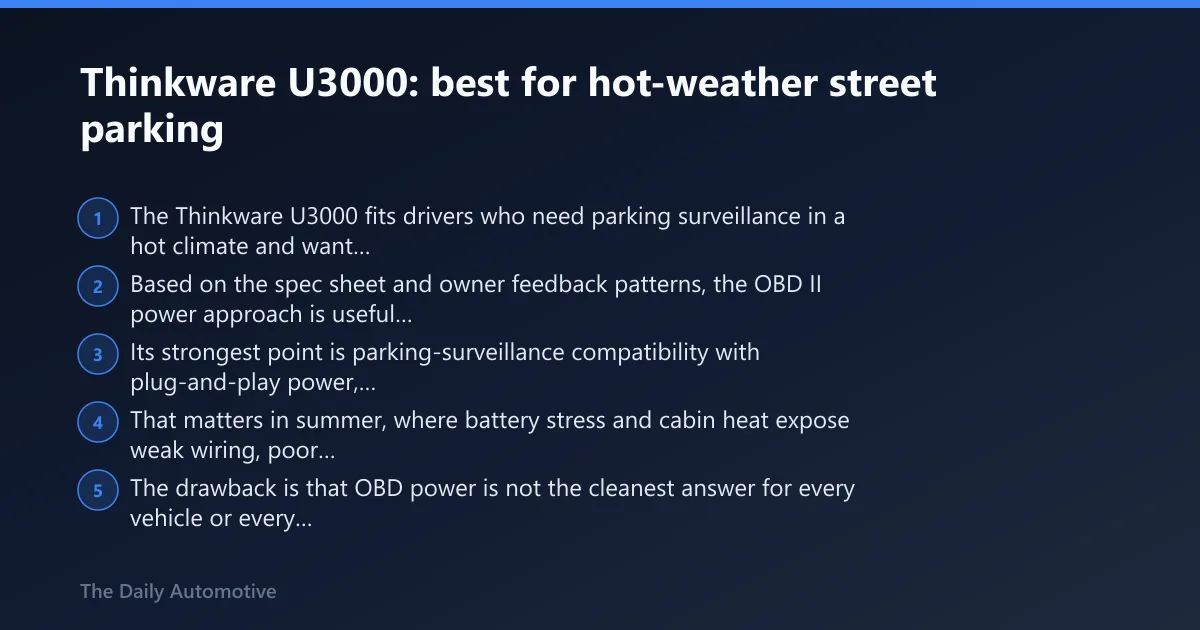
The Thinkware U3000 fits drivers who need parking surveillance in a hot climate and want a cleaner power setup without pulling fuse taps. Based on the spec sheet and owner feedback patterns, the OBD II power approach is useful for vehicles that should not be opened up for a hardwire job, especially when parking enforcement or warranty sensitivity makes a less invasive install attractive.
Its strongest point is parking-surveillance compatibility with plug-and-play power, which cuts installation effort compared with a full fuse-tap hardwire kit. That matters in summer, where battery stress and cabin heat expose weak wiring, poor card endurance, and overheating problems faster than normal driving does.
The drawback is that OBD power is not the cleanest answer for every vehicle or every parking rule set. Some drivers will prefer a fused install with explicit voltage cutoff settings, and OBD access can be a poor fit in cars with crowded diagnostic layouts or strict dealer guidance.
Vantrue N4 Pro: best for front-and-rear coverage
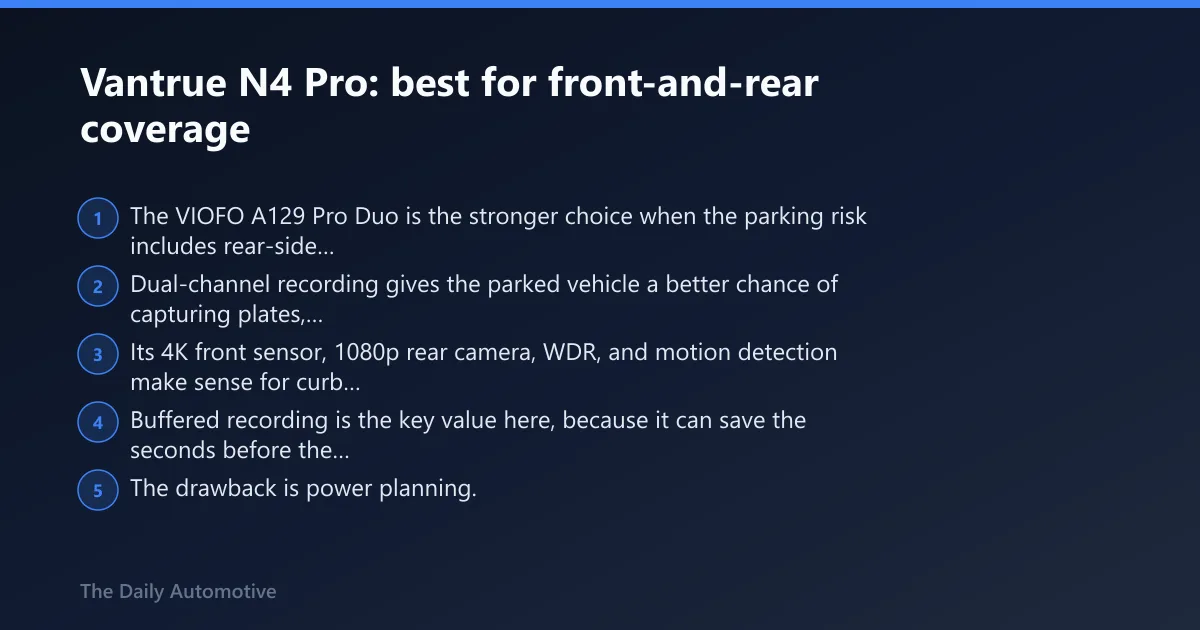
The VIOFO A129 Pro Duo is the stronger choice when the parking risk includes rear-side impact, tailgate damage, or someone backing into the car at night. Dual-channel recording gives the parked vehicle a better chance of capturing plates, body movement, and the direction of impact, especially when buffered parking mode is active.
Its 4K front sensor, 1080p rear camera, WDR, and motion detection make sense for curb parking where lighting is uneven and evidence quality drops fast after sunset. Buffered recording is the key value here, because it can save the seconds before the trigger event instead of only recording after the bump.
The drawback is power planning. Dual-channel parking mode is more demanding than a front-only setup, so this camera is not the best fit for drivers who want the simplest possible install or who park where a hardwire kit is not welcome.
Garmin Dash Cam Mini 3: best for discreet parking protection
The Garmin Dash Cam 67W is the better pick for drivers who want a small camera that is easy to hide from view and less likely to attract attention in apartment lots or on a busy street. Its compact form is a real advantage when visible indicator lights, windshield placement, or privacy concerns matter as much as recording quality.
The extra-wide 180-degree field of view helps capture more of the parking scene, which can be useful when a vandal approaches from the side or a neighboring car clips a mirror. For a discreet setup, the tradeoff is plain: a single front camera cannot give the same rear coverage as a dual-channel system.
The drawback is that wide-angle footage often stretches plates at the edges of the frame, especially at night. That means it is better for context and incident proof than for perfect plate reads from a distance.
Nextbase 622GW: best for high-value garage parking
The Nextbase 622GW bundle suits drivers who want a higher-end front camera and the convenience of a 128GB card included in the box. For garage parking, where the risk is often lower and power access is easier, the 4K front feed and image stabilization can be enough if rear coverage is not a priority.
Its bundled memory card reduces setup friction, and that matters because parking-mode systems are only as reliable as the card they record to. A larger-capacity card can also give loop recording more breathing room before older files are overwritten, which helps when an event is discovered late.
The drawback is cost. It is the least efficient value here if the real goal is legal parking protection, because the price is high for a single-channel approach and the bundle does not solve power or compliance by itself.
Parking-protection decision matrix
This matrix is the practical part. Match the parking spot, power source, and recording mode to the real risk, then check whether your local rules tolerate the install before you buy.
| Parking scenario | Best power source | Best recording mode | Risk level | Battery-drain tolerance | Legal and privacy watch-outs |
|---|---|---|---|---|---|
| Street parking near traffic or vandalism | Hardwire kit with low-voltage cutoff | Buffered parking recording with impact trigger | High | Low | Check windshield placement rules, visible LEDs, and whether constant recording is restricted by local privacy expectations |
| Apartment lot with passersby and tight spaces | Hardwire kit or battery pack, depending on rule set | Motion plus impact detection, light-buffered clips | Medium to high | Medium | Review HOA and lease rules before a visible install; some property managers object to cameras pointed into shared areas |
| Enclosed garage with lower exposure | Hardwire kit or OBD-style power if allowed | Time-lapse or event-triggered recording | Low to medium | Medium | Usually fewer privacy issues, but check building rules and camera placement so the windshield view stays legal |
| Low-risk private driveway | Battery pack or low-drain hardwire setup | Impact-triggered recording only | Low | High | Privacy complaints are less likely, but visible lights and overbroad recording can still bother neighbors |
What parking mode actually does
Parking mode is not one feature. It is a group of behaviors that let the dash cam sleep, wake, and record while the car is off. Motion detection watches for movement, impact or g-sensor mode wakes on a hit, buffered recording saves a few seconds before the trigger, time-lapse compresses long idle periods, and battery-saver settings stop recording before the car battery is abused.
Motion detection is useful, but it is the easiest to misuse. A busy apartment lot can trigger dozens of false events from people walking past, headlights, rain, or tree shadows, which fills cards and burns power faster than many owners expect.
Why buffered parking recording matters
Buffered parking recording is the difference between seeing the hit and seeing only the aftermath. It saves pre-event footage, then keeps recording after impact, which improves the odds of capturing plates, a face, or the direction a car moved away.
For license plate capture, having a pre-event window can matter more than headline resolution. A 4K file with no lead-in is often less useful than a 1440p clip that shows the car entering the frame, the contact, and the getaway path.
Hardwire kit basics
A hardwire kit is the usual way to enable reliable parking mode. The install typically uses a fuse tap, ACC and constant power wiring, and voltage cutoff settings so the camera can stay alive without flattening the 12V battery.
The tradeoff is installation complexity. A clean install takes time, the wrong fuse choice can create problems, and the setup should be checked for parking-mode enablement plus a low-voltage cutoff that matches the vehicle and climate.
When a dash cam battery pack is safer
A dash cam battery pack is an auxiliary power source that can be safer than tapping the vehicle battery if the car sits for long periods or if the owner wants to avoid draining a weak starter battery. The better units can supply recording hours, but they need charge time and must tolerate cabin heat.
Battery packs work best when the vehicle is driven regularly and the pack is mounted where heat is controlled. They are less attractive in very hot interiors, because thermal stress shortens life and can make charging slower or less predictable.
Front-only versus front-and-rear coverage
Front-only cameras are easier to power and hide, but parked-car risk does not always come from the front. Dual-channel recording gives rear coverage while parked, which helps when someone backs into the car, opens a door into it, or walks around the rear to hide a plate.
For street parking and apartment lots, front-and-rear is usually the safer call. For a private driveway or a locked garage, front-only can be enough if the goal is mainly to document entry, exit, and obvious hits.
Low-voltage cutoff and battery protection
Low-voltage cutoff protects the 12V battery by shutting the system down before the car no longer has enough reserve to start. The exact cutoff threshold should be chosen with the vehicle’s battery size, age, and cold-weather behavior in mind.
Cold weather reduces battery reserve, so a threshold that is fine in summer can be too aggressive in winter. This is why a hardwire kit should never be chosen without thinking about battery drain prevention and the way the car behaves after a night outside.
MicroSD card endurance and failure risk
Parking surveillance is hard on memory cards. A high-endurance microSD card with the right capacity, loop recording support, and a temperature rating that fits the cabin is far less likely to corrupt files when the car sits in heat or records many short events.
Cheap cards fail in predictable ways: corrupted files, missed events, and slow write errors that are only discovered after an incident. For parking mode, endurance matters more than raw capacity alone, though both matter when buffered clips and rear video are saved all day.
Parking enforcement and property rules
Legal protection can create legal trouble if the install ignores local rules. Some areas care about windshield placement, reflective or visible indicator lights, and whether a camera records neighboring property or shared walkways.
Apartment and HOA rules are especially important because they can regulate what is visible from the exterior and where electronics may be mounted. A setup that is technically effective can still become a complaint if it points into a neighbor’s window or looks like a permanent surveillance device.
Which one should you buy
Choose the VIOFO A129 Pro Duo if street parking is your main problem and you want the best mix of buffered event capture, rear coverage, and legal flexibility. It is the strongest answer when the risk is a hit-and-run, a scrape, or a nighttime curbside incident that may come from behind.
Choose the Garmin Dash Cam 67W if your parking spot is public-facing but you need a discreet camera that is less likely to draw attention in an apartment lot or near a building manager. It is also the cleaner pick when front-only coverage is acceptable and visible gear is a concern.
Choose the Thinkware OBD II power cable setup if you want parking surveillance with less installation effort and your vehicle, garage, or local rules make fuse-tapping awkward. It is a practical middle path, but only if the vehicle’s OBD access and parking policy make sense together.
Choose the Nextbase 622GW bundle if your car usually sleeps in a garage and you want a higher-end front camera with a card included. It is easiest to justify when front coverage is enough and the budget can absorb a premium bundle without expecting full dual-channel parking surveillance.
Do not choose by resolution alone. A good 4K camera with poor parking behavior is worse than a cleaner dual-channel setup with buffered recording, sane power management, and a card that survives heat.
Frequently asked questions
What dash cam is best for parking mode without draining the battery?
The best choice is a camera with buffered parking mode, a hardwire kit, and a configurable low-voltage cutoff. That combination protects the starter battery while still waking the camera for real events. For many drivers, dual-channel coverage is worth the extra power draw if the parking risk is high.
Is it legal to leave a dash cam recording while parked?
Often yes, but not everywhere and not in every form. Local privacy rules, apartment or HOA policies, windshield placement limits, and visible indicator light concerns can matter as much as the recording itself. A legal setup in one city can be a problem in another.
Do I need a hardwire kit for parking protection?
Usually yes, if you want reliable parking mode that can stay on after the ignition is off. A hardwire kit enables ACC and constant power wiring plus low-voltage cutoff. Battery packs and some OBD power solutions are alternatives, but they fit different vehicles and heat conditions.
What features should a dash cam have for street parking?
Street parking calls for buffered parking recording, motion and impact triggers, rear coverage, low-voltage cutoff, and a high-endurance microSD card. Heat tolerance matters too, because curbside parking often means direct sun. Discreet mounting can reduce complaints and make the camera less obvious to thieves.
Can parking mode record motion and impact events?
Yes. Many parking modes use motion detection, impact detection, or both. Motion is useful but prone to false triggers from pedestrians, weather, and traffic. Impact detection is better for hit-and-run evidence, especially when buffered recording saves the seconds before the contact.
How long can a dash cam record when the car is off?
That depends on power source, camera draw, temperature, and whether the setup is using time-lapse, event-only recording, or constant parking recording. A battery pack can provide hours, while a hardwired camera can run much longer if the cutoff threshold and vehicle battery capacity are set correctly.
Products related to this article
Sponsored / affiliate links. As an Amazon Associate I earn from qualifying purchases. I may earn additional commission from eligible campaigns.