Bicycle Rack for Car: Top Picks for Safe Transport
Choose a hitch rack for the easiest loading and the steadiest ride. Use a roof rack only if your vehicle has roof rails and you can lift the bike overhead. Pick a trunk rack only for light, occasional use. The wrong rack can mark paint, block rear visibility, make the bike unstable, or turn a heavy bike or e-bike into a difficult lift. This guide compares rack types, fit checks, and the best choices for sedans, hatchbacks, SUVs, and rear-access needs.
What bike rack fits your car?
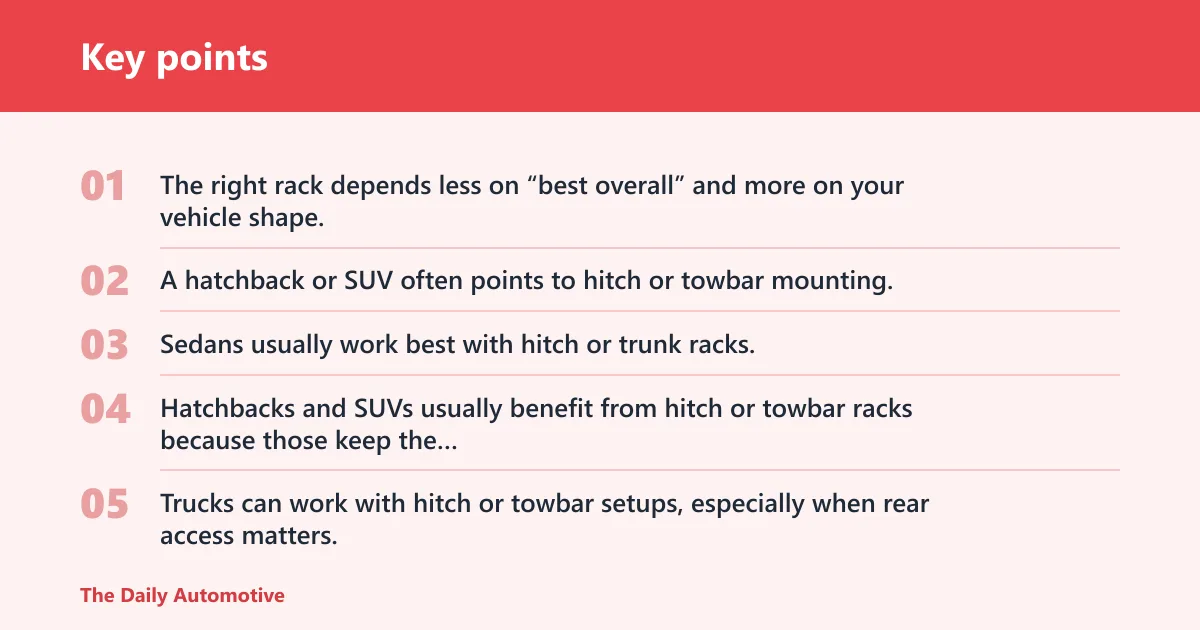


The right rack depends less on “best overall” and more on your vehicle shape, your lift strength, and whether you need rear access after the bikes are loaded. A hatchback or SUV often points to hitch or towbar mounting, while a sedan without a receiver may push you toward a trunk rack or a roof system.
Match rack type to vehicle shape
Sedans usually work best with hitch or trunk racks, but a trunk rack needs careful fit around the deck lid and spoiler. Hatchbacks and SUVs usually benefit from hitch or towbar racks because those keep the bikes lower and leave the roof free. Trucks can work with hitch or towbar setups, especially when rear access matters.
Cycle World Hub notes that a bike rack for hatchback saves space and keeps the interior clean. That matters because hatch owners often want the cargo area open for bags, coolers, or wet gear.
Match rack type to bike weight
Heavier bikes change the decision fast. Carson City Bike Shop says hitch-mounted racks are especially useful for heavier bikes, and that low loading height helps when lifting overhead is a problem. Roof systems can work for lighter bikes, but the higher load position makes them a poor match for many e-bikes and heavy mountain bikes.
Match rack type to rear access needs
If you need to open the hatch after parking, choose a rack with a tilt or fold-down function. That feature can let you reach the rear without unloading the bikes first. If rear access is a daily need, hitch and towbar racks usually make more sense than roof racks, which keep the hatch clear but force overhead loading.
Bike rack decision matrix
Use this matrix as a quick filter. The recommendation score is generally read this way: 5 means a strong fit, 3 means workable with tradeoffs, and 1 means a poor fit. It is meant to compare rack style against real use, not to rank brands.
| Use case | Best rack type | Bike weight | Lift height | Rear access need | Common failure risks | Score |
|---|---|---|---|---|---|---|
| Daily commuting on a hatchback | Towbar or hitch | Light to medium | Low | High | Receiver fit, hatch clearance, light blockage | 5 |
| One light bike on a sedan with roof rails | Roof | Light | High | Low | Overhead lift strain, drag, parking clearance | 3 |
| Weekend use on a sedan or crossover | Trunk | Light | Low | Medium | Spoiler interference, strap slip, paint contact | 3 |
| Two heavy bikes on an SUV | Hitch or towbar | Heavy | Low | Medium to high | Wobble, tongue fit, weight rating mismatch | 5 |
| E-bike transport on a crossover | Hitch or towbar | Heavy | Low | Medium | Overweight platform, ramp gap, light visibility | 5 |
| Occasional light use on a car without a receiver | Trunk | Light | Low | Low | Curved hatch fit, strap wear, spoiler contact | 3 |
| One bike on a tall SUV with roof rails | Roof | Light to medium | High | Low | Overhead lifting, extra drag, garage clearance | 2 |
Weight, lift height, and access factors
Low mounting wins when lift strength is a concern. Hitch and towbar racks put the bike closer to knee or waist height, so loading is easier and the center of gravity stays lower. Roof racks solve trunk access, but they ask for shoulder-height lifting and usually create more aerodynamic drag than hitch systems.
Suppose a rider has an e-bike weighing about 55 pounds and a crossover with a rear hatch. A roof rack makes the lift the hardest part before the trip even starts. A hitch or towbar rack turns the same bike into a simpler load, especially if the rack includes a ramp or tray-style cradle.
Failure risks by rack type
Trunk racks can fit many cars, but fit risk rises on spoilers, curved hatch shapes, and thin sheet-metal deck lids. Roof racks can hit parking barriers and low garage doors. Hitch and towbar racks can block taillights or license plates if the rack lacks lighting or a plate holder.
Are hitch bike racks safer on the highway?
Hitch racks are often the safer highway choice because the bikes sit lower and closer to the vehicle. That lower position cuts sway from crosswinds and makes the load easier to control than a trunk rack. The best setups add anti-wobble hardware and a proper receiver fit, which matter more as the bike count and weight rise.
Why low mounting helps stability
A low center of gravity gives the rack less leverage to swing. KROSS says towbar-mounted racks have a low center of gravity, and that matches the practical benefit drivers want at speed. Carson City Bike Shop also says hitch-mounted racks are especially useful for heavier bikes, which is another reason they tend to feel steadier on the road.
Anti-wobble and receiver fit
An anti-wobble mechanism reduces movement inside the hitch receiver. That matters because even small play can become visible shake on rough pavement or at highway speed. If a rack fits loosely in a 1.25-2in hitch size setup, check the lockup and anti-wobble hardware before every trip, not after the first mile.
A common first-timer mistake is loading two bikes, then driving off with the rack slightly loose in the receiver. The movement may seem minor in the driveway, but it can grow into noise, frame contact, or taillight bounce once the car reaches highway speed.
When tilt and fold features matter
Tilt and fold-down features do two jobs. They let you open the rear hatch without removing the bikes, and they let the rack tuck away when it is not in use. That convenience matters most on SUVs, hatchbacks, and crossovers where the rear door is the main cargo opening.
When a roof rack makes sense
A roof rack makes sense when you want the trunk or hatch completely free and you can lift the bike overhead without strain. It is a logical choice for lighter bikes and for drivers who regularly need rear cargo access. The tradeoff is obvious: more lifting, more wind drag, and more care around height clearance.
Best for keeping trunk space open
Carson City Bike Shop says roof-mounted racks allow bikes to be carried on top of the car. That leaves the rear cargo area open for luggage, tools, or a dog crate. It is useful on road trips where interior space matters more than easy loading.
Lift height and overhead loading limits
The main problem with roof racks is the lift itself. A tall SUV, minivan, or crossover can place the tray too high for comfortable loading, especially with a heavy mountain bike or e-bike. If the bike must be raised above shoulder level, the setup is less forgiving and slower to use.
Drag, clearance, and parking risks
Roof racks affect aerodynamics more than hitch racks, so they are more likely to add wind noise and fuel penalty. They also raise the bike above the vehicle, which increases the risk of garage strikes, tree limb contact, and forgotten clearance at parking decks. If the car is used daily, that matters.
When a trunk rack is worth it
A trunk rack is worth it when the budget is tight, the bikes are light, and the vehicle shape gives the straps a clean place to sit. Carson City Bike Shop calls trunk-mounted racks a more affordable option. That lower cost is why many drivers start there, but fit checks matter more than price.
Low cost and simple installation
Trunk racks usually install faster than hitch or roof systems because they rely on straps rather than a receiver or roof bars. That can make them attractive for occasional use. The tradeoff is that the fit depends heavily on the rear body shape, and strap placement must be checked every time.
Fit risks on spoilers and hatch shapes
Trunk racks can interfere with spoilers, wraparound glass, and curved hatch surfaces. A bad fit can press against paint or slip under load. If the rear panel is steeply sloped, or the vehicle has a large spoiler, the rack may not sit securely enough for highway use.
Strap checks and vehicle protection
Before driving, make sure each strap is tight, even, and routed exactly as the instructions require. Recheck the tension after the first short drive. Use protective pads where the rack touches painted panels, and stop using the rack if the contact points shift or rub.
What matters for e-bikes and heavy bikes?

For e-bikes and heavy mountain bikes, the deciding factor is usually weight rating, not convenience. Many of these bikes are awkward to lift and too heavy for roof loading to be practical. Hitch and towbar racks are usually the better starting point because they sit low and often support heavier loads.
Weight ratings and carry limits
Always check the rack’s rated load before buying. A rack that is fine for a 24-pound road bike may not be suitable for a much heavier e-bike with a battery installed. Weight per bike and total rack load both matter, especially on platform styles that carry multiple bikes.
Contender Bicycles lists RockyMounts GuideRail at $979.99, RockyMounts HighNoon FC at $649.99, and RockyMounts Monorail Bike Rack from $419.99 to $549.99. Price alone does not tell you capacity, but it does show how much range exists inside the category.
Wheel cradles versus hanging styles
Wheel hold and cradle systems secure the bike at the wheels or frame contact points. That cuts bike-to-bike contact, which matters when you are carrying mixed frame shapes or multiple bikes with different tube sizes. Hanging styles can work well for lighter bikes, but they often need a frame adapter for odd-shaped frames or step-through designs.
Frame adapters for awkward frames
Step-through, women’s, and other unusually shaped frames may not hang securely without an adapter bar. That add-on creates a more traditional top tube so the bike sits properly on a hanging rack. If the rack uses trays instead of hanging arms, the adapter is less likely to be needed.
Say your bike is a step-through city bike with a low top tube and a rear rack bag attached. A hanging rack may need a frame adapter to keep the bike level and stop the arms from slipping into a frame gap. A tray rack avoids that specific problem.
How many bikes can you carry?
Practical capacity depends on the rack style, the bike shapes, and the vehicle’s rear clearance. Towbar racks can carry 1, 2, 3, or even 4 bikes according to KROSS. Hitch racks often come in 1- to 4-bike layouts, but the practical limit is usually stability, not the number printed on the box.
Typical 1-bike to 4-bike setups
One-bike racks are simplest for solo riders and are usually the easiest to load. Two-bike racks are the common family choice. Three- and four-bike racks make sense only when the vehicles, bikes, and hitch rating all align, because the outer bikes create more leverage and more sway.
Mixed frame and wheel fit
Wheel cradles help when you carry bikes with different frame shapes, because they reduce bike-to-bike contact and make placement more predictable. If you mix a step-through bike, a kids’ bike, and a mountain bike, tray or cradle systems are usually easier to manage than a pure hanging rack.
Stability tradeoffs as capacity rises
As capacity rises, the rack gets longer, heavier, and more exposed to bounce. That is where anti-wobble hardware matters most. More bikes also increase the chance of handlebar interference, pedal contact, and taillight blockage, so loading order becomes part of the setup.
What’s the easiest bike rack to install?
For pure install speed, trunk racks are often the easiest because they use straps and do not need a receiver or roof bars. For the easiest day-to-day loading, hitch and towbar racks usually win because they sit low and are simpler to manage once installed. The easiest choice depends on whether you mean mounting the rack or loading the bike.
- Check your vehicle first: receiver, roof rails, hatch shape, spoiler, and rear access.
- Match the rack to bike weight, especially if you carry an e-bike or heavy mountain bike.
- Confirm lift height. If overhead lifting is a problem, rule out roof systems.
- Inspect rear access needs. If you need the hatch often, choose a tilt or fold-down rack.
- Verify mounting hardware: receiver size, towbar fit, strap points, and frame adapter needs.
- After loading, check wobble, strap tension, and light visibility before driving.
Frequently asked questions
What is the best bike rack for a car?
For most drivers, a hitch rack is the best all-around choice because it loads low, handles heavier bikes better, and usually feels steadier at speed. Choose a roof rack only if you have roof rails and prefer to keep the rear clear. Choose a trunk rack only for light, occasional use.
Which bike rack is safest for highway travel?
Hitch and towbar racks are usually safest on the highway because they sit low and are less exposed to crosswind movement. Anti-wobble hardware matters here. Roof racks can be secure, but they sit higher and create more drag, while trunk racks are more sensitive to fit and strap tension.
Are hitch bike racks better than roof racks?
For ease of loading and highway stability, yes, hitch racks are usually better. Roof racks are better only when you need the trunk fully open and can manage overhead lifting. They also raise the bike above the car, which increases drag and clearance concerns.
Can I use a bike rack for an e-bike?
Yes, but only if the rack’s weight rating and bike spacing fit the e-bike. A hitch or towbar rack is usually the practical choice because the loading height is lower. Roof racks are often a poor fit for e-bikes because the lift is harder and the bike weight can be too much to manage safely.
How do I keep a bike rack from wobbling?
Start with the correct receiver or towbar fit, then use the rack’s anti-wobble mechanism if it has one. Tighten every connection to the manufacturer’s spec, check for play after loading, and inspect it again after the first few miles. If movement remains, stop and reset the setup.
Will a bike rack fit my sedan, SUV, or hatchback?
Usually yes, but the best rack type changes by body style. Sedans often suit hitch or trunk racks, hatchbacks often favor hitch or towbar racks, and SUVs can use hitch, towbar, or roof systems depending on lift height. Fit always depends on rear clearance, spoiler shape, and mounting hardware.
Products related to this article
Sponsored / affiliate links. As an Amazon Associate I earn from qualifying purchases. I may earn additional commission from eligible campaigns.