Is a Powered Subwoofer Worth It for Car Audio?
A powered subwoofer is worth it if you want stronger bass with less space loss and a simpler install, but it limits future output compared with a separate amp-and-sub setup. Pick the wrong one and you can waste cargo room, add electrical strain, and still end up with thin low end. This guide explains when a powered sub makes sense, where it falls short, and how to judge space, wiring, power draw, and upgrade potential.
Verdict

Based on manufacturer specs, published product details, and buyer feedback, the Cerwin Vega VPAS10V2 fits the middle ground well: a 10-inch low-profile powered sub with a built-in amplifier, high-level and RCA inputs, and remote level control. It makes the most sense for drivers who want real bass lift from a factory or mild aftermarket system without committing to a separate amplifier and enclosure build.
Specs at a glance
| What to check | Why it matters | Typical powered-sub answer |
|---|---|---|
| Driver and amplifier in one box | Reduces component matching work | Self-contained subwoofer and amplifier package |
| RMS power | More useful than peak claims for judging real output | Commonly 120W to 500W RMS |
| Enclosure type | Changes sound character and space needs | Sealed for tighter bass; ported for deeper, louder output |
| Controls | Helps match the sub to factory speakers | Low-pass crossover, phase switch, and sometimes a remote bass knob |
| Fitment style | Determines where the box can live | Trunk/cargo box or slim under-seat unit |
A powered car subwoofer combines the driver, enclosure, and amplifier into one self-contained unit. The built-in amplifier is usually matched to the driver and box, and many car-audio products use Class D amplification because it fits compact housings well and keeps the package efficient.
For model-specific shopping, check the manufacturer’s listing for the exact enclosure type, RMS rating, inputs, and dimensions. A “powered” label alone does not tell you whether the box is sealed or ported, how much cargo room it will take, or whether it includes a remote bass knob.
Who it
A powered subwoofer is best for drivers who want a clear bass step-up without turning the car into a full audio project. It suits a daily commuter with a factory stereo, a lease driver who wants reversible changes, or a small-car owner who needs more low end without losing half the cargo bay.
It is also a sensible fit for someone who listens at moderate volume and wants the kick drum, bass guitar, and synth line to feel fuller. It is less appealing if the goal is trunk-rattling output, competition-level SPL, or a build that will grow into larger subs and more amplifier power later.
Daily commuter with a factory stereo
Factory systems often roll off low bass early. A powered sub can fill in that missing bottom end without replacing door speakers or adding a separate amplifier stack. It is a practical first step when the goal is better balance, not a total system rebuild.
Lease driver or small-car owner
Slim under-seat units help when cargo room matters more than maximum output. In a hatchback, compact sedan, or small pickup, that lower-profile format can be easier to live with than a large trunk box. The tradeoff is simple: less space lost, less bass output gained.
Listener who wants more bass without a full build
If you want stronger low end but do not want to choose an amp, enclosure, and sub separately, a powered unit removes a lot of matching work. That convenience is the appeal. The ceiling is lower than a separate component system, but the path to better bass is much shorter.
What a powered subwoofer changes
A powered subwoofer adds depth and impact that door speakers usually cannot produce on their own. It does not magically make the whole system loud. It mainly restores the lowest octaves so music feels fuller, while the rest of the system handles mids and highs.
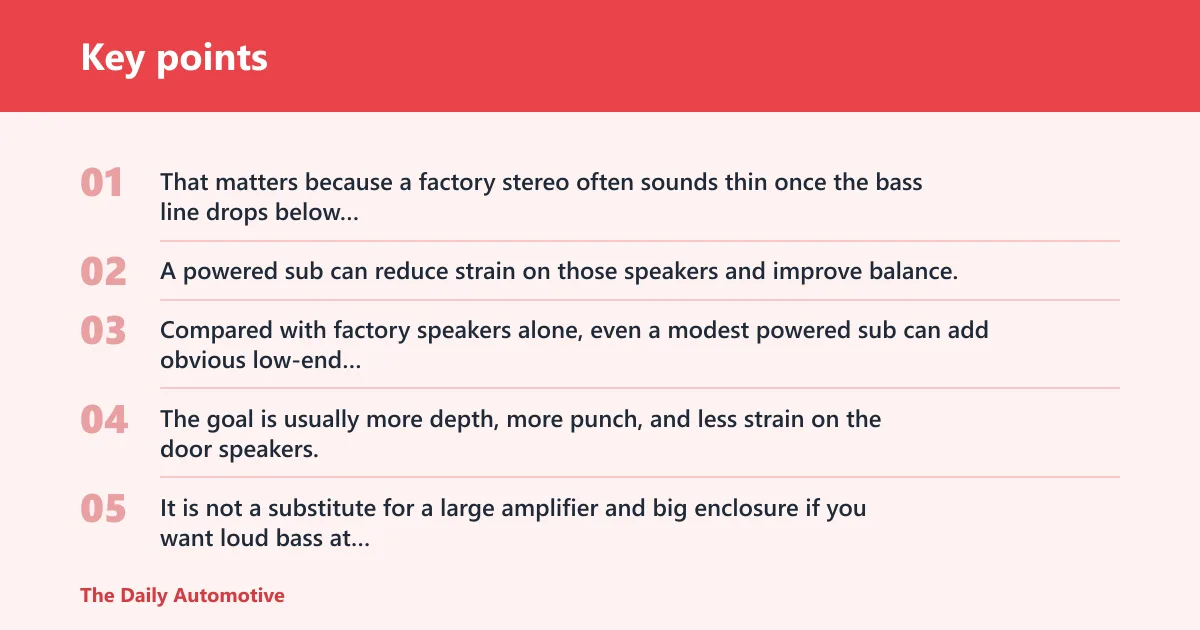
That matters because a factory stereo often sounds thin once the bass line drops below the door speakers’ comfort zone. A powered sub can reduce strain on those speakers and improve balance, but it still needs sensible gain, crossover, and phase setup to blend cleanly.
Bass output versus factory speakers
Compared with factory speakers alone, even a modest powered sub can add obvious low-end weight. The goal is usually more depth, more punch, and less strain on the door speakers. It is not a substitute for a large amplifier and big enclosure if you want loud bass at the limit.
Why RMS power matters more than peak claims
RMS power is the continuous power figure that tells you much more about real output potential than peak numbers do. A powered sub in the 120W to 500W RMS range is common. That span is useful for comparison, because peak power marketing can look impressive while revealing little about sustained performance.
Say your hatchback already has decent door speakers but the bass disappears at highway speed. A powered sub around the middle of the RMS range can restore the low end without turning the cargo area into a speaker cabinet maze. The result is usually better balance, not full concert-level slam.
How tuning features change day-to-day use
A low-pass crossover lets the sub play only the frequencies it should handle, so it blends with the rest of the system instead of overlapping too much. A 0°/180° phase switch can help line up the sub with factory speakers. A remote bass knob lets the driver trim level without reaching for the box.
Those controls matter more than many buyers expect. They are the difference between a sub that sounds integrated and one that booms from the back of the car. On powered units, those controls are common because the box is meant to be a complete, adjustable package.
Powered subwoofer decision matrix
This matrix uses plain score bands so you can match the box to your needs. Higher scores mean stronger bass potential, but they also usually mean more space loss, more install work, and less forgiveness if your vehicle has limited electrical headroom.
| Score band | Bass output | Cargo-space loss | Install difficulty | Tuning flexibility | Upgrade ceiling | Best vehicle type | Recommendation rule |
|---|---|---|---|---|---|---|---|
| 1-2 | Light bass fill | Very low | Lower | Basic | Low | Small car, lease car, truck cab | Choose this if you only want subtle depth and cannot lose space. |
| 3-4 | Clear bass upgrade | Moderate | Moderate | Good | Moderate | Sedan trunk, hatchback, SUV cargo area | Choose this for daily use when you want noticeable bass without a full system build. |
| 5 | Strongest powered-sub tier | Highest | Most involved | Best | Highest for powered units | Larger trunk, SUV, dedicated cargo space | Choose this only if you can spare room and want the most output a powered box usually offers. |
The table is the practical answer to the worth-it question. If your score lands in the low band, a slim unit is mainly a convenience play. In the middle band, powered subs are often the best value. In the top band, you are paying for more output and more box volume, not just easier wiring.
- Decide how much cargo space you can lose without changing how you use the vehicle.
- Check whether your stereo has speaker-level outputs, RCA outputs, or both.
- Compare RMS power, not peak power, across models in the same size class.
- Look for a low-pass crossover, phase switch, and remote bass knob if tuning matters to you.
- Match the enclosure to your goals: sealed for tighter bass, ported for louder output.
- Confirm power, ground, signal, and fuse requirements before you buy.
What does not work well?
Powered subs are a poor fit for heavy SPL goals, very small electrical systems, and build plans that need a lot of future headroom. They are also the wrong choice if you expect a tiny box to act like a large trunk enclosure with a separate amplifier and a bigger driver.
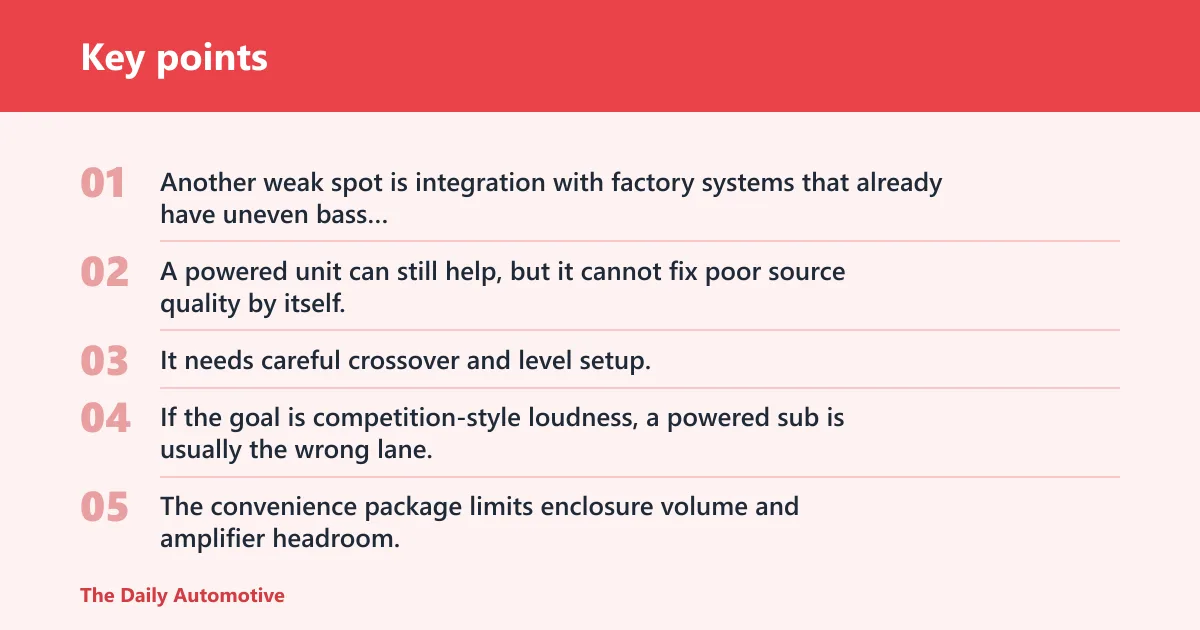
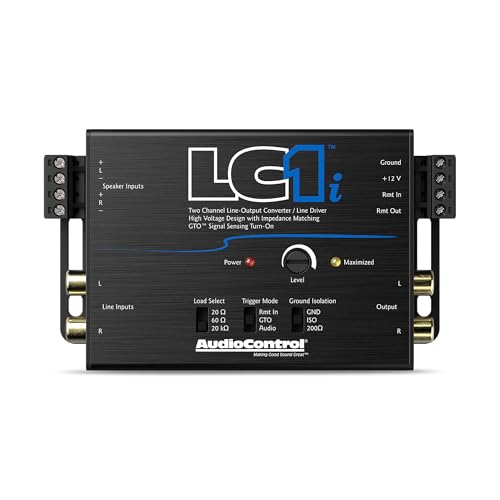
Another weak spot is integration with factory systems that already have uneven bass tuning or noisy signals. A powered unit can still help, but it cannot fix poor source quality by itself. It needs careful crossover and level setup, and sometimes a line-level converter or the right high-level input path.
Heavy bass and SPL goals
If the goal is competition-style loudness, a powered sub is usually the wrong lane. The convenience package limits enclosure volume and amplifier headroom. A separate sub and amp make more sense when maximum output matters more than easy installation.
Very small electrical systems
Even a modest powered sub adds load. That load is manageable in many vehicles, but it can be a problem in cars with weak charging systems or already stressed electrical accessories. If the system has little reserve capacity, the safest move is to check the manual and confirm the vehicle can support the added draw.
When a passive sub plus amp makes more sense
Choose a passive sub and separate amplifier when you want more tuning control, a higher upgrade ceiling, or a better path to louder bass later. That setup costs more time and space, but it gives you more flexibility if you plan to move beyond an entry-level bass upgrade.
Suppose a sedan owner wants deep bass now but already knows a larger amplifier and dual-sub setup may come later. A powered box can look cheaper at the register, yet the lower upgrade ceiling can make it more expensive in the long run if it gets replaced soon.
Should you buy one?
Yes, if you want a straightforward bass upgrade for a sedan trunk, SUV cargo area, hatchback, or truck cab and you care more about convenience than maximum output. No, if your real goal is very loud bass, a long-term upgrade path, or the biggest possible performance per cubic foot of cargo space.
For vehicle fitment, sedan trunks usually suit larger powered boxes, SUVs and hatchbacks can tolerate more cargo-area volume, and trucks often favor under-seat or behind-seat layouts. Slim under-seat subwoofers are the best match when space is tight, but they usually cap output sooner than a trunk box.
For budget and listening goal, the right choice depends on how much bass you want to add and how much space you are willing to lose. A powered sub is worth it when the answer is “some bass, little hassle.” It is less worth it when the answer is “as much bass as possible, no compromises.”
One short rule works well: if you want cleaner low-end fill for daily listening, buy one; if you want the loudest bass your car can support, keep shopping for a separate amp-and-sub setup.
Alternatives

The Kicker 11HS8 is a compact hideaway option for very tight installs. Based on the product details, its 8-inch size and 150 Watt RMS rating point it toward small-space upgrades where under-seat or tucked-away mounting matters more than big output. The honest drawback is the same one most compact units face: less bass authority than a larger trunk box.
The Cerwin Vega VPAS10V2 is a stronger all-around fit if you want a little more body than a tiny hideaway unit offers. Its built-in amplifier, high-level and RCA inputs, and remote level control make integration easier, but the larger footprint means you give up more cargo room than with an ultra-slim model.
What the product data suggests
The Cerwin Vega VPAS10V2 uses a 10-inch low-profile layout with about 300 watts of amplifier power, so it can fit a useful middle ground for a powered sub. It also includes a 0°/180° phase switch, which helps with alignment in real cars where factory speaker placement can make bass seem late or thin.
The Kicker 11HS8 is the more compact choice. Its appeal is clear for trucks and small cabins, where a bigger box becomes a problem fast. The tradeoff is that smaller hideaway designs usually deliver less output than a larger sealed or ported trunk enclosure.
Frequently asked questions
Is a powered subwoofer worth it for car audio?
Yes, if you want a clear bass upgrade without building a full system. A powered sub is usually worth it for daily listening, factory stereo improvement, and space-conscious installs. It is less worth it if you want competition-level output or a long upgrade runway.
What does a powered subwoofer do in a car?
It adds low-frequency output that small factory speakers usually cannot produce well. That means more bass depth, more impact on kick drums and synth lines, and less strain on the rest of the system. It does not replace the need for proper crossover and level adjustment.
Are powered subwoofers good for factory stereos?
Yes, because factory stereos often benefit the most from added low end. Many powered units accept high-level inputs, and some also take RCA signals. The main limit is tuning: you still need the low-pass crossover and phase setting to blend the bass cleanly.
How much bass can a powered subwoofer add?
Enough to change the sound of the system, but not enough to match a large separate sub setup. In practical terms, a powered unit can fill in missing low end and add punch. Larger boxes and higher RMS ratings usually add more output, but they also take more space.
What is the difference between a powered subwoofer and a passive subwoofer?
A powered subwoofer includes the driver, enclosure, and amplifier in one package. A passive subwoofer needs an external amplifier. The powered version is simpler to install and easier to match, while the passive route offers more flexibility, more tuning control, and a higher upgrade ceiling.
Can I install a powered subwoofer myself?
Often, yes, if you are comfortable with power, ground, and signal wiring. It is simpler than wiring a separate amp and sub, but it is not truly plug-and-play. Follow the vehicle and product manual, and use the proper fuse and grounding points for the installation.
Products related to this article
Sponsored / affiliate links. As an Amazon Associate I earn from qualifying purchases. I may earn additional commission from eligible campaigns.