Deep Cycle vs Starter Car Battery
Use a starter battery for engine cranking and a deep-cycle battery for long accessory loads. If your car has to do both, pick the battery that matches the heavier duty cycle, or add a separate auxiliary battery. Choose the wrong type, and you shorten battery life, weaken starts, and drain accessories early. This guide compares both types, explains which one fails fastest in each use case, and shows how to avoid pairing a car with power-hungry add-ons.
| Decision factor | Deep Cycle | Starter Car Battery | Winner |
|---|---|---|---|
| Primary job | Long, sustained accessory power | Short, high-current engine starts | Tie |
| Power delivery style | Steady output over time | Quick, hearty jolt of electricity | Tie |
| Best label to check first | Ah | CCA | Tie |
| Repeated deep discharge tolerance | Built for repeated discharge and recharge | Poor fit for repeated deep discharge | Deep Cycle |
| Modern car electronics compatibility | May confuse battery management systems if the car expects a starting battery | Usually the safer match for a stock charging setup | Starter Car Battery |
| Accessory-heavy use | Better for sustained loads | Can fail early if cycled hard | Deep Cycle |
How they fail under the wrong use
These batteries fail in different ways because they are built for different jobs. A starter battery gives a fast burst for cranking. A deep-cycle battery feeds loads longer and handles repeated discharge and recharge.
What each battery is built to do
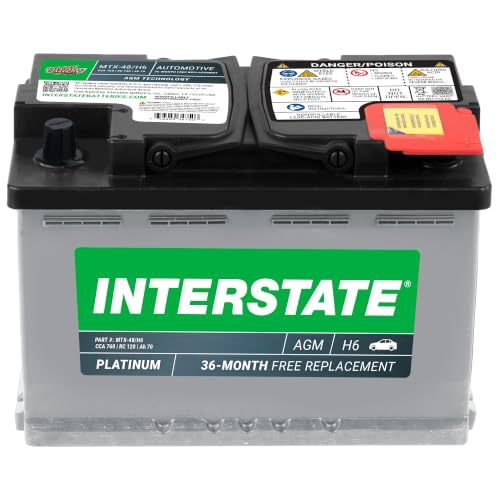
Starter batteries use thin plates and high cold cranking amps, which helps the engine turn over fast. Deep-cycle batteries are measured in amp-hours, and that rating matters more when the load stays on for a long time, such as lights, fridges, or audio gear.
Suppose a sedan spends most of its life making 10-minute trips and then sitting overnight. A starter battery fits that pattern. If the same sedan powers a large inverter at camp for several hours, the starter battery becomes the weak link first.
Where each one fails fastest
The fastest failure point for a starter battery is repeated deep discharge. The fastest failure point for a deep-cycle battery in a normal car is poor starting margin or bad charging behavior if the vehicle expects a high-CCA starting battery and a specific charging profile.
A common first-timer mistake is buying the biggest-looking battery and ignoring the use case. The label can look strong, yet the wrong chemistry or rating still leaves you with a car that starts poorly or accessories that die early.
Which spec matters first?
Start with CCA if the main job is engine cranking, and start with amp-hours if the main job is accessory runtime. Reserve capacity matters when you want a rough sense of how long the battery can support loads, but the first label to check depends on whether the battery must start the car or support equipment after shutdown.
CCA for starting
CCA is a starting-performance metric. It is commonly measured at 0 degrees Fahrenheit for 30 seconds, with a minimum 7.2 volts holding requirement, so it gives a practical sense of how well the battery can keep voltage up during a cold start.
That makes CCA the first number to compare on a starter battery. A car with a weak starter battery may crank slowly, click, or fail to start in cold weather even if the battery still has some charge left.
Ah for accessory loads
Ah, or amp-hours, is the better label for deep-cycle use because it reflects capacity over time. If you want to run accessories without the engine on, Ah matters more than a high CCA number.
This is why a deep-cycle battery can look unimpressive on a starting label but still be the right choice for a trolling motor, RV appliance bank, or overland fridge. The battery is built to deliver steady energy, not a brief burst.
Reserve capacity and fitment checks
Reserve capacity can help when you want a battery that stays useful after charging trouble or parasitic load, but it does not replace checking the physical size, terminal layout, and vehicle fitment. A battery that does not fit the tray or cable layout is the wrong battery, even if the ratings look good.
For modern vehicles, also check battery management system compatibility before you buy. The wrong battery type may trigger fault codes or odd charging behavior because the car may expect a specific battery profile.
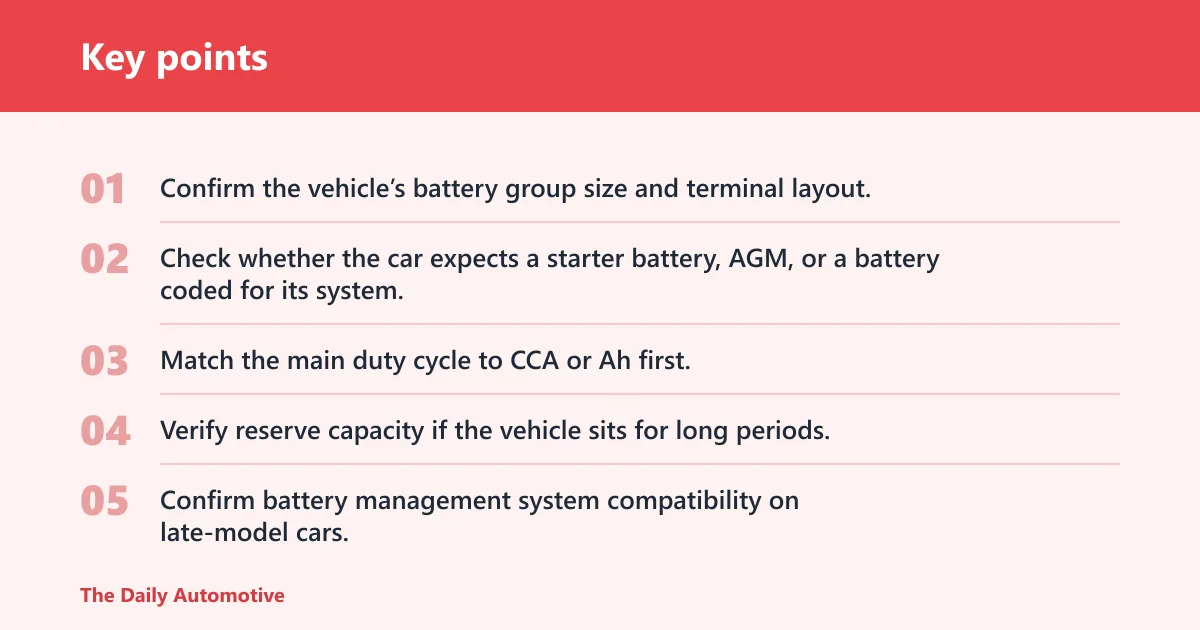
- Confirm the vehicle’s battery group size and terminal layout.
- Check whether the car expects a starter battery, AGM, or a battery coded for its system.
- Match the main duty cycle to CCA or Ah first.
- Verify reserve capacity if the vehicle sits for long periods.
- Confirm battery management system compatibility on late-model cars.
Battery decision matrix
This matrix separates six common use cases from the battery type that fits them best. The first spec to verify changes with the job, because the wrong battery usually fails first where the load is heaviest.
| Vehicle/use case | Battery type to prefer | Why | Red-flag mismatch | First spec to verify |
|---|---|---|---|---|
| Daily driver | Starter Car Battery | Frequent starts and short bursts of current are the main job. | Deep-cycle battery in a car that expects high starting current | CCA |
| Short-trip commuter | Starter Car Battery | Repeated starts and limited recharge time favor a starting battery with strong cranking output. | Deep-cycle battery that cannot keep up with crank demand or vehicle charging logic | CCA |
| Stereo-heavy car | Deep Cycle | Accessory loads after shutdown are the stress point. | Starter battery that is cycled down by audio loads | Ah |
| Seasonal stored vehicle | Starter Car Battery | If it still must start cleanly after storage, starting output matters most; add maintenance charging if needed. | Any battery left to sit unmaintained for long periods | Reserve capacity |
| Marine or RV auxiliary system | Deep Cycle | Long-duration loads are the point of the system. | Starter battery used for house loads and repeated discharge | Ah |
| Emergency jump-start backup | Starter Car Battery | You want a quick burst of cranking help, not long runtime. | Deep-cycle battery that is too weak on starting output | CCA |
How does a wrong match fail?
A wrong battery match usually fails in the first place the vehicle asks too much of it. That can mean weak cranking, early capacity loss, charging faults, or accessory shutdowns long before the battery should be done.
Deep cycle battery in a modern car
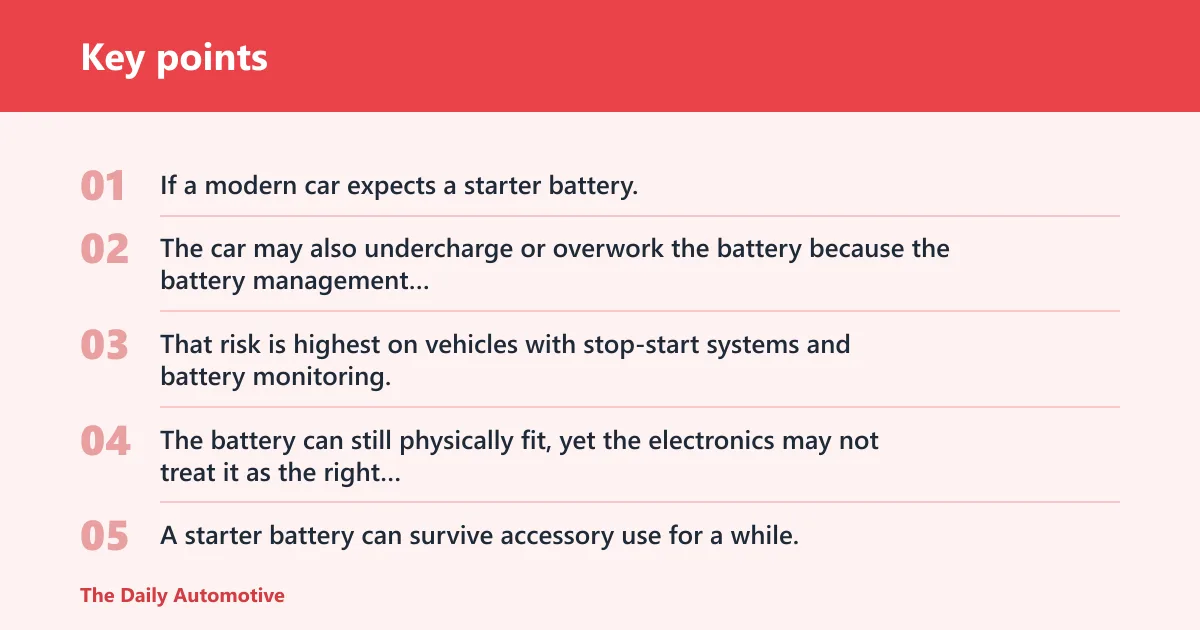
If a modern car expects a starter battery, a deep-cycle battery may upset the charging strategy or trigger fault codes. The car may also undercharge or overwork the battery because the battery management system is reacting to a type it did not expect.
That risk is highest on vehicles with stop-start systems and battery monitoring. The battery can still physically fit, yet the electronics may not treat it as the right match.
Starter battery on repeated accessory loads
A starter battery can survive accessory use for a while, but repeated deep discharge is where it loses life quickly. Thin plates and starting-focused construction are not meant for sustained discharge cycles.
That is why audio systems, camping loads, and parked-in-place electronics can drain a starter battery into early failure. The car may still start one day and then fall short the next.
Battery management system warning signs
Warning signs can include charging warnings, fault codes, stop-start disablement, or a battery that never seems to charge or behave normally after replacement. If those show up after a battery swap, the battery type and the vehicle’s battery management system need a second look.
Do not assume the battery is the only issue. Follow the vehicle and product manual, and if the battery is part of a controlled charging setup, check that the installed type is approved for that system.
Choose Deep Cycle if… / Choose Starter Car Battery if…
Choose Deep Cycle if the battery spends most of its time supporting accessories, not cranking. Choose Starter Car Battery if the vehicle’s main job is starting the engine cleanly and staying compatible with the factory charging system.
Choose deep cycle if…
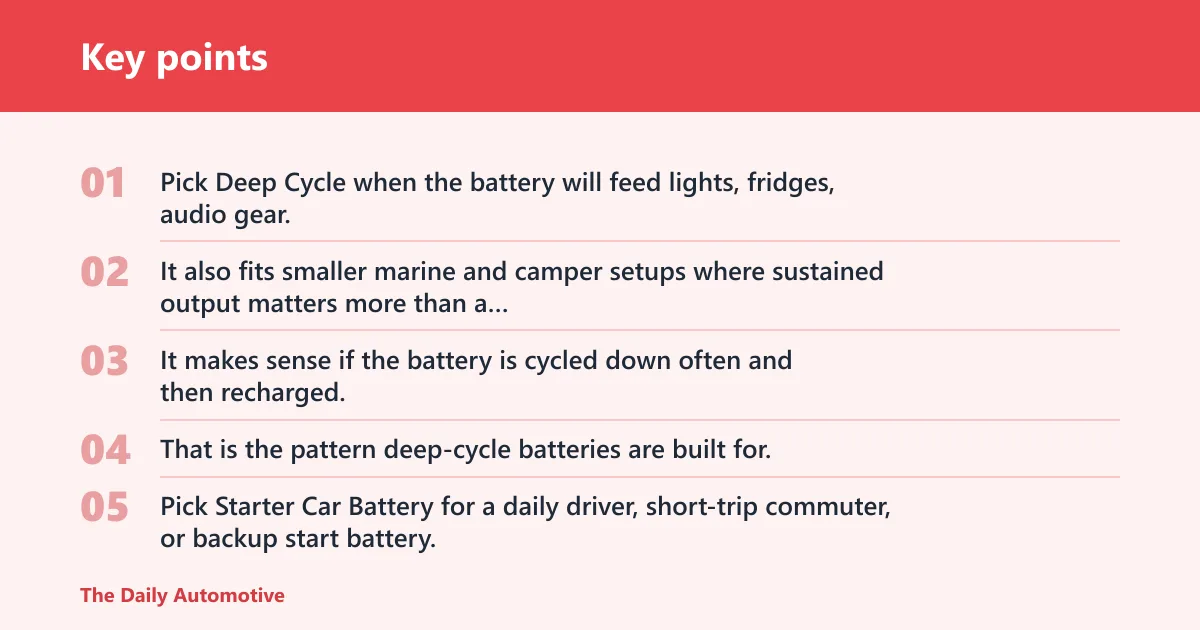
Pick Deep Cycle when the battery will feed lights, fridges, audio gear, or other loads for long periods. It also fits smaller marine and camper setups where sustained output matters more than a huge starting burst.
It makes sense if the battery is cycled down often and then recharged. That is the pattern deep-cycle batteries are built for.
Choose Starter Car battery if…
Pick Starter Car Battery for a daily driver, short-trip commuter, or backup start battery. It is the better fit when high CCA and quick cranking are the main requirements.
It also belongs in cars with modern battery management systems unless the vehicle manual says otherwise. That is the safer choice when the electronics expect a standard starting battery profile.
When a dual-purpose battery makes sense
A dual-purpose battery is the middle ground. It is mainly used in smaller marine and camper applications where space is tight and one battery has to handle both starting and light accessory use.
It is a compromise, not a full substitute for separate starter and house batteries. If the loads are heavy or the starts are hard, separate batteries usually fit the job better.
When to check for AGM or LiFePO4 instead
Check for AGM if you want a low-maintenance lead-acid option and the vehicle or marine setup calls for it. AGM is common in marine and dual-purpose use, and it is heavier than lithium equivalents.
Check for LiFePO4 if you want a smaller and lighter deep-cycle option and the system supports it. LiFePO4 batteries include a built-in battery management system that protects against short-circuiting, overheating, overcharging, and over-discharging.

Can you use a dual-purpose battery?
Yes, when the vehicle or boat needs a single battery that can start the engine and support moderate accessory use. A dual-purpose battery sits between starting and deep-cycle performance, so it is useful when space is limited and the electrical demand is mixed.
Why it is a compromise
Dual-purpose batteries do both jobs acceptably, but they do neither as well as a dedicated battery type. If starting output matters most, a starter battery is usually better. If long accessory runtime matters most, a deep-cycle battery is usually better.
Where it beats a pure starter battery
It beats a pure starter battery when the vehicle idles accessories more often than a normal car but still needs one battery for everything. That is common in smaller marine and camper applications.
It can be a practical answer when the owner wants less complexity than a two-battery setup. The tradeoff is that you give up some performance at both ends.
Where it still falls short
It falls short when the car uses a battery monitoring system that expects a precise match or when accessory loads are large enough to drain the battery repeatedly. In those cases, the compromise can become the weak point.
If the battery must survive heavy cycling, deep-cycle remains the better fit. If the car must start cleanly in cold weather, a starter battery remains the safer match.
Frequently asked questions
Deep cycle battery vs starting battery
A starting battery is built for short, high-current bursts, while a deep-cycle battery is built for longer discharge and recharge cycles. If the main task is engine cranking, use the starter type. If the main task is accessory power after shutdown, deep-cycle is the better fit.
Deep cycle vs starting battery
The practical difference is how each battery handles load. Starter batteries deliver a quick jolt and should not be deeply discharged often. Deep-cycle batteries can be repeatedly discharged and recharged, which makes them better for auxiliary loads, but they are not the first choice for pure starting duty.
Deep cycle battery vs car battery
“Car battery” usually means a starter battery in a passenger vehicle. That type is meant for cranking, not long accessory loads. A deep-cycle battery is the better choice only when the vehicle’s electrical demand after shutdown is the main job, or when the battery supports a house or auxiliary bank.
Marine starting battery vs deep cycle battery
A marine starting battery is aimed at engine cranking on boats, while a deep-cycle battery is aimed at sustained loads such as trolling motors and cabin electronics. If you need both, a dual-purpose battery can work in smaller marine setups, but it is still a compromise.
Starter vs battery problem
If a car cranks slowly or clicks, the problem may be the battery, the starter, the cables, or the charging system. Start with the battery rating and condition, but also check cable connections and follow the vehicle manual for diagnostic steps before replacing parts.
Products related to this article
Sponsored / affiliate links. As an Amazon Associate I earn from qualifying purchases. I may earn additional commission from eligible campaigns.