Are DSP Car Audio Upgrades Worth It?
DSP car audio upgrades are worth it when you need cabin correction or factory integration; if the real problem is weak speakers or rattles, spend elsewhere first. Ignore that split, and you can pay for tuning that cannot fix bad hardware or a noisy cabin. This guide explains when DSP helps, when it does not, and what to upgrade first.
Verdict

The AudioControl DM-810 fits the use case where the system already has decent hardware, but the sound still needs frequency response shaping, time alignment, phase correction, and cleaner integration with factory or aftermarket gear. That is the job a digital signal processor is built for. It is less attractive if you still need basic speaker quality, enclosure work, or sound deadening.
Specs at a glance
| Item | Details from the listing | Why it matters |
|---|---|---|
| Product type | 8-channel car audio processor | Fits systems that need multi-channel control and factory integration |
| Main tuning features | AccuBass, 30-band equalizer, RTA support | Helps with bass recovery and detailed adjustment |
| Control method | DM Smart app | Lets you make tuning changes without constant hardware access |
| System compatibility | Works with factory and aftermarket systems | Useful when you want to keep OEM features or add later upgrades |
| Integration support | Summing support | Helps when the factory signal is split across multiple channels |
| Price | $699.00 | Places it in the “buy for a specific problem” category |
Who it
A DSP is for drivers who want the system to sound more coherent, not just louder. It makes the most sense when the cabin, factory processing, or speaker placement creates uneven sound that basic tone controls cannot fix. It also helps when you want to keep OEM functions working and avoid cutting into the vehicle wiring.
That includes factory head unit setups with low clean power output, hidden equalization, and steering wheel control compatibility concerns. It also includes premium factory amp systems where the signal is already processed, but the tuning is wrong for the cabin. An aftermarket head unit can still benefit if staging, bass control, or integration remain weak.
Say your sedan keeps the backup camera, parking sensors, and steering wheel controls, but the front stage sounds flat and vocals pull to the left. A DSP can help correct timing, phase, and balance without forcing a full redesign. Suppose your hatchback has a rattly door and weak midbass; a DSP alone will not solve that.
What a car audio DSP actually does
A car audio DSP is a digital signal processor that shapes the audio signal before it reaches the speakers or amplifier. In practical terms, it adjusts frequency response, applies time delays, makes phase corrections, and manages input and output channels so the signal matches the car and the rest of the system.
Modern factory audio often needs that extra layer because the OEM system may already apply EQ, filters, and digital interface tricks that are not obvious from the dash. A DSP can sit between factory components and aftermarket upgrades, and that installation can be reversible if the wiring harness and interface parts are chosen correctly.
What works
A DSP works best when the hardware is sound but the system needs tuning. It can improve clarity by flattening peaks and dips, tighten bass by aligning the subwoofer with the front speakers, and improve staging by delaying channels so sound arrives more together at the listening position. That is why it is often the right first step in a well-built system.
It also helps factory integration. A vehicle-specific interface module can retain the backup camera, parking sensors, factory chimes, and, on some vehicles, climate or trip data. A proper no-wire-cutting install keeps the OEM system intact and reduces the chance of error-prone communication faults.
Decision matrix
| System type | Clarity | Bass control | Staging | Install complexity | Tuning time | Estimated value | Best next move |
|---|---|---|---|---|---|---|---|
| Factory radio | Often limited by OEM EQ and low clean power output | Usually weak until signal correction is added | Often uneven because the factory signal is processed for the cabin | Medium to high, depending on vehicle-specific interface needs | High, because factory processing may need summing and correction | High if you want to keep OEM features and fix the factory sound | Buy DSP first |
| Factory premium amp | Can improve if the signal path is being over-corrected by OEM tuning | Moderate, especially if bass is being held back by the factory tune | Often good enough to refine rather than rebuild | Medium, because integration details still matter | Medium to high, because the signal may already be processed | High when the speakers are decent but the tune is wrong | Buy DSP first or sound deadening first, depending on noise |
| Aftermarket head unit | Usually better source quality, but still dependent on tuning | Good if the amp and sub are matched correctly | Improves when time alignment and crossover points are set well | Low to medium, depending on wiring and channel layout | Medium, because the source is cleaner but still needs setup | Moderate if the main problem is system balance, not source quality | Buy speakers first if they are weak; buy DSP first if the system is already strong |
This matrix is the easiest way to judge value. If the sound problem is caused by cabin correction or integration, DSP earns its keep. If the problem is rattles, road noise, worn speakers, or a poor enclosure, spend on those first.
How to tune a car audio DSP
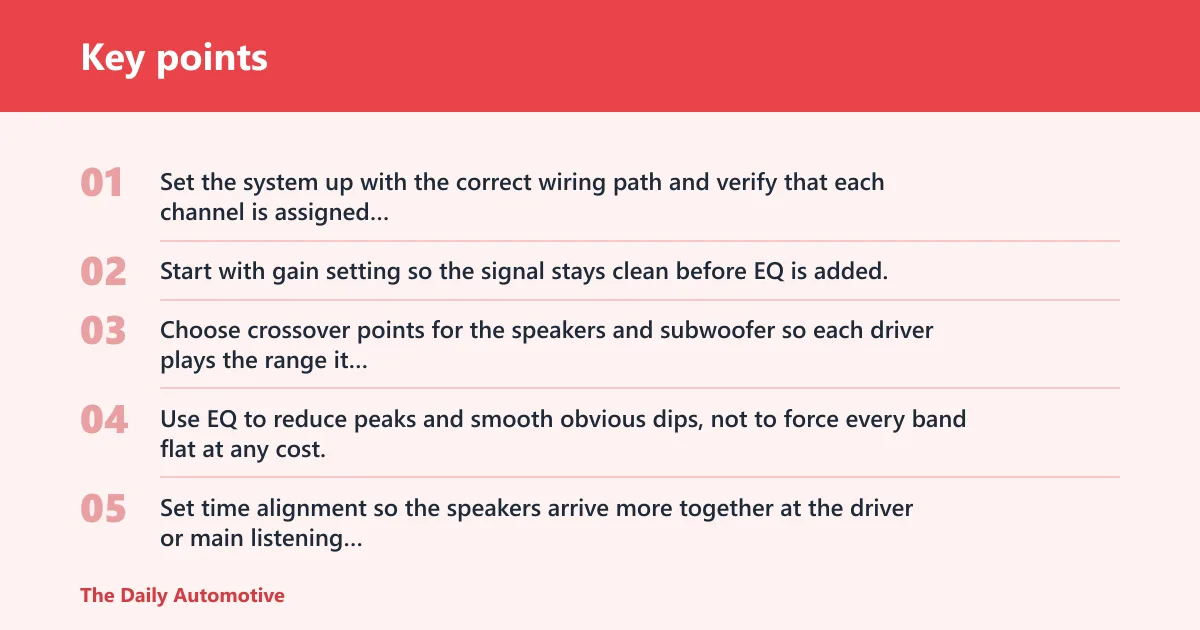
- Set the system up with the correct wiring path and verify that each channel is assigned correctly.
- Start with gain setting so the signal stays clean before EQ is added.
- Choose crossover points for the speakers and subwoofer so each driver plays the range it can handle well.
- Use EQ to reduce peaks and smooth obvious dips, not to force every band flat at any cost.
- Set time alignment so the speakers arrive more together at the driver or main listening position.
- Check phase between the subwoofer and midbass drivers, then adjust if bass sounds thin or disconnected.
- Revisit the tune after listening at normal road speed, since cabin noise changes what you hear.
Tuning time matters because even a good DSP will not sound right with rushed settings. A properly tuned DSP adjusts every frequency for the car’s acoustics, but that takes time, attention, and the right signal path. Good parts installed badly will still sound bad.
Scenario examples
Picture a compact SUV with a factory head unit, no subwoofer, and the steering wheel controls still working. If the front speakers sound bright but hollow, a DSP can help by correcting the factory EQ and setting proper time alignment. The same vehicle with rattling door cards still needs damping first.
A common first-timer mistake is buying a DSP for a sedan with tired coaxial speakers and a noisy trunk lid. The processor can shape the signal, but it cannot make damaged speakers clean or silence loose trim. In that case, speaker replacement and sound deadening come before tuning.
What does not?
A DSP does not fix broken hardware. Weak speakers, damaged cones, poor enclosures, and loose interior panels still sound bad after correction. It also does not erase road noise, so a car with a high noise floor may need sound deadening before the benefits of tuning become obvious.
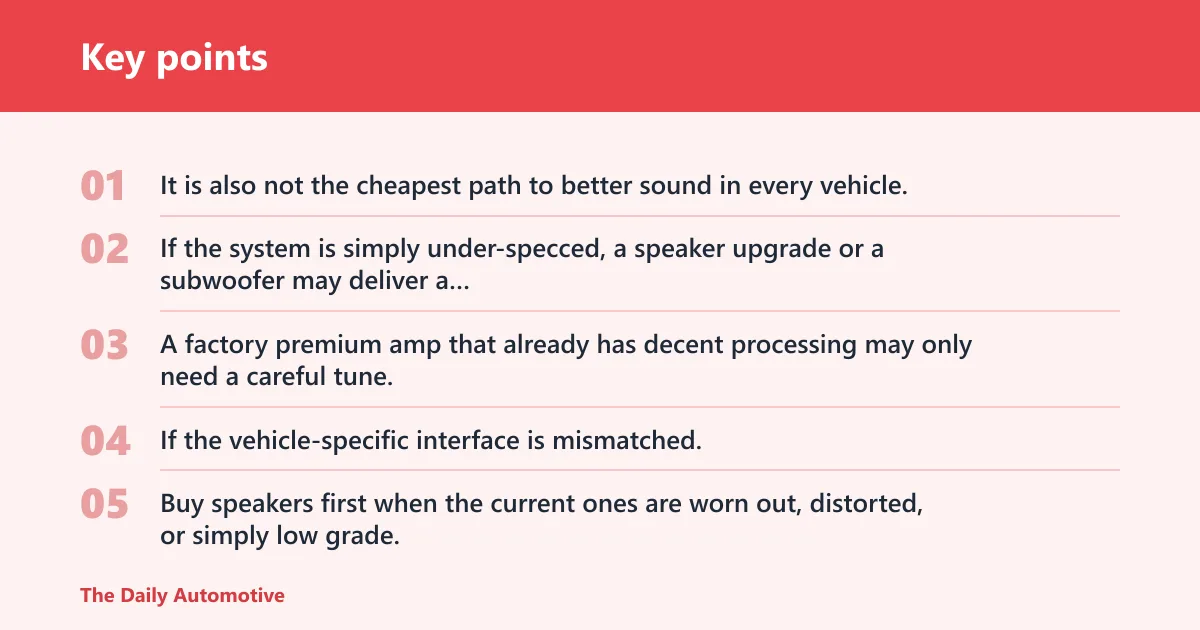
It is also not the cheapest path to better sound in every vehicle. If the system is simply under-specced, a speaker upgrade or a subwoofer may deliver a clearer improvement for the money. A factory premium amp that already has decent processing may only need a careful tune, not a full processor swap.
The wrong install can erase the gain. If the vehicle-specific interface is mismatched, the steering wheel controls may stop working, OEM chimes may be lost, or the factory signal may not communicate cleanly. Follow the vehicle and product manual.
When speakers, subwoofer, or sound deadening should come first
Buy speakers first when the current ones are worn out, distorted, or simply low grade. Coaxial speakers can be the easiest drop-in fitment, while component speakers usually give better imaging when installed and aimed correctly. A DSP can help either type, but it should not be used as a repair for bad drivers.
Buy a subwoofer first when the system lacks real low-frequency reproduction. A sealed enclosure usually takes less trunk space and can sound tighter, while a ported enclosure can trade more space for more output in the low end. If the bass problem is missing extension, a DSP cannot create physical output that the system does not have.
Buy sound deadening first when road noise, door panel vibration, or rattles dominate the cabin. That can lower the noise floor, improve bass perception, and make the rest of the system easier to tune. Without that step, a DSP may only make the same noise more carefully shaped.
Alternatives
If you are choosing between a processor, an amp, speakers, or damping, spend where the system is actually failing. The right order depends on the source, the speakers, the enclosure, and the cabin.

The Dayton Audio AXIS-8 is the more flexible choice if you want DSP plus guided setup for home and car audio in one unit. Based on the listing details, it adds automatic bass correction and Bluetooth streaming, which may help if the system needs easier configuration. The drawback is that its mixed home-and-car focus may not be the cleanest fit for a vehicle-only build.
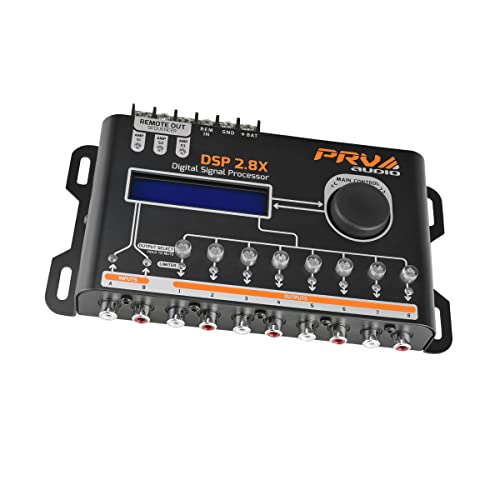
The PRV AUDIO 2.8X is the budget-minded pick for someone who wants an 8-channel DSP with digital crossover control and real-time adjustment. Its LCD interface, presets, and equalization control make it practical for a simpler build, but the lower price usually means less polish in setup support and integration comfort than higher-end options. Check the manufacturer’s listing for your model-specific fit.
Do I need a DSP if I already have good speakers?
You may still need one if the cabin is the problem. Good speakers alone can sound weak when gains, enclosures, crossover points, or tuning are wrong. A DSP becomes useful when the speakers are capable but the car is masking that capability with bad timing, phase issues, or factory EQ.
If the system already has clean power and the speakers fit the doors well, a DSP can be the next step for staging and tonal balance. If the system is already flat, clear, and balanced at normal listening volume, the money may be better spent elsewhere.
Should you buy it?
Buy a DSP first when the car already has decent speakers, the system needs cabin correction, and factory integration matters. That is the best use case for time alignment, phase correction, EQ, and channel management. Buy speakers first when the drivers themselves are weak. Buy sound deadening first when noise and rattles are the main complaint.
For a factory radio, a DSP is often worth it. For a factory premium amp, it is worth it when the processing is the problem. For an aftermarket head unit, it is worth it when you still need better staging, bass control, or integration. The key is to fix the real bottleneck, not the one that is easiest to buy.
Frequently asked questions
Are DSP car audio upgrades worth it?
Yes, when the sound problem is cabin correction or integration. A DSP can help shape frequency response, align arrival time, and correct phase so the system sounds more coherent. It is less worthwhile if the real issue is weak speakers, rattles, bad enclosures, or road noise that has not been addressed.
Dsp vs amplifier for car
An amplifier adds clean power output. A DSP changes how the signal is shaped before amplification. If the system is underpowered, an amp helps first. If the system is already loud enough but uneven, bright, or poorly staged, a DSP is the better fit. Many builds need both, in the right order.
How to tune a car audio dsp: start with gains, then set
Start with gains, then set crossovers, then apply EQ, time alignment, and phase checks. That order keeps you from fixing the wrong problem with the wrong tool. Tuning takes time because cabin acoustics, speaker placement, and factory processing all affect the result. Rushed tuning usually sounds worse, not better.
Will a DSP fix factory car audio?
It can fix some of the factory system’s weaknesses, especially hidden EQ, poor staging, and signal processing that fights the cabin. It will not fix damaged speakers, bad mounts, or a noisy interior. On modern vehicles, it is often part of a smarter factory integration plan rather than a magic cure.
Can a DSP improve bass without replacing everything?
Yes, if the bass problem is mainly tuning or integration. A DSP can recover lost low end, balance the sub with the front stage, and improve phase match. It cannot create real bass extension if the system lacks subwoofer output, and it cannot make a poor enclosure perform like a good one.
Is a DSP amp better than a separate amplifier?
A DSP amp is better when you want amplification and processing in one package, especially in a compact or factory-integrated build. A separate amplifier is better when you want more flexibility in choosing power, channels, or later expansion. The right choice depends on whether packaging simplicity or upgrade path matters more.
Products related to this article
Sponsored / affiliate links. As an Amazon Associate I earn from qualifying purchases. I may earn additional commission from eligible campaigns.