2 Bike Rack for Car: Best Options and How to Choose
For most drivers, the best 2-bike car rack is a hitch-mounted rack that matches your receiver size, clears your bike weights, and still lets you reach the cargo area. For frequent rear access, choose a tilt-away or swing-away design. Pick the wrong style, and you can block the hatch, overload the rack, or damage frames and wheels. This guide shows how to match rack type to car, hitch size, bike weight, and rear-access needs before you buy.
Best 2 bike rack for a car


For first-time buyers, the safest starting point is a hitch-mounted tray rack that fits your receiver and your heaviest bike. Wirecutter researched about 225 bike racks and tested more than 75, and its top two-bike pick is the Küat Sherpa 2.0 because it is lightweight, lets you access the vehicle even when loaded, and holds most bikes up to 40 pounds each.
If you need more capacity, the Thule Epos is the upgrade hitch-mount pick and can hold two bikes up to 75 pounds each. That matters for mixed households where one bike is a heavier e-bike and the other is a normal bike. If budget matters more than convenience, the Küat Beta is Wirecutter’s budget hitch-mount pick and is a two-bike hanging-style hitch rack.
Why this pick leads for first-time buyers
The Sherpa 2.0 fits the use case many buyers actually have: two bikes, a need to open the rear hatch, and a desire for a rack that is easier to load than roof gear. A hitch rack also keeps the bikes lower, which matters in parking garages and when lifting is limited.
Start here if you already have a receiver. If not, the hitch can become part of the budget, and that changes the buying decision fast.
Quick picks by use case
- Best for heavier bikes: Thule Epos. Two bikes up to 75 pounds each, which gives more room for e-bikes and heavier frames.
- Best for low-cost transport: Küat Beta. A hanging-style hitch rack that folds completely flat for storage.
- Best for easy rear access: Küat Sherpa 2.0. It lets you access the vehicle even when loaded.
- Best for cars without a hitch: Saris Bones EX 3-Bike, if your vehicle fit is approved and you want a trunk-mounted path.
Roof-rack buyers should look at the Yakima HighRoad, but roof loading is harder and often less practical for heavy bikes. Pickup owners can also consider the Inno Velo Gripper for bed mounting, though that is a different use case from a rear-mounted car rack.
Top picks by rack style and use case
Hitch tray: best for stability, easier loading, and heavier bikes. This style usually carries two bikes well and often tilts for rear access.
Hanging hitch: best when lower cost matters and the bikes are lighter. It often folds flat, but some designs require unloading before tilting down.
Trunk mount: best when you need the lowest upfront cost and do not have a hitch. Fit must be checked against your exact vehicle, especially around spoilers and hatch shape.
Which type of rack fits your vehicle?
The best rack style depends on your vehicle shape, whether a hitch receiver is already installed, and how often you need rear access. Hitch-mounted tray racks are usually the safest choice for stability and heavier bikes, hanging hitch racks suit lighter bikes and smaller budgets, and trunk-mounted racks fit many sedans, hatchbacks, minivans, and SUVs when the vehicle-specific fit is approved.
Hitch-mounted tray rack
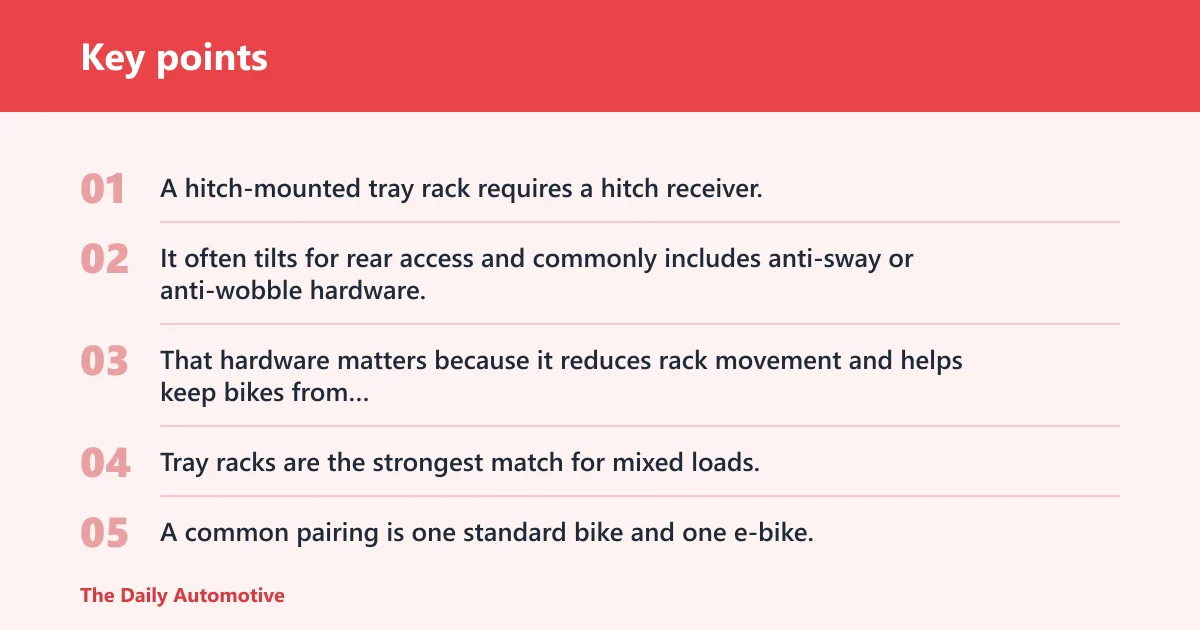
A hitch-mounted tray rack requires a hitch receiver, and it is often chosen for easier loading height and better balance for two bikes. It often tilts for rear access and commonly includes anti-sway or anti-wobble hardware. That hardware matters because it reduces rack movement and helps keep bikes from knocking into each other.
Tray racks are the strongest match for mixed loads. A common pairing is one standard bike and one e-bike, which is where per-bike limits and total rack limits must both be checked.
Hanging hitch rack
A hanging hitch rack is usually less expensive than a tray rack and is common in two-bike setups. It typically folds flat for storage, which helps in tight garages, but some designs require unloading before the rack can tilt down. The bikes hang from the frame, so frame shape and crossbar clearance matter.
It can be a good choice for lighter bikes and shorter trips. It is less forgiving when you have heavy bikes, unusual frame shapes, or rear access needs that must be met without unloading.
Trunk-mounted rack
A trunk-mounted rack fits many sedans, hatchbacks, minivans, and SUVs, and it is usually the lowest-cost option. It folds flat for storage, but you must verify the exact vehicle fit before buying. Spoilers, wipers, hatch curvature, and plastic trim can all change whether the rack fits safely.
Trunk racks are the cheapest path, not the easiest one to verify. The fit guide matters more here than on most hitch racks.
When roof racks are the wrong answer
Roof racks can work, but they are often the wrong answer for first-time buyers with two bikes. Loading is harder, height clearance becomes an issue in garages and drive-throughs, and lifting heavy bikes overhead increases the chance of contact damage. They are also less convenient when you need frequent access to the cargo area.
Two-bike rack decision matrix
Use this matrix to match the safest rack style to your vehicle, receiver, and bikes before looking at brand names. It is the quickest way to avoid buying a rack that blocks the hatch, overloads the hitch, or forces you to remove bikes every time you need the trunk.
| Vehicle type | Hitch size | Bike weight | Tire width | Rear-access need | Safest rack style |
|---|---|---|---|---|---|
| Sedan or hatchback | None | Light to moderate | Standard | Moderate | Trunk-mounted rack with vehicle-specific fit approval |
| SUV or minivan | 2-inch receiver | Moderate to heavy | Standard or fat tire | High | Hitch-mounted tray rack with tilt or swing-down access |
| Compact car with factory hitch | 1.25-inch receiver | Light to moderate | Standard | Low to moderate | Hanging hitch rack or lighter tray rack, if rated for the load |
| Family SUV with e-bike mix | 2-inch receiver | One heavy, one standard | Wide or fat tire | High | Tray rack with per-bike rating that covers the heaviest bike |
| Vehicle with spoiler or steep hatch | None or hitch | Light | Standard | High | Hitch rack if available; otherwise trunk rack only after fit verification |
Failure cases to avoid
- Spoiler interference: some trunk racks press on spoilers or upper hatch edges and can shift under load.
- Hatch clearance: a loaded rack may block the liftgate unless it has a usable tilt or swing-down feature.
- Bike-frame contact: hanging racks can let bikes sway into each other, especially with mixed frame sizes.
- Loading constraints: heavier bikes can be difficult to lift onto higher racks or onto roofs.
- Parking-garage clearance: roof systems add height, which can be a hard stop in low-clearance parking.
Say your SUV has a 2-inch receiver and you carry a 58-pound e-bike plus a 29-pound hybrid. A tray rack with a per-bike limit that covers the e-bike is the safer choice; a hanging rack may be within total weight on paper but still be the wrong tool because the heavier bike sits poorly and is harder to stabilize.
Suppose your hatchback has no hitch and a small spoiler. A trunk rack can work only if the vehicle fit guide approves that exact shape. If the pads sit on the spoiler or the straps pull the rack into the hatch glass, skip that model.
How much weight can it carry?
A bike rack must meet both the per-bike limit and the combined load limit. That sounds simple, but it is where many first-time buyers go wrong. One bike may be well under the limit while the pair together, or the rack plus bikes, crosses it.
Per-bike versus total load limits
The Sherpa 2.0 holds most bikes up to 40 pounds each, while the Thule Epos can hold two bikes up to 75 pounds each. Those numbers matter because a single e-bike can be enough to move you into a higher-capacity rack even if the second bike is lightweight.
Check the rack rating, then check your bikes. Then check the hitch rating, if you are using one. All three have to work together.
Why e-bikes need extra attention
E-bikes often push weight higher and make loading more awkward. Some racks are approved for e-bikes, but many are not. If the rack does not list an e-bike-capable per-bike limit, assume it is not the right fit.
The Thule Epos includes a foldable ramp that costs extra, which can help with heavier bikes by reducing lift height. That is a useful feature, but it is not a substitute for the weight rating itself.
Wheelbase, fat tires, and frame clamps
Check wheelbase limits, tire width support, and how the rack holds the bike. Fat tire support is not universal. Some racks use wheel cradles, which can suit a wider range of frames, while frame-clamp designs may be less friendly to unusual tube shapes, step-through frames, or carbon frames that should not be compressed.
A common first-timer mistake is buying a hanging rack for a pair of e-bikes because the product says “two-bike capacity.” That phrase does not mean two heavy bikes, and it does not mean the frames will ride securely without sway.
Will it clear the hatch or spoiler?
Clearance depends on both the rack design and the vehicle body. Tilt and swing-down features can restore cargo access, but some racks still require unloading first. On trunk racks, spoiler contact and hatch curvature are the first places to check. On hitch racks, receiver height and bike length can determine whether the liftgate opens fully.
Tilt and swing-down features
A tilt or swing-down feature lets you reach the cargo area with the rack installed. That is one of the biggest convenience wins for hitch models. It is especially useful on loaded racks, but the mechanism itself does not guarantee full access on every vehicle.
Measure from the hitch to the hatch edge and compare that with the rack’s folded and tilted positions. If the bike wheels or handlebars still hit the hatch, the feature is not enough on its own.
When you still need to unload bikes
Some hanging hitch racks tilt only after the bikes come off. That is common enough that buyers should not assume access without checking. Heavy bikes make this problem worse because unloading them just to open the hatch defeats the main convenience of the rack.
Scratch and contact risks to check first
Look for frame contact, wheel rub, bumper pressure, strap placement, and points where the rack can shift. Use locking accessories when needed, but do not confuse locks with stability. Anti-sway or anti-wobble hardware reduces motion; locks only secure the bikes or rack against theft.
How do you keep a bike rack from scratching your car? Start with the right fit, then protect contact points with the pads and straps the rack was designed to use. Do not add random padding that changes the strap tension. Loose padding can move and create more abrasion, not less.
Choose by vehicle first, then receiver size, then bike weight, then rear-access needs. That order prevents most bad purchases. If you have a hitch, a tray rack is usually the cleanest answer. If you do not, a trunk rack can work, but only after the vehicle fit is verified. Budget for the rack itself, plus installation, locks, and any ramp or adapter you may need.
Hitch size and compatibility
Do you need a 1.25-inch or 2-inch hitch for a bike rack? Check the receiver before buying, because rack compatibility starts there. Many racks are built for one size only, while some use adapters. A 2-inch receiver is generally the better fit for heavier racks and e-bike use, while 1.25-inch receivers are common on lighter-duty setups.
Never assume an adapter solves every problem. The rack still has to stay within the hitch’s weight and leverage limits.
Anti-wobble and anti-sway hardware
Anti-sway or anti-wobble hardware matters because it keeps the rack from rocking in the receiver and cuts bike-to-bike movement. That is especially important on hitch racks, where movement can magnify over rough roads. If you carry a carbon frame or a narrow step-through frame, a steadier rack is easier to live with.
Storage, locks, and hidden costs
Hidden ownership costs include hitch installation, locking cables, hitch locks, and ramps for heavier bikes. A rack that folds flat for storage is easier to keep in a garage, but compact storage does not guarantee easy installation. Check the rack’s folded length, the weight you must lift, and whether it can stay on the car without blocking daily use.
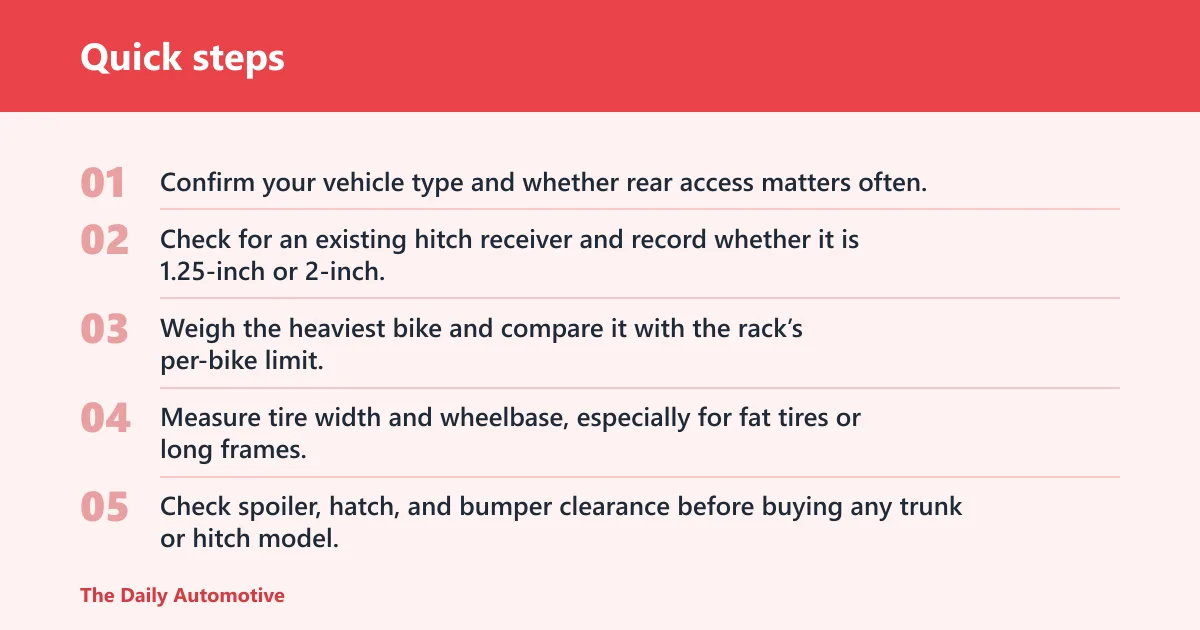
- Confirm your vehicle type and whether rear access matters often.
- Check for an existing hitch receiver and record whether it is 1.25-inch or 2-inch.
- Weigh the heaviest bike and compare it with the rack’s per-bike limit.
- Measure tire width and wheelbase, especially for fat tires or long frames.
- Check spoiler, hatch, and bumper clearance before buying any trunk or hitch model.
- Add the cost of locks, installation, and any ramp or adapter you may need.
Frequently asked questions
What is the best 2 bike rack for a car?
For most drivers, a hitch-mounted tray rack is the best all-around choice because it is steadier, easier to load, and better for heavier bikes. Wirecutter’s top two-bike pick is the Küat Sherpa 2.0, which also allows rear access when loaded and holds most bikes up to 40 pounds each.
Should I get a hitch mount or trunk mount bike rack?
Choose a hitch mount if you want better stability, easier loading, or room for heavier bikes. Choose a trunk mount if you do not have a hitch and want a lower-cost option, but only after checking vehicle-specific fit. Trunk racks are more sensitive to spoilers, hatch shape, and contact points.
Will a 2 bike rack fit my car and bikes?
It will fit only if the rack style matches your vehicle and the rack rating matches your bikes. Check hitch size, bike weight, tire width, wheelbase, and rear-access needs before buying. A trunk rack may fit many vehicles, but the exact model still has to be approved for your car.
How much weight can a 2 bike rack hold?
That depends on the model. The Sherpa 2.0 holds most bikes up to 40 pounds each, while the Thule Epos can hold two bikes up to 75 pounds each. Always check both the per-bike limit and the total rack limit, especially if one of the bikes is an e-bike.
Are hitch bike racks safer than trunk bike racks?
In general, hitch racks are more stable because they mount to the receiver and usually include anti-sway or anti-wobble hardware. Trunk racks can be safe when they fit the vehicle correctly, but they rely more on straps and body-panel contact. That makes fit verification more important.
Can a bike rack work with an e-bike or fat tire bike?
Yes, but not every rack is rated for those bikes. Choose a tray rack with a per-bike rating that covers the heaviest bike and confirm fat tire support, wheelbase limits, and loading method. A ramp can help with heavier bikes, but it does not replace the weight rating.
Products related to this article
Sponsored / affiliate links. As an Amazon Associate I earn from qualifying purchases. I may earn additional commission from eligible campaigns.