3 Best Buffer Polishers for Car Detailing (2026): We Compared
For most DIY detailers, the best buffer polisher is a 5- to 6-inch dual-action random orbital. It is safer for first-timers, works well on swirls, and is easier to control than a rotary. Pick the wrong one and you can leave haze, burn edges, or spend money on a machine that is too aggressive or too weak for the paint. This guide compares three buffer polisher types by job fit: first-time swirl removal, fast correction, and cordless convenience.
Quick comparison
| Product | Badge | Best for | Price | ||
|---|---|---|---|---|---|
 |
RUPES BigFoot LHR15 Mark V Random Orbital Polisher – ToolRUPES | Our pick | RUPES Mark V Random Orbital Polisher, tool only | $552.00
Price as of 25 Oct 2026
|
View |
 |
Dura-Gold Pro Series 7" Flexible Edge Polishing BuffingDura-Gold | Pair with it | 7" Flexible Edge Hook and Loop Backing Pad | $17.99
Price as of 25 Oct 2026
|
View |
 |
VERVEWAVE Cordless Buffer Polisher Kit for MilwaukeeVERVEWAVE | Budget pick | 6-inch Cordless Orbital Polisher, 6-speed kit | $68.39
Price as of 25 Oct 2026
|
View |
The real choice is not “best machine.” It is “best machine for this paint, this panel, and this skill level.” A 9mm DA is the safer first buy, a 15mm long-throw DA cuts faster, and a cordless unit trades wall power for mobility.
Pad size matters as much as motor type. If the backing plate and pad stack do not match, the machine can run poorly, stall more easily, or force you into buying extra pads and compounds after the fact.
How we chose
We compared each pick by job fit, not spec-sheet bragging. The main filters were correction speed, paint safety, pad and backing plate compatibility, corded versus cordless use, and whether the machine matches a first-time user, an upgrade buyer, or a detailer who needs mobility.
We also separated 9mm and 15mm DAs, because they are not the same tool in practice. The hidden cost of a usable pad stack matters too, especially once you factor in cutting, polishing, and finishing pads.
| Scenario | Paint condition | Panel size | Skill level | Runtime needs | Pad size | Hidden pad and compound cost | Best fit |
|---|---|---|---|---|---|---|---|
| First-time swirl removal | Light swirls, wash marks, mild haze | Mixed panels, including doors and hood | Beginner | No long session required | 5-inch or 6-inch | Moderate; plan for a foam cutting pad, a polishing pad, and compound | 9mm dual-action random orbital |
| Fast correction on neglected paint | Heavier swirls, oxidation, tougher defects | Large hood, roof, or full-size SUV panels | Intermediate to experienced | Long, uninterrupted sessions help | 5.5-inch or 6.5-inch | Higher; stronger compounds, more pad cleaning, and extra finishing time | 15mm long-throw DA |
| Cordless work without easy outlet access | Light to moderate correction, maintenance polishing | Exterior walkaround work, tight garage spaces | Intermediate | Battery runtime under load matters | 5-inch to 6-inch | Higher; battery system, spare pack, and pad inventory can cost more than the tool | Cordless 15mm DA |
Griot’s Garage G9: best for first-time swirl removal
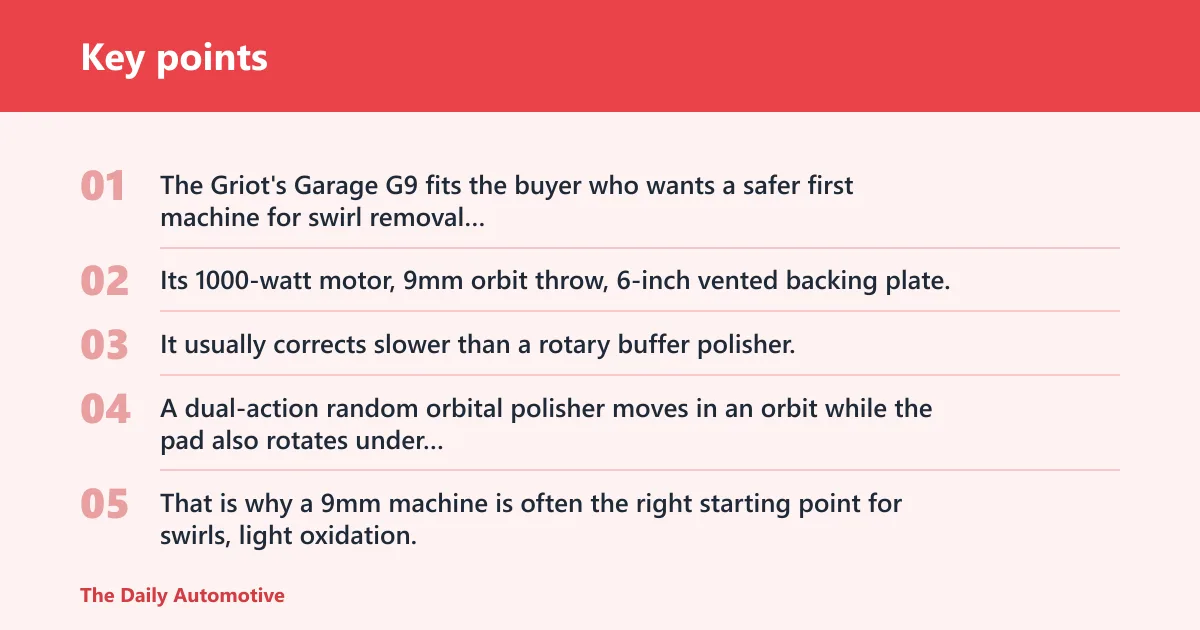
The Griot’s Garage G9 fits the buyer who wants a safer first machine for swirl removal on modern clear coats. Its 1000-watt motor, 9mm orbit throw, 6-inch vented backing plate, and 6 variable speeds put it squarely in the do-most-jobs category without pushing the user into rotary risk.
That 9mm throw is the key point. It usually corrects slower than a rotary buffer polisher, but it gives you more margin for error, and that matters on edges, body lines, and repainted panels where heat control matters more than raw cutting speed.
Why 9mm throw fits beginners
A dual-action random orbital polisher moves in an orbit while the pad also rotates under load, so it is less likely to concentrate heat in one spot. That is why a 9mm machine is often the right starting point for swirls, light oxidation, and one-panel correction on clear coat.
It is also easier to learn because the machine tends to stall before it becomes aggressive in the way a rotary can. That slower correction pace is the tradeoff for safer paint handling.
What its 6 speed settings do
Variable speed matters because a single setting cannot cover all jobs. Low speed is for spreading product and waxing, while higher settings are used for correction. The G9’s 2000-6400 OPM range gives you room to separate finishing work from cutting work, which is the whole point of a usable DA.
Dial usability matters too. A speed control that is hard to read or too easy to bump becomes a problem when you need repeatable low-speed control on trim edges or when laying down wax on softer paint.
Pad sizes and conversion limits
The listed 6-inch vented backing plate is a practical middle ground for most DIY work. The optional 5-inch conversion is useful if you want a smaller pad for tighter areas or a bit more control on curved panels.
Pad compatibility still matters. Foam pads are the standard first buy, while microfiber and wool increase cut but also increase the need for pad cleaning and careful product choice. Cross-brand fit can be imperfect, so check the backing plate thread and pad diameter before buying a stack.
A common beginner mistake is choosing a buffer polisher without any foam or wool pads to match different paint correction jobs. That usually leaves you with either too much cut, too little cut, or no finishing pad to remove the haze left by the compound.
Adam’s Swirl Killer 15mm: best for faster correction
Adam’s Swirl Killer 15mm is the better fit when you want a DA that still behaves like a safety-first machine but cuts faster than a 9mm unit. The 15mm long-throw design is built for paint correction work, and it is better suited to neglected paint than a standard short-throw DA.
Its advantage is speed on larger areas. On hoods, doors, and roof panels, a 15mm machine can cover more ground per pass, so you spend less time chasing the same defect pattern.
Why long throw cuts faster than 9mm
Long-throw DAs remove defects more efficiently because the pad spends more time moving across fresh paint under pressure. That does not make them as aggressive as a rotary, but it does make them a real upgrade when a 9mm machine feels too slow on oxidation or heavier swirling.
The tradeoff is control. A 15mm machine asks for more attention around panel edges and sharp body lines, especially if you lean on the pad or choose a compound that cuts hard.
Where a 5.5-inch or 6.5-inch pad helps
Adam’s lists 5.5-inch and 6.5-inch pad compatibility, which gives you some room to tune the cut. A smaller pad can help on tighter bodywork, while a 6.5-inch pad is better for larger flat areas where you want efficiency.
That flexibility matters more than many buyers expect. Once you move from a starter machine to a correction-focused DA, pad size becomes part of the job plan, not an afterthought.
When a DA is still the safer choice
Even a 15mm long-throw machine is still a DA, so it stays in the safer category for most DIY paint correction. It is the better choice when you want faster results without moving to a rotary buffer polisher that can build heat quickly and leave holograms if the technique slips.
If the paint is fresh, thin, or already near the limit, the safer tool still wins. Faster correction is useful only if the finish can tolerate the extra work.
Milwaukee M18 FUEL 15mm: best cordless pick
The Milwaukee M18 FUEL 15mm is the pick for detailers who value cordless movement above all else. It is a cordless 15mm polisher on the M18 battery platform, which makes it attractive for mobile work, driveway jobs, and areas where cords become a hassle.
The catch is predictable: cordless convenience can come at the cost of sustained torque consistency under compound load. Once pressure increases or the pad loads up, battery tools can feel less steady than corded machines.
Battery runtime under compound load
Battery voltage and capacity matter, but real runtime depends on load. A cordless polisher can feel strong on light polishing, then fade faster when paired with a heavy compound, a larger pad, or continuous pressure on a hood or roof.
That is why battery claims should be treated carefully. Runtime under load is not the same as no-load runtime, and polishing is a load-heavy job.
Torque consistency versus corded polishers
Corded machines usually hold torque more consistently through long correction sessions. Cordless units avoid the cord, but they can lose punch as the battery drains or as the work gets more demanding, especially on large panels.
That does not make cordless a bad choice. It just means the best use case is mobility, not maximum sustained correction on a full-size vehicle with tired paint.
Who benefits from cordless mobility
Mobile detailers, apartment users, and anyone working around vehicles parked far from an outlet will see the most value here. A cordless polisher also helps when you are moving around a vehicle a lot and do not want to manage cord routing across mirrors, wheels, and wet floor mats.
Still, a spare battery is not optional for serious work. Without one, downtime while charging can interrupt a long correction session and eat into the convenience you paid for.
Buffer polisher decision matrix
The right machine changes with the paint, not just the buyer. This matrix maps the most common scenarios to the tool type that fits the job and the hidden cost that usually gets missed at checkout.
| Scenario | Paint condition | Panel size | Skill level | Runtime needs | Pad size | Hidden pad and compound cost |
|---|---|---|---|---|---|---|
| First-time swirl removal | Light swirls on clear coat | Mixed-size panels | Beginner | Short sessions are fine | 5-inch or 6-inch | Moderate; buy at least one cutting pad, one polishing pad, and compound |
| Fast correction | Heavier swirls and mild oxidation | Large hoods and roofs | Intermediate to experienced | Long continuous sessions help | 5.5-inch or 6.5-inch | Higher; expect extra pads, better compound, and more cleanup time |
| Cordless convenience | Light correction or maintenance polishing | Tight garages and outdoor parking | Intermediate | Battery runtime and spare packs matter | 5-inch to 6-inch | Higher; batteries, charger downtime, and spare pads raise the total cost |
Suppose the paint has light swirl marks on a midsize sedan, but the panels are mostly straight and the owner is new to machine polishing. A 9mm DA with a 5-inch or 6-inch pad makes more sense than a rotary, because it is safer on edges and still strong enough for a one-step correction.
Picture the opposite case: a neglected SUV with oxidation on the hood and doors. That is where a 15mm long-throw DA starts to earn its keep, because it reduces correction time without jumping straight to the heat and risk of a rotary buffer polisher.
Should you buy a rotary buffer?
A rotary buffer is the right tool when you need single-axis spin and maximum cutting power, but it is not the default answer for DIY detailing. It builds heat faster, it can leave holograms if the pad or technique is wrong, and it raises the risk of burn-through on edges and body lines.
When single-axis spin makes sense
Rotary machines can be the right choice for experienced users dealing with severe defects, heavy oxidation, or situations where fast material removal matters more than finish safety. The machine stays in constant rotation, so the cutting action is direct and aggressive.
That is also why it is not the first recommendation for most readers. The learning curve is steeper, and the margin for error is smaller.
Heat, holograms, and burn risk
The biggest rotary downside is heat concentration. If you linger, tilt the pad, or use the wrong compound on a sharp edge, you can create holograms or burn the clear coat. Those mistakes are harder to fix than a bit of leftover swirl.
Beginner-friendly detailing usually means less heat, more control, and slower correction. That is the DA’s job.
Why most DIY buyers should start elsewhere
A beginner can safely use a rotary only with a lot of practice, tight speed control, and a willingness to work slowly. Most owners will get better results faster with a DA random orbital, then move to a rotary only if the work demands it.
If you want a safer upgrade path, start with the G9 or a 15mm DA and learn pad control before stepping into a rotary’s risk profile.
Choose Griot’s Garage G9 if… / Choose Adam’s Swirl Killer 15mm if… / Choose Milwaukee M18 FUEL 15mm if…
Choose the Griot’s Garage G9 if you are new to machine polishing, want a safer first buffer polisher for modern clear coats, and plan to work mostly on swirl removal, light haze, and one-car garage jobs. Its 9mm throw and 6 speed settings suit a careful learning curve.
Choose Adam’s Swirl Killer 15mm if you already understand DA technique, want faster correction than a 9mm unit, and expect to spend more time on neglected paint or larger panels. The 15mm long-throw format is the better upgrade when correction speed matters.
Choose the Milwaukee M18 FUEL 15mm if cord management is the main problem, you need mobility more than maximum sustained torque, and you are willing to pay more for cordless convenience. It fits mobile work and tight parking situations better than wall-powered polishers.
Which one should you buy?
If budget is the main constraint, start with the Griot’s Garage G9. It covers the broadest set of beginner jobs and keeps the learning curve manageable. If you only need a single machine for maintenance polishing and light swirl removal, that is the sensible place to start.
If your paint is more neglected and you want faster correction, step up to a 15mm DA. Adam’s Swirl Killer 15mm is the cleaner fit for that job profile because it is built around long-throw correction rather than general-purpose comfort.
If you need cordless movement, the Milwaukee M18 FUEL 15mm is the most logical pick in this set. Just plan for spare batteries and understand that runtime under compound load will be shorter than a corded machine’s uninterrupted session.
One more practical note: if a listing includes a 7-inch backing plate or a large waxer style head, do not assume it is the right match for paint correction. A machine like the Griot’s Garage G21, a 21mm throw unit, or the WEN AA6158, which is listed with a 15mm throw and an 8 A corded motor, may belong in a different job category than the three picks here.
Frequently asked questions
What is the best buffer polisher for car detailing?
For most DIY detailers, the best buffer polisher is a 5- to 6-inch dual-action random orbital. It gives enough correction for swirl removal while staying safer than a rotary on modern clear coats. If speed matters more, a 15mm DA is the better upgrade; if mobility matters, cordless becomes the draw.
Should I buy a rotary buffer or a dual-action polisher?
Buy a dual-action polisher unless you already have rotary experience and need faster cutting for severe defects. A rotary cuts faster because it spins on a single axis, but it also creates more heat and has a higher risk of holograms or paint burns. Most DIY buyers should start with DA.
Is a cordless buffer polisher worth it for detailing cars?
Yes, if cord management is the problem and you accept the tradeoff. Cordless polishers are useful for mobile work, tight garages, and quick correction jobs, but runtime under load can drop, especially with heavier compounds or larger pads. A spare battery is part of the cost.
What speed setting should I use when polishing car paint?
Use low speed for spreading product or waxing, then move up for correction according to the pad and compound. There is no single number that fits every machine, but the important point is control: a useful polisher has enough low-speed stability to spread product and enough higher-speed range for defect removal.
What pads do I need for a buffer polisher?
Most buyers need at least three pad types: a cutting pad, a polishing pad, and a finishing or waxing pad. Foam is the safest starting point, while microfiber and wool increase cut. Make sure the pad diameter matches the backing plate and that the hook-and-loop fit is secure.
How do I avoid burning paint with a car polisher?
Keep the pad flat, avoid dwelling on edges, start with the least aggressive pad and compound that can do the job, and use a DA instead of a rotary when possible. Heat is the enemy. Slow, controlled passes are safer than pressing harder or cranking the speed to the top.
Products related to this article
Sponsored / affiliate links. As an Amazon Associate I earn from qualifying purchases. I may earn additional commission from eligible campaigns.