3 Best Orbital Buffers for Cars: We Compared
The best orbital buffer for car owners is a dual-action polisher with variable speed and soft-start control. For most beginners, the Porter-Cable 7424XP is the safest all-around pick because its random-orbit motion is forgiving and its speed range covers waxing through light correction. A poor match can leave haze, burned edges, or money spent on pads and polish you cannot use well. This guide compares three beginner-safe orbital buffers, then matches each one to your paint, skill level, and long-term detailing costs.
Quick comparison
| Product | Badge | Best for | Price | ||
|---|---|---|---|---|---|
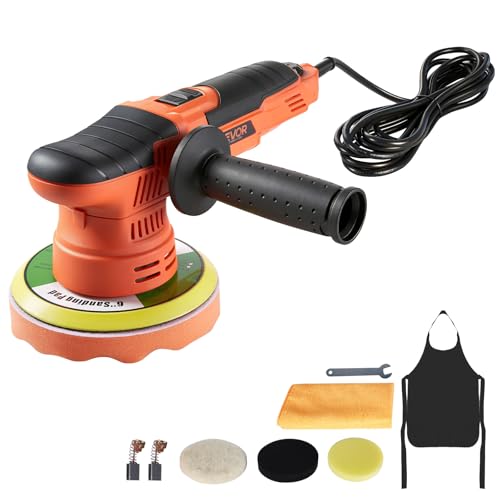 |
VEVOR Car Buffer Polisher, 6-Inch Dual Action PolisherVEVOR | Our pick | 6-inch dual action · 6 speeds · kit included | $53.91
Price as of 24 Oct 2026
|
View |
 |
Buffer Polisher, SPTA 5-Inch 125mm Dual Action RandomSPTA | Also great | $107.84
Price as of 24 Oct 2026
|
View | |
 |
PORTER-CABLE Buffer Polisher, Car Polisher for CarPORTER-CABLE | Also great | 6-inch orbital · variable speed · swirl-free action | $159.00
Price as of 24 Oct 2026
|
View |
The main trade-off is plain: safety versus correction speed. A dual-action random orbital polisher lowers swirl risk compared with a rotary buffer. A rotary’s fixed spin cuts faster, but it brings a higher burn-through risk and asks for real experience.
If you want one tool that can wax, polish, and handle light correction on modern clear coat, start with a DA. If you are fighting oxidation-heavy paint or stubborn defects, the machine matters less than choosing the right pad, compound, and speed range for the job.
| Model | Type | Orbit / action | Power | Speed range | Pad / backing plate support | Best use |
|---|---|---|---|---|---|---|
| PORTER-CABLE 7424XP | Dual-action random orbital | Forgiving random orbit | 4.5-amp motor | 2,500 to 6,800 OPM | 5-inch and 6-inch backing plates | Beginners, waxing, light polishing, smaller budgets |
| Griot’s Garage G9 | Dual-action random orbital | 9mm orbit throw | 1000-watt motor | 2,000 to 6,400 OPM | 6-inch vented backing plate | Faster correction, one-car detailers, smoother control under load |
| VEVOR Car Buffer Polisher | Dual-action random orbital | Random orbital | 650W motor | 2,000 to 6,800 RPM | 6-inch class kit | Low-cost kit buyers who want pads included |
How we chose
The comparison leans on four checks: safety and swirl risk, correction speed and stall resistance, pad and backing plate compatibility, and total ownership cost. That last piece matters more than many buyers expect, because pads, compound, backing plates, and replacement pads often change the real cost by a noticeable margin.
We also looked at how each tool fits a specific garage. A one-car owner with soft clear coat needs something different from someone cleaning up neglected paint or trying to keep vibration and fatigue low over a long weekend.
PORTER-CABLE 7424XP: best for beginners
The Porter-Cable 7424XP is the safest starting point for most first-time users. Its 4.5-amp motor and 2,500 to 6,800 OPM range give you enough speed for waxing, polishing, and light correction without pushing you straight into aggressive territory.
It also accepts 5-inch and 6-inch backing plates, which matters because pad size changes both control and cut. A 5-inch setup is easier to guide on bumpers, pillars, and other tight panels; a 6-inch setup covers more flat sheet metal with fewer passes.
This is the tool to choose if you want a beginner-safe dual-action polisher that can handle light swirl removal on modern clear coats. Its drawback is speed, not safety. On hard paint, or if you need to remove heavier defects, it can feel slow and may stall if you lean too hard on it.
Why its power range matters
The 2,500 to 6,800 OPM range gives you the usual DA workflow in one machine. Lower speeds suit waxing, mid speeds suit polishing, and higher speeds suit light correction with the right pad and compound.
That range also matters for control. If a DA bogs down under pressure, it stops working efficiently and starts forcing you to do more passes. With a machine like this, lighter pressure and slower hand movement usually work better than trying to muscle it through defects.
Where it is enough, and where it feels slow
For swirls, light oxidation, and annual maintenance on average clear coat, it is enough. For heavy water spotting, deep dealer-installed swirls, or tired paint that needs stronger cut, a small-throw entry DA often becomes a time tradeoff rather than a solution.
A common first-timer mistake is chasing one deep mark with too much pressure. That can make the pad stall, reduce correction, and increase heat at the edges of body lines. The safer move is to step up pad aggressiveness first, then compound only if the paint needs it.
Griot’s Garage G9: best for faster correction
The Griot’s Garage G9 is the best fit when you want more correction speed without leaving dual-action safety behind. Its 1000-watt motor, 9mm orbit throw, 6-inch vented backing plate, and 6 variable speed settings make it a stronger choice for users who want faster results on real-world paint.
The 2,000 to 6,400 OPM range keeps it in the same general detailing band as the Porter-Cable, but the 9mm throw and motor design help it maintain motion more confidently under load. That matters when paint is not in perfect shape and you need the pad to keep working instead of stalling out.
This is a strong fit for one-car owners who want one machine that can do seasonal maintenance and more serious correction. Its drawback is simple: it is less budget-friendly than entry tools, and it still will not behave like a rotary buffer when you need heavy, aggressive cut.
What the orbit throw changes
Orbit throw affects how much pad movement happens per cycle. In practical terms, an entry DA can handle waxing and light polishing well, while a 9mm machine generally gives you more effective correction per pass on modern clear coats.
That does not mean every defect disappears faster. It means the tool is better equipped to cut through light-to-moderate swirl marks, haze, and oxidation with less waiting, especially when paired with the right pad and compound.
Why constant speed control matters
Constant speed control helps the machine keep its pace when the pad meets paint resistance. That reduces the “falls on its face” feeling you get from weaker tools that vibrate, bog down, or stop spinning effectively under pressure.
It also helps during longer panels. A stable machine is easier to keep flat, and keeping the pad flat is one of the simplest ways to limit haze and uneven correction on clear coat.
Best use cases
Use the G9 when you have a one-car garage, want to remove more than routine swirls, and prefer a tool that still feels manageable. It is a good middle ground for owners who detail a few times a year and want a cleaner finish without stepping into pro-only equipment.
It also makes sense for multi-car owners who value consistency. If you are polishing more than one vehicle and do not want a machine that feels underpowered on the second car, this class is the safer upgrade.
VEVOR Car Buffer Polisher: best budget kit
The VEVOR kit is a low-cost choice for buyers who want the basics in one box. Its motor, multiple speed settings, and included wool and foam pads make it appealing when you want a starter setup without adding several separate purchases on day one.
That bundled approach matters because ownership cost is not just the tool. Pads, compound, and replacement pads add up quickly, so a kit can look cheaper than a bare tool once you price the full setup.
The drawback is control and long-term refinement. A budget kit can be fine for waxing and light polishing, but buyers who want smoother speed control, stronger stall resistance, or more refined paint correction will usually outgrow it sooner than a stronger branded DA.
Where a kit saves money
A kit saves money when you need pads right away and do not want to build a separate cart of accessories. If it includes usable foam and wool pads, you can start with waxing or light polishing before buying extra pieces.
It is still worth checking backing plate compatibility and replacement pad availability. If those are limited, the sticker price is less attractive because future pad purchases can be awkward or more expensive.
When a budget kit makes sense
Choose a kit if the car is a weekend project, the paint is not badly neglected, and your goal is maintenance rather than aggressive correction. It is also reasonable for someone learning technique on a softer panel set before moving to a better machine.
If the car has hard clear coat or heavy oxidation, budget does not solve the physics. You may spend more time chasing results, and a weaker machine may stall before the paint actually responds the way you want.
Which orbital buffer fits your garage?
The right buffer depends on three things: the paint you are correcting, how often you will use the tool, and how much accessory cost you can tolerate. The best decision is not “more power” by default. It is the machine that matches your finish goal, pad size, and patience.
Which Orbital Buffer Fits Your Garage?
| Skill level | Paint condition | Car count | Budget | Preferred power type | Pad size | Recommended buffer category | Avoid if |
|---|---|---|---|---|---|---|---|
| Beginner | Soft or average clear coat, light swirls | 1 car | Low to mid | Corded | 5-inch | Beginner-safe dual-action random orbital | Avoid if you expect heavy correction on hard paint. |
| Intermediate | Moderate swirls, haze, light oxidation | 1 to 3 cars | Mid | Corded | 6-inch | Higher-control dual-action with stronger stall resistance | Avoid if you want the cheapest possible kit and can accept slower work. |
| Experienced | Heavier defects, stronger correction needs | 3+ cars | Mid to high | Either, with corded preferred for consistency | 6-inch or larger | Premium dual-action or rotary only with experience | Avoid if you are new to paint correction or have sharp body lines and thin clear coat concerns. |
| Mobile detailer | Mixed, often unknown condition | Many cars | Mid to high | Corded, unless battery ecosystem fit is already in place | 5-inch and 6-inch | Dual-action with stable speed control and easy pad swaps | Avoid if battery runtime would interrupt jobs or force you to carry extra packs. |
Pad size and backing plate compatibility
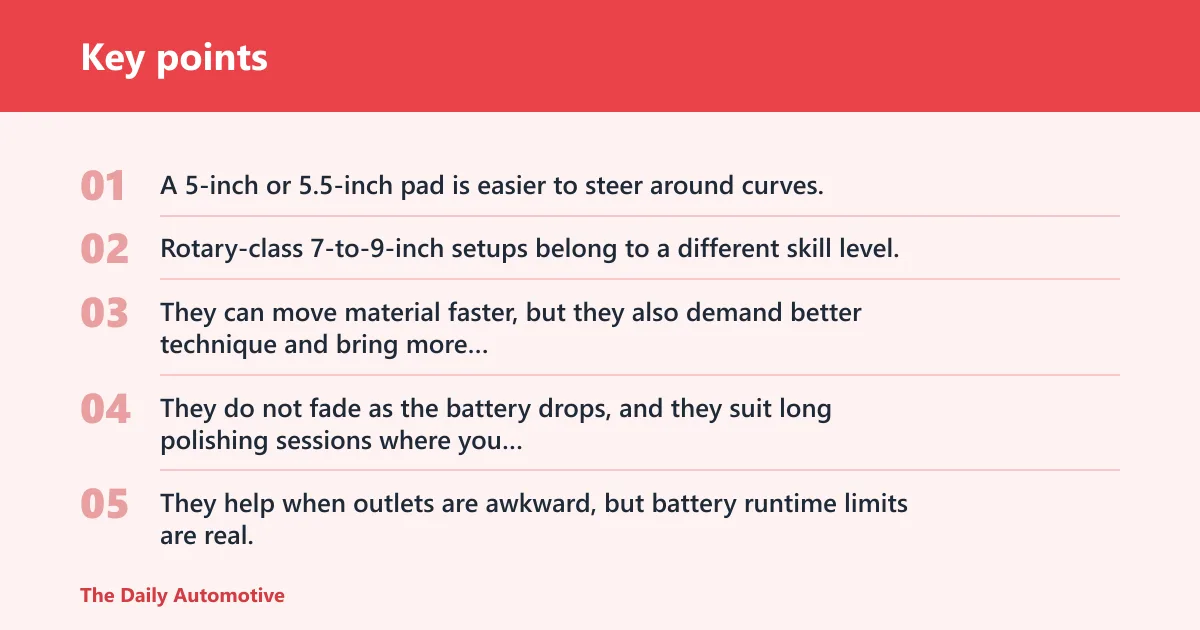
Pad size affects both cut and control. A 5-inch or 5.5-inch pad is easier to steer around curves, while a 6-inch pad covers more area and is common on dual-action tools meant for general paint correction.
Rotary-class 7-to-9-inch setups belong to a different skill level. They can move material faster, but they also demand better technique and bring more burn-through risk if you linger on an edge or keep the pad moving too slowly.
Corded versus cordless
Corded tools win on consistent power. They do not fade as the battery drops, and they suit long polishing sessions where you want the machine to feel the same on the first panel and the last.
Cordless tools win on mobility. They help when outlets are awkward, but battery runtime limits are real, and the tool only makes sense if you already own compatible batteries in the same ecosystem. For long jobs, that compatibility matters more than marketing language.
Total ownership cost
Tool price is only the first line item. Add pads, compound or polish, a backing plate if the kit does not include one, and at least one replacement pad if you plan to do more than a single car.
That is why the cheapest machine is not always the cheapest setup. A better-built tool with available pads can cost less over time than a bargain kit that forces you to replace soft, worn, or incompatible accessories sooner.
Choose Porter-Cable 7424XP if… / Choose Griot’s Garage G9 if…
Choose the Porter-Cable 7424XP if you are new to correction, want the safest DA motion, and mostly need waxing, polishing, and light swirl removal on one car. Its 5-inch and 6-inch backing plate support also makes it easy to build a practical starter setup.
Choose the Griot’s Garage G9 if you want quicker correction, stronger stall resistance, and a more confident feel on paint that needs real work. It is the better fit when you want to do more than maintenance and still stay inside dual-action safety.
Choose the VEVOR kit if budget matters most and you want pads included from the start. It makes the most sense for light-duty use, not for a buyer who expects premium control or wants to chase heavy defects efficiently.
If you are tempted by a rotary buffer, hold off unless you already know how to manage fixed spin and edge heat. Rotary tools still belong in experienced hands because they correct faster, but they also raise the chance of burn-through on thin or unfamiliar paint.
Which one should you buy?
If you are a beginner on soft or average clear coat, buy the Porter-Cable 7424XP. Its random-orbit motion is forgiving, its speed range is broad enough for waxing through light correction, and it accepts both 5-inch and 6-inch backing plates.
If you want faster correction on neglected paint, buy the Griot’s Garage G9. The 1000-watt motor, 9mm orbit throw, and constant speed control make it the strongest choice here for users who want more cutting confidence without switching to a rotary.
If you care most about control and refinement, the Meguiar’s MT300 is the premium dual-action polisher to look at, and CNET identified it as its best car buffer. It is the kind of machine to consider when smooth operation and adjustable handling matter more than the lowest price, though that is a separate premium lane from the three comparison picks above.
Buy the VEVOR kit if you want the lowest entry cost and need pads in the box. Just keep expectations realistic: a budget kit is fine for maintenance work, but it is not the best answer for hard clear coat, heavy swirls, or long-term refinement.
Frequently asked questions
What is the best orbital buffer for a car for beginners?
The best beginner choice is a dual-action random orbital polisher, and among these picks the Porter-Cable 7424XP is the safest all-around option. Its random motion is forgiving, it accepts 5-inch and 6-inch backing plates, and its speed range covers waxing, polishing, and light correction without pushing you toward rotary-level risk.
Should I buy a dual-action or rotary buffer for my car?
Buy a dual-action polisher unless you already have experience. A DA lowers swirl risk and is better for waxing, polishing, and light correction. A rotary buffer cuts faster, but its fixed spin raises burn-through risk and demands more control around edges, curves, and thin clear coat.
What orbit throw is best for car polishing?
For general polishing, a moderate orbit throw is usually the best balance. Small-throw entry tools are safe but slower, while a 9mm DA like the Griot’s Garage G9 gives more effective correction per pass. For heavy defects, throw alone is not enough; pad choice and compound still decide the result.
Is a cordless orbital buffer worth it for car detailing?
It can be worth it if mobility matters and you already own compatible batteries. The tradeoff is runtime, which can interrupt larger jobs, and some cordless tools feel less consistent as the battery drops. For long paint-correction sessions, corded power is usually the safer bet.
How much power do I need in a car buffer?
Enough power to keep the pad moving under light pressure is the real target. More important than the label is whether the machine maintains speed without stalling when the pad meets resistance.
What pad size should I choose for an orbital buffer?
A 5-inch pad is easier to control on tighter panels and for beginners. A 5.5-inch or 6-inch pad covers more area and is common for general correction. Rotary-class 7-to-9-inch setups belong with experienced users because they move more material but demand more control.
Do I need a kit with pads and backing plate or just the tool?
If you are starting from zero, a kit with pads and a backing plate is often the better buy because it reduces setup friction. If you already own quality pads and compatible backing plates, the bare tool can make sense. Either way, total ownership cost should include replacements, compound, and accessories.
Products related to this article
Sponsored / affiliate links. As an Amazon Associate I earn from qualifying purchases. I may earn additional commission from eligible campaigns.