C0265 Chevy Code Fix: Test the Relay Before You Replace the EBCM
Your Silverado’s dash lights up like a Christmas tree. The ABS light is on, and the traction control warning won’t stop flashing. You pull the code and get C0265. A quick search tells you it’s the ABS pump motor relay circuit. Now what?
Most people panic and order a new EBCM (Electronic Brake Control Module) — that’s the brain of your ABS system. That’s a $400 to $800 mistake if the relay is the actual problem. In my years of wrenching on these trucks, a failed relay is more common than a dead motor. This guide walks you through testing the relay with a multimeter, isolating the real fault, and fixing it without throwing parts at it.

FOXWELL
FOXWELL NT301 OBD2 Scanner Live Data Professional…
- 【Diagnose Check Engine Light in Seconds – No Mechanic Needed】The FOXWELL NT301 OBD2 scanner instantly reads & clears engine fault…
- 【Clear & Reset CEL with Confidence】Unlike cheap code readers that just erase codes temporarily, NT301 works like all professional…
- 【Sm-og Check Helper – Know Your Pass/Fail Status Before the Test】With dedicated one-click I/M readiness hotkeys and a simple Red-Y…
You’ll learn the difference between a relay failure and a motor failure, how to do a temporary bypass to get home, and when a rebuild makes more sense than a full replacement. You’ll also know exactly where the EBCM lives on your truck and how to reset the system afterward.
A good scan tool makes this job much easier. The FOXWELL NT301 OBD2 scanner reads the C0265 code, shows live data from the ABS sensors, and clears the code after you finish the repair. It won’t do a full ABS bleed or a bi-directional test, but for diagnosing and verifying this specific fault, it’s plenty.
What Does the C0265 Chevy Code Mean?
C0265 is a manufacturer-specific diagnostic trouble code. On GM trucks (Silverado, Sierra, Tahoe, Suburban, Yukon, Escalade), it translates to “ABS Pump Motor Relay Circuit.” The EBCM commands the pump motor relay to close, which sends battery voltage to the ABS pump motor. The motor builds hydraulic pressure for the ABS and traction control systems.
When the EBCM detects an open circuit, a short, or a voltage drop in that relay circuit, it sets C0265. It also disables the ABS and traction control as a safety measure. You’ll still have normal power brakes, but the safety nets are off.
There are two related codes you might see alongside C0265. C0266 refers to the pump motor circuit itself, and C0110 is a pump motor fault. If you see C0265 alone, the relay circuit is the prime suspect.
Symptoms of a C0265 Code (And Why It’s a Safety Issue)
The most obvious symptom is the warning lights. The ABS light will be on, and the traction control light usually follows. On some models, the brake warning light also illuminates.
You might notice the ABS pump runs continuously for a few seconds after you shut off the engine. That’s the relay stuck closed, keeping power on the motor. Or you might hear nothing at all when you hit the brakes hard — the pump should hum briefly during a self-test, and silence indicates a dead circuit.
The safety issue is real. Without ABS, your wheels can lock up during a hard stop on wet pavement. Without traction control, the rear wheels can spin freely on ice or gravel. You still have normal braking, but it’s easier to lose control in low-traction conditions. Don’t drive long-term with this code active.
Root Causes: Beyond the Relay (Ranked by Likelihood)
Before you buy anything, understand what actually fails. Here’s the list from most to least common:
- Failed relay contacts. The relay is a small electromechanical switch. Contacts pit and burn over time, especially in trucks with high mileage. The coil might still click, but the contacts don’t pass current.
- Corroded connector pins. The EBCM sits under the truck, exposed to road salt and water. The connector pins corrode, creating resistance and voltage drop. This is extremely common on 2026-2026 GMT900 trucks.
- Failed ABS pump motor. The motor’s brushes wear out. The motor draws excessive current or no current at all. This is a mechanical failure, not an electrical one, and it requires a different fix.
- Wiring harness damage. Chafed wires, broken insulation, or a pinched harness between the EBCM and the relay. Less common, but it happens after off-road use or accidents.
- Low battery voltage. A weak battery or bad ground can cause the EBCM to see insufficient voltage and set the code. Always check battery health first.
Diagnostic Steps: Test the Relay Before You Buy a New EBCM
Here’s the philosophy: test before you replace. A $10 multimeter can save you $600. Follow these steps in order.
Tools You’ll Need
- Digital multimeter (set to ohms and DC volts)
- Jumper wire with alligator clips (or a paperclip)
- Safety glasses and gloves
- A scan tool to read and clear codes
How to Test the Relay with a Multimeter
Step 1: Locate the EBCM. On most Chevy trucks, it’s mounted to the frame rail, near the brake master cylinder on the driver’s side. On GMT900 trucks (2026-2026), it’s under the truck, just behind the front bumper on the driver’s side. On K2XX trucks (2026+), it’s often mounted higher, near the firewall on the driver’s side. You might need to remove a splash shield or a skid plate to reach it.
Step 2: Disconnect the EBCM connector. There’s a large multi-pin connector. Release the locking tab and pull it straight off. Inspect the pins for green corrosion or bent terminals. If you see corrosion, that’s likely your problem. Clean the pins with electrical contact cleaner and a small wire brush.
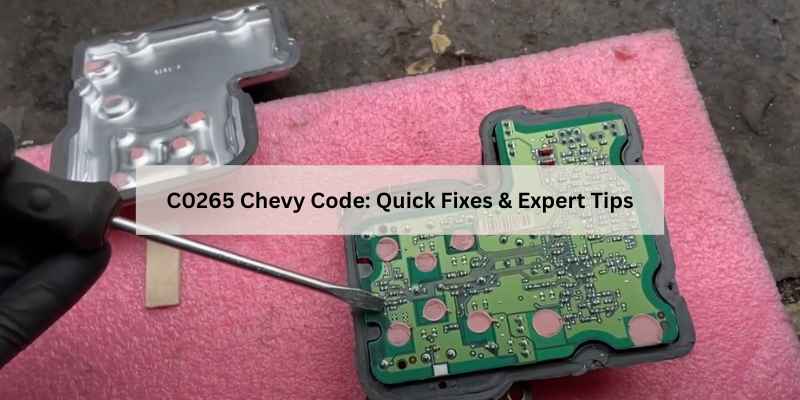
Step 3: Test the relay coil. The relay is usually integrated into the EBCM circuit board, but on many GM trucks, it’s a separate relay mounted on the EBCM housing or in the under-hood fuse box. If it’s separate, remove it. Measure resistance across the coil terminals (pins 85 and 86). A good coil reads between 50 and 120 ohms. An open circuit (infinite resistance) means the coil is dead.
Step 4: Test the relay contacts. Apply 12V across the coil terminals. You should hear a click. Then measure resistance across the switch terminals (pins 30 and 87). A good relay reads near 0 ohms. If you see high resistance (over 1 ohm) or no continuity, the contacts are burned.
Step 5: Test the motor circuit. If the relay tests good, the problem might be the motor itself. With the connector off, measure resistance between the motor power pin and ground. A healthy motor reads around 1-3 ohms. An open circuit means the motor brushes are worn out. A short to ground (0 ohms) means the motor is seized or internally shorted.
Here’s a simple decision table:
| Test Result | Diagnosis | Action |
|---|---|---|
| Relay coil open (no continuity) | Relay coil failed | Replace the relay |
| Relay contacts high resistance | Relay contacts burned | Replace the relay |
| Relay clicks, contacts good, motor open | ABS pump motor failed | Rebuild or replace EBCM |
| Relay good, motor reads 1-3 ohms, connector corroded | Connector issue | Clean pins, apply dielectric grease |
| Relay good, motor good, code persists | Wiring or EBCM board issue | Inspect harness, consider bench test |
The Fix: Relay Replacement vs. EBCM Rebuild vs. New Module
If the relay is bad, you’re in luck. A standalone relay costs $10 to $20. On some models, you can pop it out and replace it without touching the EBCM. On others, the relay is soldered to the circuit board inside the EBCM. In that case, you have two options.
EBCM rebuild: You can send your module to a company that replaces the relay board and reflows the solder joints. This costs $150 to $250 and takes a few days. It’s a solid option if the motor is healthy. Many rebuilders also replace the motor brushes while they’re in there.
New module: A brand new EBCM from the dealer costs $500 to $800. Aftermarket units run $300 to $500. You also need to program it to your VIN, which adds labor. This is the last resort, not the first step.
Temporary Bypass to Get Home Safely
If you’re stuck on the side of the road and need to get home, you can bypass the relay. This is a temporary fix, not a permanent repair. The goal is to restore normal ABS function so you can drive safely.
Find the relay in the under-hood fuse box or on the EBCM. Remove it. Look at the socket — you’ll see four pins. Two are the coil (smaller wires), two are the switch (larger wires). Use a jumper wire with alligator clips to connect the two large switch pins together. This provides constant power to the ABS pump motor.
Important caveat: the pump motor will run continuously while the ignition is on. That’s not ideal for the motor, and it will drain the battery if you leave the key on. Drive directly home or to a shop, then remove the jumper. Do not leave it in place for more than a few hours. This bypass also means the ABS will engage at full force whenever you brake, which can feel aggressive — drive gently.
Step-by-Step EBCM Replacement (Silverado/Sierra Example)
If you’ve confirmed the motor is dead or the board is fried, here’s how to swap the EBCM. This example uses a 2026 Silverado 1500, but the process is similar across GMT900 and K2XX trucks.
- Disconnect the battery. Negative terminal first. Wait 5 minutes for the system to discharge.
- Jack up the front of the truck. Use jack stands. You need clearance to reach the EBCM under the driver’s side frame rail.
- Remove the splash shield. It’s held by a few 8mm bolts and plastic push pins. Set it aside.
- Locate the EBCM. It’s a silver box with two large brake lines going into the top and a big electrical connector on the side.
- Disconnect the electrical connector. Press the release tab and pull straight out. Be gentle — the pins are fragile.
- Remove the two brake lines. Use a line wrench (flare nut wrench) to avoid stripping the fittings. Have a catch pan ready for brake fluid.
- Remove the mounting bolts. Usually three or four 10mm or 13mm bolts. Support the module while removing the last bolt.
- Install the new or rebuilt module. Bolt it in place, reconnect the brake lines, and torque them to 15 ft-lbs. Reconnect the electrical connector.
- Bleed the brakes. You’ll have air in the system. A pressure bleeder is easiest, but a two-person bleed works fine. Start at the wheel farthest from the master cylinder (passenger rear), then driver rear, passenger front, driver front.
- Reconnect the battery. Turn the key to the ON position (don’t start the engine) and wait for the ABS light to go out.
One year-specific quirk: on 2026+ K2XX trucks, the EBCM is mounted higher and often requires removing the air cleaner assembly for access. The brake lines are also routed differently, so give yourself extra room.
Post-Repair: Clearing the Code and ABS Relearn
After the repair, you need to clear the code and perform a relearn. Most scan tools can clear the code. The FOXWELL NT301 handles that easily.
The ABS relearn is simpler than you think. Drive the truck straight for about 30 seconds at 20 mph, then 30 seconds at 40 mph, then 30 seconds at 60 mph. This lets the wheel speed sensors recalibrate to the new module. If you replaced the EBCM, you might need a professional scan tool to perform a “module setup” procedure, which tells the module your truck’s VIN and options. Some aftermarket EBCMs are plug-and-play, but dealer units often require this step.
If the code comes back immediately after clearing, the repair didn’t take. Recheck the relay and motor tests. If the code returns after a few days, look for an intermittent wiring issue or a failing battery.
Cost Breakdown: DIY vs. Shop Repair
| Repair Path | Parts Cost | Labor Cost | Total Estimate |
|---|---|---|---|
| DIY relay replacement | $10 – $20 | $0 (1-2 hours) | $10 – $20 |
| DIY connector cleaning | $10 (cleaner + grease) | $0 (1 hour) | $10 |
| DIY EBCM rebuild (send out) | $150 – $250 | $0 (2-3 hours removal/install) | $150 – $250 |
| Shop relay replacement | $20 | $100 – $150 | $120 – $170 |
| Shop new EBCM + programming | $400 – $800 | $200 – $300 | $600 – $1,100 |
The difference between the top and bottom rows is over a thousand dollars. That’s why testing first matters. For a related issue, check this C0265 code guide for more context on GM-specific codes.
Frequently Asked Questions
Can I drive my truck with the C0265 code?
Yes, but only short distances. Normal brakes work fine. ABS and traction control are disabled, so you’re at higher risk in slippery conditions. It’s not safe for daily driving, especially in rain or snow.
Is the C0265 code the same on all Chevy models?
The code definition is the same across GM platforms — ABS pump motor relay circuit. But the physical location of the relay and EBCM varies. A Silverado has it under the frame rail, while a Traverse or Equinox might have it under the hood near the master cylinder. Always confirm the location for your specific model.
Why does my ABS pump run after I turn off the engine?
That’s a classic symptom of a stuck relay. The relay contacts are welded shut, keeping power on the pump motor even after the ignition is off. This drains the battery and can burn out the motor. Disconnect the battery immediately and replace the relay.
Do I need to bleed the brakes after replacing the EBCM?
Yes. Any time you open the hydraulic lines, air gets in. You need a proper bleed to remove it. Skip this step and you’ll have a soft pedal and poor braking performance.
Can a low battery cause a C0265 code?
It can. The EBCM needs stable voltage to operate the relay. If the battery is weak or the alternator is failing, the module may set false codes. Test battery voltage at rest (12.6V) and with the engine running (14.2V) before replacing any parts.
Don’t Ignore the C0265 – Here’s Why
The C0265 code isn’t a death sentence for your truck, but it’s not something to shrug off either. You lose two safety systems that matter in bad weather. The fix is often cheap and quick if you diagnose properly.
- Test the relay with a multimeter before buying anything. It’s a 10-minute job that can save $500.
- Check the connector pins for corrosion first — it’s the most common cause on GMT900 trucks.
- Use a temporary jumper wire only to get home, then remove it. Leaving it in place burns out the pump motor.
- If the motor reads open on the multimeter, prepare for a rebuild or replacement, not a relay swap.
- Bleed the brakes completely after any EBCM removal. A soft pedal is dangerous.
- Clear the code and do the drive cycle relearn. It takes two minutes and confirms the fix worked.
- If the code returns within a week, suspect a wiring harness issue or a failing battery, not the module itself.
For other Chevy-specific diagnostic issues, you might also find this P0430 Chevy code guide useful. And if you’re dealing with electrical gremlins on a trailer setup, this trailer wiring color code guide covers the basics.
Products related to this article
Sponsored / affiliate links. As an Amazon Associate I earn from qualifying purchases. I may earn additional commission from eligible campaigns.