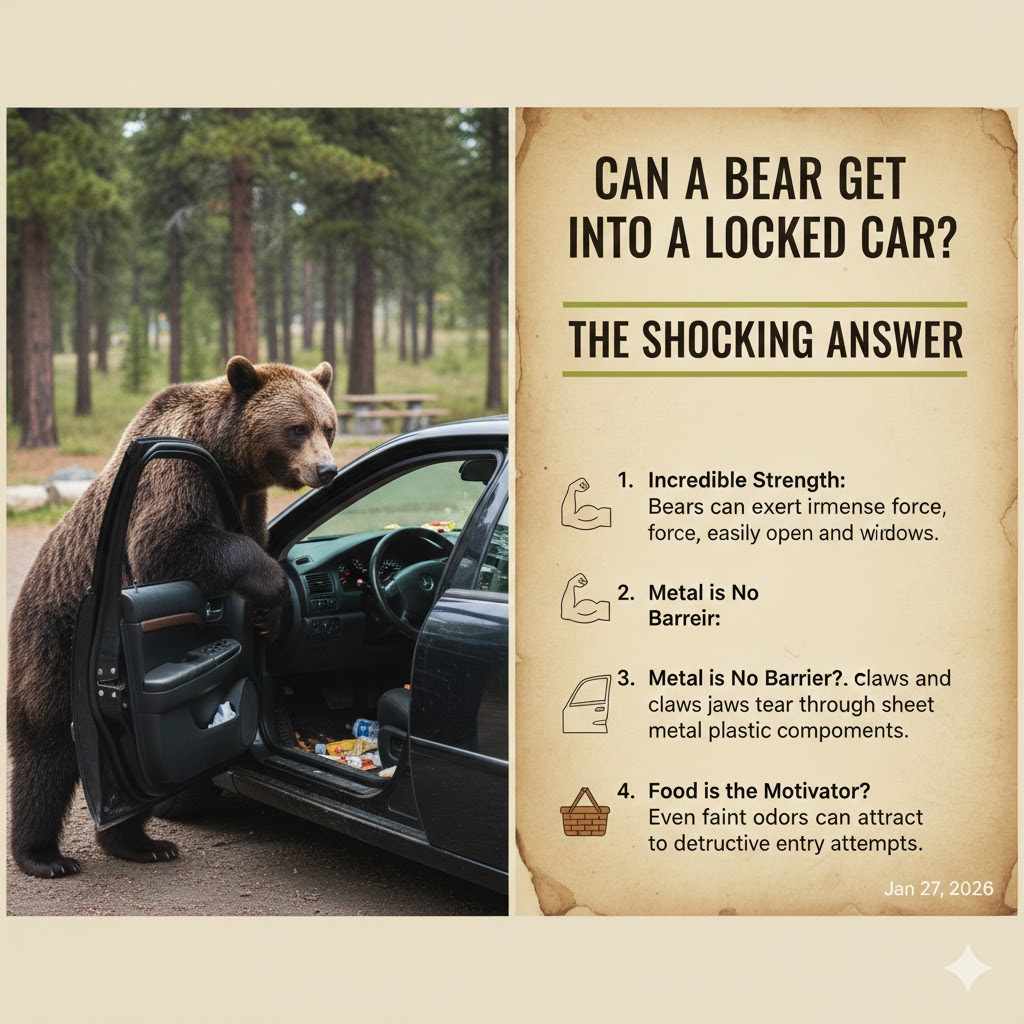
Can a Bear Get Into a Locked Car? The Shocking Answer
Yes, a bear can absolutely get into a locked car. A simple door lock offers almost no protection against a bear’s immense strength and sharp claws. If a bear smells something enticing inside, like food or even a scented air freshener, it can easily peel open a car door, shatter a window, or bend a metal frame to get inside.
Hello, I’m Md Meraj. As your friendly automotive guide, I help people understand their cars and stay safe on the road. Today, we’re tackling a question that might sound like it’s from a movie, but it’s a real concern for anyone who drives or camps in nature: can a bear break into your locked vehicle?
It’s a scary thought. You’ve packed up, locked the doors, and settled in for the night, hoping your car is a secure metal box. But is it really? The truth might surprise you. Don’t worry, though. I’m here to walk you through exactly what a bear is capable of and give you simple, practical steps to make sure your car—and you—stay safe. Let’s get started.
Why Your Car Isn’t the Fortress You Think It Is
We see our cars as solid, protective shells. To us, they are heavy, strong, and secure. But to a bear, a car is just a container with a potential meal inside. Understanding why a car is so vulnerable is the first step to protecting it.
A Bear’s Incredible Superpowers: Strength and Smell
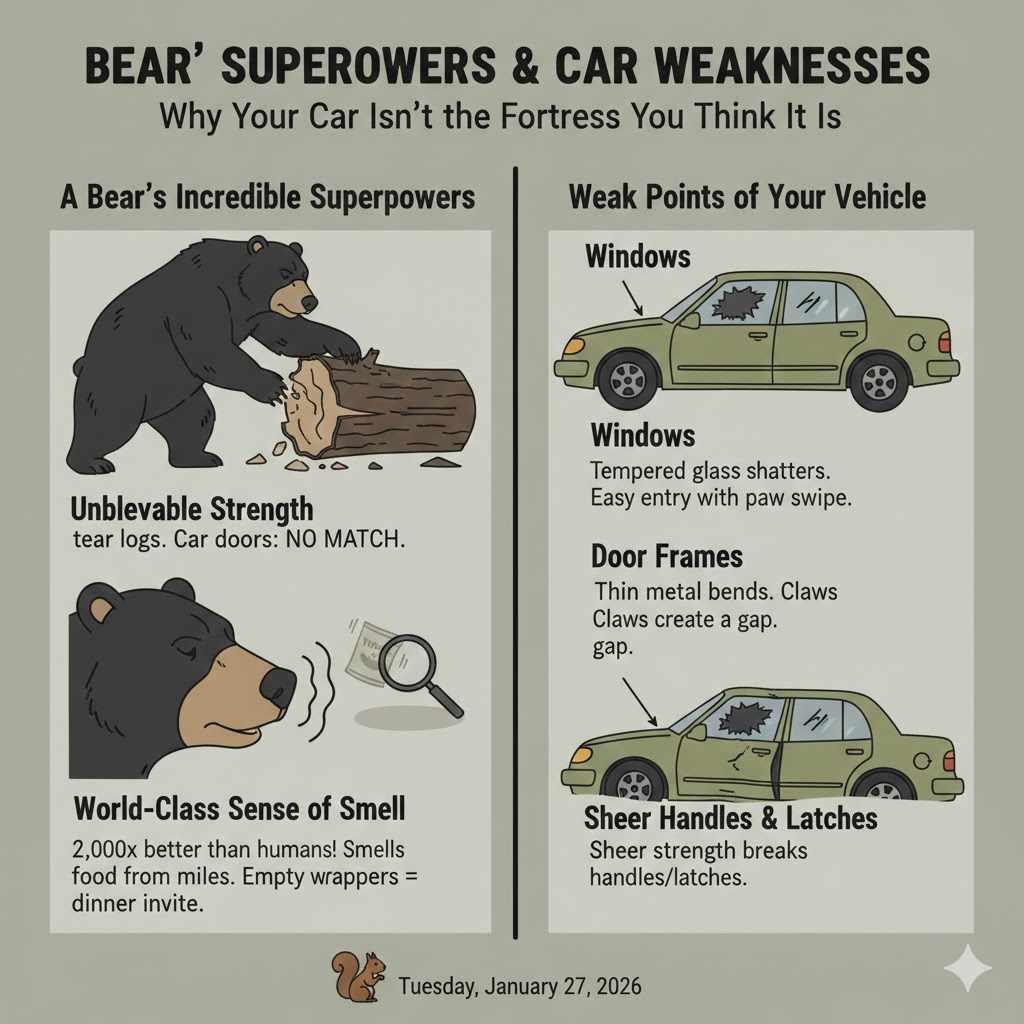
Bears have two main advantages that make them a serious threat to any vehicle: their brute strength and their phenomenal sense of smell.
- Unbelievable Strength: A black bear, the most common type in North America, is incredibly powerful. An adult male can weigh over 500 pounds and is strong enough to flip over large rocks and tear apart logs. A car door, held shut by a small metal latch, is no match for this kind of force. Bears can use their claws to pry open doors, bend the metal frames, and pop windows right out of their seals.
- A World-Class Sense of Smell: A bear’s sense of smell is its greatest tool. It is said to be about seven times better than a bloodhound’s, or over 2,000 times better than a human’s. A bear can smell food from miles away. That sealed bag of trail mix, the empty fast-food wrapper under your seat, or even the lingering scent of groceries you brought home last week can be an open invitation.
The Weak Points of Your Vehicle
Every car has weak points that a determined bear can exploit. These are the areas where a bear will focus its efforts.
- Windows: Car windows are made of tempered glass, which is strong but shatters into small pieces under enough force. A bear can easily break a window with a swipe of its paw or by applying pressure.
- Door Frames: While car doors feel solid, the thin metal around the window frame can be bent. A bear can hook its claws into the top of the door frame and pull it outward, creating enough of a gap to get inside or break the window.
- Door Handles and Latches: Some intelligent bears have even learned how to operate car door handles. While this is less common, their sheer strength means they can often just break the handle or the latch mechanism by pulling on it.
So, Does Locking Your Car Even Help at All?
After hearing about a bear’s strength, you might wonder if locking the door makes any difference. It’s a fair question, and the answer isn’t a simple yes or no.
The Short Answer: A Little, But Not Much
Locking your car door is better than leaving it unlocked. An unlocked door is a welcome mat for a curious bear, especially one that may have learned how to use door handles. A lock adds one small barrier. It might confuse a younger, less experienced bear for a moment.
However, you should never rely on a lock for protection. It provides a false sense of security. A motivated bear, driven by the scent of food, will not be stopped by a lock. The lock is just a minor inconvenience it will quickly overcome with brute force. Think of it as a helpful habit, but not a solution.
Real-Life Stories: When Locks Mean Nothing
Every year, park rangers in places like Yosemite and Yellowstone National Parks deal with dozens, if not hundreds, of “bear break-ins.” In almost every case, the car was locked. Rangers have countless stories of owners who thought they were safe because they had locked their doors, only to return to find their car torn apart.
These bears aren’t picking locks; they’re using pure power. They see a car not as a vehicle, but as a puzzle box with a reward inside. They will smash, tear, and bend their way to that reward, and a simple lock won’t change their mind.
What Exactly Attracts Bears to Your Car?
The number one reason a bear will try to get into your car is scent. Their survival depends on finding high-calorie food, and they have learned that cars often contain it. It’s not just obvious food items; many everyday products have strong scents that attract bears.
Here’s a table of common items that can turn your car into a bear magnet. The key is to remove every single one of these before leaving your car in bear country.
| Item Category | Specific Examples | Why It’s a Problem |
|---|---|---|
| Food & Drinks | Coolers (even empty), groceries, snacks, candy, pet food, soda cans, water bottles with flavor additives. | These are direct sources of food. Even sealed packages emit scents that bears can easily detect. |
| Scented Products | Toothpaste, soap, deodorant, sunscreen, lip balm, air fresheners, scented hand sanitizer, baby wipes. | Bears don’t know the difference between food and non-food scents. A fruity air freshener smells like a potential meal. |
| Trash & Empties | Empty food wrappers, fast food bags, soda cans, coffee cups, used utensils. | The lingering scent on an empty wrapper can be just as strong as the food itself. This is one of the most common attractants. |
| Cooking Supplies | Pots, pans, stoves, used dishes, garbage bags. | These items retain the smell of cooked food long after they have been used. |
Your Ultimate Guide: How to Properly Bear-Proof Your Car
Now for the good news: you have complete control over making your car uninteresting to a bear. It just takes a little discipline and following a few simple steps. This is the only proven way to prevent a break-in.
Step 1: The “Clean Car” Rule Is Everything
This is the most important rule. Before you park your car for the night or for a hike, you must remove everything that has a scent. This includes all items from the table above. Don’t just hide them in your trunk or glove compartment; bears can still smell them. Physically remove them from the vehicle and store them properly.
Step 2: Check Every Nook and Cranny
Do a thorough sweep of your car. Look under the seats, in the side door pockets, in the center console, and in the glove compartment. Check for fallen crumbs, a stray candy wrapper, or a forgotten tube of lip balm. A car that is completely empty of attractants is a boring car to a bear, and a boring car is a safe car.
Step 3: Windows Up, Doors Locked
Always roll up your windows completely. Even a small crack allows scents to escape and gives a bear a convenient place to start prying. And yes, lock your doors. As we discussed, it’s not a foolproof solution, but it’s a good habit and eliminates the easiest point of entry.
Step 4: Use a Bear Canister or Food Locker
So, where do you put all the scented items you just removed from your car? The answer is a designated food storage locker. Most established campgrounds in bear country provide metal bear-proof boxes for this exact purpose. According to the National Park Service, proper food storage is mandatory in many areas. If you are backpacking or camping in a more remote area, you should use a portable, certified bear-resistant canister to store your food and toiletries.
Step 5: Park Smart When Possible
If you have a choice, avoid parking near dumpsters, trash cans, or designated fish-cleaning stations, as these areas are frequently visited by bears. Try to park in open, well-lit areas away from dense forest cover.
What If a Bear Gets In Anyway? A Safe Action Plan
Even with the best precautions, a bear might still target a car, perhaps because of a scent left by a previous owner. If you find a bear in or on your car, your personal safety is the only priority.
First Rule: Your Safety Comes First
Never, ever approach a bear. Do not yell, throw things, or try to scare it away yourself. A bear that is in a car can feel cornered and may become defensive or aggressive. Your car can be repaired or replaced; you cannot. Keep a significant distance—at least 100 yards.
How to Safely Get the Bear Out
From a safe distance, you have a few options. The best and safest one is to contact the authorities. Call the park rangers, campground host, or local police. They are trained to handle wildlife situations safely.
If you are in a safe location (like a building or another vehicle far away) and have a remote key fob, you can try activating the panic alarm. The sudden, loud noise can sometimes be enough to startle the bear and make it leave. Do not attempt this if you are nearby and exposed.
Assessing the Damage After the Bear is Gone
Once the authorities have confirmed the bear is gone and the area is safe, you can inspect your vehicle. Before you touch anything, take plenty of photos and videos of the damage from every angle. This will be crucial for your insurance claim. Check for broken windows, bent door frames, damaged handles, and torn or chewed interior components.
Bear Damage vs. Car Damage: A Quick Comparison
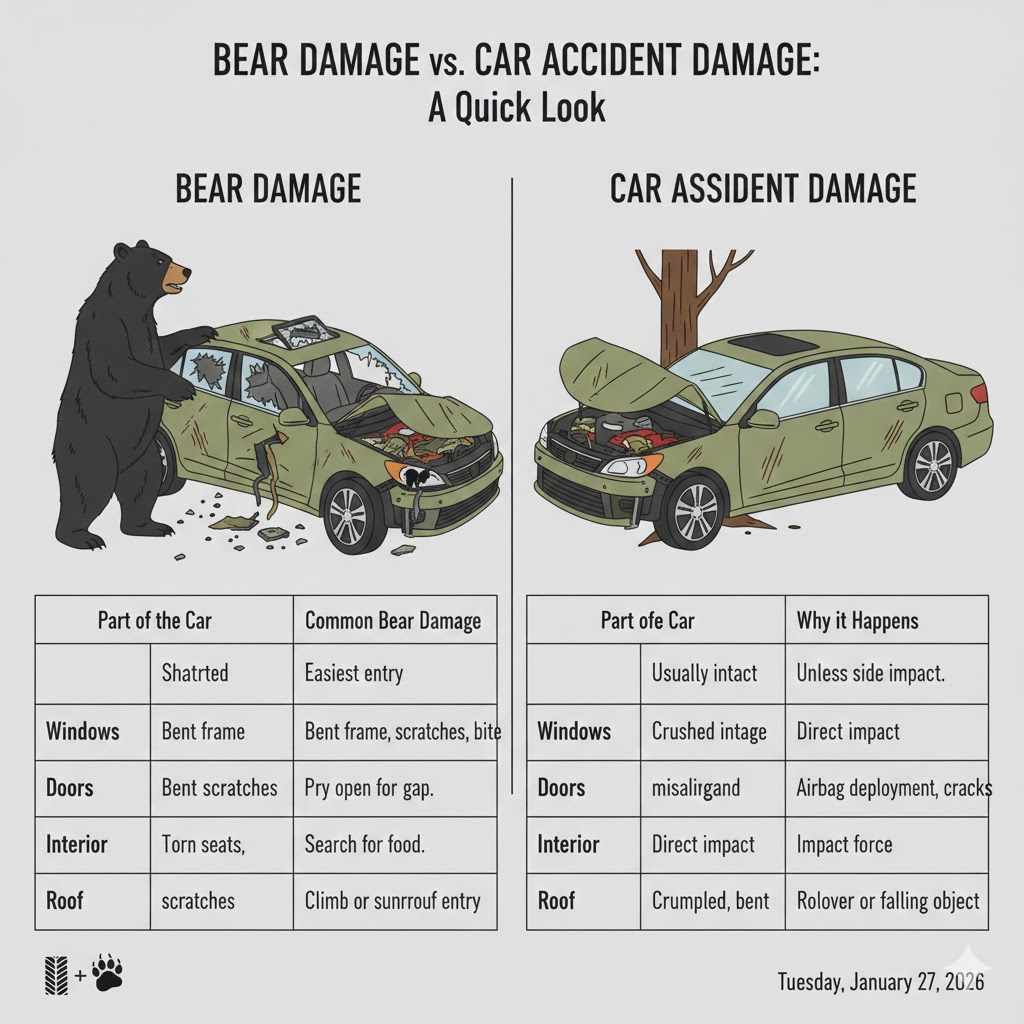
The damage a bear can inflict on a car is extensive and often shocking. They don’t just take the food and leave; the process of getting in is destructive. Here’s a look at the common types of damage.
| Part of the Car | Common Bear Damage | Why it Happens |
|---|---|---|
| Windows | Completely shattered or popped out of the frame. | This is often the easiest entry point for a bear. They use their paws to push or strike the glass until it breaks. |
| Doors | Bent frames, deep scratches, broken handles, bite marks. | Bears will pry at the top of the door frame, bending the metal to create a gap. Their claws leave deep gouges in the paint and plastic. |
| Interior | Torn upholstery, shredded seats, chewed dashboard, broken center console. | Once inside, the bear will frantically search for the source of the scent, tearing apart anything in its way. |
| Roof | Dents and scratches. | Bears may climb on top of cars to get a better vantage point or to try to enter through a sunroof, causing significant dents. |
Frequently Asked Questions (FAQ)
Can a bear learn how to open a car door handle?
Yes, some bears, particularly in high-traffic areas like national parks, have learned to operate simple lever-style door handles. This is another reason why locking your doors is a good habit, as it prevents this type of easy entry.
Are certain types of cars more vulnerable to bear break-ins?
Not really. While a minivan with sliding doors or a car with a flimsy frame might be slightly easier to get into, bears are strong enough to break into almost any passenger vehicle, including large trucks and SUVs. The presence of a scent is the deciding factor, not the type of car.
Will my car alarm scare a bear away?
Sometimes. A loud, sudden car alarm can startle a bear and cause it to flee, especially if it’s a younger, less experienced bear. However, bears in populated areas may become accustomed to loud noises and might ignore an alarm if they are determined to get food.
Does my car insurance cover bear damage?
In most cases, yes. Damage caused by animals is typically covered under the comprehensive portion of your auto insurance policy. It’s always a good idea to check your specific policy details and take plenty of photos of the damage for your claim.
What smells repel bears? Is there anything I can put in my car?
While some strong scents like ammonia or pine-scented cleaners are sometimes thought to repel bears, they are not reliable and can be messy. The only proven method is to have no scent at all. Trying to cover up a food smell with a repellent smell will likely just make your car smell more interesting to a curious bear.
Can a grizzly bear get into a car easier than a black bear?
Yes. Grizzly bears are significantly larger and more powerful than black bears. While a black bear can do immense damage, a grizzly can do it even more quickly and destructively. Fortunately, grizzly bears are less common and typically live in more remote areas than black bears.
Conclusion: Your Car, Your Responsibility in the Wild
So, can a bear get into a locked car? The answer is a clear and resounding yes. A car door lock is simply no match for a determined, hungry bear. But this isn’t a reason to be afraid—it’s a reason to be smart and prepared.
The power to protect your vehicle lies entirely in your hands. It’s not about buying a stronger car or a fancier lock; it’s about discipline. By keeping your car spotlessly clean and free of any scented items, you make it completely uninteresting to a bear. A bear that smells nothing has no reason to investigate your car and will simply move on.
Remember the golden rule of bear country: a clean car is a safe car. Follow the steps we’ve outlined, store your food and toiletries properly, and you can enjoy the beauty of nature with peace of mind. Stay safe out there!