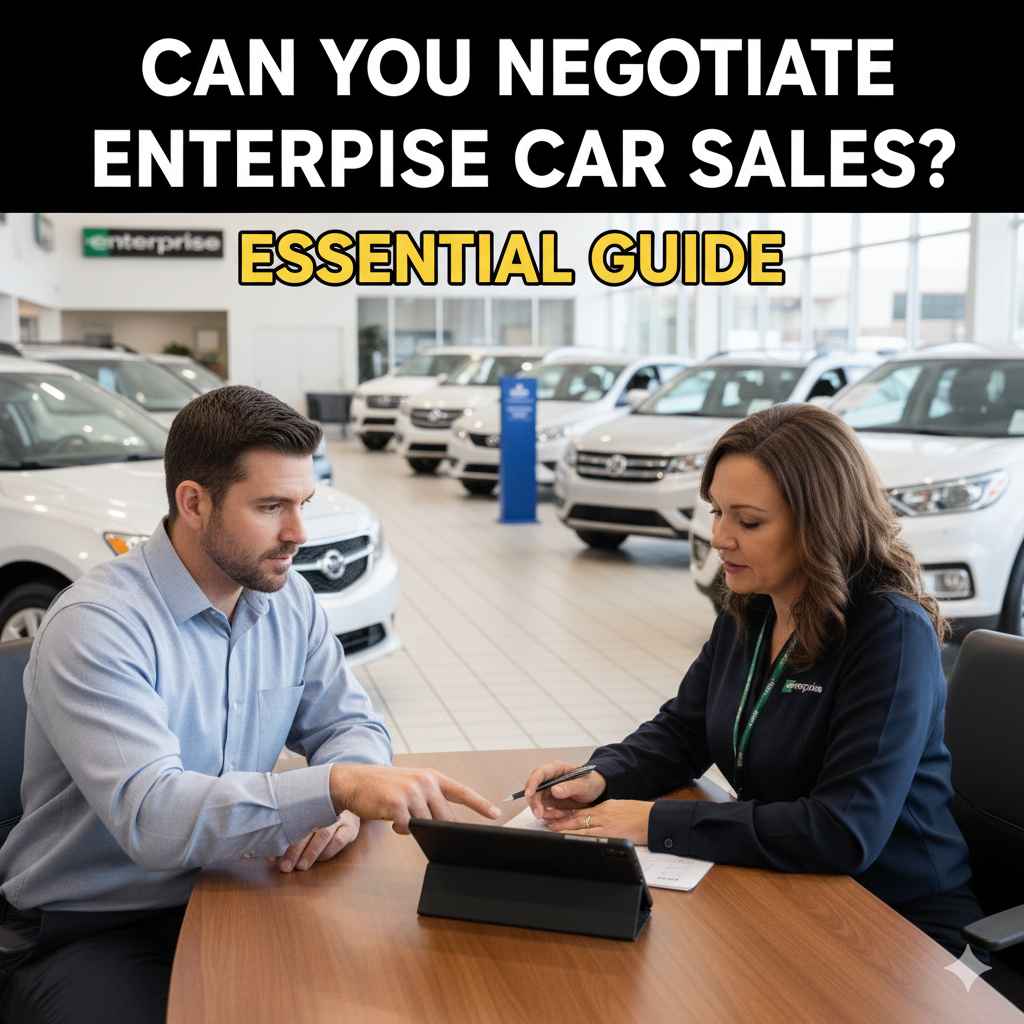
Can You Negotiate Enterprise Car Sales? Essential Guide
Yes, you can absolutely negotiate Enterprise car sales! While Enterprise often presents itself as a fixed-price retailer, savvy buyers can still find room for negotiation, especially on the final price and added services. Being prepared and informed is your best tool for securing a better deal.
Can You Negotiate Enterprise Car Sales? Your Essential Guide
Buying a car is a big deal, and feeling like you got a fair price is important. When you’re looking at Enterprise car sales, you might wonder if there’s any wiggle room. Enterprise buys and sells a lot of vehicles, and while their pricing might seem set in stone, there are definite ways you can approach the negotiation process. Think of it less like a high-stakes back-and-forth and more about smart, informed discussion. We’re here to guide you through it, making sure you feel confident and in control.
Understanding Enterprise Car Sales
Enterprise has a unique model. They primarily sell vehicles from their own rental fleet after they’ve reached a certain mileage or age. This means they have a large volume of cars and a fairly standardized pricing strategy. Their goal is to move these vehicles efficiently. Because they aren’t a traditional dealership with a huge overhead of floor plans for hundreds of new cars, their pricing is often already competitive. However, “competitive” doesn’t always mean “rock bottom.”
The cars are typically sold “as-is,” but Enterprise does perform maintenance and some checks before selling. This can give you a bit more peace of mind than buying from a private seller. Knowing how they operate is the first step to understanding where negotiation might fit in.

Why Negotiation is Possible (And How to Approach It)
Even though Enterprise aims for transparent pricing, negotiation is still possible. Here’s why and how:
Volume and Inventory Turn: Enterprise wants to keep their fleet fresh. If a car has been on the lot for a while, or if they have an excess of a certain model, they might be more open to a slightly lower price to move it.
Financing and Add-ons: While the car’s price is one part, extras like extended warranties or add-on protection plans can also be areas for negotiation.
Market Conditions: Just like any car market, demand and supply play a role. Knowing what similar cars are selling for elsewhere gives you leverage.
Your Preparedness: The more you know about the car and the market, the stronger your negotiating position.
Step-by-Step Guide to Negotiating Your Enterprise Car Purchase
Ready to dive in? Here’s how you can approach negotiating with Enterprise:
Step 1: Research, Research, Research!
This is the most crucial step. Before you even set foot on an Enterprise lot, do your homework.
Know the Car’s Value: Use reputable online resources like Kelley Blue Book (KBB), Edmunds, and NADA Guides. Look up the specific year, make, model, trim level, and mileage of the car you’re interested in. Understand its market value in your local area. Pay attention to the “fair purchase price” or similar metrics. You can find valuable resources on car valuation from government agencies like the Federal Trade Commission (FTC), which offers guidance on buying used cars.
Check Competitors: See what similar cars are listed for at other dealerships (both franchised and independent used car lots) and on private sale sites in your area. This gives you a benchmark for pricing.
Inspect the Car Thoroughly: If possible, take the car for a thorough test drive. Listen for any strange noises, check that all electronics work, and examine the interior and exterior for wear and tear. Consider bringing a trusted mechanic for an independent pre-purchase inspection if you’re serious about the car. This inspection can uncover issues that are bargaining chips.
Step 2: Get Pre-Approved for Financing
Knowing your financing options beforehand gives you significant power.
Shop Around for Loans: Get quotes from your bank, credit union, or online lenders before you go to Enterprise. Compare interest rates (APR), loan terms, and monthly payments.
Understand Your Budget: Knowing how much you can realistically afford for a monthly payment and a total loan amount prevents you from overspending.
Compare Offers: If Enterprise offers you financing, you can compare it to your pre-approval. If their rate is higher, you can ask them to match it or even walk away and use your own financing.
Step 3: Visit Enterprise and Inspect
Once you’ve identified a car online, head to the dealership.
Take Your Time: Don’t feel rushed. Look at the car carefully. Note down any imperfections you find – scratches, dents, worn tires, interior stains, or mechanical quirks you noticed during the test drive.
Ask Questions: Inquire about the car’s maintenance history (Enterprise usually keeps good records), why it’s being sold, and if there are any known issues.
Step 4: The Negotiation Begins
This is where you put your research and preparedness to work.
Start with a Fair Offer: Based on your research, make an offer that is below the asking price but still reasonable. Don’t start with an insultingly low offer, as this can immediately shut down communication. A good starting point might be 5-10% below their asking price, depending on your market research and the car’s condition.
Justify Your Offer: Use your research to explain why you’re offering a certain price. For example: “I’ve seen similar models with comparable mileage in this area listed for around $[X amount], and based on KBB, the fair market value is closer to $[Y amount]. Given the current condition and mileage, I’d like to offer $[Your Offer].”
Focus on the Out-the-Door Price: Always negotiate the total price you will pay, including all fees and taxes, not just the sticker price. Ask for an “out-the-door” price. This prevents them from adding hidden fees later.
Be Polite but Firm: Maintain a friendly and respectful tone. This isn’t a battle; it’s a business transaction. However, be firm on your price based on your research and budget.
Be Prepared to Walk Away: This is your most powerful negotiating tactic. If you can’t reach an agreement that works for you, thank them for their time and be willing to leave. Sometimes, this can prompt them to reconsider their price or terms. Don’t be afraid to say, “Thank you for your time, but at this price, I don’t think it works for me right now.”
Step 5: Negotiate Add-Ons and Fees
Once you’ve agreed on a price for the car, you might discuss additional items.
Extended Warranties: Enterprise often offers extended service contracts. These can be negotiable. Compare the cost and coverage to third-party warranties. Understand what is covered and for how long. You can often negotiate a better price or ask them to include a certain level of coverage for free or at a reduced rate.
Fees: Question any fees that seem unclear or excessive. Enterprise typically has documentation fees, but ask for a breakdown. Ensure they are reasonable and in line with local regulations. For example, some states have caps on dealer fees.
Accessories: If the car is missing something basic (like floor mats in good condition), you might ask if they can be included as part of the deal.
Step 6: Review the Paperwork Carefully
Before signing anything, read every document.
Check the Numbers: Make sure all the agreed-upon prices, interest rates, and terms are accurately reflected in the contract.
Understand All Terms: If anything is unclear, ask for clarification. Don’t feel pressured to sign if you’re unsure about something.
What Can You Negotiate?
Let’s break down the specific areas where you might find negotiation room:
The Sticker Price: This is the most obvious area. It’s highly dependent on market value, car condition, and how long the car has been on the lot.
Financing Terms: If you’re financing through Enterprise, their offered interest rate (APR) is often negotiable, especially if you have a better pre-approval from another lender.
Extended Warranties/Service Contracts: These are profit centers for dealerships, and there’s usually significant room to negotiate the price of these add-ons.
Potentially Minor Reconditioning: If you identify a minor issue that would cost a little to fix (e.g., a scratched bumper that could be buffed out), you might ask if they’d address it or offer a small discount to compensate. Major mechanical issues found during inspection would likely be a reason to walk away or ask for a substantial price reduction.
What is Generally NOT Negotiable?
While negotiation is possible, some things are usually fixed:
Federal Taxes: You absolutely have to pay federal taxes on your purchase.
State and Local Sales Tax: These are set by your state and local governments and are non-negotiable.
Title and Registration Fees: These are administrative costs for transferring ownership and are usually set by government agencies.
Enterprise’s Base Service Fee: They might have a standard service fee for processing the sale that is often fixed.
Factors That Influence Your Negotiation Power
Your ability to negotiate effectively depends on several things:
The Specific Enterprise Location: Some locations might have more flexibility than others.
The Car’s Age and Mileage: Older cars with higher mileage might have more room for negotiation.
How Long the Car Has Been for Sale: Cars that have been on the lot for an extended period are more likely to have price flexibility.
Current Market Demand: If the car you want is very popular and in high demand, your negotiating power will be weaker.
Your Own Preparedness: As highlighted, research and pre-approved financing are your strongest assets.
Negotiating Add-Ons: A Closer Look
Enterprise, like many used car retailers, offers add-ons that can increase the final price. These are excellent candidates for negotiation.
Types of Add-Ons:
Extended Service Contracts (Warranties): These cover repairs after the initial limited warranty (if any) expires. They can range from basic powertrain coverage to comprehensive bumper-to-bumper plans.
Guaranteed Asset Protection (GAP) Insurance: If you finance your car and it’s totaled or stolen, GAP insurance covers the difference between what you owe on the loan and what your standard auto insurance pays out.
Tire and Wheel Protection: Covers damage to tires and wheels from road hazards.
Key Replacement: Covers the cost of replacing lost or damaged key fobs.
Paintless Dent Repair (PDR): Small cosmetic repairs for minor dents.
Negotiation Tactics for Add-Ons:
Ask for the Price Breakdown: Always ask for the individual price of each add-on.
Research Third-Party Prices: For extended warranties, compare Enterprise’s price to those offered by reputable third-party providers. You might find significantly better deals elsewhere.
Bundle and Negotiate: If you’re interested in multiple add-ons, see if you can get a package deal at a discounted price.
“Throw It In”: If you’ve negotiated a good price on the car but are still a bit on the fence, sometimes asking for a specific add-on (like basic floor mats or a particular warranty plan) to be included for free can seal the deal.
Be Prepared to Decline: If the price or terms don’t work for you, it’s perfectly fine to decline any and all add-ons. Buying them is rarely mandatory for purchasing the vehicle itself.
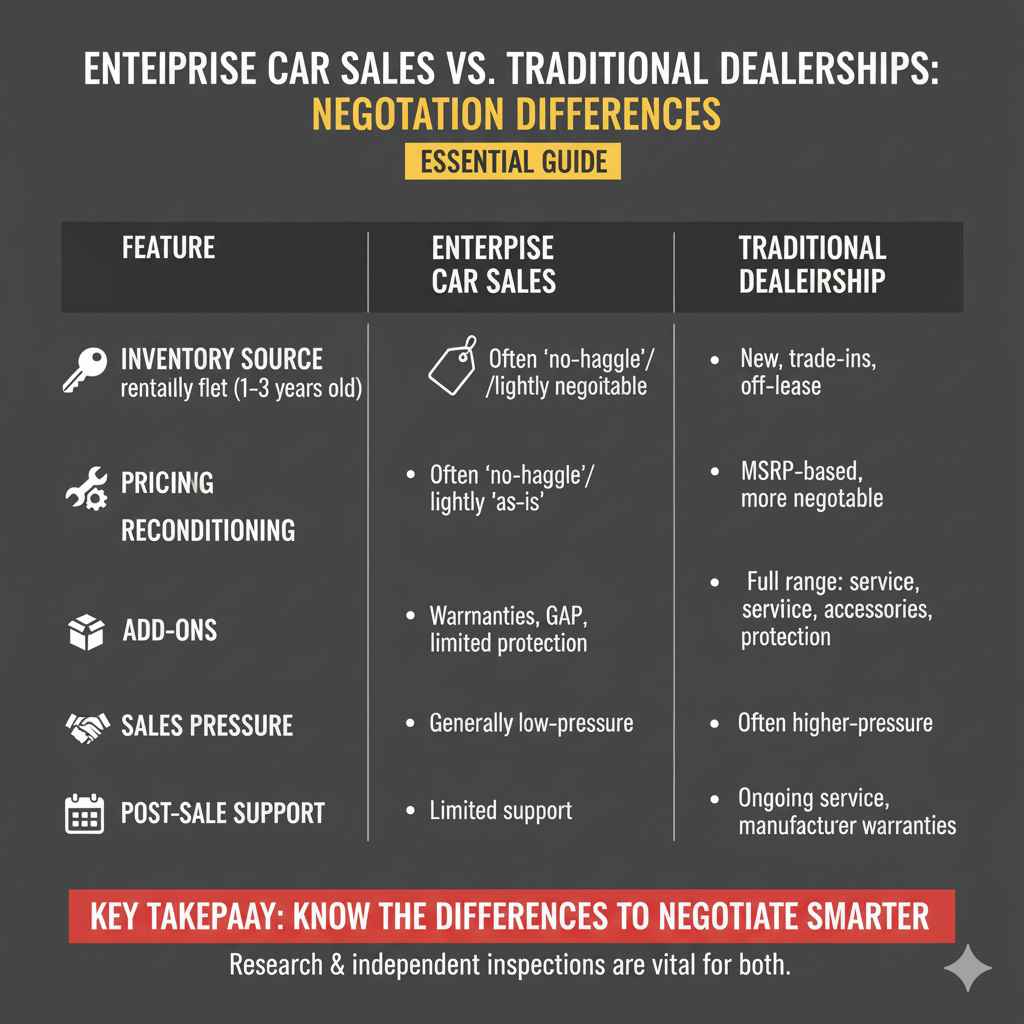
Enterprise Car Sales vs. Traditional Dealerships: Negotiation Differences
Understanding how Enterprise differs from a traditional franchised dealer can help set your expectations:
| Feature | Enterprise Car Sales | Traditional Dealership (e.g., Ford, Toyota Dealer) | Negotiation Impact |
|---|---|---|---|
| Inventory Source | Primarily from Enterprise’s own rental fleet (1–3 years old, well-maintained). | Mix of new cars, trade-ins, and off-lease vehicles. | Enterprise offers more consistency in vehicle condition and pricing; traditional dealers may offer broader selection and promotional discounts. |
| Pricing Structure | Typically “no-haggle” or lightly negotiable fixed pricing. | Usually MSRP-based, with more room for negotiation and dealer incentives. | Enterprise’s prices are often close to fair market value upfront, while traditional dealers may allow for larger negotiated discounts. |
| Reconditioning | Standardized internal reconditioning; vehicles sold clean but typically “as-is.” | Often includes comprehensive inspection and repairs pre-sale. | Enterprise buyers should plan their own inspection and use any findings to negotiate. Traditional dealers might preemptively fix issues. |
| Add-ons | Extended warranties, GAP coverage, and limited protection plans. | Warranties, service packages, accessories, tire/wheel and paint protection. | Both push add-ons for profit; negotiation on these extras can yield savings at either type of dealership. |
| Sales Pressure | Generally low-pressure retail experience. | Often higher-pressure, especially with new car quotas and incentives. | Enterprise’s lower-pressure environment favors buyers who rely on research rather than high-stakes negotiation. |
| Post-Sale Support | Limited support, mostly tied to optional warranty. | Ongoing service support, manufacturer warranties, and recall handling. | Enterprise’s minimal post-sale support means ensuring all details and terms are perfect before signing. Traditional dealers provide long-term service convenience. |
Frequently Asked Questions About Negotiating Enterprise Car Sales
Frequently Asked Questions
Can I negotiate the price of a car at Enterprise if it says “No Haggle”?
While Enterprise often uses “no-haggle” pricing to simplify the process, there can still be some room for negotiation, especially on the out-the-door price, financing terms, or add-ons. It’s always worth making a polite, research-backed offer, particularly if the car has been on the lot for a while or if you’ve found similar vehicles priced lower elsewhere.
What is the best way to prepare for negotiating with Enterprise?
The key to successful negotiation is preparation. Research the car’s market value using online guides (KBB, Edmunds), compare prices of similar vehicles in your area, and get pre-approved for financing from your bank or credit union. Thoroughly inspect and test drive the car, and be ready to point out any issues you find.
Are Enterprise’s extended warranties negotiable?
Yes, extended warranties and other add-on products are often the most flexible part of negotiating with Enterprise. You can usually negotiate the price of these service contracts. It’s also wise to compare their offerings and prices against reputable third-party warranty providers.
What if I find a car at Enterprise that has minor damage?
If you notice minor damage (like scratches, small dents, or worn tires) during your inspection, this can be a strong point for negotiation. You can use the estimated cost of repair as leverage to ask for a price reduction. Be specific about what needs fixing and the cost involved.
Can I negotiate the interest rate if I finance through Enterprise?
Absolutely. If Enterprise offers financing, their quoted interest rate (APR) is often negotiable. If you have secured pre-approved financing from your own lender with a lower rate, you can use that as leverage. Ask Enterprise if they can match or beat that rate. If not, you always have the option to use your own financing.
Is it better to negotiate on the car price or on the add-ons?
It’s best to focus on negotiating the car’s price first, aiming for the best out-the-door price. Once that’s settled, you can then negotiate the price and necessity of any add-ons. Remember, add-ons are often the place where there’s the most room for significant discounts. Don’t be afraid to decline them entirely if they don’t fit your budget or needs.
Conclusion
Buying a car from Enterprise Car Sales can be a smart move, offering a wide selection of well-maintained vehicles. While they project a straightforward pricing approach, remember that negotiation is still a part of the process for those who come prepared. By doing your research on vehicle value, securing financing beforehand, thoroughly inspecting the car, and politely but firmly presenting your case, you can significantly improve your chances of getting a better deal.
Focus on the total out-the-door price, be informed about add-ons, and never be afraid to walk away if the numbers don’t align with your expectations. Your confidence in the negotiation process will grow with each step you take, ensuring you drive away feeling good about your purchase and the value you’ve secured. Happy car hunting!