Best 5 Aux Jack for Car Review
The best 5 aux jack options for an older car stereo are a standard 3.5 mm aux cable, a USB-C to 3.5 mm adapter cable, a right-angle 3.5 mm aux cable, a braided 3.5 mm aux cable, and a longer 3.5 mm cable for awkward dash layouts. Choose the wrong connector and you can get dead audio, hiss, charging-only ports, or a cable that fits your phone but not the head unit. This roundup ranks each option by fit, failure mode, and which phone-and-car pairing it solves.
Quick comparison
| Product | Badge | Best for | Price | ||
|---|---|---|---|---|---|
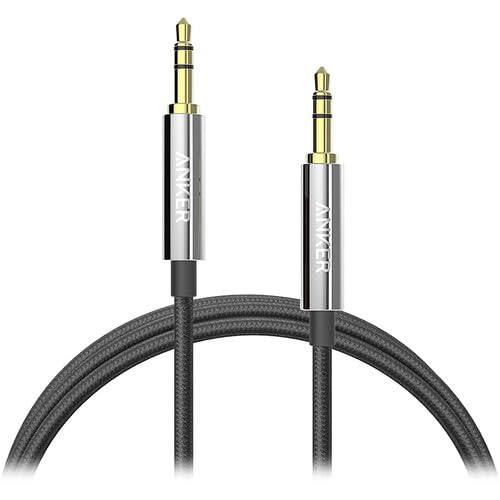 |
Anker Powerline 3.5mm Audio Cable 4ftAnker | Our pick | 4ft · Gold-Plated Connectors · Anker Powerline | $11.99
Price as of 3 Nov 2026
|
View |
 |
Nanxudyj AUX Cord 6ftNanxudyj | Budget pick | 6ft · Right Angle · Nylon Braided | $4.99
Price as of 3 Nov 2026
|
View |
 |
Amazon Basics 3.5mm Stereo Audio Auxiliary CableAmazon Basics | Also great | 8ft · Gold-Plated Plugs · Amazon Basics | $12.20
Price as of 3 Nov 2026
|
View |
 |
CableCreation Aux CableCableCreation | Upgrade pick | 6FT · Flat Design · CableCreation | $7.46
Price as of 3 Nov 2026
|
View |
 |
2 Pack AUX Cable, (6.6ft/2m, Hi-Fi Sound) 3.5mm TRSQianLink | Pair with it | 6.6ft · 2 Pack · QianLink | $6.99
Price as of 3 Nov 2026
|
View |
Use the table to match your phone port to the car input before you shop by brand. Fit matters more than marketing language here, especially when the jack is recessed, the phone case is thick, or the stereo has intermittent audio.
How we chose
The picks below use manufacturer specs, listing details, and published buyer feedback. The focus is car fit, connector type, likely failure mode, and the practical differences between passive 3.5 mm cables, USB-C DAC cables, and Bluetooth-style wireless add-ons.
One cable can be right for sound and still fail in the car because the plug sits too deep, the cord is too short, or the phone case blocks full insertion. That is why this guide weighs dash layout, port shape, and daily use pattern alongside the usual audio features.
Say your center stack has a recessed AUX jack and your phone is in a thick case. A short, straight plug may work on the desk and fail in the car, while a right-angle connector can stay seated without pushing the cable into the console trim.
3.5mm aux cable: best for simple analog runs
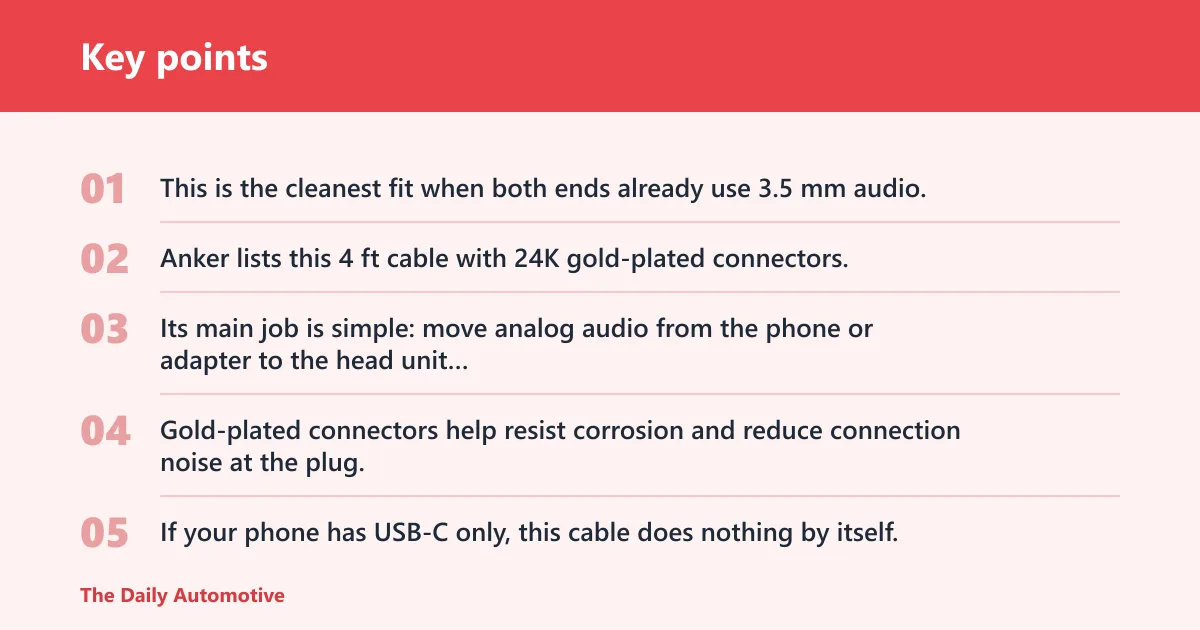
This is the cleanest fit when both ends already use 3.5 mm audio. Anker lists this 4 ft cable with 24K gold-plated connectors, a slim case-friendly connector design, and durability claims around 10,000+ bends, so it appears suited to basic plug-and-play use in a car stereo.
Its main job is simple: move analog audio from the phone or adapter to the head unit with as little friction as possible. Gold-plated connectors help resist corrosion and reduce connection noise at the plug, which matters more in a car than in a quiet desk setup.
The drawback is also simple. If your phone has USB-C only, this cable does nothing by itself. Check the phone port first, then use this when the source device already has a 3.5 mm output or a compatible adapter.
USB-C to 3.5mm adapter cable: best for modern phones
A USB-C to 3.5 mm adapter cable is the right buy when the phone has no headphone jack but the car stereo does. In that setup, the DAC smart chip matters because it converts digital audio to analog inside the cable instead of relying on a separate dongle or a charging port workaround.
That extra conversion step is what makes these cables different from passive 3.5 mm cords. For modern Android phones and recent iPhone models with USB-C, a DAC cable can be the practical fix when the car still expects a standard AUX plug.
The drawback is compatibility checking. Some phones and cases fit poorly with bulky adapter ends, and some low-end cables only work with specific devices. Confirm that the listing supports your exact phone model before you buy.
Bluetooth aux receiver: best for wireless commuting
A Bluetooth aux receiver is the better buy when you want wireless audio and hands-free calling more than a physical cord. It plugs into the car’s AUX input, pairs to the phone, and can be the smarter choice for commuters who get in and out of the car all day.
Bluetooth 5.3 or 5.4 matters most for pairing stability and daily convenience, not for making a wired stereo magically better. Some adapters also include a built-in microphone or dual microphones, which can help with calls when the factory head unit has no hands-free support.
The drawback is that wireless gear adds another layer of setup and another battery or power lead in many cases. If you want zero pairing steps and no charging schedule, a wired cable is still the simpler answer.
Right-angle aux cable: best for tight dashboards
This CableCreation 6 ft right-angle cable fits cramped consoles where a straight plug sticks out too far. The listing calls out a flat tangle-free design, a 90-degree right angle, a 24K gold-plated connector, and TPE plus enameled wire for durability and light weight.
Right-angle plugs help when the AUX jack sits close to trim, a storage bin, or a phone mount. They reduce sideways stress on the port and can stop the cable from getting bumped loose every time you reach for climate controls or cup holders.
The tradeoff is that a right-angle plug is not always the best fit for every car. If the jack is easy to reach and the cable has to travel farther, a straighter plug or a longer cord may route more cleanly.
Braided aux cable: best for daily wear
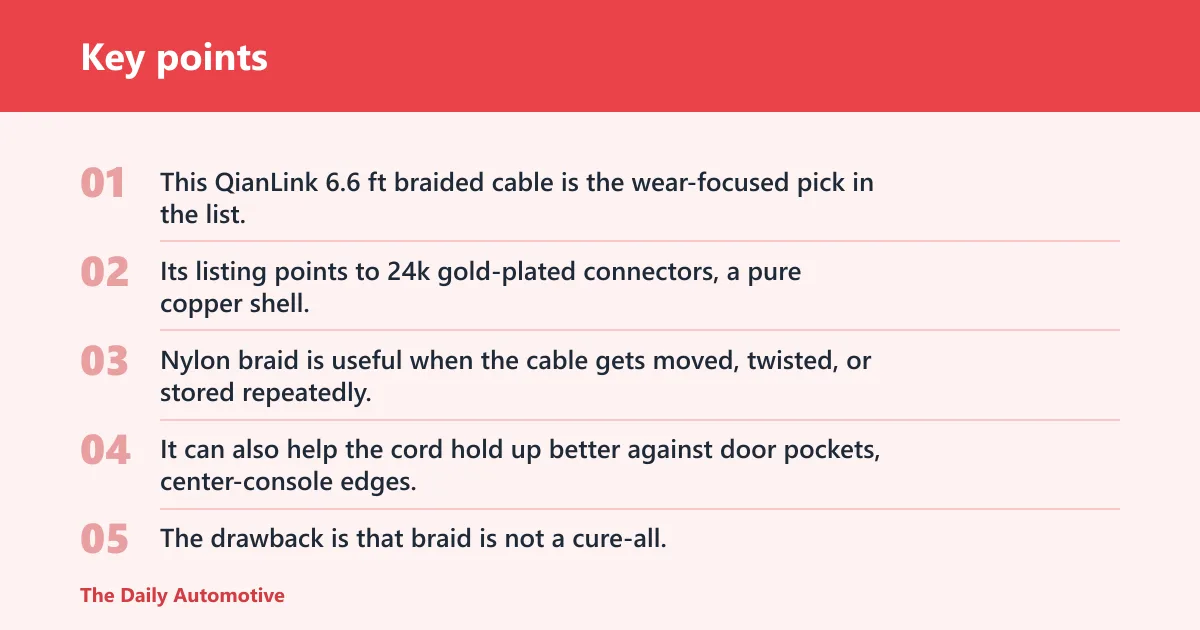
This QianLink 6.6 ft braided cable is the wear-focused pick in the list. Its listing points to 24k gold-plated connectors, a pure copper shell, double-braided nylon, and a 20,000+ bend lifespan, which are the sort of details that matter in daily in-and-out car use.
Nylon braid is useful when the cable gets moved, twisted, or stored repeatedly. It can also help the cord hold up better against door pockets, center-console edges, and the constant bending that happens in a commuter car.
The drawback is that braid is not a cure-all. A braided jacket improves durability, but it does not fix a loose AUX jack, a bad phone port, or an adapter that does not match the device.
Which one should you buy?
If your phone already has a headphone jack, start with a standard 3.5 mm cable. If your phone uses USB-C only, choose the USB-C to 3.5 mm adapter cable first, because the issue is device compatibility, not cable quality.
If your dash is cramped or the AUX port sits flush with the trim, a right-angle cable is usually the safer fit. If the cable will stay in the car full time and get tugged often, the braided option is the better durability play.
For commuters and rideshare drivers, Bluetooth is worth considering when hands-free calling and quick phone hops matter more than perfect plug simplicity. For family cars or older vehicles with limited dash clearance, a wired cable with a right-angle end usually causes fewer day-to-day annoyances.
A common first-timer mistake is buying a 3.5 mm cable because the car has an AUX jack, then discovering the phone only has USB-C. The reverse happens too: the phone fits, but the plug barely seats because the case is thick or the jack is recessed.
Aux jack decision matrix
| Vehicle setup | Phone port | Car input | Best product type | Minimum specs | Common failure point | Notes |
|---|---|---|---|---|---|---|
| Older sedan with visible AUX port | 3.5 mm | 3.5 mm AUX | Standard 3.5 mm aux cable | 3.3 ft to 4 ft, gold-plated plugs | Loose plug or worn jack | Best when the phone already has analog output and the run is short. |
| Compact car with recessed center stack | 3.5 mm | 3.5 mm AUX | Right-angle aux cable | Right-angle connector, about 3.94 ft to 6 ft | Plug interference with trim | Right-angle ends reduce side load in tight dash spaces. |
| Android phone with no headphone jack | USB-C | 3.5 mm AUX | USB-C to 3.5mm adapter cable | DAC smart chip, 3.3 ft to 4 ft | Incompatible dongle or case obstruction | Use this when the phone cannot output analog audio on its own. |
| Recent iPhone with USB-C | USB-C | 3.5 mm AUX | USB-C to 3.5mm adapter cable | DAC smart chip, case-friendly connector | Loose fit at the phone end | Check the listing for exact phone support before buying. |
| Daily commuter car | USB-C or 3.5 mm | 3.5 mm AUX | Bluetooth aux receiver | Bluetooth 5.3 or 5.4, hands-free calling microphone | Pairing problems or power management issues | Better when wireless calls matter more than a cable route. |
| Family SUV with kids moving seats around | 3.5 mm or USB-C | 3.5 mm AUX | Braided aux cable | Nylon braided jacket, strain relief | Repeated bending near the plug | Durability helps when the cord gets pulled, stepped on, or stored often. |
| Older head unit with intermittent audio | 3.5 mm | 3.5 mm AUX | Shorter gold-plated 3.5 mm cable | Short run, secure fit, gold-plated connectors | Intermittent contact from a loose jack | Shorter routing can reduce movement at the connector. |
| Rideshare vehicle with frequent passenger use | USB-C or 3.5 mm | 3.5 mm AUX | Bluetooth aux receiver or braided cable | Mic support if wireless, braid if wired | Wear from repeated plugging and unplugging | Bluetooth is the better buy when repeated cable swaps are the problem. |
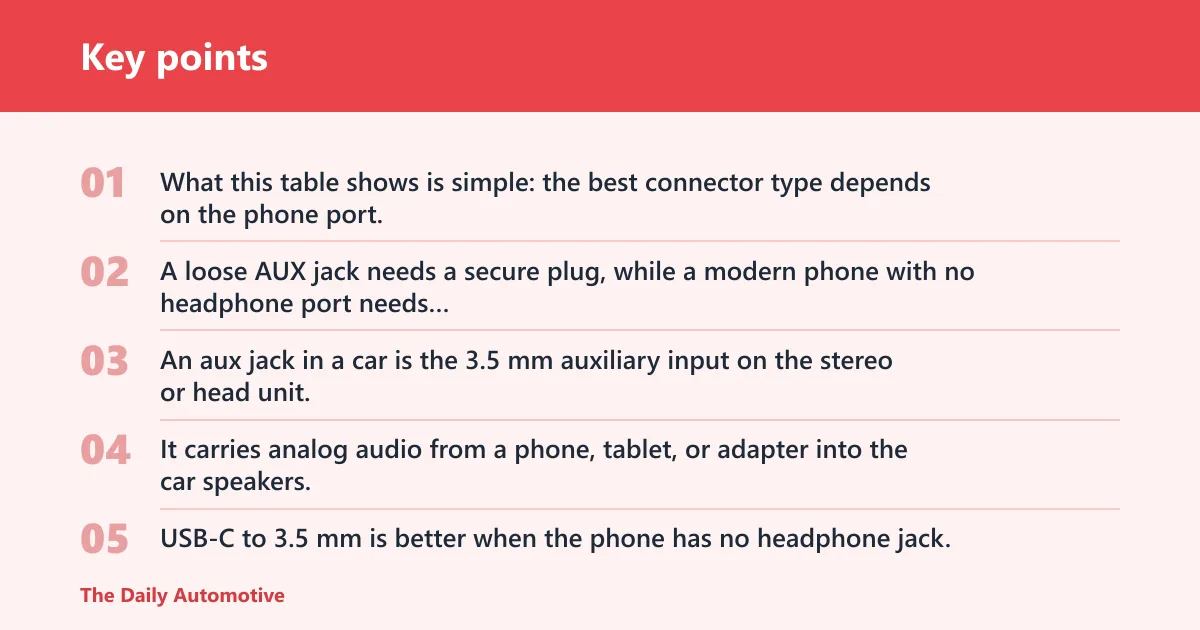
What this table shows is simple: the best connector type depends on the phone port, the car input, and the failure mode you are trying to avoid. A loose AUX jack needs a secure plug, while a modern phone with no headphone port needs a DAC cable or a wireless receiver.
What is an aux jack in a car?
An aux jack in a car is the 3.5 mm auxiliary input on the stereo or head unit. It carries analog audio from a phone, tablet, or adapter into the car speakers, so it is different from USB charging ports and from ports meant only for a microphone.
Which is better for car audio: USB-C to 3.5mm or 3.5mm to 3.5mm?
USB-C to 3.5 mm is better when the phone has no headphone jack. 3.5 mm to 3.5 mm is better when both devices already speak analog audio, because it is simpler, cheaper, and one less conversion step is involved.
Do I need a DAC in an aux cable for car use?
You need a DAC smart chip when the source device outputs digital audio over USB-C and the car expects analog through AUX. If the phone already has a 3.5 mm jack, a passive cable is enough. The DAC matters most for compatibility, not for every car.
What cable length is best for a car aux connection?
For most cars, 3.3 ft to 4 ft is enough when the phone sits near the center console. Use a longer cable if the phone has to reach from a mount or passenger seat, and use the shortest length that still avoids tension and sharp bends.
Will a right-angle aux plug fit my dashboard better?
Usually, yes, when the AUX jack is recessed or boxed in by trim. A right-angle connector reduces how far the plug sticks out, which can help with clearance and accidental bumps. If the port is open and easy to reach, a straight plug may route more cleanly.
Can a braided aux cable improve durability in a car?
Yes, a nylon braided jacket can help a cable handle repeated bending, pulling, and storage better than a basic smooth jacket. It does not fix bad ports or poor compatibility, but it can be a good choice for daily commuters and passengers who handle the cord often.
How do I know if my phone is compatible with my car aux input?
Check two things: the phone’s output port and the car’s input jack. If the phone has USB-C only, look for a USB-C to 3.5 mm adapter cable with a DAC smart chip. If the phone has a 3.5 mm jack, a standard aux cable is the easier fit.
What should I do if my aux jack is not playing audio?
First, reseat both ends and check for a loose or partially inserted plug. Then try another cable, because intermittent audio often comes from worn contacts, a bent plug, or phone-case interference. If the jack is physically damaged, the head unit may need repair.
What is an aux jack?
An aux jack is the car stereo’s 3.5 mm audio input for analog sound. It is used for phones, media players, and adapter cables. It is not the same as a charging port or a microphone-only port, even when the connector shape looks similar.
Mic jack vs aux jack
A mic jack is meant for microphone input, while an aux jack is meant for audio output into the car stereo. The two may look alike, but they do different jobs. If you plug the wrong one, you may get no sound or very low-level input.
What is internal aux jack?
An internal aux jack usually means the audio input is built into a head unit, console storage area, or factory module rather than sitting in plain view. That can help with cable routing, but it can also make access tighter, so right-angle plugs often fit better.
How to remove broken aux jack
If a plug tip breaks off inside the jack, power off the unit first and avoid forcing metal tools into the port. Use the vehicle and stereo manual for the correct removal method. If the fragment is deep or the jack is damaged, a repair shop is the safer choice.
Products related to this article
Sponsored / affiliate links. As an Amazon Associate I earn from qualifying purchases. I may earn additional commission from eligible campaigns.