Can You Negotiate Enterprise Car Sales? Proven Strategy
Yes, you absolutely can negotiate at Enterprise Car Sales. While they are known for their no-haggle pricing, there’s still room for negotiation, especially on the final out-the-door price, trade-in value, and added services. A proven strategy involves thorough research, understanding their pricing structure, and being prepared to walk away. This guide will walk you through it step-by-step, making the process less intimidating and more rewarding.
Finding the right used car can feel like a treasure hunt, and sometimes a bit of a puzzle. Enterprise Car Sales offers a unique way to buy a vehicle, often directly from their rental fleet, which usually means well-maintained cars. But the big question many people wonder is: can you actually haggle on the price? It’s a common concern, especially when you want to make sure you’re getting the best deal possible without feeling pressured. You might think “no-haggle” means exactly that, but with a smart approach, there are definite ways to negotiate and drive away with more savings.
This guide is designed to demystify the process. We’ll break down how Enterprise Car Sales sets its prices, what factors you can influence, and a clear, step-by-step strategy to help you negotiate confidently. By the end, you’ll have the knowledge and tools to get the best possible deal on your next Enterprise vehicle.
Understanding Enterprise Car Sales Pricing
Enterprise Car Sales operates a bit differently than a traditional dealership. Many of their vehicles come directly from their own rental fleet. This means they have a good understanding of the car’s history and how it’s been maintained. They also aim for transparency by offering what they call “no-haggle” or “no-pressure” pricing. This approach is meant to simplify the buying experience and eliminate the stressful back-and-forth often associated with car negotiations.
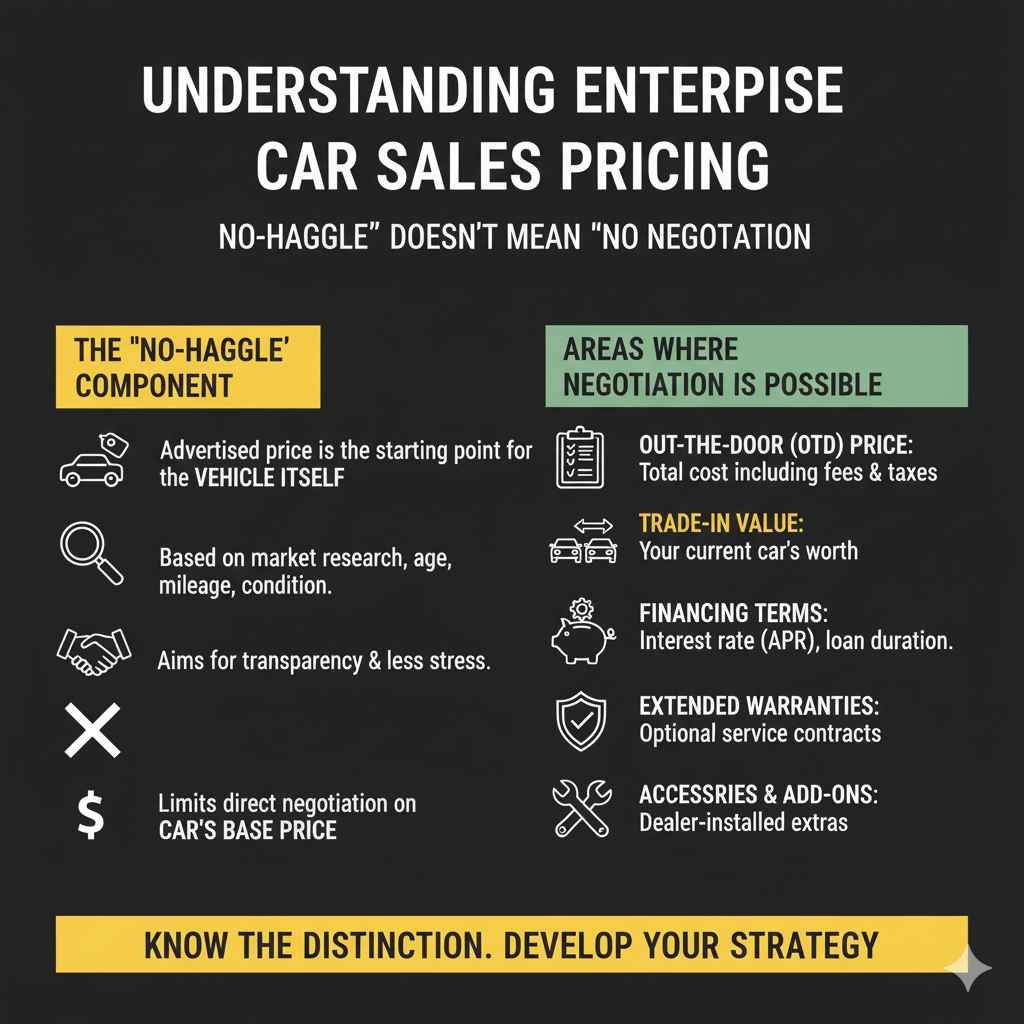
However, “no-haggle” doesn’t always mean “no negotiation” entirely. It typically means the sticker price is their starting point. The real opportunities for negotiation often lie in areas beyond the advertised vehicle price itself. Understanding this crucial distinction is the first step in developing your negotiation strategy.
The “No-Haggle” Component Explained
When Enterprise Car Sales advertises a price, that’s generally the price they’ve set for the vehicle itself. This price is usually based on market research, the car’s age, mileage, condition, and its history as a rental vehicle. The idea is to offer a fair, competitive price upfront, so customers don’t feel compelled to fight for a better deal on the car’s base price. This can be appealing to buyers who dislike the traditional car buying negotiation dance.
The benefits of this model are clear: less stress, a more straightforward process, and a sense of fairness. However, it’s important to know that this applies primarily to the initial advertised vehicle price. Other components of the total purchase can still be areas for discussion.
Areas Where Negotiation is Possible
While the listed price of the car is often fixed, several other elements of the transaction are open to negotiation. These include:
- The Out-the-Door (OTD) Price: This is the total cost you’ll pay, including all fees, taxes, and any additional products or services. Sometimes, even if the car’s price is firm, there might be wiggle room on certain mandatory fees or the way they are calculated.
- Trade-In Value: If you’re trading in your current vehicle, this is almost always an area where negotiation can happen. Enterprise needs to value your car, and their initial offer can often be improved.
- Financing Terms: If you’re financing through Enterprise or one of their partner lenders, you can potentially negotiate the interest rate (APR) or loan term, especially if you have pre-approved financing from another source.
- Extended Warranties and Service Contracts: Enterprise often offers optional extended warranties or service contracts. The pricing for these can sometimes be negotiated, or you might be able to decline them altogether if you don’t want them.
- Accessories and Add-Ons: Any dealer-installed accessories or packages might also be a subject for negotiation, especially if they are bundled into the final price.
Your Proven Negotiation Strategy: Step-by-Step
Success in negotiating at Enterprise Car Sales hinges on preparation and a clear understanding of what you’re willing to accept. Here’s a strategy designed to maximize your savings and confidence.
Step 1: Do Your Homework (Research is Key!)
Before you even step foot on the lot or browse their website, become an expert on the specific car you’re interested in. This is arguably the most important step.
- Market Value: Use online resources like Kelley Blue Book (KBB.com), Edmunds, and NADA Guides to determine the fair market value of the car you want. Look at both the dealer retail price and the private party value to get a range.
- Compare Similar Vehicles: Look at other Enterprise Car Sales locations and other dealerships selling similar makes, models, and years. This will give you a benchmark for their pricing.
- Vehicle History Report: Enterprise usually provides a vehicle history report (like Carfax or AutoCheck) for their cars. Review it carefully for any accidents, title issues, or recalls. If there’s a minor issue, it could be a talking point.
- Common Problems: Research common issues or recalls for the specific make and model you’re considering. Knowing potential future repair costs can be valuable leverage.
- Financing Pre-Approval: Get pre-approved for a car loan from your bank or credit union. This gives you a clear understanding of the interest rate you qualify for and provides a benchmark against any financing Enterprise offers. You can often find tools and resources on sites like Consumer Financial Protection Bureau (CFPB) for guidance on car loans.
Step 2: Inspect the Vehicle Thoroughly
Even though Enterprise cars are generally well-maintained, you still need to inspect the car as you would any other used vehicle.
- Exterior: Check for dents, scratches, rust, and uneven panel gaps. Make sure all lights and signals work.
- Interior: Look for tears, stains, or excessive wear on seats, carpets, and the dashboard. Test all electronics: radio, air conditioning, power windows, locks, etc.
- Under the Hood: Check fluid levels (oil, coolant, brake fluid). Look for leaks or corrosion.
- Tires: Inspect tire tread depth and look for uneven wear, which could indicate alignment issues.
- Test Drive: Drive the car on various road surfaces and at different speeds. Listen for unusual noises, feel for strange vibrations, and check how the brakes and steering perform.
If you find any issues, note them down. These can be leverage for a price adjustment on the car itself or for asking for certain repairs to be completed before purchase, especially if they are significant enough to impact safety or your immediate driving experience.
Step 3: Understand the “Out-the-Door” Price
The advertised price of the car is just the beginning. You need to know the total cost.
The Out-the-Door (OTD) price includes:
- The advertised price of the vehicle.
- Sales tax (varies by state and local jurisdiction).
- Title and registration fees (state-dependent).
- Dealer fees (documentation fees, admin fees, etc. – these are often where some negotiation potential lies, or at least understanding their justification).
- Cost of any add-ons or packages.
Always ask for a breakdown of the OTD price. Some dealer fees may be non-negotiable, but others might be reduced or waived if you push back politely, especially if they seem excessive. Compare these fees to what other dealerships charge. Some states cap certain dealer fees, so knowing your local regulations can be helpful.
Step 4: Negotiate Your Trade-In Value
This is often the most flexible part of the deal at Enterprise.
- Know Your Trade-In’s Value: Use the research from Step 1 (KBB, Edmunds) to get an estimated trade-in value before you go to Enterprise.
- Be Prepared for Their Offer: They will likely offer you a value for your trade-in.
- Counter-Offer: If their offer is lower than your researched value, politely present your findings and explain why you believe your car is worth more. For example, “Based on my research with KBB and Edmunds, similar cars in this condition are trading in the range of X to Y. I was hoping for an offer closer to X.”
- Flexibility: Understand that they need to make a profit. If their offer is close to your minimum acceptable, consider it. But if it’s significantly lower, be prepared to sell your old car privately if the difference is substantial.
Step 5: Negotiate Financing (If Applicable)
If you plan to finance your purchase through Enterprise, don’t just accept the first offer.
- Present Your Pre-Approval: If you have financing pre-approval from your bank or credit union, mention it. Enterprise’s finance department may try to beat your rate.
- Compare Offers: Lay out the details of Enterprise’s financing offer against your pre-approval. Look at the APR, loan term, and any associated fees.
- Focus on the APR: Even a small difference in the Annual Percentage Rate can save you hundreds or even thousands of dollars over the life of the loan.
Step 6: Discuss Add-Ons and Warranties
Enterprise often offers extended service plans and other add-ons. These can be valuable but are also a place to negotiate.
- Evaluate Necessity: Do you really need an extended warranty? Consider the car’s age, mileage, and reliability ratings.
- Negotiate Price: If you decide you want one, ask if the price is firm. You can often negotiate a discount, especially if you’ve found comparable warranties elsewhere for less.
- Shop Around: Get quotes for third-party extended warranties. Sometimes these are more affordable and offer better coverage than dealer-offered plans.
- Decline if Unnecessary: Don’t feel pressured to buy add-ons you don’t want or need.
Step 7: The Final Push: The “Walk-Away” Power
This is your strongest negotiating tool.
- Be Prepared to Leave: If you aren’t getting the deal you want on the OTD price, trade-in value, or financing, be respectful but firm. State that you appreciate their time but need to think about it or explore other options.
- Don’t Fall in Love: If you’re too emotionally attached to a specific car, you lose leverage.
- They Might Call You Back: Often, a dealership will call you back with a better offer if they believe they are about to lose your business. This is especially true if you’ve built a good rapport.
Key Negotiation Tactics for Enterprise Car Sales
Beyond the step-by-step process, certain tactics can significantly improve your negotiation outcome.
Be Polite and Respectful
Salespeople are human! A friendly, respectful demeanor goes a long way. You’re more likely to get concessions from someone you like and respect. Aggression or rudeness will shut down communication quickly.
Know Your Numbers
This can’t be stressed enough. Having your research on market value, trade-in value, and financing pre-approval at your fingertips gives you confidence and credibility.
Focus on the Total Price, Not Just Monthly Payments
Dealers might try to focus on a low monthly payment. This can be achieved by extending the loan term, meaning you pay more interest over time. Always focus on the total OTD price of the vehicle.
Ask Questions, Lots of Them!
Don’t be afraid to ask for clarification on fees. “What is this fee for?” “Is this negotiable?” “Can you explain how you arrived at this valuation for my trade?”
Use Competitor Offers (Carefully)
If you have a written offer from another dealer for a similar car, or a pre-approved loan rate, you can use it as leverage. “I have an offer for a similar car at X price from [Dealership Name],” or “My bank has approved me for X% interest. Can you match or beat that?”
Be Patient
Negotiation takes time. Don’t rush the process. If you feel pressured, it’s a sign you might need to take a step back.
Pros and Cons of Negotiating at Enterprise
Every car buying situation has its ups and downs. Here’s a look at the benefits and potential drawbacks of negotiating with Enterprise Car Sales.
| Pros | Cons |
|---|---|
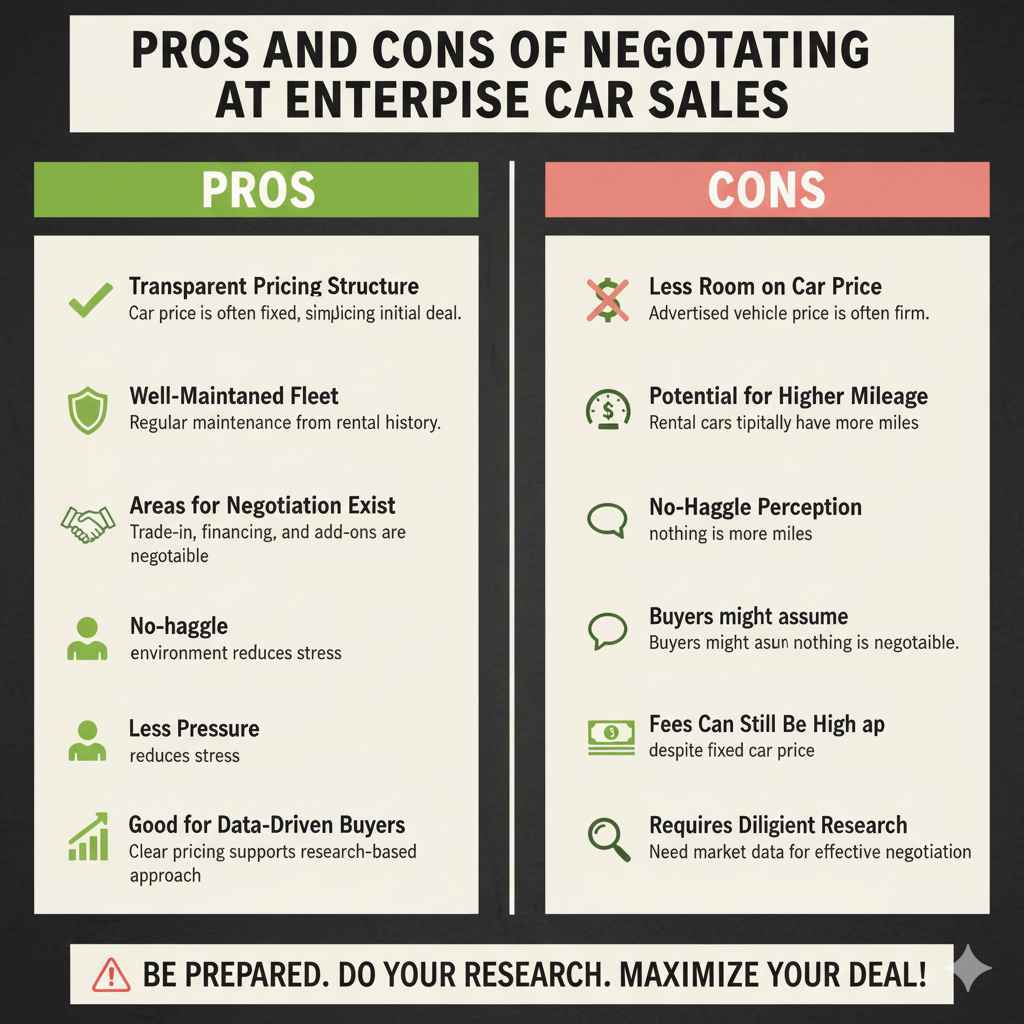
| Transparent Pricing Structure: “No-haggle” on the car price can simplify the initial part of the deal. | Less Room on Car Price: The advertised price for the vehicle itself is often firm, limiting direct negotiation on that specific figure. |
| Well-Maintained Fleet: Cars often come from their rental fleet, meaning they’ve undergone regular maintenance. | Potential for Higher Mileage: Rental cars are driven more than typical privately owned cars. |
| Areas for Negotiation Exist: Trade-in, financing, and add-ons are still negotiable. | “No-Haggle” Perception: Buyers might assume nothing is negotiable, making them hesitant to try. |
| Less Pressure: The “no-haggle” sales environment can reduce stress for some buyers. | Fees Can Still Be High: While the car price is fixed, dealer fees can sometimes add up. |
| Good for Data-Driven Buyers: The clear pricing supports a data-driven negotiation approach. | Requires Diligent Research: To negotiate effectively, you need to be well-prepared with market data. |
Frequently Asked Questions (FAQ)
Q1: Is Enterprise Car Sales really no-haggle?
A: The sticker price for the car itself is generally a “no-haggle” price. This means they have set a fair market value and aren’t typically going to move much on that specific number. However, areas like your trade-in value, financing terms, and any add-on products or fees can still be negotiated.
Q2: What’s the best way to negotiate my trade-in at Enterprise?
A: The best way is to do your research beforehand. Check sites like Kelley Blue Book and Edmunds to know your trade-in’s market value. Present your research politely and be prepared to explain why you believe your car is worth more than their initial offer.
Q3: Can I negotiate the fees charged by Enterprise Car Sales?
A: Some fees, like documentation or administrative fees, might have a small amount of flexibility. It’s always worth asking politely for a breakdown and inquiring if any can be reduced or waived. However, government-mandated taxes and registration fees are usually non-negotiable.
Q4: Should I get my own financing before going to Enterprise?
A: Yes, it’s highly recommended! Getting pre-approved for a car loan from your bank or credit union gives you a clear benchmark for interest rates. You can then compare this to any financing offers Enterprise provides, potentially negotiating a better rate with either them or your own lender.
Q5: Are Enterprise’s extended warranties negotiable?
A: Often, yes. The price of extended warranties and service contracts can sometimes be negotiated. It’s also a good idea to shop around for third-party warranty providers, as they may offer better coverage or pricing. You can use these offers as a basis for negotiation with Enterprise.
Q6: What if I find a mistake or issue during my inspection?
A: If you find a significant issue during your inspection (e.g., a noticeable mechanical problem, significant cosmetic damage), use it as a point of negotiation. You can ask for the price to be adjusted to cover the repair cost or request that Enterprise fix the issue before you complete the purchase.