Should You Tip Car Service Workers?
Tip most car service workers when the job is hands-on, time-consuming, or clearly extra: $2 to $5 for quick help, 10% to 20% for detailed work, and nothing if a service charge already covers gratuity. Skip the extra payment when the receipt already includes it. This guide breaks down what to tip for towing, detailing, valets, rides, repairs, and what changes when a fee is already included.
Which car service workers are usually tipped?
Ride drivers, valets, tow operators, wash staff, and transport drivers are the most common tipping candidates. Mechanics are different: their pay is usually built into shop labor rates, so tipping is uncommon. The real question is not whether to tip every car worker, but which jobs are service-heavy enough to justify it.
Ride drivers and livery service
Private-hire and livery drivers are usually tipped, especially when the ride is clean, punctual, and handled with care. A common tip is about 10% to 20% of the fare, or a flat $2 to $5 on short rides. Many apps offer an in-app tip option, which is the easiest fallback when you do not have cash.
Tow operators and roadside help
Tow truck drivers often get small cash gratuities, especially for roadside calls, difficult hookups, or after-hours work. Tipping is still optional, but about $5 to $20 is a common range when the operator goes beyond the basic tow. Safety-sensitive work, poor weather, and fast response can all make a tip more appropriate.
Valets, wash staff, mechanics, and transport drivers
Valets are commonly tipped at handoff or when the car is returned. Car wash attendants may get a few dollars, while full-service detailing often draws a larger tip. Auto transport drivers usually receive a tip after damage-free delivery. Mechanics are often among the least likely to be tipped, though a small gratuity can be appreciated in special cases.
How much to tip by service type
The amount depends on the job, not the car. For quick service, a few dollars is normal. For detailed labor or difficult conditions, a percentage or larger flat amount makes more sense. If the bill already includes gratuity or a service charge, do not add a second tip unless the service was clearly exceptional.
Car service drivers
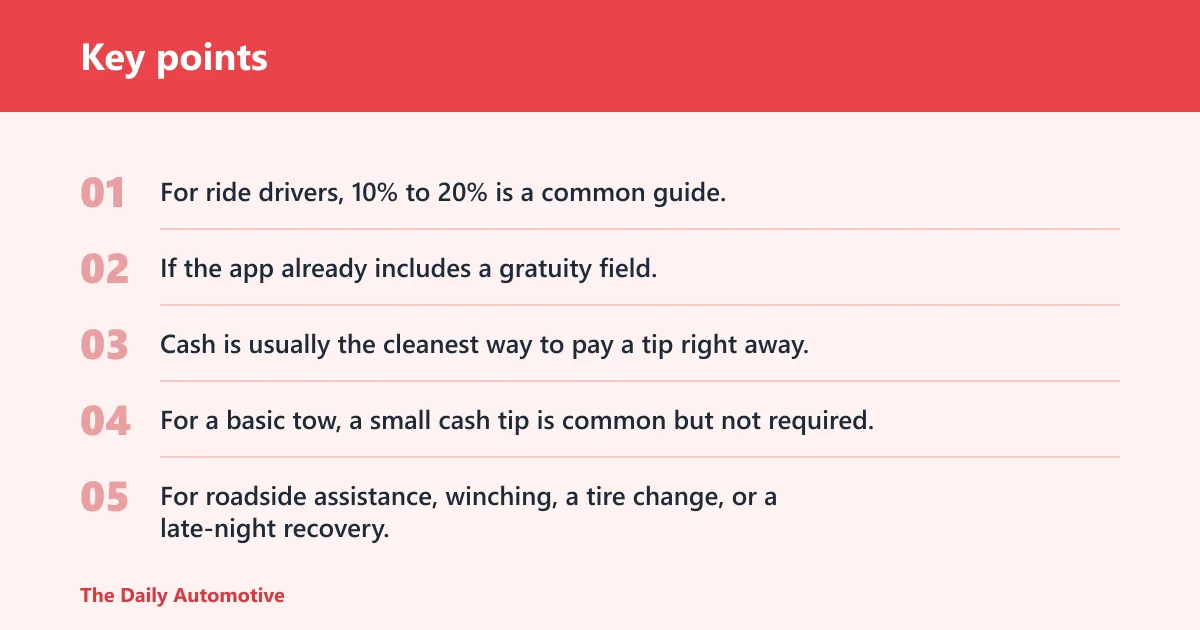
For ride drivers, 10% to 20% is a common guide, with a flat $2 to $5 working well on short trips. If the app already includes a gratuity field, you can add the tip there or hand over cash at the end of the ride. Cash is usually the cleanest way to pay a tip right away.
Tow truck drivers
For a basic tow, a small cash tip is common but not required. For roadside assistance, winching, a tire change, or a late-night recovery, a larger amount is more reasonable. If the tow is bundled into insurance or roadside membership pricing, check whether the driver receives the payment directly before tipping twice.
Valets, car wash staff, and transport drivers
Valets are often tipped about $2 to $5 when the car is dropped off, and again when it is returned if the service was especially helpful. Car wash attendants may receive $2 to $5 for a wash, with more for detailing. Auto transport drivers often receive a tip after the handoff, especially when the vehicle arrives on time and undamaged.
Do you tip your auto mechanic?
Usually no. Mechanics are paid for labor through posted shop rates, dealer labor schedules, or flat-rate billing, and parts markup is already built into the invoice. A tip is uncommon because the shop is not structured like a front-line service role, but a small cash thank-you can be appropriate for urgent, difficult, or especially helpful work.
Shop labor, parts, and flat-rate billing
Mechanics do not usually rely on tips the way ride drivers or valets do. Labor is billed separately from parts, and flat-rate work often means the shop pays for a set repair time regardless of how fast the job goes. That is why a tip is rare rather than expected.
Independent shop versus dealer service
Dealer service departments often post higher labor rates than independent shops, and that does not create a tipping rule. In either setting, the invoice already covers the repair. If a technician squeezes in a last-minute diagnosis, explains a hidden issue, or stays late to finish a safe repair, a small cash tip is a kind gesture, not an obligation.
When a tip is optional, rare, or appreciated
Tip a mechanic only when the help goes beyond the paid job: fitting in a stranded driver, tracking down a hard-to-find issue, or handling a rushed same-day fix. If the repair was routine, the bill was clear, and the work matched the estimate, no tip is needed.
When should you not tip?
Do not tip when the bill already includes a mandatory service charge, included gratuity, or pooled tip that goes to the worker. The key is to read the receipt or app summary before adding more money. If the charge is already in the total, a second tip can become double-tipping rather than generosity.
Mandatory service charges and included gratuity
A service charge is not the same as an optional tip. If the receipt says “service charge,” “gratuity included,” or “tip included,” treat it as part of the total unless the business says otherwise. Some operators pool those funds, so ask only if the receipt is unclear.
Where to check the receipt or app
Look for a line item near taxes and fees, or check the app’s payment screen before you hit submit. If the booking platform already adds a gratuity or booking fee that covers the service worker, an extra tip should be reserved for unusual effort, not routine service.
How to avoid double-tipping
Review the final amount, not the estimate. If the receipt shows “service charge,” “driver fee,” or “gratuity,” pause before adding cash or an app tip. When in doubt, ask whether the fee goes to the worker or stays with the platform or business.
Car service tipping matrix
This matrix gives a quick decision point for seven common car-service situations. It separates customary tipping from cases where a fee is already included. Use it to avoid over-tipping on one job and under-tipping on another.
| Scenario | Customary? | Usual amount | When not to tip | What changes the recommendation |
|---|---|---|---|---|
| Ride driver on a standard app trip | Yes | 10% to 20% or $2 to $5 | Tip already included on the receipt | Bad weather, heavy bags, extra stops, long wait |
| Auto mechanic for routine repair | Uncommon | Optional $10 to $20 | Regular maintenance, posted labor rate, clear invoice | Rush job, diagnostic favor, late-day rescue |
| Tow truck driver for roadside help | Often | $5 to $20 | Membership or insurance already pays a direct gratuity | After-hours call, dangerous shoulder, poor weather |
| Self-serve car wash | No | Usually nothing | No attendant help | Staff hand-dry, vacuum, or guide extra service |
| Full-service wash or detail | Yes | $2 to $5 for a wash, more for detailing | Only if the posted price already includes gratuity | Large vehicle, interior cleanup, extra hand work |
| Valet parking at a hotel or restaurant | Yes | $2 to $5 at drop-off or pickup | Gratuity already included in the valet charge | Peak hour, bad weather, heavy luggage, fast retrieval |
| Auto transport delivery | Sometimes | $20 to $50 after delivery | Damage claim, missed delivery, poor handoff | Open versus enclosed carrier, long-haul route, careful inspection |
Do you tip for weather, delays, or emergency calls?
Yes, those conditions can change the norm. Weather, delays, and emergency calls do not make tipping mandatory, but they do move a job from routine into difficult territory. If the worker had to deal with snow, rain, after-hours timing, or a risky roadside setup, a tip becomes more appropriate.
After-hours and roadside jobs
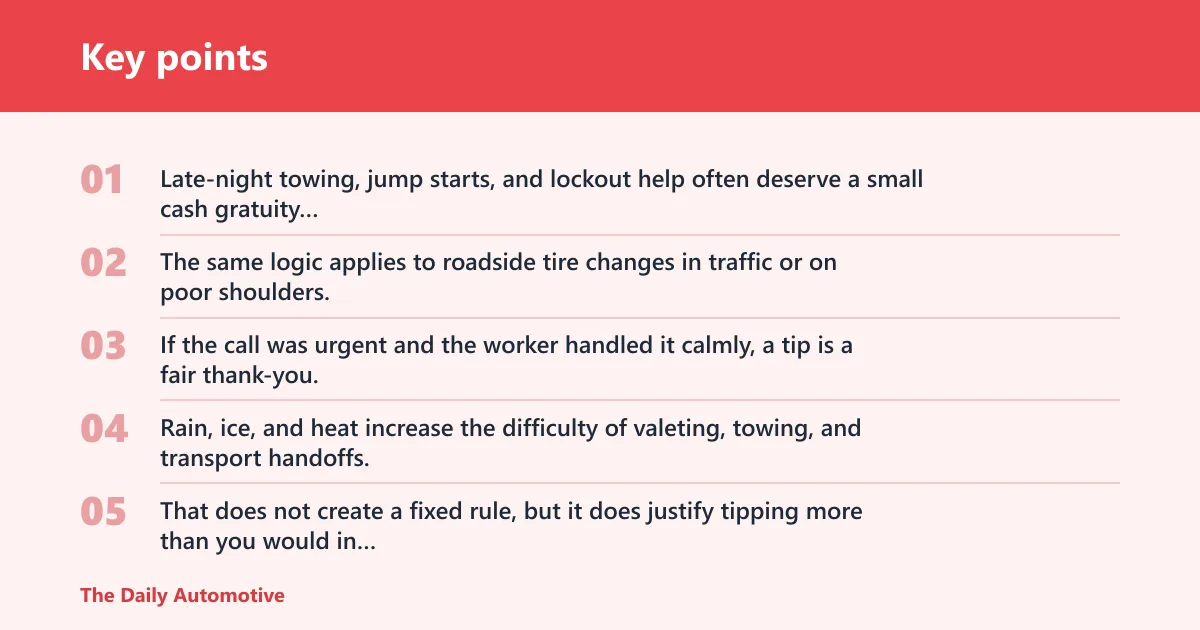
Late-night towing, jump starts, and lockout help often deserve a small cash gratuity because the work is inconvenient and safety-sensitive. The same logic applies to roadside tire changes in traffic or on poor shoulders. If the call was urgent and the worker handled it calmly, a tip is a fair thank-you.
Poor weather and safety-sensitive work
Rain, ice, and heat increase the difficulty of valeting, towing, and transport handoffs. That does not create a fixed rule, but it does justify tipping more than you would in easy conditions. Safety-sensitive work should be rewarded for careful handling, not only speed.
Damage-free delivery and exceptional help
For auto transport, a tip is most appropriate after damage-free delivery and a clean inspection at handoff. The same is true for valets who return the car quickly in a crowded lot or drivers who wait through a delayed pickup without complaint. Reward the extra effort, not the bare minimum.
Say your tow driver pulls a sedan from a snowy shoulder at 11 p.m., then waits while you sign the release. A $10 or $20 cash tip fits that kind of job better than a generic percentage. By contrast, a short daytime tow from a driveway can stay at the lower end or skip tipping entirely.
How to tip with cash, apps, or receipts
Cash is still the simplest choice for small gratuities because it is immediate and clear. If you do not have cash, an in-app tip or receipt line is the next best option. For services with crews or pooled tips, add a note so the money reaches the right person or team.
Small bills and timing at pickup or drop-off
Keep a few small bills in the car for valets, wash staff, tow operators, and drivers. Hand cash at pickup or drop-off, depending on the job. For valets, the exchange happens at return. For ride drivers and transport drivers, tip at the end, once the service is complete.
When an app tip is the cleaner choice
Use the app when the service is booked digitally and the worker expects payment through that channel. This is especially useful for ride services and some transport platforms, where the app records the tip and reduces confusion. If the app already adds gratuity, do not add a second cash tip unless the service was unusually helpful.
Receipt notes for crew or pooled tips
If the work was shared, write a brief note on the receipt or ask the counter staff how the tip is divided. Car wash teams, valet stands, and some transport companies pool gratuities. A note such as “for the whole team” helps avoid a missed handoff.
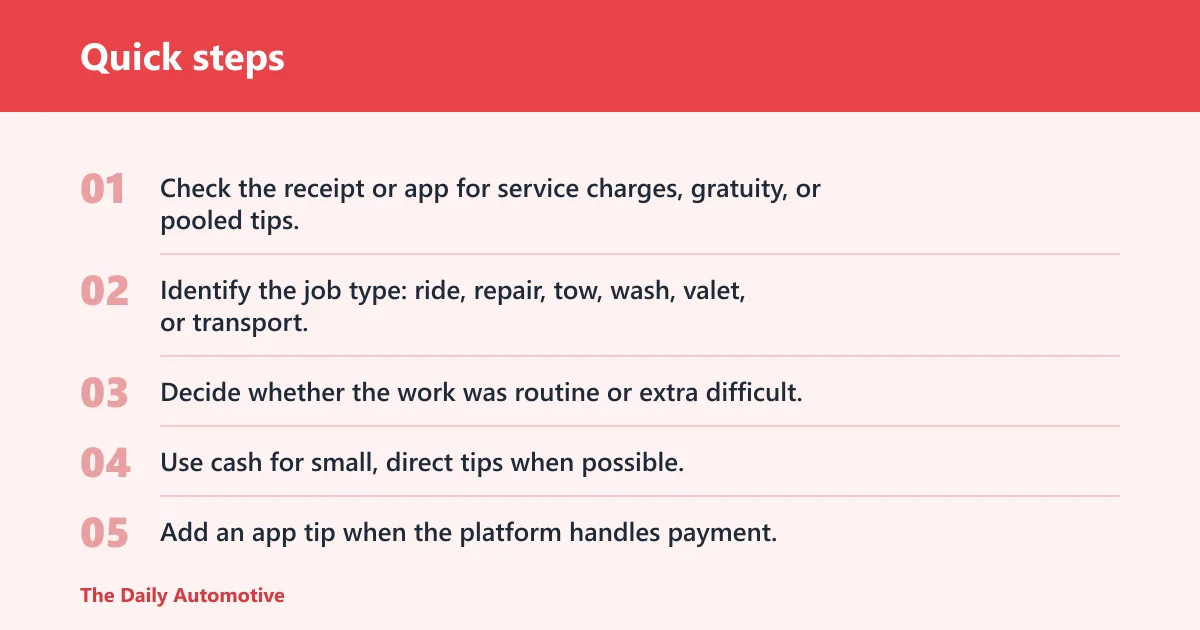
- Check the receipt or app for service charges, gratuity, or pooled tips.
- Identify the job type: ride, repair, tow, wash, valet, or transport.
- Decide whether the work was routine or extra difficult.
- Use cash for small, direct tips when possible.
- Add an app tip when the platform handles payment.
- Skip the extra tip if gratuity is already included.
A common first-timer mistake is tipping a mechanic the same way they would tip a ride driver. Those are different jobs with different pay structures. The mechanic’s bill usually already covers labor; the driver’s fare often leaves room for a gratuity.
One language note matters here because the keyword includes “should.” Should is a modal verb and is followed by the bare infinitive. It is commonly used when giving advice, and it is also used to speculate about what will happen. Should have is used for past regrets or missed actions, while should you is a formal conditional structure used in contracts.
Frequently asked questions
How much to tip a car service
For a standard ride, $2 to $5 or 10% to 20% is a useful guide. More is reasonable for heavy luggage, extra stops, long waits, or poor weather. If the bill already includes a service charge or gratuity, do not add more unless the service was exceptional.
Should you tip your car transport driver?
Often yes, but not every time. A tip is most common after damage-free delivery, careful vehicle handoff, and clear inspection at arrival. Many people use $20 to $50 as a rough range. If the delivery was late, damaged, or confusing, the tip can be reduced or skipped.
Do you tip on service charge?
Usually not. If the receipt or app says the service charge includes gratuity, that amount already covers the tip. Check the receipt line by line, because some fees go to the worker and others do not. The safest move is to avoid double-tipping unless the service clearly went beyond the charge.
Do you tip at a car wash?
At a self-serve wash, no tip is usually needed because no one is doing hands-on labor for you. For full-service washes, hand-drying, vacuuming, or detailing, a small tip is more normal. Cash is easiest, and more is fair when the job is detailed or the vehicle is large.
Products related to this article
Sponsored / affiliate links. As an Amazon Associate I earn from qualifying purchases. I may earn additional commission from eligible campaigns.