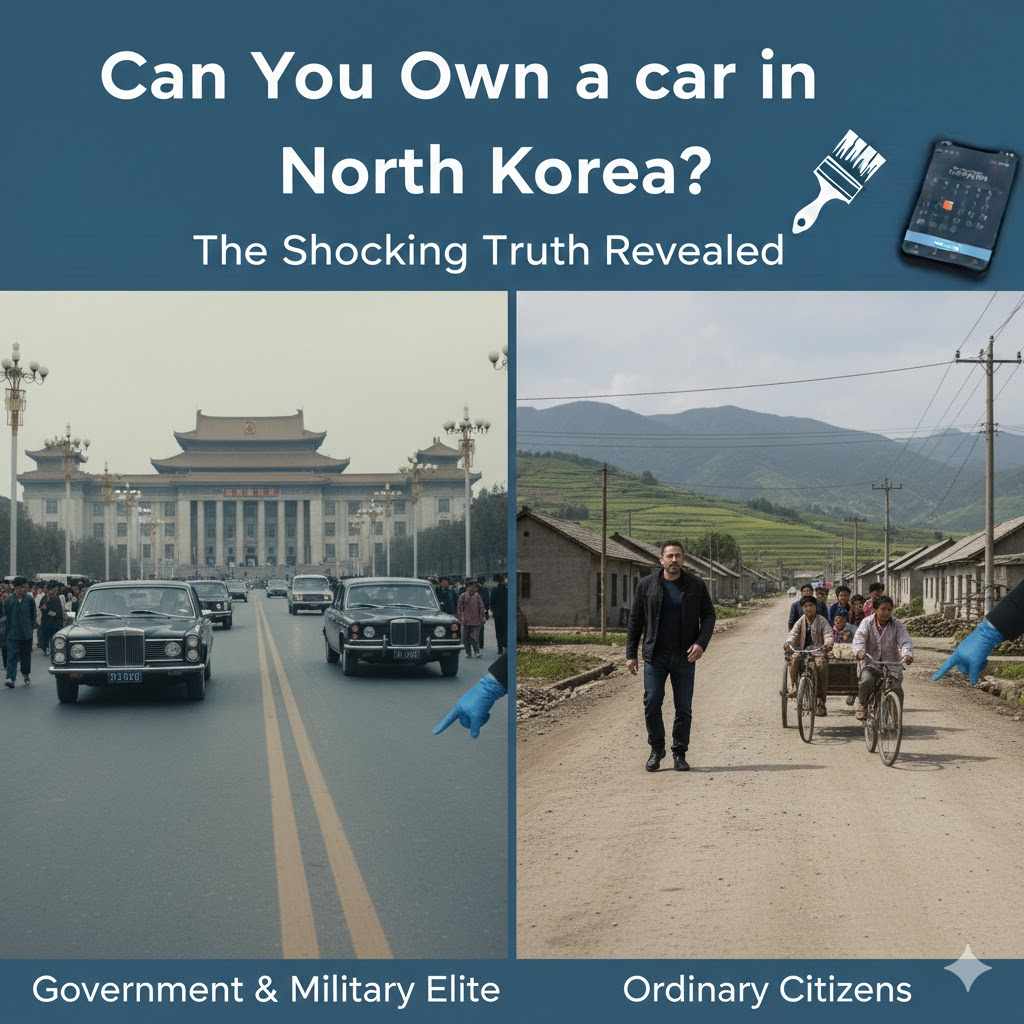
Can You Own a Car in North Korea? The Shocking Truth
Yes, you can technically own a car in North Korea, but it is extremely rare and nearly impossible for the average person. Car ownership is a symbol of great wealth or high status within the government or military. For the vast majority of citizens, private car ownership remains an unattainable dream.
Hello! I’m Md Meraj, your friendly guide to everything about cars. We often think of our cars as essential tools for daily life—getting to work, buying groceries, or visiting family. It’s a freedom we sometimes take for granted. But have you ever wondered what car ownership is like in a place as different as North Korea? The answer is fascinating and reveals a lot about life there.
It’s a topic filled with myths and mystery. You might have seen pictures of empty highways in its capital city, Pyongyang, and wondered, “Does anyone even drive there?” Today, we’re going to pull back the curtain. We will look at who gets to own a car, what kind of cars they drive, and what daily travel is like for everyone else. Let’s explore the surprising world of cars in the Hermit Kingdom.
Understanding Car Ownership in North Korea
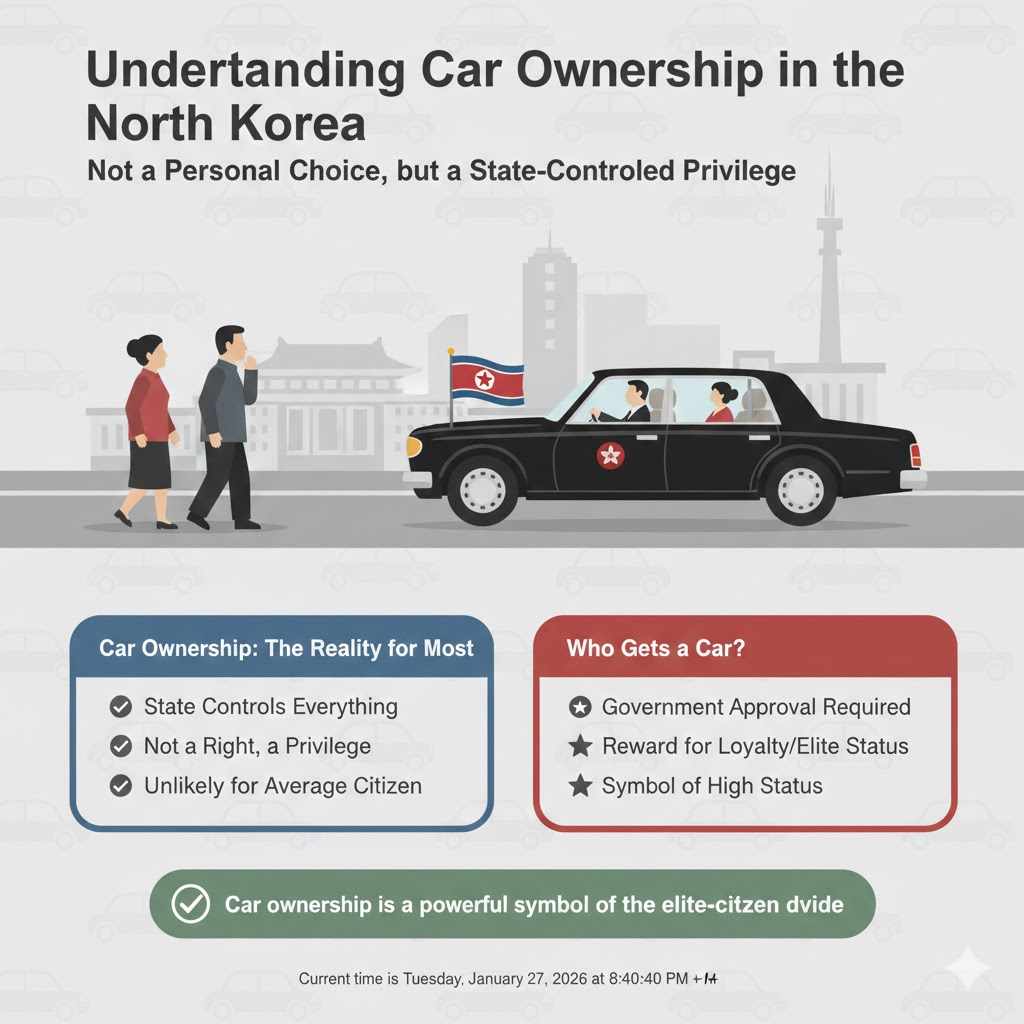
In most countries, buying a car is a personal choice. You save money, get a loan, and pick a vehicle that fits your needs. In North Korea, the story is completely different. The state controls almost everything, and that includes who is allowed to own and drive a car. Private car ownership isn’t a right; it’s a privilege reserved for a select few.
The government must approve any car purchase. This means you can’t just walk into a dealership. Instead, the ability to own a car is often a reward for loyalty to the state or a sign that you are part of the country’s elite. For the average worker or farmer, owning a car is as likely as owning a private jet.
Who Actually Drives a Car? The Elite Few
So, if not the average citizen, who are the people behind the wheel? The cars you see on the streets of Pyongyang belong to a very small, exclusive group. This group represents the top tier of North Korean society.
- High-Ranking Officials: Top members of the Workers’ Party of Korea, government ministers, and high-level bureaucrats are the primary car owners. A car is a tool for their work and a very visible symbol of their power.
- Military Leaders: Senior officers in the Korean People’s Army are often given vehicles. These are typically rugged, military-style SUVs or sedans.
- Successful Businesspeople (Donju): A growing class of entrepreneurs, known as “donju” (masters of money), has emerged. They have earned wealth through state-approved and semi-legal market activities. Many use their money to buy cars, often imported from China.
- Athletes and Artists: As a reward for winning international competitions or for creating art that glorifies the regime, the state sometimes gifts cars to famous athletes and artists.
- State-Owned Enterprises: Many vehicles are not owned by individuals but by government departments or companies. These cars, vans, and trucks are used for official business.
Where Do the Cars Come From?
Since North Korea is under heavy international sanctions, getting new cars is not easy. However, they have found several ways to supply vehicles for their elite class. The sources are a mix of domestic production, imports, and gifts.
Pyeonghwa Motors: The Local Automaker
Believe it or not, North Korea has its own car company: Pyeonghwa Motors. The name means “Peace” in Korean. It was started as a joint venture with a South Korean organization. For years, it was the only company with rights to produce and sell cars in the country.
However, Pyeonghwa doesn’t design cars from scratch. It mostly assembles “knock-down kits,” which are parts of cars from other companies, primarily from China. They rebadge these vehicles with their own brand names. Production numbers are very low, likely only a few thousand cars per year.
| Pyeonghwa Model Name | Original Car Model (Often Based On) | Car Type |
|---|---|---|
| Hwiparam (Whistle) | Fiat Siena / Brilliance BS4 | Sedan |
| Ppoggugi (Cuckoo) | Fiat Doblò / Shuguang SUV | SUV / Van |
| Junma (Swift Horse) | SsangYong Chairman / Volkswagen Passat | Luxury Sedan |
Luxury Imports for the Top 1%
The highest leaders, including Kim Jong Un, are often seen in luxury vehicles like armored Mercedes-Benz S-Class sedans, Lexus SUVs, and Rolls-Royces. These cars are smuggled into the country, bypassing strict UN sanctions that ban the sale of luxury goods to North Korea. These imports are a testament to the regime’s ability to find ways around international pressure. For more on these sanctions, you can read reports from institutions like the Council on Foreign Relations, which tracks these measures.
Used Cars from China and Japan
For those who can afford a car but are not at the very top, used vehicles from neighboring China and Japan are a common choice. These cars enter the country through trade routes, and while they are not brand new, they are still a major status symbol. It is not uncommon to see older Toyotas or Nissans on the streets, often with the steering wheel still on the right side (for Japan’s roads).
What Is It Like to Drive in North Korea?
Driving in North Korea is an experience unlike anywhere else in the world. The infrastructure and rules are unique and reflect the country’s closed-off nature.
Empty Roads and Female Traffic Officers
The most striking feature of driving in North Korea is the lack of traffic. Even in the capital, the multi-lane highways are often eerily empty. This is a direct result of how few cars there are. Instead of traffic lights at many intersections, you will find crisply dressed female traffic officers directing the sparse flow of vehicles with precise, robotic movements. They are a famous symbol of Pyongyang.
The Challenge of Getting a Driver’s License
Getting a license is a long and difficult process. Aspiring drivers must attend a driving school, which involves rigorous practical and theoretical tests. They must also learn basic car maintenance and repair because mechanics and spare parts are incredibly scarce. The process is designed to ensure that only capable and state-approved individuals get behind the wheel.
The Constant Search for Fuel
Gasoline is a precious commodity. It is expensive and often rationed. Fuel shortages are common, which means even if you own a car, you might not be able to drive it. The price of fuel can fluctuate wildly based on imports and the country’s economic situation. This makes the cost of running a car another major barrier for all but the wealthiest.
Travel Restrictions and Checkpoints
Freedom of movement is heavily restricted. A car does not give you the right to travel wherever you want. To leave your home city or province, you need a special travel permit. The roads connecting different parts of the country are dotted with military checkpoints, where soldiers inspect papers and vehicles. Driving is primarily for local travel within an approved area.
Life for the Other 99%: Bicycles and Public Transit
Since cars are not an option for almost everyone, how do people get around? The answer is much simpler: on their feet, on bicycles, or using state-run public transportation.
- Bicycles: The bicycle is the most common form of private transport. It is an essential tool for commuting, shopping, and transporting goods. In cities and rural areas alike, streets are filled with people on bikes.
- Public Buses and Trams: Cities have networks of buses, trolleybuses, and trams. These are often old, crowded, and run on infrequent schedules, but they are the main way people travel longer distances within a city.
- The Pyongyang Metro: The capital city boasts a deep and ornate subway system. Built as a nuclear bunker as well as a transport network, its stations are decorated with grand chandeliers and revolutionary murals. It is a source of national pride but only serves a small part of the city.
| Feature | North Korea | United States |
|---|---|---|
| Private Ownership | Extremely rare, state-controlled | Common and widespread |
| Cars per 1,000 People (Est.) | ~1 to 2 | ~800 (Data from sources like the U.S. Department of Energy) |
| Primary Purpose | Status symbol, official state use | Personal transport, utility |
| Most Common Transport | Bicycle, walking, public transit | Private car |
The Future of Cars in North Korea
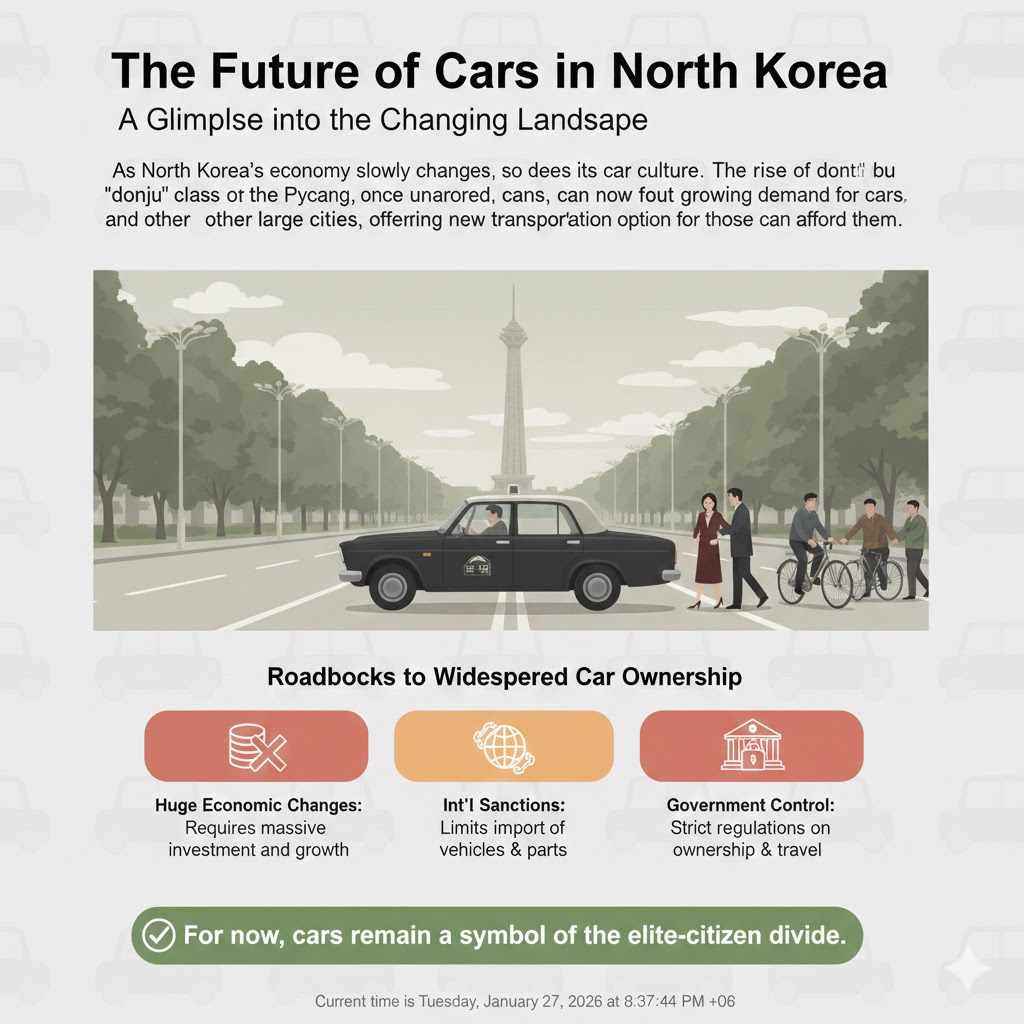
As North Korea’s economy slowly changes, so does its car culture. The rise of the “donju” moneyed class has created a small but growing demand for cars. Taxis, once unheard of, can now be found in Pyongyang and other large cities, offering a new transportation option for those who can afford them.
However, any major shift towards widespread car ownership is unlikely to happen soon. It would require huge economic changes, an end to international sanctions, and a fundamental shift in how the government controls the lives of its people. For now, the car will remain a powerful symbol of the deep divide between the country’s elite and its ordinary citizens.
Frequently Asked Questions (FAQ)
Can a regular person in North Korea save up and buy a car?
No, not really. Even if someone could save enough money, which is nearly impossible for an average worker, they would still need government permission to own a car. This permission is only granted to those with high status or special connections.
Are there car brands made in North Korea?
Yes, Pyeonghwa Motors is North Korea’s domestic car brand. However, it mostly assembles cars using parts from foreign manufacturers, especially Chinese ones, and puts its own badge on them.
Are there traffic jams in North Korea?
Traffic jams are virtually non-existent. With so few cars on the road, even in the capital city of Pyongyang, traffic flows freely. The wide, empty highways are one of the most famous images of the country.
Do people need car insurance in North Korea?
The concept of private car insurance as we know it does not exist. Any accidents or damages are typically handled through state-controlled processes or private arrangements, but details are scarce. The state owns or controls most vehicles, so it manages its own fleet.
Can tourists drive in North Korea?
No, tourists are not allowed to drive in North Korea. All visitors must be accompanied by official government guides at all times and are transported in vehicles with designated local drivers. You cannot rent a car and explore on your own.
What happens if you have a car accident?
Car accidents are taken very seriously. Since cars are so valuable and rare, the consequences can be severe. The process would be managed by state authorities, and fault would be determined by them. For the average person involved in an accident with an official’s car, the outcome would likely not be in their favor.
Are electric cars available in North Korea?
There have been reports and state media features about North Korea developing its own electric cars. However, these appear to be very limited prototypes. Given the country’s chronic electricity shortages, widespread adoption of electric vehicles is not practical at this time.
Conclusion: A World Away
So, can you own a car in North Korea? The answer is a heavily qualified “yes.” While a few thousand people do enjoy the privilege, for the other 25 million, it’s a reality that exists only in foreign films or on the streets of their capital, where they see the powerful drive by.
The car in North Korea is not about freedom or convenience. It is the ultimate symbol of power, loyalty, and status in one of the world’s most controlled societies. The empty roads tell a story not of a lack of desire, but of a system where mobility is a luxury granted only to a chosen few. It reminds us that something as simple as getting in a car and driving where you want is a freedom that should never be taken for granted. Keep driving safely, and appreciate the open road ahead of you.