Car Covers vs Garage Parking: Which Protects Best?
Garage parking protects a car better in enclosed spaces. A quality cover is the right tool for an exposed driveway or street, and shared or semi-open parking often calls for both. Ignore the setup and you invite scratches, UV fade, moisture, and dirt grinding into the paint. This guide breaks down which protection fits enclosed, semi-exposed, and fully exposed parking, plus climate and use patterns.
Car covers vs garage parking: the real trade-off
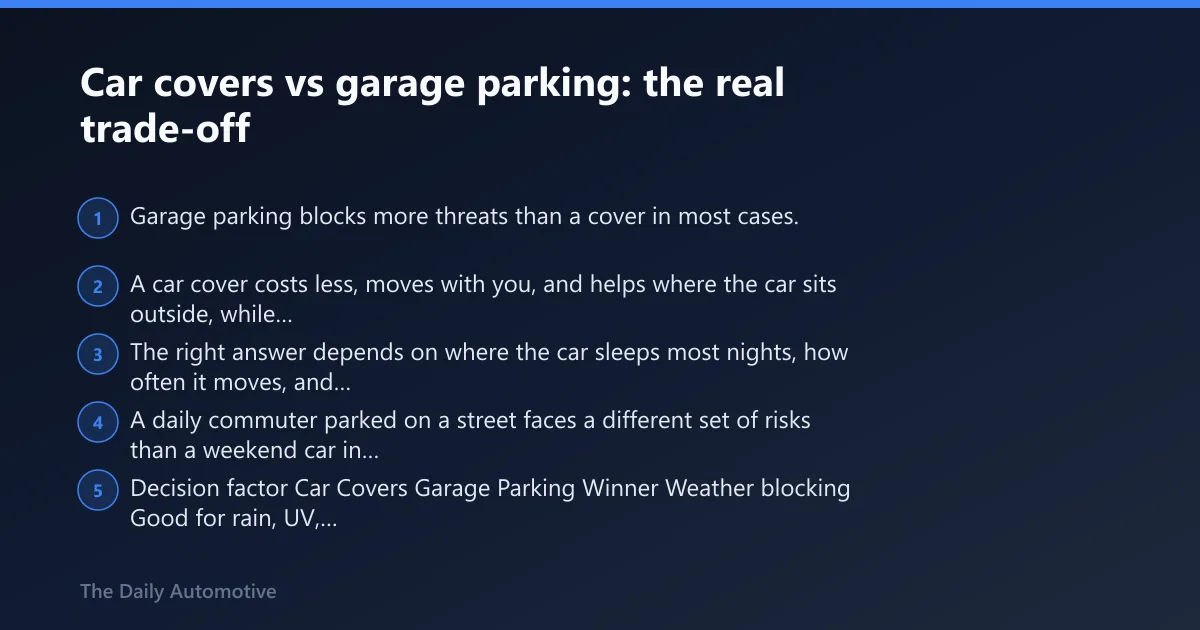


Garage parking blocks more threats than a cover in most cases. A car cover costs less, moves with you, and helps where the car sits outside, while garage parking is the stronger shield when the space is truly enclosed.
The right answer depends on where the car sleeps most nights, how often it moves, and which damage matters most. A daily commuter parked on a street faces a different set of risks than a weekend car in a dry private garage.
| Decision factor | Car Covers | Garage Parking | Winner |
|---|---|---|---|
| Weather blocking | Good for rain, UV, dust, and debris when fitted correctly | Blocks direct sun, rain, snow, and most debris more completely | Garage Parking |
| Cost to start | Usually $50 to $300; indoor covers start under $100 | Building a garage can cost thousands to tens of thousands of dollars | Car Covers |
| Use in exposed parking | Works on a driveway, street, or while traveling | Not available unless a garage already exists | Car Covers |
| Daily convenience | Needs a few minutes to put on and take off | Park and walk away | Garage Parking |
| Moisture control | Depends on breathability and fit; trapped moisture is a risk | Can still have humidity and condensation problems | tie |
Weather blocking
A garage gives the stronger barrier because it blocks direct sun, rain, snow, and most debris completely. That matters when the car sits for long stretches, or when a storm rolls through and the paint would otherwise take the hit.
A quality outdoor cover still earns its keep when there is no enclosed space. It is a partial substitute, not a full match.
Cost to start
Covers cost far less than a garage to build. Car covers can run $50 to $300 depending on fit and material, while indoor covers start under $100 and a custom-fit outdoor car cover is about $150 to $300.
A garage sits in a different budget bracket entirely. Building one can cost thousands to tens of thousands of dollars, and even a DIY garage parking bumper can be made for under $10 in about 20-30 minutes.
Use in exposed parking
Outdoor car covers are made for the places garages cannot reach: a driveway, a curbside spot, or a car in transit. That portability matters for apartment dwellers, street parkers, and drivers without private storage.
If the vehicle never leaves an enclosed space, that portability matters less. If it lives outside, it matters a lot.
Daily convenience
A garage wins on friction. Park, close the door, and you are done.
A cover takes only a few minutes to put on and take off. That still adds up. If the routine gets old, people stop using it, and a cover left in the trunk protects nothing.
Moisture control
Neither option makes a car scratch-proof. A breathable cover helps avoid trapped moisture, but a poor one can hold dampness against the paint.
Garages can also create problems when humidity builds up or condensation forms on the car. Dust drift, pests, and stale air can still be part of the picture.
According to DIY Garage Parking Bumper Keeps You from Knocking Over the Bicyc… — DIY garage parking bumper can be made for under $10.
How much protection does each option actually give?
Garage parking gives broader protection, but the value changes by threat. Sun and debris are where enclosed parking tends to win hard, while a good outdoor cover does the best work against the same threats in open air.
Sun, UV fading, and paint oxidation
Direct sun is a slow enemy. UV exposure fades paint, dries trim, and can push oxidation on neglected finishes.
A garage blocks that exposure cleanly. A UV-resistant outdoor cover also helps a parked car outside, especially if it sits in the same spot every day.
Rain, snow, dust, bird droppings, and tree sap
Rain and snow are obvious, but bird droppings and tree sap are the ugly ones. They can stain quickly and etch into the clear coat if left to bake on.
A garage blocks those contaminants far better than street parking. A waterproof outdoor cover also helps, but only if it stays clean enough not to become the dirt source itself.
Scratches, hail, pests, and theft
Neither option makes a car scratch-proof. A cover can cut light scuffs and dust abrasion, but a bad fit can flap in wind and rub the finish.
Hail-rated covers often use padded construction and may help reduce dents from small hail. That is not the same as garage protection, and it is not a shield against large hail, impacts, pests, or theft.
What kind of car cover do you need?
The cover has to fit the parking job. Indoor and outdoor covers are not the same product, and using the wrong one usually creates new problems instead of solving old ones.
Indoor car cover: dust control and soft lining
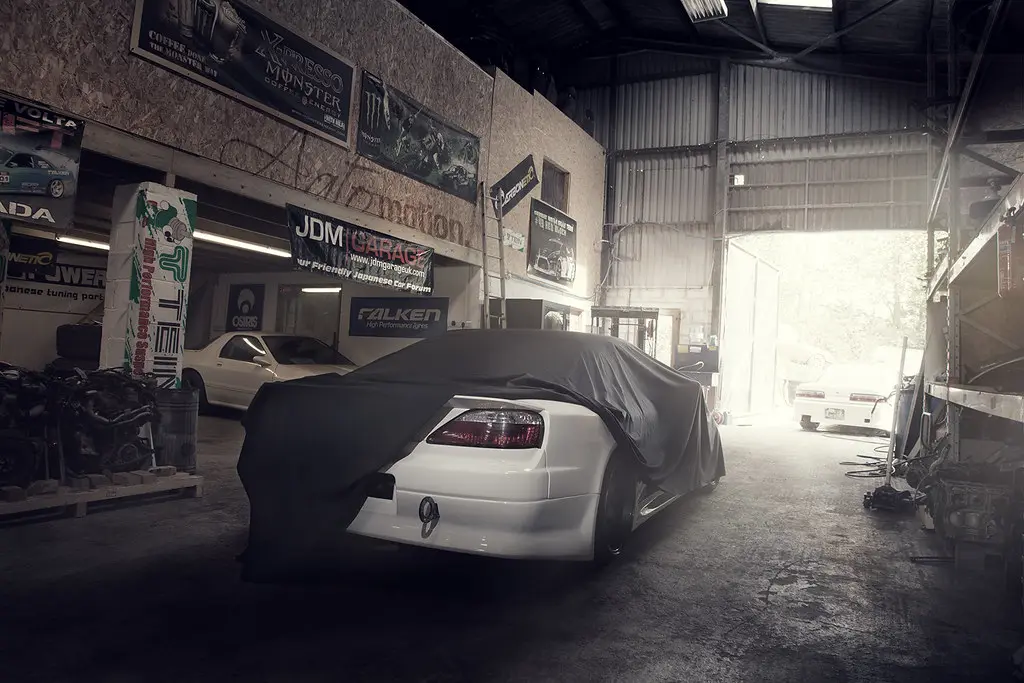
An indoor car cover is for garage use only. It is made to keep dust off the paint and often includes a soft inner lining to reduce light scuffs.
It is not built for rain. Put it outside and you have the wrong tool on the car.
Outdoor waterproof car cover: rain, UV, and debris
An outdoor waterproof car cover is the street-parking answer. It needs rain blocking, UV resistance, and a breathable laminate so moisture does not stay trapped underneath.
That extra protection comes with more daily effort. If a driver uses the car every morning, putting it on and removing it every day may become the deciding factor.
Hail-rated cover: what padded construction can and cannot do
Hail-rated covers use padding to reduce small-hail dents. They can help when a storm is expected and there is no garage available.
They still do not equal a garage. If the hail is severe, the best answer is still real overhead shelter.
Fit, breathability, waterproofing, and daily install burden
Fit matters because loose material flaps, shifts, and wears the paint. Custom-fit options usually hold better in wind than universal-fit covers.
Breathability matters as much as waterproofing. A cover that blocks water but traps moisture can create a damp pocket around the finish. That is the wrong trade for long-term storage.
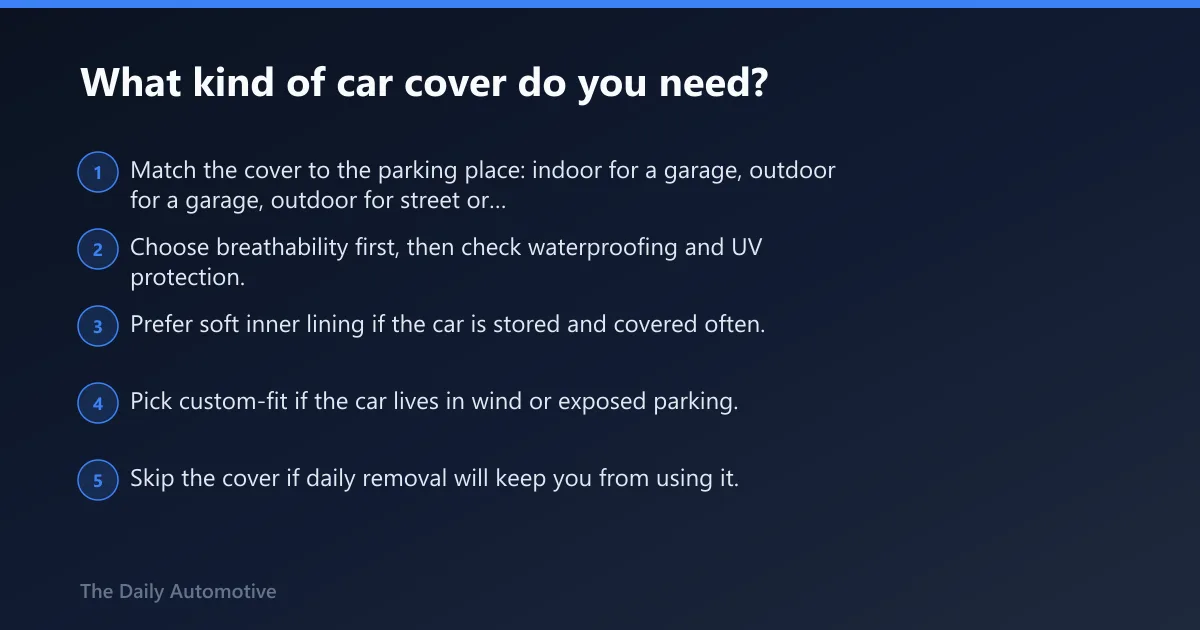
- Match the cover to the parking place: indoor for a garage, outdoor for street or driveway use.
- Choose breathability first, then check waterproofing and UV protection.
- Prefer soft inner lining if the car is stored and covered often.
- Pick custom-fit if the car lives in wind or exposed parking.
- Skip the cover if daily removal will keep you from using it.
Is garage parking always better?
Garage parking is better for raw weather protection, but it is not flawless. A garage can still leave a car exposed to humidity, dust drift, pests, and door-ding risk in shared spaces.
How enclosed parking reduces weather exposure
An enclosed garage blocks direct sun, rain, snow, and most debris more completely than a cover. That is the clearest advantage, and it is why garage parking wins for long-term protection when the space is truly private and sealed.
It also removes the daily install burden. For a car that stays home most of the time, that convenience is hard to beat.
Where garages still leave cars exposed
Humidity can build in a garage, especially if the space is damp or poorly ventilated. Condensation on the car can be a real issue, and that moisture can be as unwelcome as outdoor rain if it sits long enough.
Shared garages also bring dust drift, pests, and door dings from nearby vehicles or foot traffic. So “garage” does not always mean “safe from every kind of damage.”
Fixed location, access limits, and cost
A garage is tied to one place. That works at home, not so well for street parking, travel, rentals, or apartment living.
The hidden cost matters too. A garage can carry rent, maintenance, electricity, or construction expense, while a cover has a much lower lifecycle cost but may need replacement after wear, UV damage, or torn seams.
What does a car cover protect against?
A car cover can help protect against common parked-car exposure like sun, dust, bird droppings, sap, rain, and light contamination. It can also reduce minor scuffs and, with padded versions, soften small hail impacts.
Street-parking use cases
For street parking, an outdoor waterproof car cover is the practical choice. It can work on a driveway, street, or while traveling, which makes it the only realistic option for many drivers without enclosed parking.
That is especially useful in sunny neighborhoods, under trees, or in places where airborne dirt settles fast.
What a cover cannot fully stop
A cover cannot fully stop hard impacts, vandalism, or severe hail. It may reduce the damage, but it does not replace a structure.
It also does little if the car sits uncovered most of the week because the owner does not want the routine hassle.
Why breathability matters as much as waterproofing
Waterproofing keeps outside moisture out, but breathability lets trapped dampness escape. Without that balance, the cover can hold condensation against paint and trim.
That is why material choice matters more than marketing language. The best outdoor cover is one that blocks weather without turning into a wet blanket.
Use the decision matrix
Start with the parking environment, then add climate risk and how often the car moves. That combination gives a much better answer than asking whether one product is “better” in the abstract.
| Parking environment | Climate risk | Daily use frequency | Garage | Indoor cover | Outdoor cover | No cover |
|---|---|---|---|---|---|---|
| Fully enclosed | Dusty, humid, or temperate | Weekly or long-term storage | Yes | Yes | No | No |
| Fully exposed driveway or street | Sunny, rainy, or tree-lined | Every day | No | No | Yes | No |
| Semi-open carport or shared garage | Humid, dusty, urban | Every day | Maybe | Maybe | Yes | No |
| Private garage with good ventilation | Low moisture and low dust | Long-term storage | Yes | Yes | No | No |
| Open parking, mild weather, short stop | Low sun and low debris | Weekly | No | No | Maybe | Yes |
Choose Car Covers if… / Choose Garage Parking if…
Choose Car Covers if the car lives on a driveway or street, you need protection while traveling, or you cannot justify the cost of building or renting enclosed storage. A custom-fit outdoor cover makes the most sense for daily street parking; an indoor cover fits garage use and dust control.
Choose Garage Parking if you have a real enclosed space, the car is valuable enough to keep inside, or the main threat is sun, snow, and debris. If the garage is humid, dusty, or shared, add ventilation, cleaning, or a cover rather than assuming the space is perfect.
Frequently asked questions
Is a car cover better than a garage?
No. A garage usually protects better because it blocks weather and debris more completely than a cover. A car cover is the better answer when the car has to sit outside, because it is far cheaper and works where a garage does not exist.
Does a car cover protect as well as a garage?
Not overall. A good outdoor cover can do a strong job against UV, rain, dust, and tree debris, but it cannot fully match an enclosed garage for all-around protection. It is a partial substitute for people without garage access, not an equal replacement.
Is it worth buying a car cover if I have a garage?
Yes, in some cases. If the garage is dusty, shared, or prone to condensation, an indoor cover can protect the finish during long storage. It is also useful when the car is parked in a garage for weeks or months and you want extra dust control.
Can a car cover stop hail damage?
Only partly. Hail-rated covers with padding can reduce small-hail dents, but they are not the same as overhead shelter. For severe storms, a garage is still the stronger protection, and a cover should be treated as damage reduction rather than a full defense.
How much does a car cover cost compared with a garage?
Car covers can cost $50 to $300 depending on fit and material, with indoor covers starting under $100 and custom-fit outdoor covers about $150 to $300. Building a garage can cost thousands to tens of thousands of dollars, so the ownership gap is huge.
Products related to this article
Sponsored / affiliate links. As an Amazon Associate I earn from qualifying purchases. I may earn additional commission from eligible campaigns.