
Car Rental Options for a Temporary Automotive Lifestyle
Choose a daily rental for a few days, a weekly or monthly rental for longer stretches, and consider a subscription or corporate-rate option only if the included miles and fees compare well with standard pricing for your route. Pick the wrong format, and mileage, insurance, and late-return charges can wipe out the savings fast. This guide matches rental type to trip length, mileage, and use case, then flags the costs that make the wrong choice expensive.
Temporary car rental options: what fits your use case?

The best rental format depends on how long you need the vehicle, how far you will drive, and whether cargo space or replacement urgency matters. A short trip favors a daily rental. A multi-week gap after an accident may point to a long-term rental with roadside assistance.
Enterprise says it has over 10,000 locations across multiple regions, and it lists cars, trucks, SUVs, vans, luxury and exotic cars. That range matters because the vehicle class is part of the decision, not an afterthought. A compact car and a cargo van solve very different problems.
The core trade-off: daily flexibility versus monthly value
Daily rentals give you flexibility. Monthly rentals usually make budgeting easier for longer use, especially when the contract includes insurance, roadside assistance, or no mileage limit. The catch is simple, the cheapest headline rate is rarely the cheapest total.
For short use, you often pay more per day but less overall. For multi-week use, you may accept a longer contract to avoid repeated booking fees, airport surcharges, or a rising total from day-by-day extensions. The right choice is the one that matches your use, not the posted rate with the lowest number.
How trip length, mileage, and downtime change the answer
Trip length sets the rental format. Mileage sets the contract risk. Downtime sets the urgency. If your own car is in the shop for weeks, a long-term rental can make more sense than stringing together short reservations. If you only need a car for errands twice a week, a car-sharing service may fit better.
Say your sedan needs a transmission repair that will keep it off the road for three weeks. A monthly rental can be easier to manage than three separate weekly bookings, especially if the rate includes roadside assistance and the contract allows unlimited mileage on the class you choose.
Car rental options compared by length, mileage, and use case
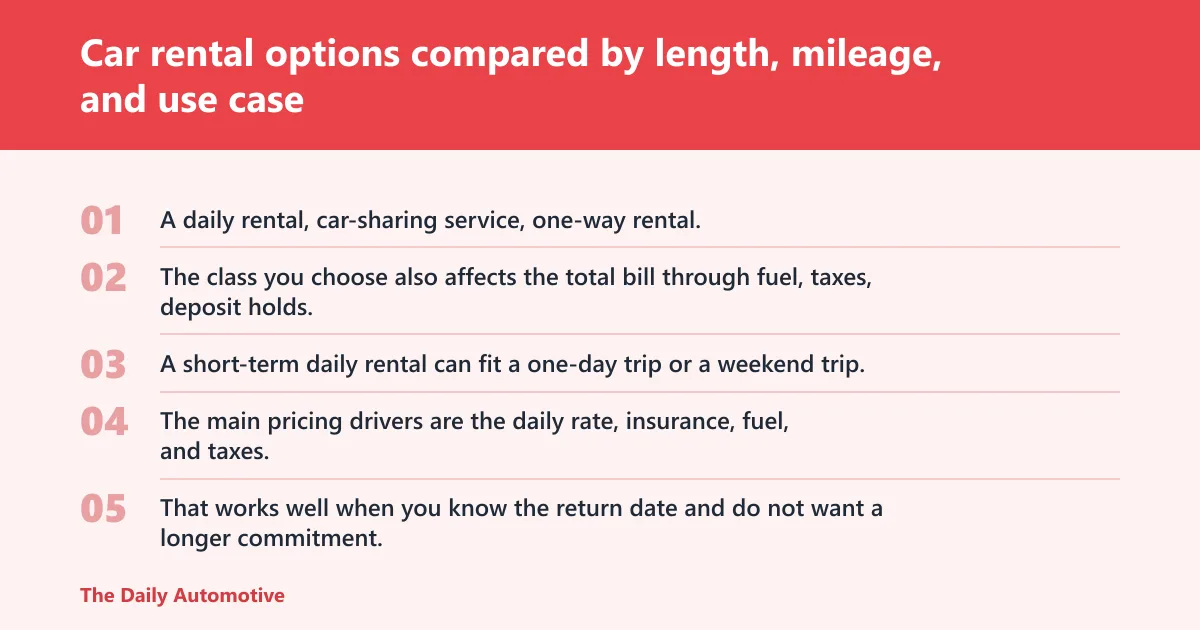
These options are not interchangeable. A daily rental, car-sharing service, one-way rental, and long-term rental each solve a different problem. The class you choose also affects the total bill through fuel, taxes, deposit holds, and location pricing.
| Option | Best for | Typical timing | Mileage and policy notes | Main cost risk |
|---|---|---|---|---|
| Short-term daily rental | Weekend travel, one-off appointments, flexible plans | 1 day to 1 week | Often cheaper for short use; check mileage terms and return time | Insurance, fuel, taxes, late return charges |
| Long-term car rental | Replacement vehicles, seasonal stays, commuting for weeks or months | Several weeks to 365 days | Enterprise says rates begin with rentals longer than 28 days and most vehicle classes have no mileage limit on long-term rentals | Deposit holds, coverage gaps, class restrictions |
| Car-sharing service | Errands, infrequent use, pickup and drop-off convenience | Hourly or daily access | Best when you do not need all-day ownership of the car | Per-hour fees can rise fast with delays |
| One-way rental | Relocation, temporary moves, point-to-point travel | Any length, with different pickup and return sites | Useful when the car will end somewhere else | Drop fees and location surcharges |
| SUV rental | Families, gear, bad weather, taller cargo | Daily to monthly | More space than economy classes, usually at a higher price | Higher base rate and fuel use |
| Van rental | Groups, moving jobs, work projects | Daily to monthly | Capacity-oriented choice for passengers or cargo | Can be pricier and less available than standard cars |
| Truck rental | Hauling, tools, temporary business needs | Daily to project-based use | Often a separate category from cars | Equipment add-ons, fuel, and commercial-use rules |
Short-term daily rental versus long-term car rental
A short-term daily rental can fit a one-day trip or a weekend trip. The main pricing drivers are the daily rate, insurance, fuel, and taxes. That works well when you know the return date and do not want a longer commitment.
Long-term car rental can fit a range from several weeks to about a year. Enterprise says long-term rentals are for several weeks, a month, or more, and rates begin with rentals longer than 28 days. That matters when you need steady access without buying a car for a short stretch.
Car-sharing service versus monthly rental
Car-sharing is the better fit for hourly or daily access when you need a car only now and then. Pickup and drop-off convenience is the main appeal. A monthly rental works better when the vehicle will sit with you for days at a time and you need predictable access.
A common first-timer mistake is paying monthly-rental pricing for an errand car that only moves twice a week. In that case, a car-sharing service often costs less than a long rental because you are not paying for idle time.
One-way rental versus round-trip rental
One-way rental means pickup and return happen in different locations. That is useful for relocation, temporary moves, or a route that ends far from the starting point. The trade-off is that drop fees can make the bill jump.
Round-trip rental usually fits the cleaner plan when you return to the same city. If you are staying put and just need transportation during a temporary automotive lifestyle, round-trip pricing is often simpler to control.
SUV, van, and truck rental by cargo or passenger need
Choose an SUV when you need more passenger room or more cargo volume than a compact or mid-size car can handle. Choose a van when the job is people moving or boxy cargo. Choose a truck when the work is hauling or a temporary business project needs an open bed.
Enterprise notes that rental types range from compact cars to spacious SUVs and vans. It also lists trucks as part of its lineup, which matters because work projects often need a separate category from passenger cars.

Which option is cheapest for your trip length?
The cheapest option changes with the length of the trip and the shape of the bill. For a day or two, a daily rental is usually the cleanest comparison point. For several weeks, the monthly rate may win on total cost, but only if mileage and fees stay in line.
1 day to 1 week
For a day to about a week, a daily rental is often the baseline to compare. Car-sharing can be cheaper for short, occasional use, but it becomes less attractive if the clock keeps running while you sit in traffic or wait for a meeting to end.
2 to 4 weeks
For a few weeks, a long-term rental can start to compete more strongly, especially when the pricing shifts closer to a monthly rate. At this point, unlimited mileage can matter if you commute daily or make repeated cross-town runs.
1 to 6 months
For a few months, long-term rental often becomes the cleaner temporary solution if you do not want to buy, lease, or rely on rideshare for every trip. Enterprise says long-term rental can include insurance and roadside assistance, which reduces out-of-pocket risk during a longer gap.
When buying or leasing starts to compete
Buying or leasing starts to compete when the rental turns into a long enough stopgap that monthly rental charges, insurance, and deposit holds approach the carrying cost of a used car or short lease. Compare total outlay, not just the monthly headline. Include tires, registration timing, and resale hassle if ownership is on the table.
How mileage changes the best choice
Mileage can swing the decision faster than vehicle class. Unlimited mileage is valuable on road trips, commutes, and repeated errands. A daily or weekly cap may be fine for a low-mileage city trip, but it can become expensive fast if the contract charges by the mile.
When unlimited mileage matters
Unlimited mileage matters when the rental will see long highway runs, a daily commute, or frequent back-and-forth trips across town. Enterprise says most vehicle classes have no mileage limit on long-term rentals, which is a major reason those contracts fit multi-week use.
When a daily or weekly cap is acceptable
A capped plan can work when your driving pattern is light and predictable. If you only need a car for a few local appointments and a grocery run, paying for unlimited miles may add cost without adding value. The right answer is to estimate miles before booking, then compare the total.
Commuting, road trips, and repeated errands
Commuting creates steady daily mileage. Road trips create bursts of high mileage. Repeated errands create uneven use that can surprise you if the cap is low. Match the contract to the actual pattern, not the hopeful one.
Choose long-term car rental if you need X; choose car-sharing if you need Y

Choose long-term car rental if you need a replacement for weeks or months, want a vehicle parked outside your home or office, or expect enough mileage that unlimited miles would matter. Choose car-sharing if access is occasional and you can return the car quickly without paying for idle time.
Choose long-term car rental if you need a replacement for weeks or months
If your own car is in the shop after an accident or major repair, Enterprise says long-term rental works for that situation. It also notes long-term rentals can help preserve a personal vehicle’s value by reducing unnecessary wear. That is useful when the gap is temporary but not brief.
Choose car-sharing if you only need occasional access
Car-sharing fits a renter who needs errands, a doctor visit, or a few work stops and then wants the car gone. It is less useful when the vehicle must stay with you all week, because the hourly clock is the enemy of low cost.
Choose daily rental if flexibility matters more than parking convenience
Daily rental works when travel plans may change, the destination shifts, or you need a specific class for a short span. Enterprise says reservations start online and you only pay at pickup, and it offers a no cancellation fee. That can help when plans remain in motion.
Choose one-way rental if the car will end somewhere else
One-way rental is the practical choice for a move, a seasonal relocation, or a trip that ends in another city. Just watch the drop fee. If the fee is high, a round-trip rental plus separate transport back may cost less.
What hidden costs should you check before booking?
Hidden costs can turn a good rate into a bad deal. Insurance, damage liability, fuel, tolls, taxes, deposit holds, driver surcharges, and one-way fees all change the total. Read the contract with the same care you would use on the price quote.
Insurance and damage liability
Check whether your personal auto policy, credit card, or employer policy actually covers the rental class and country. Long-term offers may include insurance, but not every plan does. Damage liability matters because one scratch can trigger a deductible or a claim process you did not budget for.
Fuel, tolls, taxes, and deposit holds
Fuel rules are easy to miss. Return the car with less fuel than required and the refill charge can be far above pump price. Taxes and toll transponders add more. Deposit holds can also tie up cash for days after pickup.
Drop fees and location surcharges
Airport branches are common, but they can price differently from neighborhood locations. That network choice matters because availability varies by city and convenience has a cost. One-way rentals may also carry drop fees that outweigh the time saved.
Extra-driver and underage-driver charges
Extra-driver fees can turn a family trip into a more expensive booking. Underage-driver charges can be even steeper. If multiple people will drive, check the added cost before you reserve. A cheap base rate is not cheap if every driver adds a fee.
Decision table: pick the right rental for your situation
Use this table as a booking filter. Start with trip length, then confirm mileage, cargo needs, and downtime. If two options look close, pick the one with the lower damage and fee risk.
| Situation | Best option | Why it fits | Cost-risk checklist |
|---|---|---|---|
| Weekend city trip, 150 to 300 miles | Short-term daily rental | Simple pickup and return, flexible for a short booking | Check fuel rule, insurance, taxes, and late-return cutoff |
| Three-week commute while a car is repaired | Long-term car rental | Fits replacement use and may reduce cost versus repeated extensions | Confirm mileage policy, roadside assistance, and deposit hold |
| Errands twice a week, less than 60 miles total | Car-sharing service | Pay only for short, occasional access | Watch hourly charges, late returns, and cleaning fees |
| Move to another city with one carload of items | One-way rental | Pickup and return in different locations | Compare drop fee, airport surcharge, and fuel policy |
| Family trip with luggage and a stroller | SUV rental | More space for passengers and cargo | Check fuel use, seat count, and price versus full-size car |
| Apartment move or contractor gear | Van rental | Capacity-oriented choice for bulky items | Confirm cargo dimensions, mileage terms, and damage coverage |
| Jobsite hauling or temporary business project | Truck rental | Separate category better suited to hauling | Check commercial-use rules, insurance, and equipment add-ons |
- Estimate total miles for the booking.
- Decide whether cargo, passengers, or tools matter most.
- Confirm whether you need the car for days, weeks, or months.
- Check mileage limits, deposit holds, and damage liability.
- Compare airport and neighborhood branches before reserving.
- Read one-way fees, driver charges, and fuel rules before paying.
What are the best car rental options for a temporary automotive lifestyle?
The best option depends on how long the gap lasts and how much you drive. For a few days, a short-term daily rental usually fits. For several weeks to months, a long-term rental often makes more sense. For low-frequency errands, car-sharing can be the leaner choice.
Is a long-term car rental cheaper than buying a car for a few months?
Sometimes, but not always. Long-term rental can be cheaper when you need a temporary vehicle and want to avoid insurance changes, registration, maintenance, and resale hassle. Buying can compete if the used-car market is favorable and you can recover much of the purchase price later.
How long can you rent a car long term?
Long-term rental usually means several weeks to 365 days, and some programs start at longer than 28 days. The exact ceiling depends on the company and contract. Some long-term offers also include roadside assistance, which matters when the rental will be your main transportation for a while.
Does a long-term rental include maintenance or roadside assistance?
It can. Enterprise says long-term rentals can include insurance and roadside assistance. That lowers the risk of surprise repair bills on the rental itself. Still, coverage details vary, so confirm whether tire damage, lost keys, towing, and battery issues are covered before you book.
What’s the difference between a car-sharing service and a monthly rental?
Car-sharing is built for short, occasional access, usually by the hour or day, with easy pickup and drop-off. A monthly rental is better when you need the same vehicle for weeks and do not want to keep restarting the clock. The monthly plan usually works better for commuting or replacement use.
Can you rent a truck or van for a temporary work project?
Yes. Vans work well for crews, equipment, and moving jobs. Trucks are a separate category and often better for hauling or temporary business needs. Check whether the contract allows commercial use, because that rule can change coverage, mileage terms, and eligibility.
What mileage limits apply to long-term rentals?
Many long-term classes have no mileage limit, and Enterprise says most vehicle classes have no mileage limit on long-term rentals. That said, exceptions can apply by class, location, or contract. Always confirm the mileage rule before you reserve, especially if commuting or road trips are part of the plan.
What should I choose if my car is in the shop for weeks?
A long-term rental is often the best fit if the repair will take weeks. It keeps you mobile without forcing repeated short renewals. Enterprise specifically notes long-term rental works for a car in the shop after an accident or major repair, which is exactly the kind of replacement scenario this option is built for.
Products related to this article
Sponsored / affiliate links. As an Amazon Associate I earn from qualifying purchases. I may earn additional commission from eligible campaigns.