Car Maintenance Hacks for Busy Professionals
Busy professionals can handle a 5-minute weekly car check: tire pressure, oil level, coolant, lights, and washer fluid first, then anything overdue by mileage or warning light. Skip that order and small faults become late-day breakdowns, uneven tire wear, dead batteries, and repair bills that cost far more time than the check. This guide ranks the highest-risk tasks first, then gives 5-minute routines, simple batching, and a few emergency tools for commuters.
What can you do in 10 minutes a week?
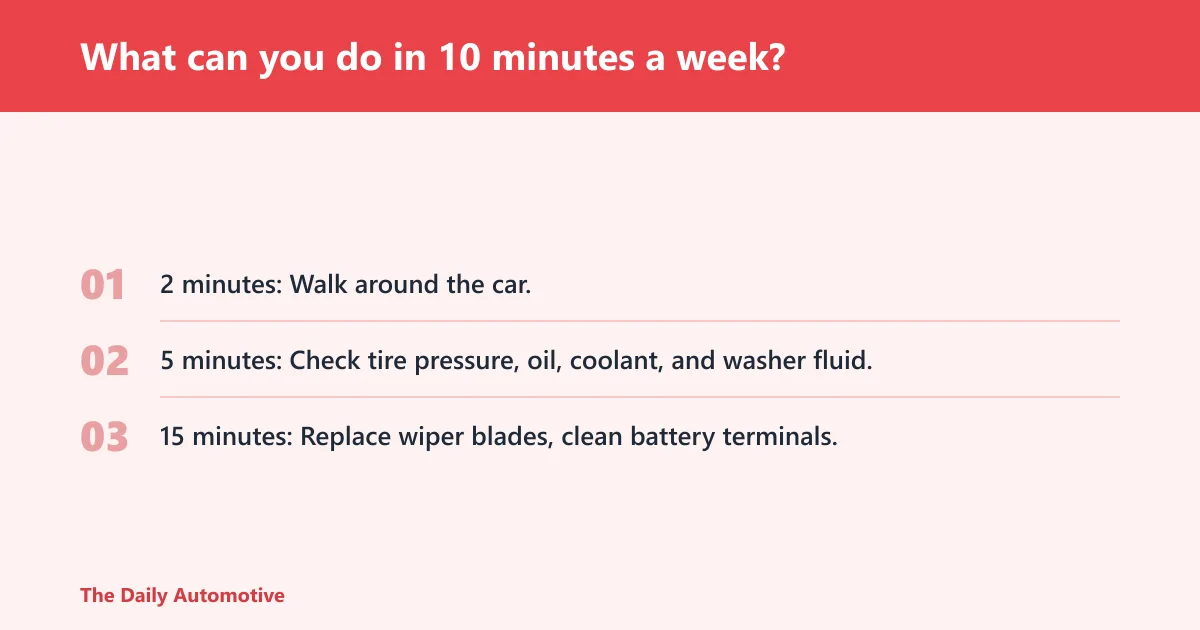
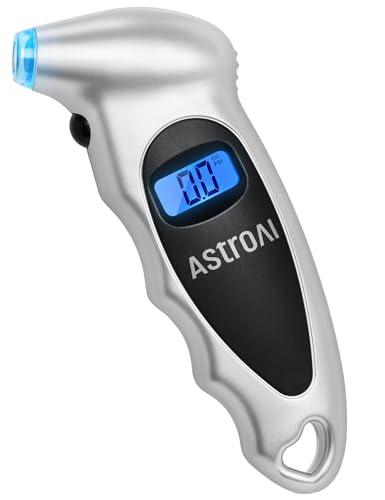

A realistic 10-minute routine covers the checks that prevent the priciest surprises: tire pressure, engine oil, coolant, washer fluid, exterior lights, and a quick scan for leaks or warning messages. If you do them the same day each week, the task stops feeling like another errand and starts working like a calendar reminder.
Use 2-minute, 5-minute, and 15-minute blocks
Think in time blocks, not in “car care.” A brief check can catch obvious problems. A short routine can handle fluids and tires. A longer block lets you clean terminals, replace wipers, or connect a scan tool without rushing.
- 2 minutes: Walk around the car. Look for a flat tire, broken light, puddles, or a hanging trim piece.
- 5 minutes: Check tire pressure, oil, coolant, and washer fluid.
- 15 minutes: Replace wiper blades, clean battery terminals, or read a check-engine code with an OBD2 scanner app.
Sort tasks by safety first
Put safety-critical items ahead of convenience jobs. Tires, brakes, lights, and battery condition belong near the top. Cosmetic cleaning and nice-to-have accessories can wait.
Suppose the dashboard shows a tire-pressure warning on a rainy Monday morning. That is not a “deal with it later” item. It belongs in the first stop you can make, because underinflation affects handling, stopping distance, and tire wear.
Know what can wait until the weekend
Anything that needs a warm engine, a lift, special parts, or more than 15 minutes usually belongs at home or in a shop bay. That includes brake work, coolant flushes, and most electrical repairs. The goal is to keep weekday checks small and fast.
📊 AUTODECO Portable Car Roadside Emergency Kit costs $21.99. Source: Car Maintenance Hacks for Busy Lifestyle Professionals.
How often should you check tire pressure if you’re busy?
Check tire pressure about monthly with a tire pressure gauge on cold tires, and compare the reading with the door-jamb PSI sticker. A monthly five-minute tyre check can also include tread depth and a visual inspection for cuts or bulges. That cadence catches slow leaks before they become rushed roadside problems.
What to do in practice
Use the gauge before the car has been driven far enough to heat the tires. Cold readings are the point of comparison the manufacturer expects. If the numbers are low, add air in small steps and recheck.
Do not guess from tire sidewall numbers. The door-jamb sticker is the target for the vehicle, load, and suspension setup. Sidewall markings are tire limits, not the recommended running pressure.
What busy drivers should watch for
Underinflation often shows up first as sluggish steering, a vague feel on the highway, or uneven shoulder wear. Overinflation can make the ride harsh and reduce the contact patch. Either direction wastes time later.
A common first-timer mistake is checking pressure at a gas station after a 20-minute commute and trusting the number. Hot tires read differently. If time is tight, check at home before departure or after the car has sat long enough to cool.
Which fluids should you top up between services?
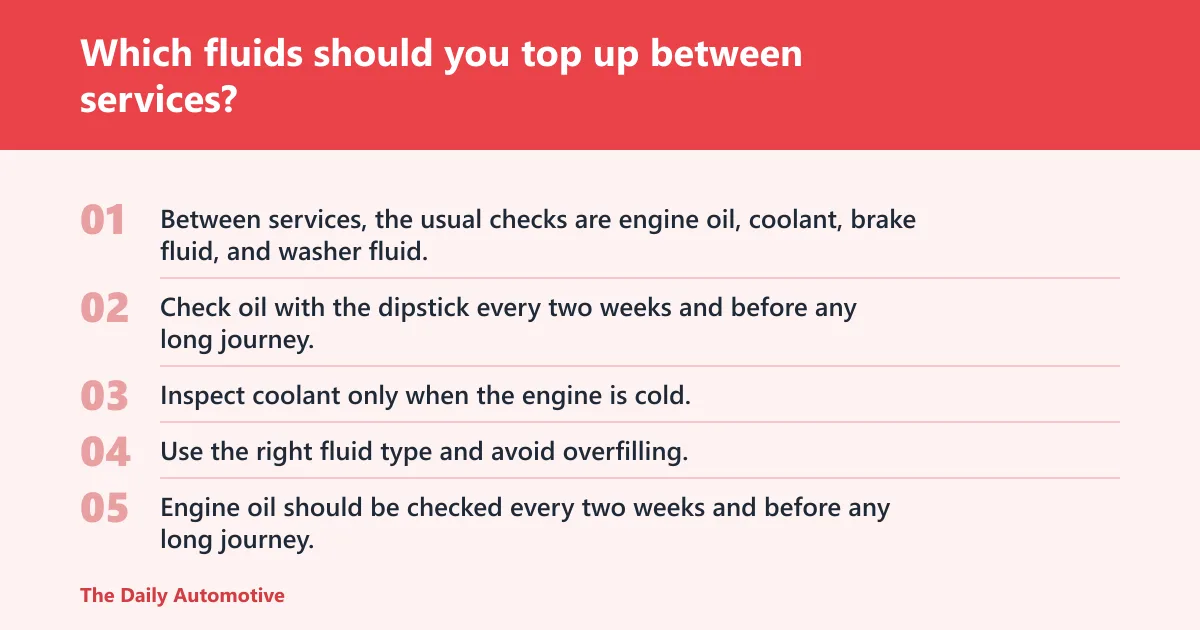
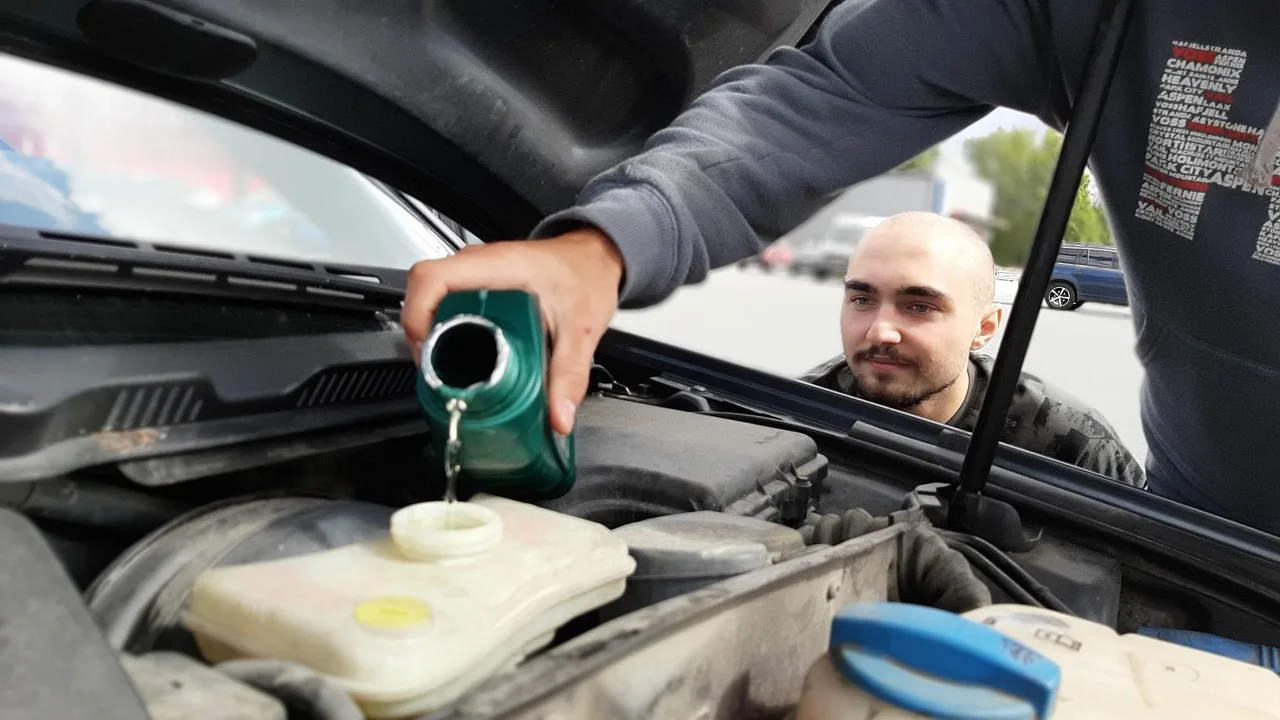
Between services, the usual checks are engine oil, coolant, brake fluid, and washer fluid. Check oil with the dipstick every two weeks and before any long journey. Inspect coolant only when the engine is cold. Check brake fluid near the firewall. Use the right fluid type and avoid overfilling.
Engine oil
Engine oil should be checked every two weeks and before any long journey. Pull the dipstick, wipe it, reinsert it fully, then read the level again. Top up to the manufacturer recommendation, not past it. Too much oil can cause foaming and other problems.
Most manufacturers recommend a full service every 12 months or every 10,000–15,000 miles. Oil checks do not replace that schedule. They help you catch consumption between services.
Coolant
Check the coolant reservoir only when the engine is cold. The level should sit between the minimum and maximum marks. If topping up is needed, use a 50/50 coolant-distilled water mix when the vehicle calls for that mix, and never mix random coolant types.
Wrong coolant or an overfilled reservoir can create new problems. Pressure behavior changes with heat, and some coolant formulas do not play well together. If the level keeps dropping, stop topping up and look for a leak or a shop inspection.
Brake fluid
Brake fluid lives near the firewall in many cars, so the reservoir is easy to spot once you know where to look. A low level may indicate worn pads or a leak. It is not a fluid you should casually “fix and forget.”
If the pedal feels soft, the brake warning light comes on, or the level keeps falling, book service promptly. That is not a parking-lot problem.
Other fluids and a simple rule
Washer fluid is the easiest top-up. Keep it full, especially if you commute before sunrise or in wet weather. If a reservoir cap is unclear, do not improvise with the wrong fluid. The few minutes saved are not worth a damaged system.
Can you do maintenance at lunch or in a parking lot?
Yes, but only for low-risk jobs with no warm-engine work, no lifting, and no need to remove major parts. Parking-lot tasks should be fast, tidy, and reversible. If a job needs bleeding, lifting, or torque-critical fasteners, save it for home or a shop.
Quick jobs that fit a parking space
These are usually safe, fast, and realistic during a work break: tire-pressure check, washer fluid top-up, quick visual inspection, wiper replacement, and reading fault codes with a scan tool. A full fluid check takes under ten minutes, so it can fit into a lunch stop.
Jobs better left for home
Battery terminal cleaning, while simple, is easier at home where you can work methodically and keep the paste, brush, and towels organized. Oil changes, coolant changes, and brake work need better conditions than a work parking lot usually provides.
Tasks that need a shop
Any issue involving brake hydraulics, repeated coolant loss, charging-system faults, or persistent check-engine codes should move to a shop. If the car is leaking, overheating, or hard to start, triage first and drive less until it is inspected.
Picture a commuter with a 9 a.m. meeting and a low battery warning after a week of short trips. A portable jump starter can get the car moving, but the underlying charging issue still needs diagnosis. The jump starter buys time. It does not repair the fault.
How do apps and reminders keep maintenance from slipping?
A Bluetooth OBD2 scanner app helps turn warning lights into plain English and keeps service dates from drifting. The FIXD Bluetooth OBD2 Scanner with Maintenance App costs $39.99 and is described as a Bluetooth OBD2 scanner that pairs with a free app. That setup is useful when you need a quick read before leaving for work.
What the app can do
Paired with a Bluetooth OBD2 scanner, the app can read check-engine codes in plain English, log service history, and track reminders. That matters when the car is shared across schedules or when a lease return is coming and records need to be clean.
What it cannot do
An app does not replace diagnosis. A code reader can point to a system or a likely fault, but it cannot tell you whether a sensor, wiring issue, vacuum leak, or mechanical failure is the real cause. Use it to decide next steps, not to skip them.
Segment-specific advice
City commuters should focus on brake wear, battery health, and tire pressure because short trips and stop-and-go use can stress those systems. Hybrid and EV owners should still check tires, 12-volt battery condition, and cabin air filters, even though engine oil may not apply in the same way. Leased vehicles need cleaner records and earlier attention to wear items, because return inspections punish neglect.
What emergency items should you keep in the car?
Keep a roadside emergency kit and a portable jump starter in the trunk for quick access. The kit is a stopgap, not roadside assistance, and it is there to keep a flat tire or breakdown from derailing the commute. A lithium portable jump starter helps when the battery dies at the wrong time.
What goes in the kit
- Reflective triangle or warning device
- Basic gloves
- Tire inflator or sealant if your vehicle uses one
- Flashlight with spare batteries
- First-aid basics
- Phone charging cable
- Water and a small towel
The AUTODECO Portable Car Roadside Emergency Kit costs $21.99 and is positioned as protection for a packed commute schedule. The NOCO Boost GB40 Portable Lithium Jump Starter costs $99.95 and is presented as a portable lithium unit kept in the car. If your schedule depends on getting moving fast, that difference matters.
Why the jump starter helps
A jump starter is useful on meeting days because it avoids waiting for another vehicle. That saves time in office lots, garages, and curbside pickup zones where help may not be nearby. Keep it charged and store it where you can reach it without unpacking the trunk.
Use this maintenance triage matrix to decide what to do first
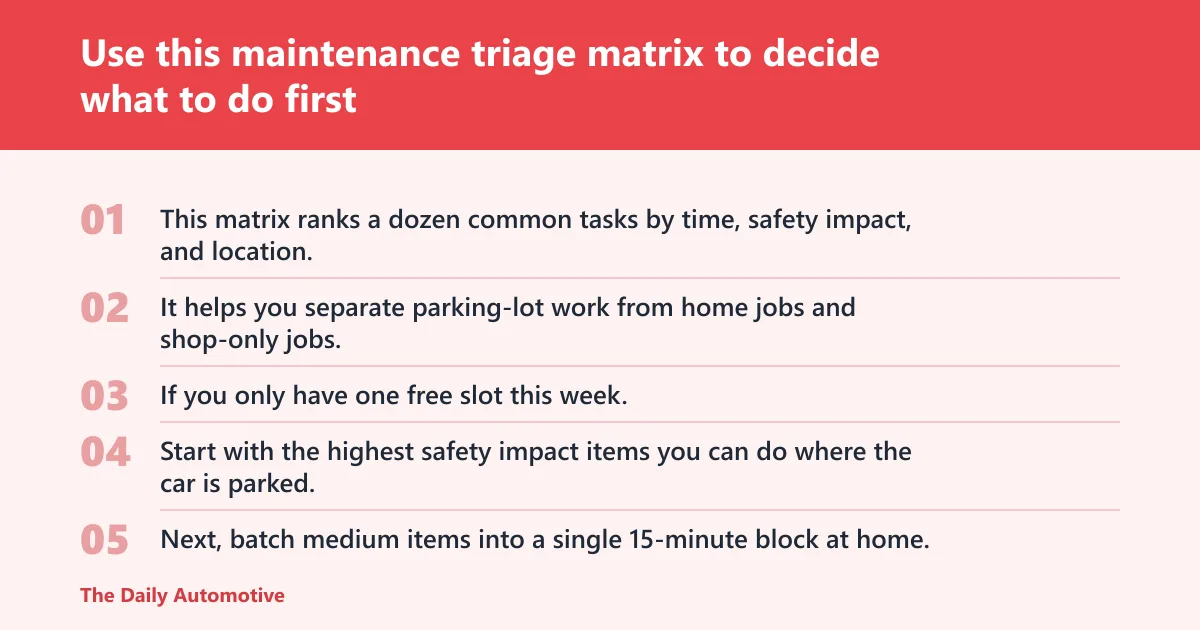
This matrix ranks a dozen common tasks by time, safety impact, and location. It helps you separate parking-lot work from home jobs and shop-only jobs. If you only have one free slot this week, start with the highest safety impact task that fits your location and time window.
| Task | Time | Safety impact | Best location | Do it now or later? |
|---|---|---|---|---|
| Tire pressure check | 5 min | High | Parking lot or home | Do now |
| Oil level check | 5 min | High | Home or parking lot | Do now |
| Coolant reservoir check | 5 min | High | Home only, engine cold | Do now if cold |
| Brake fluid level check | 5 min | High | Home or shop bay | Do now, service soon if low |
| Wiper blade replacement | 5 to 10 min | Medium | Parking lot or home | Do now if streaking |
| Exterior light check | 2 min | High | Parking lot | Do now |
| Battery terminal cleaning | 15 min | Medium | Home | Do this weekend |
| OBD2 code read | 5 min | Medium | Parking lot or home | Do now if warning light is on |
| Washer fluid top-up | 2 min | Low | Parking lot or home | Do now |
| Roadside kit restock | 10 min | Low | Home | Do this week |
| Air filter inspection | 10 to 15 min | Low | Home | Batch with other tasks |
| Brake service | Shop time | High | Shop only | Book a visit |
How to use the matrix
Start with the highest safety impact items you can do where the car is parked. Next, batch medium items into a single 15-minute block at home. Leave shop-only work to a mechanic, especially if the problem involves brakes, overheating, repeated warning lights, or fluid loss that returns after a top-up.
When to stop DIY and book a shop visit
Stop DIY if a warning light stays on after a basic check, if a tire loses pressure again within days, if a coolant level keeps falling, or if braking feels different. Those are fault patterns, not maintenance gaps. A quick check is useful only if it leads to the right next step.
Frequently asked questions
What car maintenance can I do in 10 minutes a week?
In 10 minutes, you can check tire pressure, oil level, coolant, washer fluid, and lights, then scan for leaks or dashboard warnings. That is enough to catch the most common time-wasting failures early. Keep the routine same-day, same-order, and the car becomes easier to manage.
How often should I check tire pressure if I’m busy?
Check tire pressure monthly, using a gauge on cold tires and comparing the reading with the door-jamb PSI sticker. If the car does a lot of short city trips or carries extra passengers often, check a bit more often. A monthly five-minute tyre check is the baseline.
What fluids should I top up between services?
Between services, focus on engine oil, coolant, brake fluid, and washer fluid. Check oil every two weeks and before long trips. Inspect coolant only when cold. If brake fluid is low, treat that as a clue, not a casual top-up request, because worn pads or leaks may be involved.
Which car maintenance tasks are safe to do at lunch or in a parking lot?
Parking-lot safe tasks usually include tire checks, washer fluid top-up, light inspection, wiper replacement, and reading OBD2 codes. Anything that needs a lift, warm engine, brake work, or fluid bleeding belongs elsewhere. A lunch break is enough for low-risk tasks, not for uncertainty.
What apps can help me track car maintenance reminders?
A Bluetooth OBD2 scanner app can read codes in plain English and track service history and reminders. That is helpful for people who juggle commuting, travel, and shared vehicle use. Use the app to remember dates and mileage, then pair it with the manufacturer service schedule.
What emergency items should busy drivers keep in the car?
Keep a roadside emergency kit, a portable jump starter, a flashlight, charging cable, and basic first aid items in the trunk. The kit helps you stay stable through a flat tire or breakdown, but it is not roadside assistance. The jump starter helps when the battery dies before a meeting.
Products related to this article
Sponsored / affiliate links. As an Amazon Associate I earn from qualifying purchases. I may earn additional commission from eligible campaigns.