Finding Community in the Automotive Lifestyle: A Guide
Start with one niche, one platform, and one low-pressure first event; that can be a practical way to find an automotive community that fits your car, budget, and comfort level. Pick badly and you waste time in cliques, spam, or groups that never move beyond posting. This guide shows how to find, vet, and join the right online and offline communities.
How do you find a car community near you?
Start with the vehicle or activity you actually care about, then search by city, model, brand, and event type. Local car clubs are usually the main in-person entry point, and social media groups plus car shows are the quickest ways to spot active members, current meets, and organizers nearby.
Begin with the niche, not the platform
Clubs are usually built around a specific vehicle, brand, or shared interest. That means a Miata group, a classic Ford club, an off-roading crew, and an EV meetup may all live in different places and follow different norms. If you start with the car type or activity, the search gets cleaner.
Use the terms people actually post
Search your city name plus model, brand, meet, cruise, club, cars and coffee, show, or the specific niche you want. For off-roading, add trail, overland, or 4×4. For classic cars, add restoration, vintage, or marque. For EVs, add charging, owners, or regional owner group.
Check club pages, event calendars, and recent meet posts
The best leads are not always polished websites. A club’s current social post, a show flyer, or a pinned event thread can tell you more than a long description. Look for recent dates, clear location details, and replies from real members instead of old reposts.
Where do automotive communities live online now?
Most clubs now use Discord, Telegram, or Instagram as their home base. Social media groups are often the discovery layer, while the club’s main coordination may happen in chat apps. That makes online search useful, but only if you know what each platform is best at.
Discord as a club home base
Discord is common when a club wants structured chat, topic channels, and event coordination in one place. It works well for technical questions, build threads, local meet planning, and moderation. If a club has active channels, recent replies, and clear rules, it usually feels more organized than a loose comment feed.
Telegram for coordination and quick updates
Telegram is sometimes used for fast group messaging, day-of schedule changes, and simple coordination. It can be useful for small local circles or clubs that want light friction and rapid updates. That convenience is helpful, but it also means you should check whether the group has real moderation and clear boundaries.
Instagram for discovery and event promotion
Instagram is useful for finding clubs, seeing event posters, and checking whether a group actually meets in person. Clubs often use it to post cars, recap meets, and advertise upcoming shows. A steady stream of current event posts is a better sign than a page filled only with generic car photos.
How do you tell if a group is worth your time?
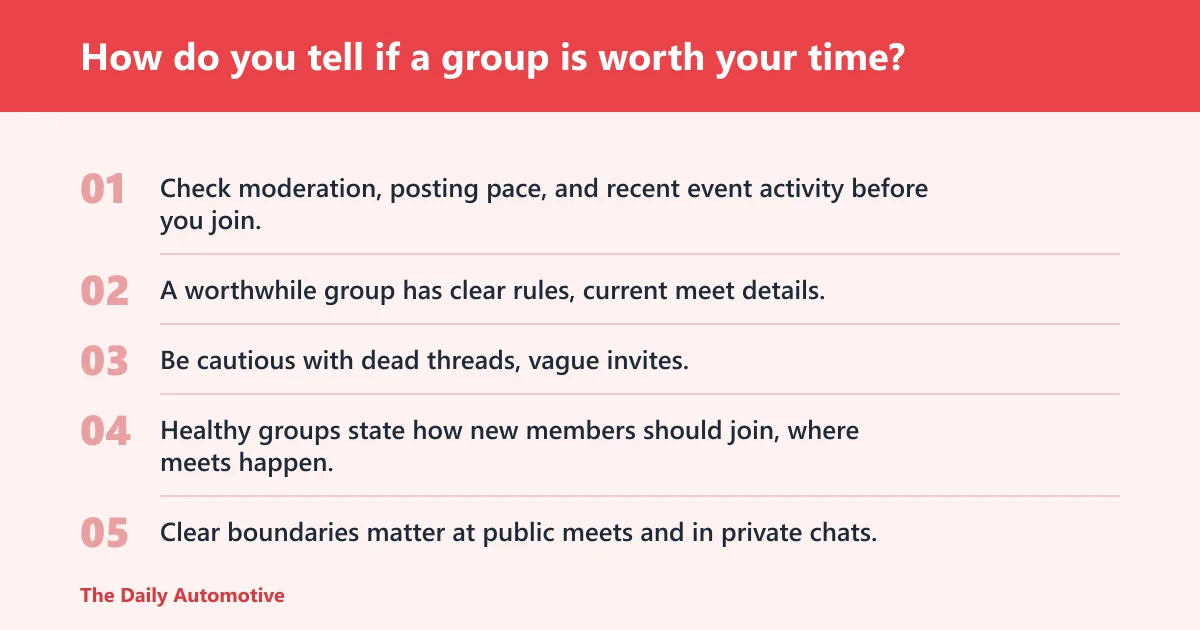
Check moderation, posting pace, and recent event activity before you join. A worthwhile group has clear rules, current meet details, and signs that people actually talk to each other. Be cautious with dead threads, vague invites, and chats where no one answers beginner questions.
Look for active moderation and clear rules
Healthy groups state how new members should join, where meets happen, and what behavior is not allowed. Clear boundaries matter at public meets and in private chats. If moderation is absent, spam stays visible, arguments linger, and unsafe suggestions can spread without correction.
Watch the pace of posts and replies
Activity matters more than follower count. A group with several recent event posts and actual replies is more useful than a large page with months of silence. You want evidence that members still plan meets, answer questions, and show up when they say they will.
Spot the warning signs early
Cliques often answer only a few insiders, then ignore newcomers. Dead groups post once, then stall. Unsafe meets hide the location, change the time at the last minute, or give no parking guidance. A vague “pull up if you know, you know” invite is not enough.
Say your search turns up a large Instagram club with attractive photos but no recent comments, no meetup details, and no response to direct messages. That group may look active, yet it is functionally closed. A smaller Discord with weekly event planning can be a better first step.
What kind of automotive group fits your interests?
The right group matches both your vehicle and your reason for joining. Local car clubs and broader auto clubs work well for many owners, while off-roading communities, classic car clubs, and electric vehicle groups serve distinct interests with different expectations, language, and event styles.
Local car clubs and auto clubs
Local car clubs are often a common in-person entry point, especially when you want nearby meets and repeated contact. Auto clubs are the broader category; they were once closely linked to racing and competition, and now include many niches, events, rallies, and social gatherings.
Off-roading communities
Off-roading communities are a distinct niche centered on shared interest rather than one model. They may care more about tires, recovery gear, trail rules, and convoy etiquette than about brand loyalty. If you drive a 4×4, overland rig, or trail build, this niche can feel more relevant than a general car page.
Classic car clubs and electric vehicle groups
Classic car clubs focus on preserving heritage and shared knowledge, including period-correct parts, restoration approaches, and meet etiquette around older vehicles. Electric vehicle groups are another distinct niche and often discuss charging access, software, range planning, and local infrastructure alongside social events.
Picture a young owner of a stock hatchback joining a lifted-truck trail group because both are “car people.” The parking lot may be friendly, but the event focus, tools, and driving expectations can be wrong. A better fit is a compact-car or model-specific group with beginner-friendly meetups.
How do you move from online chat to an in-person meet?
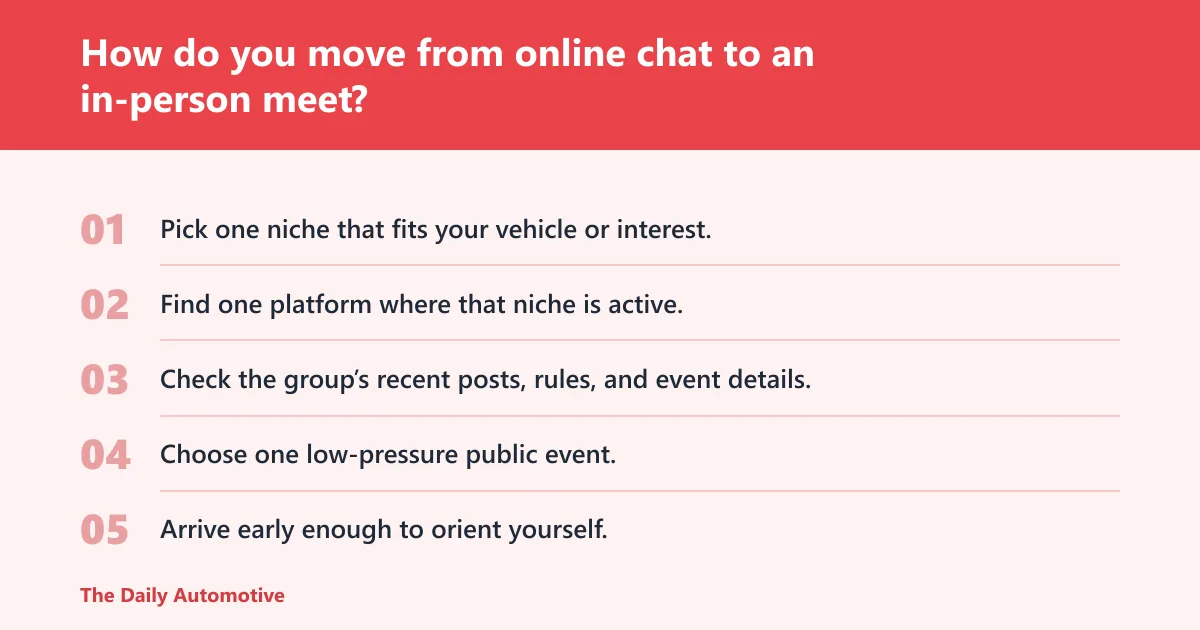
Use a low-pressure first event, read the format before you go, and arrive with simple etiquette in mind. Car shows can be a useful way to find community and turn online contact into offline friendships, especially when the first visit is short, public, and easy to exit.
Choose the least intimidating first event
Start with a daytime show, a casual parking-lot meet, or a public club gathering rather than a late-night cruise or a high-pressure convoy. The goal is to observe how the group behaves, not to prove anything. A short visit gives you an exit if the vibe feels wrong.
Read the event format before you arrive
Check whether the meet is static display, a rolling cruise, a technical workshop, a family-friendly gathering, or a trail run. Each format has different expectations. A show wants clean presentation and foot traffic. A meet may expect you to park, say hello, and avoid blocking lanes.
Keep arrival and parking simple
Follow the posted start time, park where directed, and do not assume you know the unwritten rules. Leave space for other cars, keep music reasonable, and avoid revving or moving around the lot without cause. If you are unsure, ask an organizer or a long-time member where to stand.
- Pick one niche that fits your vehicle or interest.
- Find one platform where that niche is active.
- Check the group’s recent posts, rules, and event details.
- Choose one low-pressure public event.
- Arrive early enough to orient yourself.
- Leave after a reasonable stay if the fit is not right.
Platform-and-community fit checklist
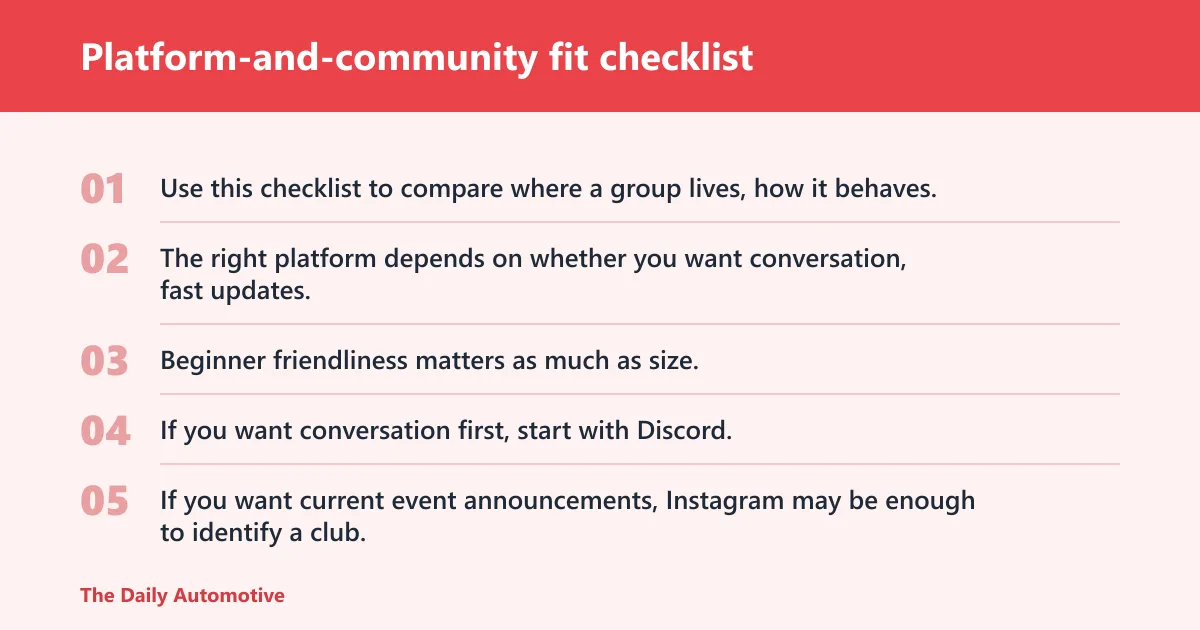
Use this checklist to compare where a group lives, how it behaves, and how easy it is to join. The right platform depends on whether you want conversation, fast updates, public discovery, or face-to-face meetings. Beginner friendliness matters as much as size.
| Platform or format | Primary purpose | Activity signals | Meetup style | Beginner friendliness |
|---|---|---|---|---|
| Discord | Club home base, chat, coordination, technical talk | Recent replies, active channels, event planning threads | Organized meets, member-led discussions, recurring events | Good if rules and roles are clear |
| Telegram | Quick updates, group messaging, day-of coordination | Fast responses, schedule changes, active admin posts | Short-notice meetups, small group coordination | Mixed; easy to join, but quality varies |
| Discovery, event promotion, visual identity | Current event flyers, comments, tagged attendees | Public meets, show promotion, recap posts | Good for finding groups, weaker for deep discussion | |
| Local car clubs | In-person entry point, shared ownership or interest | Regular meet schedule, membership info, organizer contact | Meets, rallies, social gatherings, club drives | Often strong if the club welcomes newcomers clearly |
| Car shows | Discovery and offline connection | Vendor lists, attendee posts, current event notices | Walkaround visits, parking-lot conversations, public contact | Very good for first visits because the setting is public |
How to use the checklist
If you want conversation first, start with Discord. If you want current event announcements, Instagram may be enough to identify a club. If you want a face-to-face entry point, a local car club or a public car show is usually more useful than a quiet chat room.
What should you do before your first visit?
Prepare your questions and contact details, plan for safety and comfort, and know how to leave if the meet feels off. A first visit works best when you treat it like a short introduction, not a commitment. Keep your expectations practical and your exit easy.
Bring the basics and keep them easy to access
Save the event location, the organizer’s handle, and any posted parking notes. Have a phone charged, a small amount of cash if needed, and a clear sense of when you plan to leave. If the meet is at night, choose a route and parking spot that feel well-lit and simple.
Ask a few direct questions
Ask how often the group meets, whether newcomers are expected to introduce themselves, and what the usual parking or check-in process is. That helps you learn the tone quickly. Good groups answer without making you feel out of place.
Know when to leave
If the crowd seems hostile, the location changes without explanation, or the event looks unsafe, leave. A clean exit is not rude. It is the right call when the group’s behavior does not match the public description or your comfort level.
Common first-timer mistake: arriving late, parking wherever there is space, and then standing alone for 20 minutes without speaking to anyone. A better move is to arrive near the posted start time, introduce yourself to one organizer, and ask where newcomers usually park.
Frequently asked questions
How do I find a car community near me?
Search by city plus the niche you want: brand, model, show, meet, club, or off-roading. Then check whether the group has recent posts, current event details, and active replies. Local car clubs, social media groups, and car shows are the most direct starting points.
What are the best places to meet car enthusiasts?
Car shows, local club meets, and public parking-lot gatherings are the easiest places to start because the setting is visible and conversational. Social media groups help you identify those events first, while Discord and Telegram often handle the planning behind the scenes.
Are car clubs active on Discord or Instagram now?
Yes. Most clubs now use Discord, Telegram, or Instagram as their home base. Discord is common for conversation and coordination, while Instagram is useful for discovery and event promotion. Many clubs use both, with one platform for planning and another for public visibility.
How do I choose the right car club for my interests?
Match the club’s niche to your actual interest, then check moderation, event frequency, and safety cues. A good fit has clear rules, recent meet details, and a tone that welcomes questions. If you drive a classic, EV, or trail rig, look for a group built around that use case.
What should I expect at my first car meet?
Expect a mix of casual conversation, parked cars, and some people who already know each other. You should also expect different levels of formality depending on the group. Public events are usually easier for first visits because you can arrive, look around, talk, and leave without pressure.
Can automotive communities help with skills and friendships?
Yes. Communities can help with maintenance knowledge, parts advice, event planning, and practical driving tips, and they often become a path to friendships and networking. The strongest groups make room for beginners and answer questions without turning the conversation into gatekeeping.
Are there communities for off-roading, classic cars, and EVs?
Yes. Off-roading communities, classic car clubs, and electric vehicle groups are all distinct niches within the broader automotive world. They differ in language, event style, and expectations, so choosing the right one matters. Each can be a strong entry point if the format matches your interest.
How do online car groups turn into real-life friendships?
They usually move from chat to a public event, then to repeated low-pressure contact. A group becomes social when people answer questions, recognize names, and show up more than once. The shift happens faster when the first meet is short, clear, and easy for newcomers to attend.
Products related to this article
Sponsored / affiliate links. As an Amazon Associate I earn from qualifying purchases. I may earn additional commission from eligible campaigns.