Finding Cheap Auto Services Without Cutting Corners
Save money on routine maintenance by comparing about three quotes, and keep diagnostics, brakes, steering, and warranty-related work out of the bargain options. Skip those guardrails and a cheap visit can turn into a breakdown, a denied claim, or a much larger repair bill. This guide shows where low prices are safe, where they are not, and how to compare shops without getting misled.
What cheap auto service should mean
Cheap should mean low total cost, itemized pricing, and no surprise add-ons. A low sticker price only helps if the estimate also lists labor hours, parts quality, shop supplies, disposal fees, and any required inspections. If the quote hides those items, the final bill may not be cheap at all.
Hidden costs usually show up in four places: diagnostic fees, shop-supplies charges, fluid disposal, and add-ons like alignment checks or brake hardware. Ask for each line item in writing before approval. A fair quote makes it easy to compare labor rate, parts, and any fee that is not part of the repair itself.
Labor rates vary widely. Dealership labor often costs more than an independent shop because of facility overhead and brand-specific training, but that does not make it better by default. For routine work, compare hourly shop rate, labor time estimate, and whether the shop charges a separate diagnostic fee.
How to compare shops without guessing
Compare shops by total written estimate, not by a single hourly rate. An independent shop with a lower labor rate can still cost more if it books more hours, adds a scan fee, or lists extra supplies. A dealer with a higher rate can sometimes stay competitive on simple maintenance if the labor time is shorter and the price is flat.
Chains can work for predictable service such as oil changes, batteries, and tires, but the quote still matters. Mobile mechanics may save on overhead for simple jobs, yet many are not set up for advanced drivability diagnosis, alignments, or brake-hydraulic work. Specialty shops are often the better value for transmissions, steering, and European or hybrid systems.
Ask each shop to separate labor, parts, and fees. Then compare the same repair scope across all three estimates. If one quote is vague, it is not a bargain; it is an unknown.
Compare the numbers line by line
- Request a written estimate with labor hours, parts, and fees.
- Confirm whether the diagnostic fee is credited to the repair.
- Ask whether the quote includes fluids, shop supplies, and disposal.
- Check the warranty terms in writing.
- Compare the exact scope, not a rough description.
Which car services are safe to price-shop?
Oil changes, battery replacement, tire rotation, and some straightforward alignments are often safer places to save. These services are predictable, the failure mode is usually obvious, and the parts list is easy to verify. You still want the right fluid, filter, battery rating, and alignment printout, but the risk of a low-cost mistake is lower than with diagnostics or brakes.
Say your compact sedan needs a 5W-30 synthetic oil change and a new filter. A fair low-cost quote should specify synthetic versus conventional oil, the filter brand or tier, the service interval, and whether disposal is included. If the shop cannot tell you those details, the low price is hiding too much.
Battery service is another good comparison point. A proper battery test should mention CCA rating, reserve capacity if available, and a load-test result. If the battery is weak, compare replacement warranty terms and confirm fitment before buying.
Tire rotation is usually routine, and alignment pricing is often fair when the issue is clear. Tire wear indicators, steering-wheel pull, off-center wheel position, or a new set of tires are common reasons to ask for an alignment check. The shop should tell you whether it is correcting thrust angle, front toe, or a full four-wheel setup.
When cheap repairs become risky
Brakes, steering, suspension, drivability complaints, and transmission service belong in the caution category. These repairs affect stopping distance, vehicle control, or long-term reliability, so the cheapest quote can become expensive if it skips inspection or installs weak parts. Pay for competence here, not a lower invoice.
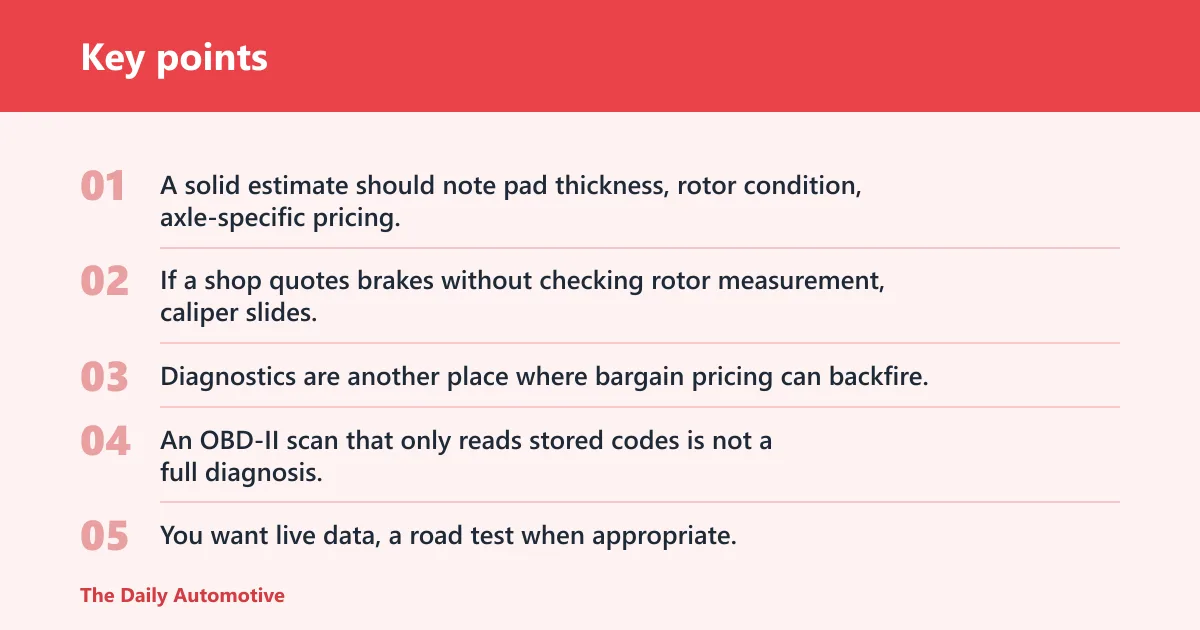
Brake service needs more than a pad swap. A solid estimate should note pad thickness, rotor condition, axle-specific pricing, and any hardware that needs replacement. If a shop quotes brakes without checking rotor measurement, caliper slides, or pad wear pattern, the work is incomplete.
Diagnostics are another place where bargain pricing can backfire. An OBD-II scan that only reads stored codes is not a full diagnosis. You want live data, a road test when appropriate, and a plan that avoids the parts-cannon problem of replacing parts until the symptom disappears.
Transmission service deserves caution because fluid type, fill level, and service method matter. Draining and refilling with the correct specified fluid is very different from a vague “flush.” If the shop cannot name the fluid standard and explain why service is needed, pause.
Brake fluid and safety-related fluids
Brake fluid should not be treated as a generic add-on. Many vehicles use DOT 3, DOT 4, or DOT 5.1, and the wrong fluid can cause problems. A flush is usually justified by age, moisture contamination, or service interval, not by a blanket sales pitch at every visit.
Brake fluid absorbs moisture over time, which lowers boiling point and can affect pedal feel under heat. A shop should explain why the flush is needed, not just that it is “due.” If there is no test result or age-based interval in the owner’s schedule, ask for the basis before approving it.
Finding cheap auto services matrix
| Service | Cost-saving opportunity | Risk level | Typical shop type | Acceptable part quality | Red flags | When to pay more |
|---|---|---|---|---|---|---|
| Oil change | High | Low | Independent, chain | Correct synthetic or conventional oil, quality filter | Wrong viscosity, no filter change, mystery fees | Turbo engines, warranty sensitivity, severe-service intervals |
| Brakes | Moderate | High | Independent, brake specialist | OE-quality or better friction material, proper hardware | No rotor check, one-axle-only upsell without inspection | Noise, pulsation, thin pads, rotor wear, safety concerns |
| Batteries | High | Low to moderate | Independent, chain, dealer | Correct CCA, reserve capacity, warranty in writing | No load test, wrong group size, vague warranty | Start-stop systems, harsh climates, hard-to-access batteries |
| Tires | Moderate | Moderate | Tire shop, chain, dealer | Known brand, proper load and speed rating | Mismatch in size, load index, or DOT age concerns | AWD systems, uneven wear, road hazard coverage needed |
| Alignments | Moderate | Moderate | Alignment specialist, tire shop | Correct specs with before/after printout | No symptom check, no printout, ignored thrust angle | Pulling, steering wheel off-center, new tires, suspension work |
| Diagnostics | Low | High | Specialist, dealer, competent independent | Scan tool data, testing, documented findings | Parts-cannon approach, code reading only, no test plan | Warning lights, misfires, intermittent faults, drivability issues |
| Coolant flushes | Low to moderate | Moderate | Independent, dealer, specialty shop | Correct coolant spec, sealed refill, bleed procedure | Universal fluid without spec match, no explanation of need | Overdue service, contamination, overheating history |
| Transmission service | Low | High | Specialty shop, dealer | Specified fluid and correct service method | Flush without fluid spec, no level-setting procedure | Shift issues, service history unknown, warranty coverage |
How do you spot a fair quote?
A fair quote names labor hours, parts line items, and the exact reason for the repair. For brakes, that means pad thickness, rotor condition, axle-specific pricing, and any hardware that should be replaced. For diagnostics, it means stored codes, live data, and a clear test plan instead of a guess.
A common first-timer mistake is accepting a brake quote that lists only “front brakes” with no measurements. That leaves too much room for padded labor or unnecessary parts. Another mistake is treating an OBD-II code like a diagnosis. A code points to a fault area; it does not identify the failed part on its own.
For alignments, look for a printout before and after service. It should show toe, camber, caster where applicable, and thrust angle on vehicles that use it. If the shop says the numbers are fine but will not show them, the quote is incomplete.
What honest shops usually provide
- Written labor hours and hourly shop rate.
- Parts brand, quality tier, and warranty terms.
- Old parts on request.
- Final invoice that matches the estimate or explains the change.
What should you ask before approving work?
Ask what part brand is included, what warranty applies, and whether the estimate includes disposal fees, fluids, and final checks. Also ask whether the old parts will be returned and whether the labor warranty is local or nationwide. Written terms matter more than verbal reassurance.
OEM parts matter when fitment, programming, or warranty sensitivity is at stake. That often includes sensors, electronic modules, some transmission components, and repairs on new vehicles still under warranty. Aftermarket parts can be the better value for filters, brakes, batteries, and many suspension pieces if the quality tier is clear.
ASE-certified technicians are worth considering, but certification is not a guarantee of honesty or correct diagnosis. It signals training and testing in one or more specialties. For complex drivability problems, specialty training and a good diagnostic process matter more than a logo on the wall.
Suppose a midsize SUV needs front pads and rotors, plus a battery. A fair shop may use aftermarket brake parts from a reputable supplier, OEM battery fitment if the vehicle has battery management software, and written labor warranty terms for both jobs. That is a stronger value than the lowest individual part price.
How can I find cheap auto services without getting ripped off?
Start with routine work that has clear specs, then compare about three written estimates. Keep safety-critical jobs, drivability diagnosis, and warranty-sensitive repairs separate from bargain hunting. Cheap service works best when the quote is itemized, the parts are appropriate, and the shop explains every charge.
Frequently asked questions
What auto maintenance can I safely compare by price?
Oil changes, battery replacement, tire rotation, and straightforward alignments are the easiest services to price-shop. These jobs have clear parts and labor, so you can compare oil type, filter replacement, battery ratings, and alignment printouts without much guesswork. Even then, itemized quotes still matter.
How do I know if a mechanic is being honest about needed repairs?
Honest shops explain the symptom, show measurements or scan results, and separate diagnosis from repair. If the estimate jumps straight to parts replacement without test data, ask for the evidence. A fair mechanic should be able to explain pad thickness, code data, or wear measurements in plain terms.
What should I ask before approving cheap car repairs?
Ask which part brand will be used, what warranty applies, whether labor is covered, and whether fees for fluids, disposal, or shop supplies are included. Also ask to see old parts and any test results. Written answers are far more useful than a verbal “it’s all set.”
Are independent shops cheaper than dealerships for routine service?
Often, yes, but not always. Independents usually have lower overhead, while dealers may be competitive on some flat-rate services or brand-specific work. Compare the full estimate, including labor hours and fees, because a lower labor rate can still produce a higher final bill.
Which car services should never be chosen just because they are cheapest?
Brakes, steering, suspension, diagnostics, transmission service, and any warranty-related repair should not be bought on price alone. These jobs carry higher risk if the parts are poor or the process is sloppy. Savings are possible, but only after the shop proves competence and uses the correct materials.
How can I tell whether a quote is fair for brakes, oil changes, or diagnostics?
For brakes, look for pad thickness, rotor condition, and axle-specific pricing. For oil changes, confirm the oil spec, filter, interval, and disposal fee. For diagnostics, expect stored codes, live data, and a test plan. If those details are missing, the quote is incomplete.
What signs show a low-cost auto shop still does quality work?
Quality signs include itemized estimates, written warranties, clear communication, returned old parts on request, and before-and-after alignment or diagnostic printouts. A good low-cost shop does not hide the scope of work. It explains the job plainly and charges exactly for what it agreed to do.
Products related to this article
Sponsored / affiliate links. As an Amazon Associate I earn from qualifying purchases. I may earn additional commission from eligible campaigns.