Finding Trusted Auto Repair in Eugene, Oregon
For trusted auto repair, compare a few shops, pick the one that gives a written diagnosis, labor rate, parts list, and authorization before any work starts. Weak screening can lead to vague estimates, repeat visits, and repairs you never approved. This guide gives a trust-first checklist for calling shops, comparing quotes, and spotting warning signs before you book.
How do you judge a shop before the first visit?

Start with proof, not promises. A solid Eugene repair shop has a real street address, current hours, a working phone number, and staff who can explain whether they handle your vehicle type, repair type, and timeline before you arrive. Reviews matter most when the same strengths or problems show up across recent posts.
Look for pattern recognition. One five-star review means little; several recent reviews that mention clear estimates, follow-up calls, or a clean handoff matter more. Photo evidence of the shop, bays, and equipment helps confirm it is an active automobile repair shop, not a stale listing. Local referrals carry more weight when they match your exact need, such as brake work or European service.
What to check before you call
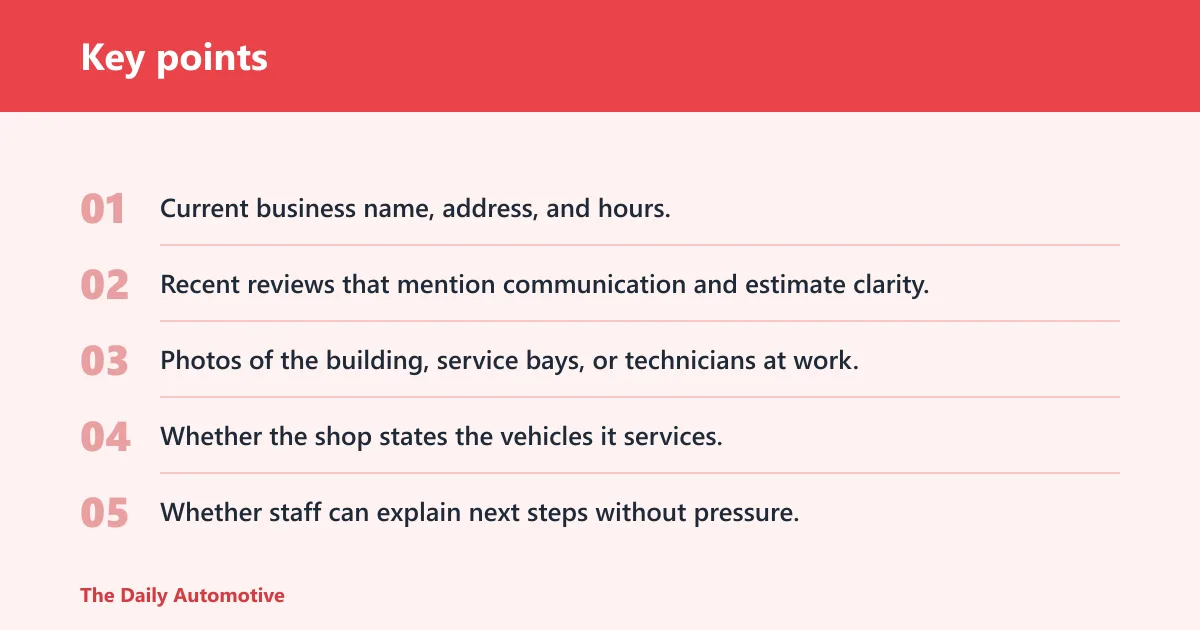
- Current business name, address, and hours.
- Recent reviews that mention communication and estimate clarity.
- Photos of the building, service bays, or technicians at work.
- Whether the shop states the vehicles it services.
- Whether staff can explain next steps without pressure.
Say your check engine light came on after a commute over the Beltline Highway. A shop that only says “bring it in” is less useful than one that asks for the light behavior, whether the car runs rough, and whether you want a diagnostic first or a repair quote only after testing.
What should a written estimate include?
A proper written estimate should separate parts, labor, and any shop fees or tax that apply, then state what needs approval before work starts. It should also show the labor rate, the job description, and whether the shop expects to call you if it finds added damage or extra wear.
Without that detail, you cannot compare shops fairly. One estimate may include brake pads, rotors, hardware, and fluid exchange, while another lists only pads. Those are not equal quotes. Ask for the same scope from every shop so the numbers match the same repair.
What a fair estimate usually shows
| Estimate item | What it should tell you | Why it matters |
|---|---|---|
| Parts | Part names, quantities, and whether they are new, remanufactured, or aftermarket | Lets you compare the same components across shops |
| Labor | Labor hours and the shop labor rate | Shows how the total was built |
| Fees and tax | Any disposal, shop, or environmental charges, plus tax if applicable | Prevents surprise totals |
| Authorization rule | Whether work needs your approval before diagnosis, teardown, or added repair | Protects you from surprise add-ons |
| Warranty terms | Parts and labor coverage, plus time or mileage limits | Lets you judge real protection, not vague promises |
How to compare quotes without apples-to-oranges pricing
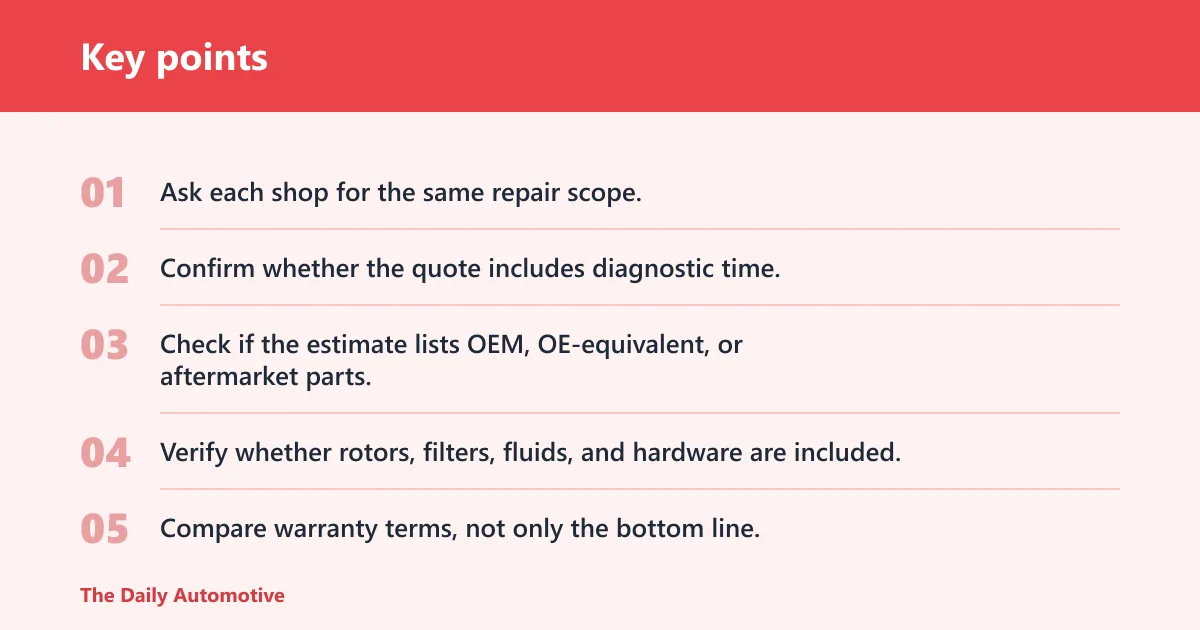
- Ask each shop for the same repair scope.
- Confirm whether the quote includes diagnostic time.
- Check if the estimate lists OEM, OE-equivalent, or aftermarket parts.
- Verify whether rotors, filters, fluids, and hardware are included.
- Compare warranty terms, not only the bottom line.
Which credentials and equipment matter most?
ASE certification typically means a technician has passed tests in certain repair areas and has met experience requirements. It does not guarantee every repair will be perfect, but it does signal formal training and subject-matter knowledge that matters for diagnostics, brake work, engine repair, and electrical troubleshooting.
Equipment matters too. Modern vehicles often need brand-specific scan tools, calibration capability, or procedures that generic tools cannot finish. If you drive a BMW, Audi, Volkswagen, or Volvo, ask whether the shop has the scanner, software, and technical data for that platform before you book.
When ASE matters most
ASE certification becomes more important when the repair involves a no-start condition, a persistent warning light, a brake complaint with multiple possible causes, or a drivability issue that needs methodical testing. It is a signal of training, not a substitute for a clean estimate or good communication.
When dealer-level or brand-specific tools matter
Some late-model European vehicles need more than universal scan data. A shop may need access to reset procedures, module coding, brake service functions, or manufacturer-specific diagnostics. If the shop cannot explain how it handles those steps, keep looking.
How do you evaluate diagnostics and repair authorization?
An OBD-II scan can read check engine light codes and related data, but the code alone rarely identifies the exact failed part. A misfire code can come from plugs, coils, injectors, vacuum leaks, or wiring. Good diagnostics start with code reading, then move to testing, not parts guessing.
Authorization should be clear before any work begins. The shop should tell you when you must approve diagnosis, teardown, or supplemental repairs, and how it will contact you if the first findings grow into a larger estimate. Ask how it handles parts return if a repair is declined after diagnosis.
What a scan can and cannot do
- It can read stored and pending trouble codes.
- It can show freeze-frame data and some live readings.
- It cannot prove which part failed on its own.
- It should lead to testing when the cause is unclear.
A common first-timer mistake is authorizing a part swap from a single code read. Suppose a car in West Eugene shows an oxygen sensor code. That code might point to the sensor, but it can also be triggered by an exhaust leak or fuel control issue. The right next step is diagnosis, not a fast guess.
Red flags in authorization language
- No approval required before extra work.
- “We will just handle it” without a cap or call-back rule.
- No written note on supplemental estimates.
- No explanation of what happens to removed parts.
When is a shop the right fit for your repair type?
Choose the shop based on the job, not only the location. Brake repair, oil change service, European maintenance, hybrid systems, and high-mileage vehicles all have different needs. A good fit is a shop that handles your exact repair cleanly and can explain its method before work begins.
Brake repair and other safety-critical work
Brake repair should be treated as safety-first work. Squealing, grinding, pedal pulsation, pulling, or steering wheel vibration during braking can point to worn pads, warped rotors, sticking calipers, or suspension issues. You want a thorough inspection, not a quick pad-only quote when rotors or hardware may also need attention.
Oil change service and maintenance timing
For oil change service, ask for the maintenance interval that matches your vehicle, the correct filter, and the factory-spec oil grade. Many newer vehicles use synthetic oil and longer intervals, but the right interval depends on the manufacturer schedule, driving conditions, and engine design. Short-trip driving and heavy idling can shorten service timing.
Older, high-mileage, hybrid, and European vehicles
Older and high-mileage vehicles often need a shop that can separate wear from failure. Hybrids need system knowledge beyond basic engine repair. European vehicles often need special tools and brand-specific procedures, especially for BMW, Audi, Volkswagen, and Volvo. A small local shop can be the better fit when it knows your model well; a dealer can be the better fit when factory programming or rare parts access matters.
How do I know if an auto repair shop is honest?
You know by checking process, not by guessing character. Honest shops show their work: written estimates, clear repair authorization, photo evidence when needed, and plain explanations of why a repair is needed now versus later. They also separate urgent safety items from maintenance and refuse to pressure you into a decision before you are ready.
Recent reviews that mention clear communication matter more than star count alone. Look for comments about whether the shop called before doing extra work, explained the diagnosis, and returned old parts when asked. Those details are harder to fake than generic praise.
How do I find European auto repair in Eugene, OR?
Look for a shop that names the brands it services, explains its scan and programming tools, and can describe repair procedures for BMW, Audi, Volkswagen, or Volvo without vague answers. European repair often depends on brand-specific knowledge, torque procedures, and diagnostic access that general shops may not have.
Ask whether the shop handles engine electronics, brakes, cooling systems, and routine service for your model year. For newer European vehicles, you want a shop that can reset service reminders, run module scans, and document what parts and fluids it uses. That is especially important if your car is still under a factory or third-party warranty.
How do warranty terms separate strong shops from weak ones?
Strong warranty terms should spell out parts coverage, labor coverage, and the time or mileage limit. Weak terms stay vague, rely on verbal reassurance, or bury exclusions in fine print. If the paperwork does not state what is covered and for how long, ask for a clearer written version before you approve the repair.
What to ask about warranty coverage
- Does the warranty cover both parts and labor?
- How long does the coverage last, in time or miles?
- Does the warranty change if you supply parts yourself?
- What happens if the same problem returns?
Use this Eugene auto repair checklist before you book

Print this checklist and use it on every shop you call. It gives you a simple yes/no way to compare Eugene shops before you hand over the keys. If a shop misses several points, keep looking.
Printable 12-point vetting list
- 1. Real street address and current hours listed.
- 2. Staff can name the repair type you need.
- 3. Recent reviews mention communication, not only price.
- 4. Photos or clear shop information are easy to verify.
- 5. ASE certification is stated or technicians can explain training.
- 6. The shop services your vehicle make and model.
- 7. The estimate lists parts and labor separately.
- 8. The estimate includes tax, fees, or states that they may apply.
- 9. The shop explains approval before extra work starts.
- 10. Diagnostic work is separated from replacement parts when needed.
- 11. Warranty terms name parts coverage, labor coverage, and limits.
- 12. The shop can explain what happens to removed parts if you ask.
Quote-comparison table for two or three shops
| Shop | Diagnostic fee | Parts listed separately? | Labor rate | Approval before extra work? | Warranty terms |
|---|---|---|---|---|---|
| Shop A | Yes / No | Yes / No | Write it here | Yes / No | Write it here |
| Shop B | Yes / No | Yes / No | Write it here | Yes / No | Write it here |
| Shop C | Yes / No | Yes / No | Write it here | Yes / No | Write it here |
Red flags for authorization, diagnostics, and warranty terms
- The shop refuses to separate diagnosis from repair.
- It will not put approval rules in writing.
- It will not explain a supplemental estimate.
- It will not say whether old parts can be returned.
- It gives a vague “lifetime” warranty without limits.
- It pushes parts replacement without testing first.
Frequently asked questions
How do I find trusted auto repair in Eugene, Oregon?
Compare a few shops, then look for a written estimate, current contact information, recent reviews, and clear approval rules before work starts. A trusted shop can explain its diagnosis, labor rate, parts list, and warranty terms without pressure. That process matters more than a high star rating alone.
What should I look for in a good mechanic in Eugene?
Look for ASE certification, experience with your vehicle type, and a clear process for diagnostics and authorization. A good mechanic explains whether the repair needs testing, which parts are involved, and what coverage applies after the job. If the answers stay vague, keep comparing shops.
Are ASE-certified mechanics worth choosing?
Often, yes. ASE certification signals formal training and tested knowledge in specific repair areas, which matters for diagnostics and repairs. It is not the only factor, but it is a useful filter when you are comparing shops that otherwise look similar in price or location.
What questions should I ask before approving repairs?
Ask what failed, how the shop confirmed it, whether the quote includes parts and labor, whether any extra work needs separate approval, and what warranty applies. For large jobs, ask whether the shop can show removed parts or photo evidence. Those questions reduce surprise charges.
What should I do if my check engine light comes on?
Get the OBD-II codes read, then ask what testing comes next. A code is a starting point, not a final diagnosis. If the car runs poorly, loses power, or flashes the warning light, the issue may need faster attention. If it drives normally, you still need a proper diagnosis before replacing parts.
Products related to this article
Sponsored / affiliate links. As an Amazon Associate I earn from qualifying purchases. I may earn additional commission from eligible campaigns.