Does a BMW Battery Need to Be Programmed? Explained
In my experience, most BMW battery replacements do not need full programming, but many 2000s and 2010s models do need battery registration, and some cars may also need the battery type and capacity coded if the new battery differs. Skip the right step, and the car can overcharge, undercharge, wear the battery faster, or keep old fault codes active.
Does a BMW battery need to be programmed after replacement?



Why BMW battery systems differ from conventional cars
BMW batteries are not like regular car batteries. Since 2002, BMWs use an Intelligent Battery Sensor, or IBS, and the car’s ECU adjusts charging based on battery state, age, and load. That means the vehicle needs to know when the battery is new, and sometimes what kind of battery was installed.
Battery registration vs coding vs programming
Battery registration tells the car that a new battery is installed. It resets the battery adaptation data so the ECU stops treating the battery as old. Battery coding or programming is different: it links the battery’s unique identification code to the vehicle and matches battery characteristics such as chemistry or capacity.
People often mix the terms because shops and scan tools use them loosely. The clean rule is simple: registration is the replacement update, coding is the battery match, and full programming is only needed when the car’s battery information must be written into the vehicle’s control logic.
📊 BMWs use an Intelligent Battery Sensor, or IBS, since 2002. Source: Does a BMW Battery Need to Be Programmed?.
How BMW charging strategy depends on the battery
BMW uses the IBS to monitor voltage, current, and temperature, then sends that data to the car’s control system. The ECU drives the alternator intermittently on newer models and recognizes battery age and mileage. That charging strategy helps fuel economy, but it also depends on the battery being identified correctly.
Why the alternator strategy matters for battery life
When the car thinks the battery is old, it may charge differently than it should. If a fresh battery is installed but not registered, the ECU can keep an aging-battery strategy in place. That can shorten battery life and, in some cases, contribute to electrical complaints that seem unrelated at first.
Suppose a 2011 3-Series gets a new AGM battery, but the replacement is left unregistered. The car may continue charging it as though the battery were near the end of its life. The owner sees repeated low-voltage warnings, then a weak crank a few weeks later.
Which BMW model years need registration or coding?

Use model year and battery type together. Many BMWs from the 2000s onward need registration after battery replacement, and some also need coding if the battery chemistry or capacity changes. The threshold is not “all BMWs,” and it is not “full programming every time.” The table below gives the practical split.
Model-year decision table for BMW battery replacement
| BMW chassis / model year | Required action | What can go wrong if skipped |
|---|---|---|
| 2001 and earlier BMWs | Replace only in many cases; verify if the car has IBS or battery adaptation features | If the car has newer charging control hardware, incorrect charge behavior or stored faults can linger |
| 2002 and newer 7-Series E65/E66 | Register after replacement | Incorrect charging, shortened battery life, possible electrical malfunctions |
| 2004 and newer 5-Series E60/E61 | Register after replacement | Car may continue an old-battery charging strategy and overcharge or undercharge the new battery |
| 2006 and newer 3-Series E90/E91/E92/E93 | Register after replacement; code if battery chemistry or capacity changes | Charge strategy mismatch, shorter lifespan, persistent warnings |
| 2007 and newer X5 E70 | Register after replacement; code if battery type changes | Improper charging and repeat battery failures |
| 2008 and newer X6 E71 | Register after replacement; code if battery type changes | Incorrect alternator control and shortened battery life |
How to use the table
- Identify the chassis or exact model year.
- Check whether the replacement battery matches the old battery in chemistry and capacity.
- If the battery is the same type, register it after installation.
- If the battery type changes, code the car to match the new battery, then register it.
- Clear stored battery adaptation only through the proper scan tool or service routine.
When battery type changes affect the required step
An AGM battery and a conventional flooded battery do not behave the same way. If you replace one with the other, coding becomes important because the car needs the correct charging profile. Matching only the physical size is not enough if the chemistry or amp-hour rating changes.
What happens if you replace a BMW battery without registering it?
If you skip registration, the ECU still thinks the battery is old and adapts charging the wrong way. That can cause overcharging or electrical malfunctions, and it can also shorten battery life. BMW batteries need to be registered and coded after replacement, because the car depends on that data to manage charging correctly.
Likely charging behavior after an unregistered swap
The car may continue to use the old battery’s age, mileage, and charge history. On newer BMWs, the ECU and alternator strategy are built around intermittent charging, so the system may not respond as it should. The result can be repeated low-voltage events, warning messages, or a battery that fails again too soon.
Battery life impact and electrical faults
Skipping matching can decrease fuel economy and shorten battery life. It can also keep fault codes active, which makes diagnosis harder later. A common first-timer mistake is to install a correct-size battery, start the car, and assume the job is finished. On many BMWs, that leaves the control system out of sync.
Does a 2001, 2007, or 2011 BMW need programming?
A 2001 BMW usually does not need the same battery registration step as the newer E-series cars, unless its control system has been updated in a way that changes battery adaptation. A 2007 BMW often does need registration, and a 2011 BMW usually needs registration too, with coding if the battery type or capacity changes.
2001 BMW models
For a 2001 BMW, the safest rule is to check the exact chassis and charging system before assuming any programming step. Many of the later registration requirements begin with the models that use IBS-based battery management. If the car predates that system, replacement may be simpler.
2007 BMW models
A 2007 BMW is in the range where battery registration is often required. If it is an X5 E70, the registration requirement applies. If the battery chemistry changes, add coding. A 2007 BMW that gets a new battery without registration can end up charging the wrong way.
2011 BMW models
A 2011 BMW usually falls into the newer charging-strategy era. That means registration is typically required after replacement, and coding may also be needed if the replacement battery is AGM instead of conventional, or if the capacity changes. Do not treat it like a simple plug-in battery swap.
When battery type changes, do you need coding too?
Yes, if the new battery does not match the old one in chemistry or capacity, coding usually matters. Battery registration alone tells the car that a fresh battery is present. Coding tells the vehicle what battery it is managing, so the ECU can use the correct charging strategy and energy management settings.
AGM versus conventional batteries
AGM batteries often tolerate different charging behavior than conventional flooded batteries. If the car was coded for AGM and you install a conventional battery, or the other way around, the charging profile may be wrong. That mismatch can lead to poor charging, shorter battery life, and repeat battery failures.
What to check before the swap
- Match the battery chemistry: AGM to AGM, conventional to conventional when possible.
- Match capacity where practical, or code the new rating into the car.
- Confirm whether the chassis needs registration after installation.
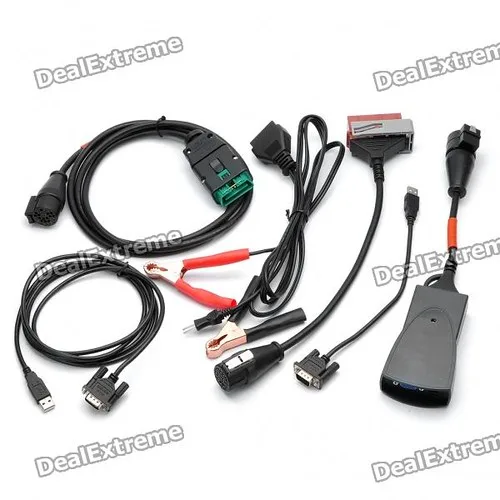
- Use the correct scan tool or service function to code and register in the right order.
Why do you have to program a BMW battery?
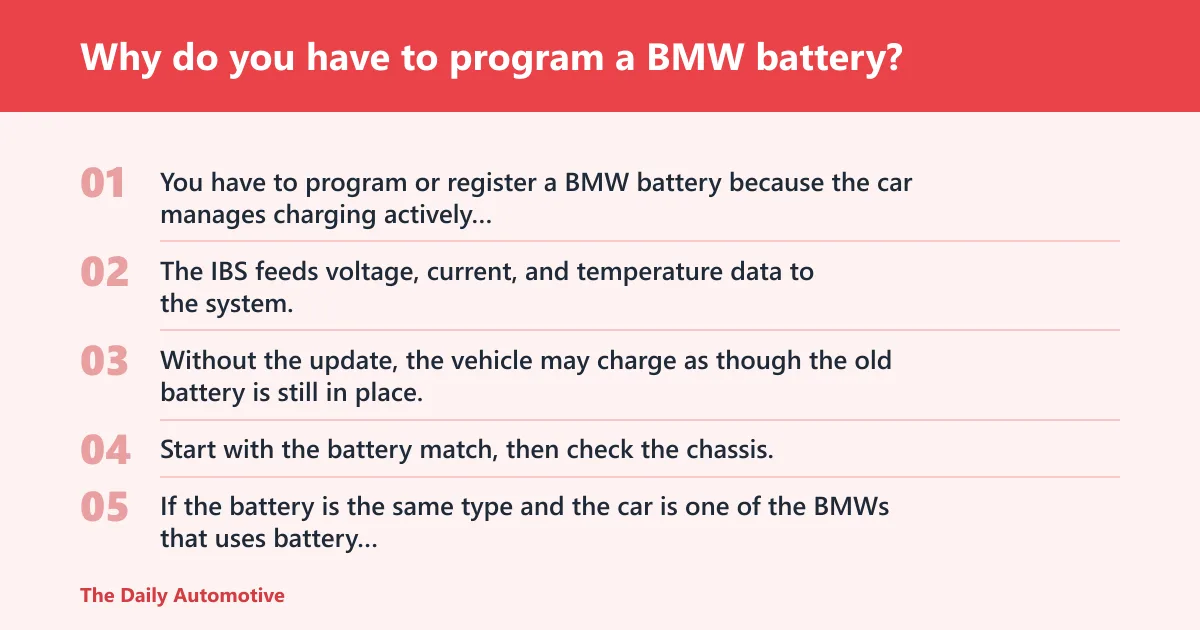
You have to program or register a BMW battery because the car manages charging actively instead of treating every battery the same. The IBS feeds voltage, current, and temperature data to the system, and the ECU uses that data to control charging. Without the update, the vehicle may charge as though the old battery is still in place.
Practical rule for owners
Start with the battery match, then check the chassis. If the battery is the same type and the car is one of the BMWs that uses battery adaptation, register it. If the replacement changes chemistry or capacity, code it as well. Full programming is not the default step for every BMW battery swap.
Frequently asked questions
Does a BMW battery need to be programmed after replacement?
Often, yes in the sense that it must be registered, but not always in the sense of full programming. Many BMWs need the new battery information recorded so the ECU updates charging behavior. If the replacement battery differs in chemistry or capacity, coding may also be required.
Does a new BMW battery need to be programmed?
A new BMW battery usually needs registration after installation, and it may need coding if it is not the same type as the old one. The car needs to know the battery is new so it can adjust charging correctly. That is separate from physical installation.
Does a 2011 BMW battery need to be programmed?
A 2011 BMW usually needs battery registration, and it may need coding if the replacement battery changes from AGM to conventional or if the capacity changes. The exact step depends on the chassis, but most 2011 BMWs are not simple install-only cars.
Does a 2007 BMW battery need to be programmed?
A 2007 BMW commonly needs battery registration after replacement, especially on models such as the X5 E70. If the new battery differs from the old one in chemistry or amp-hour rating, code the battery data as well. Skipping the step can cause incorrect charging.
Does a 2001 BMW battery need to be programmed?
A 2001 BMW often does not follow the same registration routine as later BMWs, but the exact answer depends on the chassis and charging hardware. Earlier cars are less likely to use the IBS-based strategy found on newer models, so the replacement may be simpler.
What happens if you replace a BMW battery without registering it?
The ECU may keep using the old battery’s charge history, which can cause overcharging, undercharging, shorter battery life, and possible electrical malfunctions. On newer BMWs, that also disturbs the alternator’s intermittent charging strategy and can leave the car with recurring warning messages.
Products related to this article
Sponsored / affiliate links. As an Amazon Associate I earn from qualifying purchases. I may earn additional commission from eligible campaigns.