
3 Best Car Brush Kits for Cars (2026): We Compared
Pick a brush kit by the surfaces you clean: soft-detail brushes for interior trim, medium brushes for wheels, and stiff brushes only for rubber and heavy grime. Choose the wrong one, and you can leave swirl marks, shed bristles, or waste money on tools you never use. This guide compares 4 real brush kits by cleaning job and surface risk, so you can buy the right mix for interior, wheel, and trim work.
Which brush kit should you buy?
The best buy depends on where the brush touches the car. For delicate trim, a soft-bristle interior kit with boar hair blend or soft synthetic bristles is the safest starting point because it protects vents, emblems, and piano black surfaces. For wheels and tires, a dedicated wheel set does the work faster and reaches deeper. A mixed kit only makes sense if you clean several zones often and will actually use the extra pieces.
Quick comparison
| Product | Badge | Best for | Price | ||
|---|---|---|---|---|---|
 |
Chemical Guys, Rimpaca Ultimate Wheel Brush Set, SoftChemical Guys | Our pick | 3-piece · wheel-focused · soft synthetic bristle kit | $54.99
Price as of 21 Oct 2026
|
View |
 |
Mothers Car Detailing Brush Set for Auto Detailing, SoftMothers | Budget pick | 3-pack · feather-soft bristle · wooden handle set | $7.99
Price as of 21 Oct 2026
|
View |
 |
Adam’s Wheel & Tire Brush Kit (3-Item) – Includes WheelAdam’s Polishes | Also great | 3-item · wheel + tire + barrel brush kit | $50.99
Price as of 21 Oct 2026
|
View |
 |
12PCS Car Detailing Brush Set, Interior Cleaning Kit withJohocox | Also great | $8.99
Price as of 21 Oct 2026
|
View |
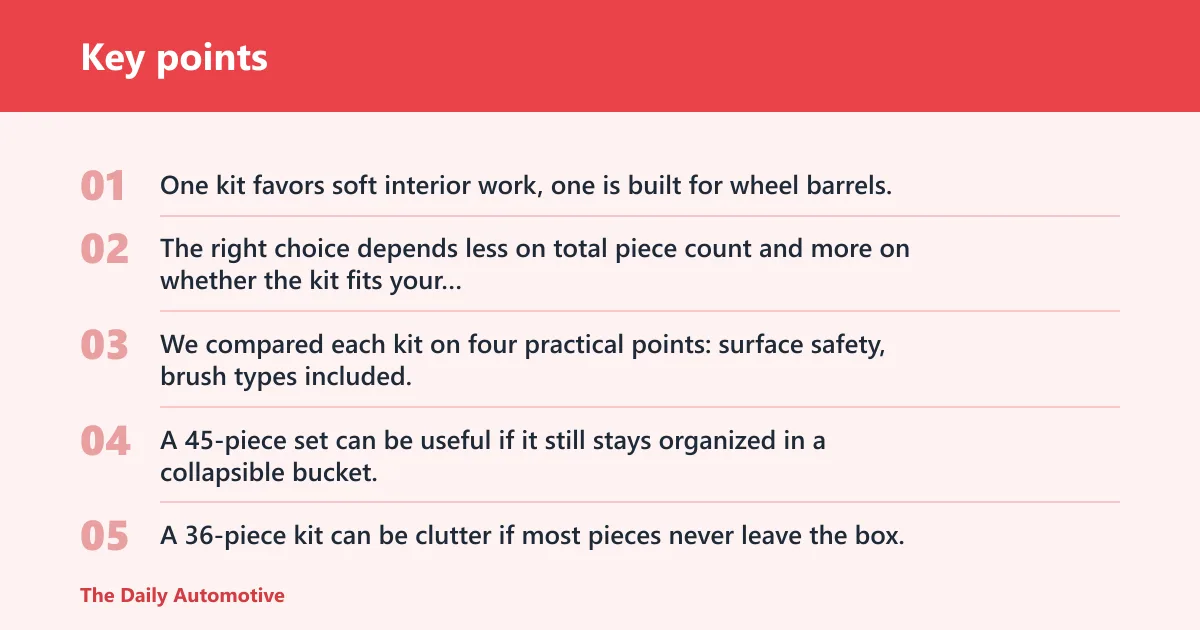
One kit favors soft interior work, one is built for wheel barrels, and one adds tire-specific coverage. The right choice depends less on total piece count and more on whether the kit fits your most common surfaces.
How we chose
We compared each kit on four practical points: surface safety, brush types included, whether it solves a real cleaning job, and whether storage would stay manageable after the first use. A 45-piece set can be useful if it still stays organized in a collapsible bucket. A 36-piece kit can be clutter if most pieces never leave the box.
We also weighed the failures buyers run into most often: bristles that are too stiff for piano black trim, wire brushes used where they do not belong, and drill attachments bought for speed even though a hand brush would do the job. A good kit should lower risk, not add it.
 As an Amazon Associate we earn from qualifying purchases. Prices and availability are accurate as of the date shown and are subject to change.
Mothers 3-Pack: best for interior detailing
The Mothers set fits buyers who want soft, simple brushes for vents, emblems, button clusters, and other trim-heavy areas. At $7.99, it is the cheapest of the four and the easiest to justify as a first purchase when you need safe brushes more than a crowded kit.
What stands out is the feather-soft bristle feel and the small, medium, and large sizes. That mix is useful because tight crevices need a narrow brush, while broader trim panels clean faster with a larger head. It is also a practical choice for painted plastics and sensitive interior pieces, where soft bristles matter more than sheer quantity.
The drawback is obvious: this is not a wheel-first kit. It lacks the long-reach shapes and stiffer cleaning tools that help with barrels, tires, and heavy brake dust. For anyone who wants one brush to do everything, this set is too narrow.
Mothers 3-Pack: best for budget buyers
If your main goal is safe cleaning without spending much, this is the cleanest entry point. The soft bristles make it suitable for interior trim, emblems, and light-duty engine-bay dusting, where harsh nylon or wire would be the wrong call.
The main advantage is value. You get small, medium, and large brushes without paying for drill adapters or specialty wheel tools you may never use. That keeps clutter down, which matters if you already own towels, buckets, and a vacuum.
The limitation is scope. It is the least specialized kit here, so it will not replace a dedicated wheel brush or a long-handle barrel brush. Buyers with stubborn wheel grime will likely outgrow it.
As an Amazon Associate we earn from qualifying purchases. Prices and availability are accurate as of the date shown and are subject to change.
Chemical Guys Rimpaca: best for wheels
This is the strongest wheel-focused choice in the group. The three soft synthetic brushes are aimed at rims, barrels, grilles, and tight spots, and the set is commonly presented as suitable for use on a wide range of wheel finishes. That makes it the best fit for coated wheels, painted wheel faces, and other surfaces where scratch control matters.
The big practical advantage is shape coverage. A dedicated wheel set matters more than raw count because wheel cleaning depends on reaching spokes, rim lips, and barrels without forcing the brush into a bad angle. The ergonomic non-slip handles also help when your hands are wet or soapy.
The drawback is that it is not an interior-first solution. It can clean some exterior trim, but it does not answer the full range of interior crevices that a car with lots of switches, vents, and seat tracks needs. For interior-only buyers, it is more brush than they need.
Chemical Guys Rimpaca: best for wheel faces and barrels
Choose this set when wheel cleaning is the main job and you want brush heads that stay gentle on finished surfaces. It is also the better call if you care more about control than piece count, since each brush size has a specific role.
The trade-off is that soft synthetic bristles are safer, but they may take longer on baked-on grime than a stiffer wheel brush would. That is a fair trade for owners of sensitive wheels. It is not the best choice if your wheels see heavy caked dirt and you are tempted to solve everything with brute force.
A common first-timer mistake is using one wheel brush for every surface on the car. That is how soft trim gets marked and wheel barrels get cleaned with the wrong head. A dedicated wheel kit lowers that risk.
As an Amazon Associate we earn from qualifying purchases. Prices and availability are accurate as of the date shown and are subject to change.
Adam’s Wheel & Tire Brush Kit: best for wheels and tires
This kit is the best fit for buyers who want separate tools for wheel faces, barrels, and tires. The bristles are tuned for tougher wheel and rubber grime, which helps when you need more bite than a soft detailing brush can deliver. It is the most job-specific option in the group.
Its strength is the division of labor. A tire brush should be firmer than a wheel-finish brush, and a barrel brush should reach farther than a short interior brush. That separation matters because tires, aluminum, chrome, and spokes do not all want the same stiffness.
The drawback is pressure on delicate surfaces. The stiffer side of a wheel-and-tire kit can be too much for painted plastics, piano black trim, or soft interior pieces. It is a better wheel solution than a general-purpose interior solution, and buyers who only clean light dust may not need this much aggression.
Adam’s Wheel & Tire Brush Kit: best for dedicated wheel cleaning
If you clean wheels often, this is the most logical buy. It gives you a cleaner split between wheel work and tire work, which reduces the urge to use one brush where it does not belong. That matters on coated wheels and high-gloss finishes.
The drawback is portability of intent, not just storage. A wheel-and-tire kit can tempt buyers into over-cleaning or using a stiff brush on the wrong surface. If your real need is vents, cup holders, and piano black trim, this kit will sit unused more often than not.
As an Amazon Associate we earn from qualifying purchases. Prices and availability are accurate as of the date shown and are subject to change.
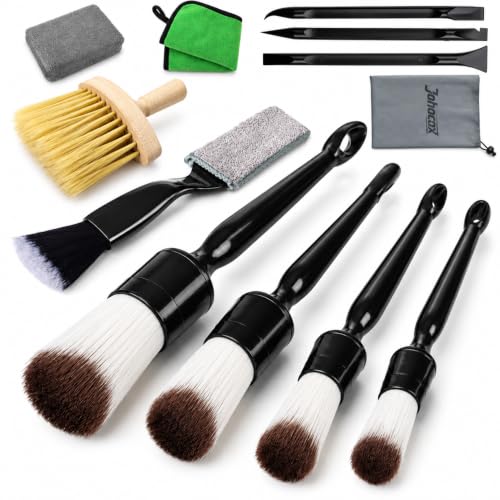
Johocox 12PCS: best for mixed interior touch-ups
This is the broadest low-cost interior option in the list. The included air vent brush makes it easier to handle the tight areas most owners miss, and the 12-piece layout gives you more shape choices than a simple three-brush set. That makes it a sensible pick for door-panel seams, vents, and cup holders.
The drawback is that a bigger interior kit can become clutter if you only use two or three pieces regularly. Buyers who already have towels and a vacuum may not need a dozen tools. The other limitation is that the listing does not clearly solve wheel barrels or tire sidewalls the way a dedicated wheel kit does.
For the right buyer, though, it hits a useful middle ground. It is the closest fit here for someone who wants an interior-first kit with a little extra reach for awkward crevices.
Brush types by surface risk matrix
Brush stiffness should match the surface, not the mood of the job. Soft brushes belong on interior trim, soft plastics, piano black trim, painted plastics, and badges. Medium brushes fit many wheel faces and dirtier trim pieces. Stiff brushes belong on rubber, heavy grime, and mechanical cleanup only.
| Task | Safest brush type | Recommended stiffness | When to avoid drill or wire brushes |
|---|---|---|---|
| Vents | Interior detailing brush | Soft | Avoid drill brushes; wire brushes can snag fins and scratch trim |
| Cup holders | Interior detailing brush or brush pick | Soft to medium | Avoid wire brushes; drill brushes are usually overkill in tight plastic cups |
| Badges | Boar hair blend or soft synthetic detailing brush | Soft | Avoid wire brushes; drill brushes can flick grime into paint seams |
| Wheels | Wheel brush or long-handle wheel brush | Soft to medium | Use drill brushes only if you need speed; avoid wire brushes on coated wheels |
| Lug nuts | Small detailing brush or narrow wheel brush | Medium | Avoid wire brushes on finished lug faces; drill brushes can be too aggressive |
| Tires | Tire brush | Stiff | Avoid wire brushes on sidewalls; drill brushes can be useful only for heavy buildup |
| Seat rails | Detailing brush or brush pick | Medium | Avoid wire brushes near upholstery and exposed coatings |
| Emblems | Soft detailing brush | Soft | Avoid drill brushes and any wire brush; they can catch edges and mark paint |
| Piano black trim | Boar hair blend or soft synthetic brush | Soft | Avoid drill brushes and wire brushes; stiffness shows as haze or micro-marring |
| Door jambs | Detailing brush | Soft to medium | Avoid wire brushes unless the area is bare metal and heavily soiled |
| Engine bay | Nylon brush | Medium to stiff | Avoid wire brushes near painted plastic covers, sensors, and delicate hoses |
| Glass edges | Soft detailing brush or brush pick | Soft | Avoid wire brushes; drill brushes can be too much for tight seals and trim |
How to read stiffness in practice
Soft bristles bend easily and are the safest choice for sensitive surfaces. Medium bristles clean faster but need more care on plastics and painted trim. Stiff bristles are for rubber, caked dirt, and mechanical cleanup, where surface sensitivity is lower. If a brush feels scratchy in dry use on your fingertip, it is usually too harsh for piano black trim.
Boar hair brushes fit sensitive interior trim and painted plastics because they are soft and often blended with synthetic fibers for shape retention. Nylon brushes work better for wheel grime and engine bays, but they can be too harsh on soft plastics. Wire brushes belong to steel, brass, or nylon wire styles used for heavy grime and mechanical cleanup only.
How to avoid scratches and brush failure
Inspect bristles before every use. Shedding bristles matter because loose fibers can get trapped in seams and can scratch if dragged across clear-coated surfaces. A brush that sheds early is a poor choice for piano black trim or coated wheels.
Drill brush attachments are a speed tool, not a requirement. They can help on wheels and rims, but they need a separate drill and can become overkill on trim, emblems, or tight interiors. A long-handle wheel brush is often the better first buy for deep barrels because it reaches farther without the extra speed and risk.
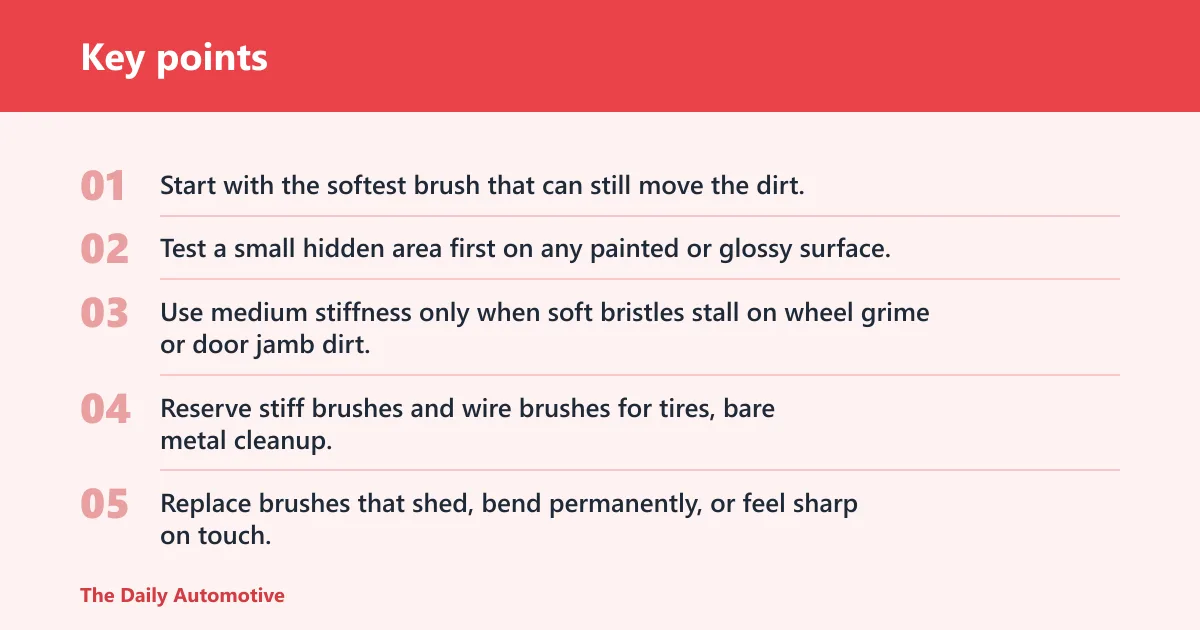
- Start with the softest brush that can still move the dirt.
- Test a small hidden area first on any painted or glossy surface.
- Use medium stiffness only when soft bristles stall on wheel grime or door jamb dirt.
- Reserve stiff brushes and wire brushes for tires, bare metal cleanup, or heavy mechanical grime.
- Replace brushes that shed, bend permanently, or feel sharp on touch.
Storage and portability
Storage matters because a kit only helps if you can find the right brush quickly. A storage box keeps pieces sorted, a bag is easier to carry, and a collapsible bucket can reduce clutter between washes. The practical value is organization, not just compactness.
That is why the 45-piece kit with a collapsible bucket stands out for space-saving between washes, while the 36-piece kit with a storage box is better if you want firmer separation between interior and wheel tools. The best storage system is the one that keeps the brushes you actually use from mixing with the ones you do not.
Which one should you buy?
If you clean mainly interiors, start with the Mothers 3-Pack or the Johocox 12PCS. The Mothers set is the safer, cheaper choice for vents, buttons, trim, and emblems. The Johocox kit makes more sense if you want more shapes in one box and do not mind extra pieces.
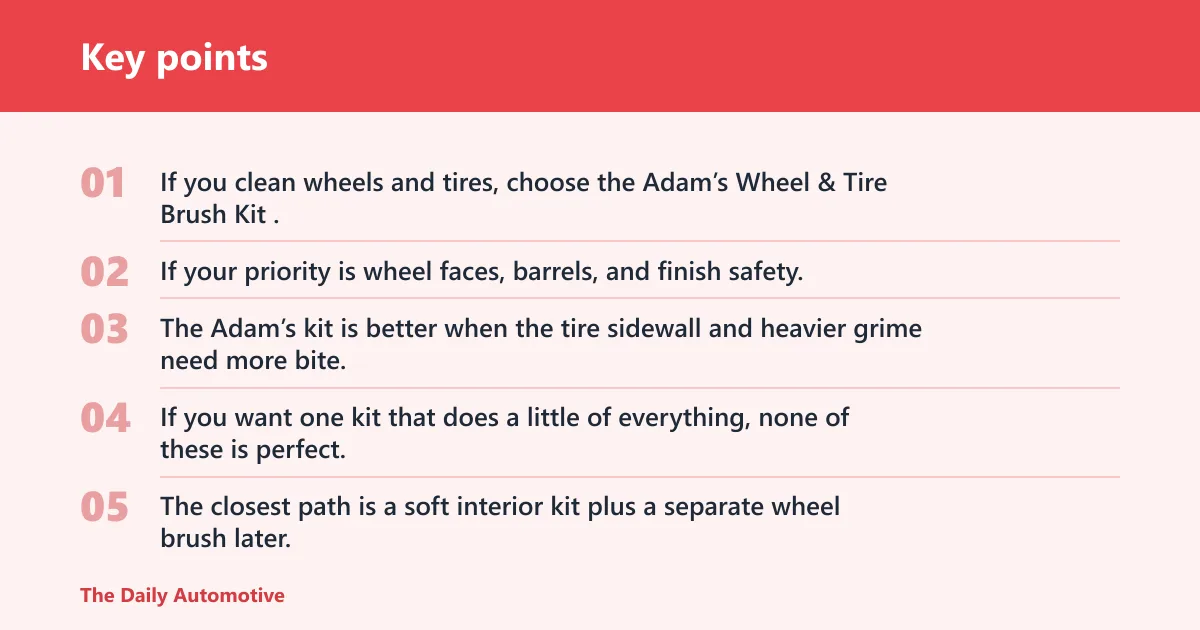
If you clean wheels and tires, choose the Adam’s Wheel & Tire Brush Kit. If your priority is wheel faces, barrels, and finish safety, the Chemical Guys Rimpaca is the gentler wheel-first option. The Adam’s kit is better when the tire sidewall and heavier grime need more bite.
If you want one kit that does a little of everything, none of these is perfect. The closest path is a soft interior kit plus a separate wheel brush later. That route keeps you from buying stiff tools you will not use and from forcing one brush onto piano black trim, soft plastics, and coated wheels alike.
Say your sedan has piano black trim around the shifter, a dusty dash vent cluster, and only light wheel dust. A soft interior kit is the right first move. A drill brush would be more speed than you need, and a wire brush would be the wrong tool entirely.
Suppose your SUV has deep wheel barrels, sticky tire browning, and brake dust on the spokes. A wheel-focused kit with a long-reach brush makes more sense than a general interior set, because the barrel and tire need different stiffness levels. That is the split that saves time and lowers damage risk.
Frequently asked questions
What is the best brush to use for car detailing?
The best brush depends on the surface. Soft boar hair blend or synthetic detailing brushes are safest for interior trim, piano black, and painted plastics. Medium nylon brushes fit wheels and engine bays better. Stiff brushes belong on tires and heavy grime, not delicate finishes.
How do I choose the right paint brush or detailing brush for my car?
Match stiffness to surface sensitivity first. Use soft brushes for paint-adjacent trim, badges, and glossy interior surfaces. Choose medium brushes for wheels, door jambs, and dirtier plastics. Skip stiff or wire brushes unless the surface is rubber, bare metal, or clearly built for aggressive cleaning.
How do you use brush picks in tight car crevices?
Use a pick only to lift trapped dirt, not to scrape a finish clean. Work gently in seat rails, cup holders, and switch gaps, then follow with a soft brush or microfiber towel. If the crevice borders piano black or soft plastic, lighter pressure matters more than speed.
What is the best car detailing brush kit for wheels?
A wheel kit with a dedicated barrel brush and a safe face brush is the best fit. The Chemical Guys Rimpaca is the gentler wheel-first choice here, while the Adam’s kit is better if you also want tire cleaning in the same set. Avoid wire brushes on coated wheels.
How do I know if a brush is too stiff for paint or trim?
If the bristles feel scratchy on your fingertip, they are usually too harsh for glossy trim. Watch for permanent bending, visible haze after a light pass, or bristle tips that feel sharp rather than flexible. Piano black trim and soft plastics are the easiest places to see damage.
How do I avoid scratching interior and exterior surfaces with detailing brushes?
Use the softest brush that still removes the dirt, keep brushes clean, and stop using any tool that sheds bristles. Avoid wire brushes on delicate finishes, and treat drill brush attachments as optional speed tools rather than default equipment. A safe brush is usually slower, and that is fine.
Products related to this article
Sponsored / affiliate links. As an Amazon Associate I earn from qualifying purchases. I may earn additional commission from eligible campaigns.
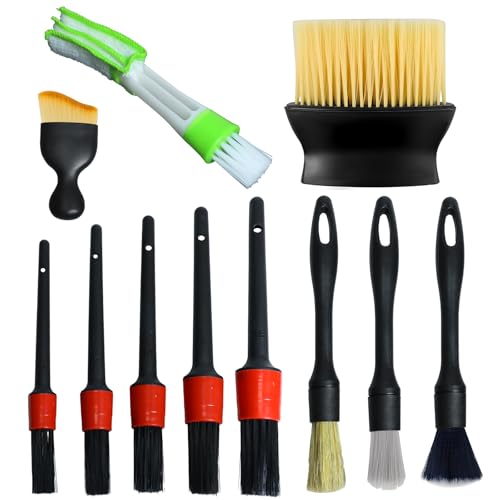 11 Pcs Car Interior Detailing Brush Set, Car Interior Soft Cleaning Brush for Interior Automotive Air Vent, Dashboard, Leather, Wheel, Air-Conditioning Outlet Cleaning
 Zymothrix 15Pcs Car Detailing Brush Kit, Car Cleaning Tool Set for Interior and Exterior, Professional Auto Wash Brush with ABS Handle, Safe Scratches - Free Design for Cars Trucks Motorcycl