3 Best Car Cargo Storage Bags in 2026
The 3 best car cargo storage bags in 2026 are the ones matched to your trip length, weather, and roof setup: short weekend runs do well with compact, easy-loading bags, while long wet drives need larger waterproof models with stronger straps. A poor match can leave luggage wet, straps loose, fuel use higher, or the bag incompatible with your roof. This guide ranks the top three by trip type first, then by capacity, weather exposure, and vehicle fit.
Quick picks

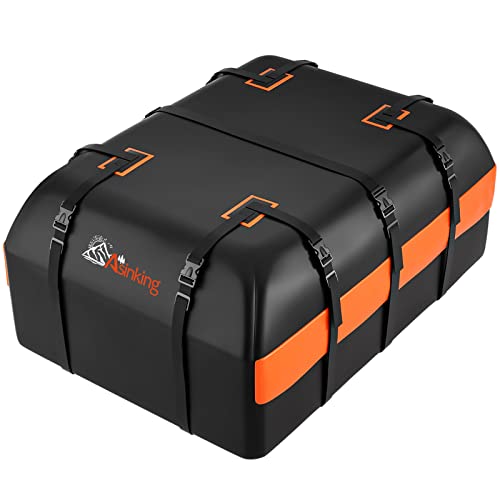
The best default choice is the Asinking 21-cubic-foot roof bag for drivers who need more space than a compact bag, better weather protection than a basic soft carrier, and enough attachment hardware for mixed roof setups. It suits the widest range of trips without moving into oversized-bag territory.
- Best for road trips: Asinking 21-cubic-foot roof bag
- Best for compact cars: FIVKLEMNZ 15-cubic-foot roof bag
- Best for larger SUVs: FIVKLEMNZ 21-cubic-foot rooftop cargo carrier
1. Asinking 21-cubic-foot roof bag
This is the strongest all-around pick for drivers who want a mid-size cargo bag with better wet-weather hardware than a bare-bones option. Its 21 cubic feet gives enough room for family luggage or bulky camping gear without forcing a full-size rooftop load on smaller vehicles. The bag uses 900D PVC tarpaulin, reinforced seams, 8 adjustable straps, 6 door hooks, 1 anti-slip mat, and 1 luggage lock.
Choose this one for long highway trips, rainy departures, and drivers who want more margin against zipper leakage and shifting cargo. Skip it if your vehicle has a very short roof or weak crossbar spacing that makes a larger bag hard to center.
2. FIVKLEMNZ 15-cubic-foot roof bag
This is the compact-car pick. At 15 cubic feet, it fits the lighter packing loads that make sense for hatchbacks, sedans, and smaller crossbar setups. Green Patio Lawn lists roof bags in a common 15 to 30 cubic-foot range, and this bag sits at the low end of that span. It uses 840D PVC and high-frequency welded seams, plus 8 reinforced straps and 6 door hooks.
Choose this one if you need extra room for a weekend road trip, a couple of duffels, or a small family’s overflow bags without overcommitting roof space. Skip it if you are packing hard-sided gear, winter sports bags, or a full vacation load that needs more volume than a 15-cubic-foot shell can comfortably hold.
3. FIVKLEMNZ 21-cubic-foot rooftop cargo carrier
This is the best choice for larger SUVs and trips where roof space matters more than compact packaging. My Road News lists this FIVKLEMNZ carrier at 21 cubic feet, with 840D PVC, reinforced seams, 10 straps, and six door hooks. That extra hardware helps when the bag sits on a longer roof span and carries larger, uneven loads.
Choose it for family vacations, camping, and winter sports gear when you need a larger opening and more packing depth. Skip it for short-roof vehicles where a larger bag could crowd the antenna area, block rearward sight lines, or sit too close to the roof edge.
Best cargo bag for road trips?
The best cargo bag for road trips is the Asinking 21-cubic-foot model because it balances capacity, attachment hardware, and weather protection better than a smaller 15-cubic-foot bag. It is large enough for multi-bag trips, yet not so large that it becomes hard to load on most SUVs and crossbar-equipped cars.
Capacity and luggage fit
A 21-cubic-foot bag is a practical middle ground for road trips because it gives more room for carry-ons, duffels, and soft-sided luggage without forcing every item into a tight stack. Green Patio Lawn’s 15-to-30-cubic-foot range is a useful planning band, and 21 cubic feet lands in the part of that range that many families can actually fill without overstuffing.
Car and Driver’s testing on a Hyundai Santa Cruz found the Thule Force 3 Large carried 4 carry-on suitcases, with a cargo access height of 14.5 inches. That is a hard-shell box, not a roof bag, but it shows how access height affects packing effort. With soft bags, a wide opening matters most when loading bulky luggage on a roof. (Caranddriver)
Weather exposure and seam protection
Road trips often mean long exposure to spray, wind, and steady rain. That is where 900D PVC tarpaulin and reinforced seams matter more than a casual “weather resistant” label. Zipper flaps and covered closures help shed splash water, but they do not turn a soft bag into a sealed container during hours of highway rain.
A common first-timer mistake is treating a weather flap as a guarantee. It usually helps with rain hitting the zipper area, but highway spray and pooled water on the roof can still find weak seams or an under-tensioned zipper.
Fit on crossbars or a bare roof
The Asinking bag includes an anti-slip mat, adjustable straps, and door hooks, so it can work on vehicles with or without roof racks if the vehicle fit is checked first. On crossbars, placement is easier to center and tighten. On a bare roof, door-hook routing matters more, and the load should sit flat with no sharp edges under the base.
Suppose a sedan has no roof rack but needs extra luggage room for a weeklong drive. A soft bag can work if the hooks seat correctly in the door jambs and the straps lay flat. If the roof is very short or the doors have odd weather-strip shapes, fit becomes the limiting factor, not capacity.
Best cargo bag for compact cars?
The best cargo bag for compact cars is the FIVKLEMNZ 15-cubic-foot roof bag because it keeps weight, height, and roof footprint more manageable. Compact cars usually benefit from a lower-volume bag that is easier to center, simpler to strap down, and less likely to create drag or overhang issues.
Door-hook fit and strap routing
On smaller vehicles, the main job is not just volume. It is clean strap routing. The 15-cubic-foot FIVKLEMNZ uses 8 reinforced straps and 6 door hooks, which gives more control when the roof lacks crossbars. That matters because bag movement usually starts when a strap rubs, twists, or loosens at one corner.
Confirm that the hooks sit securely in the door frame and do not pinch weather seals. A bag that sits slightly off-center can also pull more air noise on a compact roof, especially at highway speed.
How much space to expect
For compact cars, 15 cubic feet is often enough for light vacation overflow: a few duffels, soft bags, or a couple of bulky items that do not fit neatly in the cabin. It is not the right choice if the trip includes multiple hard suitcases or sports gear with rigid shapes that waste space inside a soft carrier.
Keep the load low and even. A taller stack can make a small car feel more wind-sensitive, and a roof bag that is too full is more likely to press against the zipper line.
Why low-profile packing matters
Low-profile packing reduces wind noise, helps the bag keep its shape, and lowers stress on the straps. On a compact car, a soft bag that sits flatter often performs better than a bigger one with unused volume and loose fabric flapping in the wind.
Think of the bag as a shape problem, not just a storage problem. The best compact-car setup is the one that stays tight across the entire base.
Best cargo bag for SUVs?
The best cargo bag for SUVs is the FIVKLEMNZ 21-cubic-foot rooftop cargo carrier because larger SUVs can usually handle the footprint, roof height, and luggage volume better than smaller cars. For family vacations or camping trips, 21 cubic feet gives enough space to move bulky gear out of the cabin without pushing into oversized territory.
When a larger cubic-foot range makes sense
A larger bag makes sense when the trip includes several people, winter layers, camp bedding, or soft-sided luggage that does not stack neatly inside the vehicle. SUV owners can usually use the extra roof area more effectively because the roof is longer and the cargo zone is less cramped.
Green Patio Lawn’s 15-to-30-cubic-foot range still applies. An SUV does not always need the biggest size, but it can use 21 cubic feet more comfortably than a compact car can.
How roof-rack spacing affects fit
Roof-rack spacing matters because a bag should sit across the usable crossbar span without sagging at the ends. A bag that lands partly on unsupported roof sheet metal or too close to the edge can shift under load, especially if the straps are not tensioned evenly.
Check whether the crossbars are wide enough to support the main body of the bag. If they are oddly spaced, the bag may still fit, but the cargo inside should be packed to avoid one heavy end pulling the load out of balance.
Wind and load-distribution concerns
At highway speed, a large soft bag has more sail area than a smaller one. That means more wind noise, more force on the straps, and more attention to how weight is spread inside. Soft luggage and duffels are easier to manage than awkward, rigid items with empty corners.
A common failure mode is overloading one side of the bag and leaving the other side loose. The straps stay attached, but the bag starts to shift because the load inside is uneven.
Cargo bag decision table
This table maps trip type, vehicle size, weather risk, and luggage volume to the bag class that fits best. It also shows the most common failure risk to avoid, which is usually more useful than a generic “waterproof” claim.
| Car type | Expected luggage count | Recommended cubic-foot range | Roof-rack requirement | Weather-risk level | Top failure risk to avoid |
|---|---|---|---|---|---|
| Compact sedan or hatchback | 2 to 3 soft bags or duffels | 15 cubic feet | Works with or without roof racks, but fit must be checked carefully | Low to moderate | Door-hook misfit and strap rubbing on weather seals |
| Midsize sedan with crossbars | 3 to 4 bags | 15 to 21 cubic feet | Preferred for cleaner placement | Moderate | Loose packing that creates wind noise and shifting cargo |
| Family SUV | 4 to 5 bags plus soft gear | 21 cubic feet | Best with crossbars | Moderate to high | Uneven weight distribution across the roof |
| Large SUV or road-trip hauler | 5 or more bags, camp bedding, winter layers | 21 to 30 cubic feet | Strongly preferred | High | Overfilling the bag past the zipper line |
How do you choose the right cargo bag?
Start with the roof shape, then match bag size to luggage volume, then check weather exposure and attachment hardware. The right cargo bag is not the biggest one available. It is the one that fits the vehicle, closes cleanly, and stays stable at highway speed.
Roof bag capacity: 15 to 30 cubic feet
Most roof bags fall in the 15 to 30 cubic-foot range. Green Patio Lawn’s figures line up with that common spread. In practice, 15 cubic feet suits lighter weekend use, while 21 cubic feet is the better middle ground for road trips and family travel. Larger bags work best when the roof is long and the cargo is soft.
Capacity maps to how you pack, not just how much you own. A bag with awkward dimensions can hold fewer useful items than a slightly smaller but better-shaped one.
Waterproof construction: fabric, seams, and zipper covers
Look for 840D or 900D PVC fabric, reinforced or welded seams, and zipper flaps or Velcro covers. The FIVKLEMNZ examples use 840D PVC with welded or reinforced seams, while the Asinking bag uses 900D PVC tarpaulin and reinforced seams. Those details matter because the seams often fail before the fabric does.
Heavy rain is a different test from splash resistance. A bag may shrug off road spray and still leak at a weak zipper track during long, fast highway rain exposure.
Attachment system: hooks, straps, and anti-slip mats
Door hooks, adjustable straps, and anti-slip mats are the pieces that keep a soft cargo bag from wandering across the roof. The Asinking bag includes all three, and the FIVKLEMNZ options add multiple straps and door hooks for better hold-down control. More attachment points usually help when the load is large or uneven.
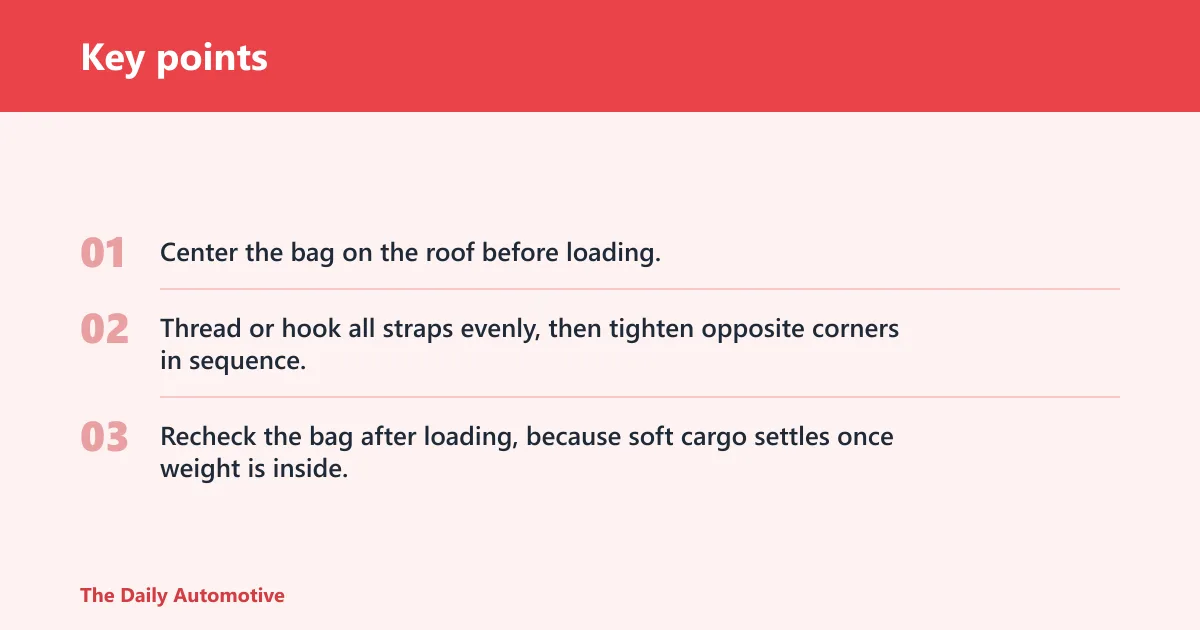
- Center the bag on the roof before loading.
- Thread or hook all straps evenly, then tighten opposite corners in sequence.
- Recheck the bag after loading, because soft cargo settles once weight is inside.
Roof rack compatibility: crossbars versus bare roofs
Roof bags can work with or without roof racks, but crossbars usually make placement easier and more predictable. Bare roofs depend more on door hooks, strap routing, and clean contact points. With either setup, confirm vehicle fit and load distribution before heading out.
Crossbars also help keep the bag from sitting directly on painted roof panels. That reduces abrasion risk and usually makes the setup easier to tension correctly.
Security features and storage portability
Luggage lock options, weather flaps over zippers, and tight closures help with both theft deterrence and rain control. The Asinking bag includes a luggage lock, while covered zippers reduce casual access and help keep water from working into the opening. None of these features make a soft bag theft-proof.
Storage matters, too. Foldable designs and included storage bags are useful because soft cargo carriers should collapse to a small off-season footprint instead of taking up garage space all year. That portability is one of the main reasons many drivers prefer a roof bag over a bulkier rooftop carrier.
How this is typically evaluated: installation ease, cargo access height, durability and build quality, and first impressions of handling. For soft bags, that means checking whether the setup is straightforward, whether the zipper opens cleanly when loaded, and whether the bag stays quiet and centered once in motion.
Frequently asked questions
What is the best car cargo storage bag for road trips?
The best road-trip pick is the Asinking 21-cubic-foot bag because it balances usable volume, a strong attachment setup, and better weather hardware than a bare-minimum compact bag. It is the safer default when the trip is long, the route includes rain, and the luggage count is more than a light weekend load.
How do I choose the right cargo bag size for my car?
Start with the luggage count, then check roof length and attachment compatibility. A compact car usually does better with 15 cubic feet, while many SUVs can use 21 cubic feet more comfortably. If the roof is short or the hooks do not seat well, smaller is usually the safer choice.
Are rooftop cargo bags waterproof in heavy rain?
Not automatically. A soft roof bag with PVC fabric, reinforced seams, and zipper flaps can resist rain well, but that is not the same as being fully waterproof in sustained highway rain. Splash resistance is common; long exposure to spray, wind, and pooled water is where weak seams or closures can still leak.
Can I use a cargo bag without roof racks?
Yes, many roof bags can work without roof racks if they include door hooks and adjustable straps. The key is fit. The hooks must seat securely, the straps must route cleanly, and the bag must sit flat without slipping. A bad door-jamb fit is a common reason a rackless setup fails.
How do I secure a cargo bag so it doesn’t shift at highway speeds?
Use all the attachment points, tighten opposite corners evenly, and place the bag on the flattest part of the roof possible. Anti-slip mats help, but the real fix is balanced packing and even strap tension. If the load is lopsided or the straps cross awkwardly, shifting is more likely.
What is the difference between a roof bag and a cargo box?
A roof bag is a soft-sided carrier that folds down for storage and usually costs less, while a cargo box is a hard-shell rooftop container with a rigid lid. A bag is lighter and more flexible for odd-shaped luggage. A box is typically better for consistent structure and weather protection, but it takes more storage space.
Products related to this article
Sponsored / affiliate links. As an Amazon Associate I earn from qualifying purchases. I may earn additional commission from eligible campaigns.