3 Best Car Pet Barriers for SUVs and Sedans
The 3 best car pet barriers in 2026 start with fit: cargo-area barriers for SUVs, back-seat barriers for sedans, and adjustable barriers for frequent seat changes. Pick the wrong layout and your dog can slip forward, pull your attention off the road, or push through weak spots. This guide ranks the best picks for SUV cargo areas, sedan back seats, and vehicles with moving seats, then shows which pets and body styles each one handles poorly.
Best car pet barriers at a glance



The top pick depends on where your dog rides and how often the seating changes. For a fixed cargo area, a steel wire divider is usually the strongest choice. For a sedan back seat, a mesh barrier with the right anchor points is lighter and easier to live with. For frequent seat movement, the adjustable gate wins.
- Best for SUV cargo areas: steel wire cargo barrier or cargo-area divider with precise width and height matching.
- Best for sedan back seats: DYKESON 11.7-inch Dog Car Barrier with Mesh Storage for compact, tool-free mounting.
- Best for frequent seat adjustment: ZooKeeper EZ Pet Barrier 42-61in Adjustable Dog Gate.
- Best for a wider, one-piece setup: JOYTUTUS 52-Inch Dog Car Barrier.
Quick picks by vehicle type
| Pick | Best for | Key fit point | Likely weak spot |
|---|---|---|---|
| DYKESON 11.7-inch Dog Car Barrier with Mesh Storage | Sedan back seat | Exposed headrest bars or under-seat loops | Very determined dogs can paw at the mesh |
| JOYTUTUS 52-Inch Dog Car Barrier | Wider back-seat spans | One-piece framing with no-tool installation | Seat-angle and trim conflicts if the cabin is irregular |
| ZooKeeper EZ Pet Barrier 42-61in Adjustable Dog Gate | Vehicles with seat movement | Adjustable width and bungee-cord headrest mounting | Wide bar spacing can let small paws through |
Quick picks by dog size
- Small dogs: DYKESON is the easiest fit if you need a compact barrier and storage pocket.
- Medium dogs: JOYTUTUS gives more structure when the cabin opening is wider.
- Larger dogs: ZooKeeper is the better match when you need height and seat-movement tolerance.
- Escape-prone dogs: steel wire cargo barriers usually hold shape better than mesh, especially in cargo areas.
Quick picks by mounting style
- Headrest bars and loops: DYKESON and ZooKeeper, depending on whether you need compact or adjustable coverage.
- No-tool, one-piece setup: JOYTUTUS.
- Fixed cargo tie-in: steel wire cargo barrier for SUVs and minivans.
Car barrier fit matrix
This matrix shows the fit problem many shoppers miss: the barrier has to match the cabin, the mounting points, and the dog. A barrier can be the right style and still fail if the width is off, the headrests are wrong, or the rear seat reclines into the frame.
| Vehicle type | Mounting points needed | Width range | Dog size fit | Likely failure mode | Best-use scenario |
|---|---|---|---|---|---|
| Sedan back seat | Headrest bars or under-seat loops | Compact to mid-width spans | Small to medium dogs | Paw-through, slip at the edges, seat-recline conflict | Keeping a calmer dog off the front console and footwell |
| SUV cargo area | Cargo tie-downs, headrests, or divider anchors | Wide cargo opening with matching height | Medium to large dogs | Rattle, tilt, or poor top-to-bottom coverage | Separating the rear cargo space from the cabin |
| Truck rear cabin | Headrest bars and secure side anchoring | Cab width that stays consistent near the pillars | Small to medium dogs | Slip-off, cab shape mismatch, short vertical coverage | Blocking a back-seat gap in a compact rear cabin |
| Hatchback | Headrest bars plus stable lower contact points | Mid-width opening with limited roof height | Small to medium dogs | Roof-height conflict or seatback interference | Containing a dog in the rear area without blocking every access point |
What is the best car pet barrier for an SUV?
The best car pet barrier for an SUV is usually a cargo-area divider or steel wire cargo barrier that matches the opening from floor to roof and from side trim to side trim. That style is better than a back-seat divider when the dog rides in the rear cargo space and the opening is wide enough to need real structure.
When a cargo-area divider fits better than a back-seat barrier
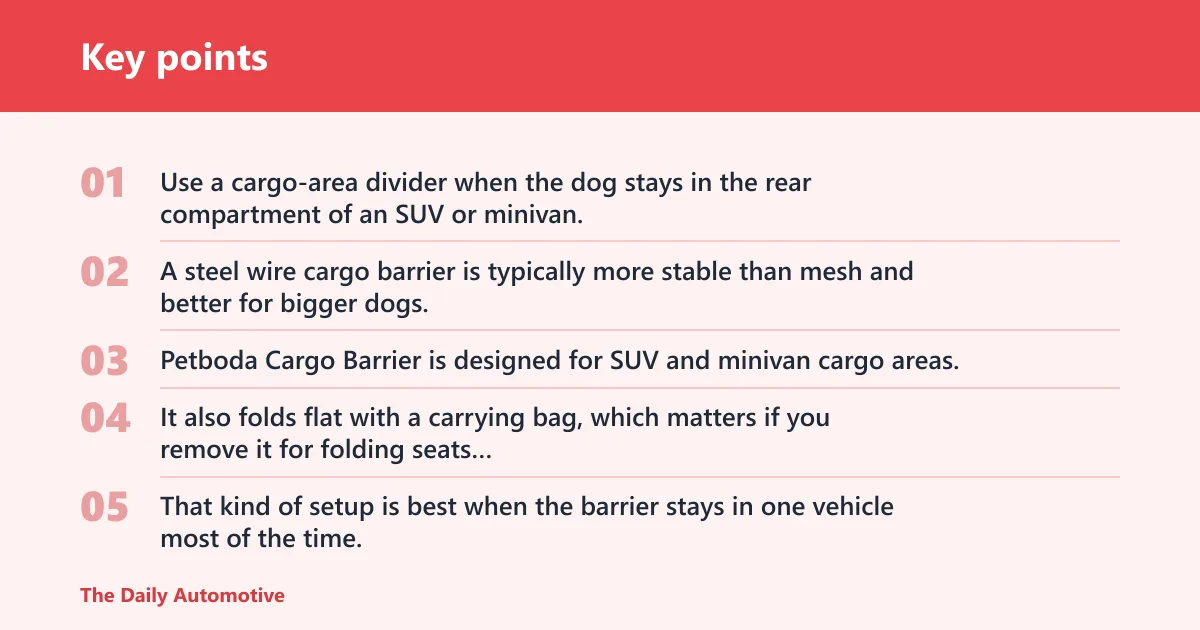
Use a cargo-area divider when the dog stays in the rear compartment of an SUV or minivan, especially if the goal is to keep a large dog away from the front cabin. A steel wire cargo barrier is typically more stable than mesh and better for bigger dogs, but it still has to match the vehicle’s width and height.
Petboda Cargo Barrier is designed for SUV and minivan cargo areas, and it uses bungee cords. It also folds flat with a carrying bag, which matters if you remove it for folding seats or cargo runs. That kind of setup is best when the barrier stays in one vehicle most of the time.
Why larger dogs expose weak mounting points first
Larger dogs load the frame with their body weight, shoulder pressure, and sudden movement. If the barrier is mounted to weak headrest bars or loose cargo points, the first failure is often rattling, then shifting, then a gap at the side or top. A rigid frame helps, but it cannot fix the wrong fit.
Suppose a 70-pound dog hits the barrier at a stoplight. If the frame is only lightly tensioned, the problem is not the dog’s size alone. The real issue is whether the mounting points can hold the barrier in place without slipping or flexing.
DYKESON 11.7-inch Dog Car Barrier review
DYKESON is the best fit when you want a compact, tool-free mesh barrier for a sedan back seat or a smaller cabin opening. Its 4-sided elastic mesh design works with exposed headrest bars or under-seat loops, and the included mesh storage makes it easy to remove when the rear seat needs to fold.
Best fit scenario
This is the pick for smaller or calmer dogs in a sedan, compact SUV, or smaller truck cab. It is especially useful when you need a barrier that goes in and out without tools, and when the mounting points are simple enough that a quick install is realistic.
Mounting points and setup
The barrier uses headrest bars or under-seat loops, so compatibility depends on whether your seats expose those points. That kind of mounting can be fast, but the stability depends on the shape of the seatbacks and how snugly the mesh is tensioned.
Mesh barriers are lightweight and see-through, which helps rear visibility. They also tend to work better with smaller or calmer dogs than with jumpy dogs or hard pawers.
Where it fails first
DYKESON is most likely to fail first against pawing dogs and escape-prone dogs. Mesh can allow paw-through, and a determined dog may press the barrier outward enough to create a gap. It is not the right choice for a large, forceful dog that tests every seam.
JOYTUTUS 52-Inch Dog Car Barrier review
JOYTUTUS is the best middle-ground pick when you want a one-piece barrier with alloy framing, thickened mesh, and a removable visual window. It is a no-tool option that suits wider back-seat spans and drivers who want a sturdier feel than a basic mesh panel.
Best fit scenario: this barrier fits best
This barrier fits best in vehicles where the rear cabin opening is broad but not constantly changing. It works for drivers who want a firmer frame than a soft mesh panel, yet still want something lighter and easier to handle than a cargo-specific steel divider.
Mounting points and setup: the one-piece construction can simplify
The one-piece construction can simplify installation. That matters when the barrier is moved between vehicles or removed often. The removable visual window can also help if the driver wants a clearer line of sight through the rear area.
Because it uses a framed build, the fit depends less on elastic tension and more on whether the cabin width and seat shape give the frame a steady seat. If the side trim or seatback angle is unusual, that can create edge gaps.
ZooKeeper EZ Pet Barrier review
ZooKeeper EZ Pet Barrier 42-61in Adjustable Dog Gate is the best pick for vehicles with frequent seat adjustment. It tilts, slides, and reclines with seat changes, installs in under five minutes using bungee cords, and works well when you need width flexibility and taller coverage for larger dogs.
Best fit scenario: this is the right choice
This is the right choice when the vehicle layout changes often, such as with split rear seats, family use, or a driver who regularly adjusts the cabin. It is also the strongest fit of the three for a taller dog that needs more vertical containment than a low mesh panel can give.
Mounting points and setup: zooKeeper uses bungee cords
ZooKeeper uses bungee cords at the headrests, so it depends on compatible bars and secure anchor points. The quick install is a plus, but bungee mounting can move more than a rigid clamp if the dog leans hard into the barrier.
The wide bar spacing is the detail to watch. It can let small dogs stick paws through, which matters if your dog is a climber, a scratcher, or a door-to-console jumper.
How do you choose the right barrier?
Start with the vehicle, then match the barrier type to the dog. Mesh works for lighter-duty use, steel wire is better in cargo areas, and adjustable gates help when seats move or recline often. The wrong style usually fails at the mounting points, not the center of the frame.
Mesh versus steel wire versus adjustable gate
Mesh barriers are light, easy to remove, and better for smaller or calmer dogs. They can be less rigid and may allow paw-through. Steel wire cargo barriers are often more stable and can suit SUVs and minivans, though they may rattle if poorly mounted. Adjustable gates cover changing widths and seat movement better than fixed panels.
Headrest bars, straps, hooks, and loops
Headrest-bar mounting systems use bungee cords, straps, hooks, or loops, and the right one depends on what your seats expose. If the mounting points are thin, loose, or oddly shaped, expect more slip and more noise. A secure mount matters as much as the barrier material.
A common first-timer mistake is buying a barrier for the dog instead of the cabin. A 60-pound dog in a hatchback with short roof height can create more fit trouble than a larger dog in a square SUV cargo area, because the barrier has less vertical room to hold its shape.
Storage, fold-flat design, and installation speed
Storage matters if you fold seats often. Petboda folds flat with a carrying bag, and DYKESON includes mesh storage for small items. ZooKeeper installs in under five minutes using bungee cords, which makes it the quickest moving-seat choice among the three.
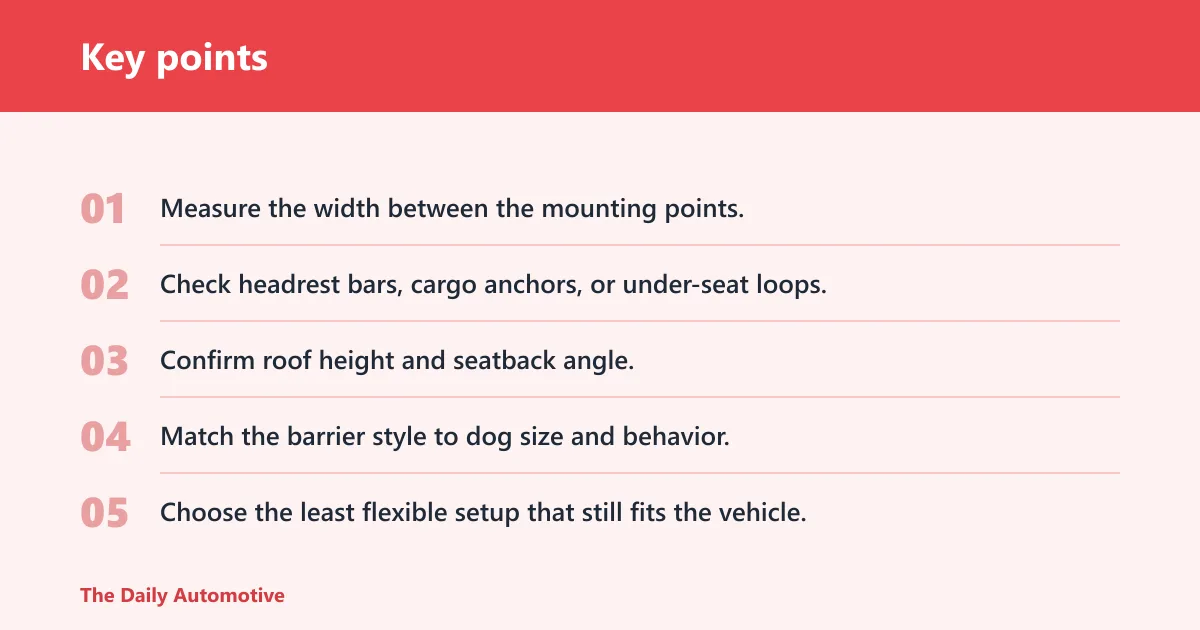
- Measure the width between the mounting points.
- Check headrest bars, cargo anchors, or under-seat loops.
- Confirm roof height and seatback angle.
- Match the barrier style to dog size and behavior.
- Choose the least flexible setup that still fits the vehicle.
Can a pet barrier work for cats?
Yes, but only in a narrower use case than dogs. A cat barrier can help keep a cat out of the front seat area, yet cats are smaller, better climbers, and more likely to slip through wide bars or around loose edges. A tight fit and low gaps matter more than raw barrier height.
When cat use makes sense
Use a barrier for a cat when the goal is to keep the animal in the back seat or cargo area during short trips, and when the mounting points leave no easy path around the sides. Mesh can work for calmer cats, but small openings and secure lower edges matter more than the style name on the box.
When a carrier is the better choice
If the cat is nervous, tries to climb, or can slip under a loose panel, a carrier is the safer choice. Cats are more likely than dogs to twist through gaps or reach a loose edge, so a barrier alone should not be treated as universal cat containment.
Frequently asked questions
Will a pet barrier work for a large dog in the cargo area?
Yes, if the barrier is a cargo-area divider or steel wire cargo barrier with the right width and height. Large dogs put more force into the frame, so weak mounts are the first problem. A barrier that fits a small hatchback may not hold a large dog in an SUV cargo space.
What size pet barrier fits a SUV or truck?
The right size depends on the distance between mounting points and the available roof height. Most buyers need to measure the opening at the widest point, then compare that to the barrier’s adjustable range. Trucks often need careful checks near the pillars and headrests, not just a simple width measurement.
Are mesh pet barriers safe for big dogs?
Mesh pet barriers are not the best choice for big dogs. They can work for smaller or calmer pets, but they are less rigid and may allow paw-through or outward flex when a large dog pushes on them. Big dogs usually do better with steel wire or a more rigid adjustable gate.
Do adjustable pet barriers fit different vehicles?
Yes, adjustable pet barriers fit more vehicle shapes than fixed panels, which is why they work well for frequent seat changes. ZooKeeper is the clearest example here because it can tilt, slide, and recline with seat adjustments. Even so, the vehicle still has to provide secure headrest mounting points.
Which pet barrier is best for a hatchback?
A hatchback usually does best with a compact or adjustable barrier that respects limited roof height and the rear seat angle. If the rear area is small, a mesh barrier may fit more easily, but it can be weaker for pawing dogs. Measure the hatch opening before choosing any style.
Products related to this article
Sponsored / affiliate links. As an Amazon Associate I earn from qualifying purchases. I may earn additional commission from eligible campaigns.