Does Returning a Leased Car Affect Your Credit?
Returning a leased car usually does not affect your credit if you turn it in on time and pay every final charge. Credit trouble starts when fees, early termination charges, or unpaid balances sit past the due date. Missed charges can turn a routine closeout into collections, late marks, or a lease deficiency on your reports. This guide explains which lease-end charges matter, when a return stays harmless, and how to keep the account off your credit file.
Does returning a leased car affect your credit?
A normal lease-end return usually does not directly hurt credit. The main issue is what happens after the car is turned in: if the account closes cleanly and every final charge is paid, the return itself is usually a non-event for credit. Problems begin when the lease ends with an unpaid balance.
Why a closed lease account can still change your credit mix
Closing the lease account can cause a small, temporary dip because it changes your mix of active credit accounts. That is a score movement, not a negative mark by itself. The change typically shows up about a month later, and the score usually settles if other accounts stay in good standing.
When a return becomes a credit problem
The return stops being harmless when the final bill is ignored. Unpaid excess wear-and-tear fees can trigger negative reporting, and an unresolved lease balance can also trigger negative reporting. If a balance is sent to collections, the damage can extend beyond the lease account itself.
What happens to your credit after a lease-end return?
After a lease-end return, the account is usually closed, then the lender or leasing company sends a final bill for any remaining charges. If that bill is paid, the account can close without a credit problem. If it is not paid, the unpaid balance may move into collections and then show up negatively.
How lease account closure is usually reported
A returned lease is commonly marked as closed once the vehicle is accepted and the final accounting is complete. That closeout is not the same thing as a derogatory mark. The credit file only turns negative if the closing process leaves money due and unpaid.
Why the impact may appear about a month later
Lease-end timing matters. The impact may appear about a month later because the closing information has to move from the lessor’s records to the credit bureaus. If the account closes with no balance due, that delayed update is usually limited to the small score shift tied to account closure.
Score change versus negative report entry
A score change is not the same as a negative report entry. A brief dip can come from the lease leaving your active credit mix, while a negative entry comes from unpaid charges, collections, or a deficiency balance. Those are different events, and they do not carry the same weight.

Which lease-end charges can hurt credit if unpaid?

Several final charges can become credit issues if they are left unpaid. The common ones are excess mileage, wear-and-tear fees, disposition fees, tolls, and other final billing items. None of those is a credit problem by itself; the risk starts when the bill remains unresolved after the lease ends.
Excess mileage and wear-and-tear fees
Excess mileage charges are common when the odometer goes past the lease limit. Wear-and-tear fees can also be charged for damage that goes beyond ordinary use. If those amounts are disputed but not resolved, or simply ignored, they can become part of a lease-end balance that may be reported negatively.
Disposition fees, tolls, and final billing items
Disposition fees, unpaid tolls, missing key charges, and inspection-related amounts can all appear on the final bill. These are often separate from the monthly payment history. A late or unpaid final invoice can still matter because any unresolved lease-end balance can move from billing to collections.
How an unresolved lease-end balance can reach collections
First comes the return, then the final statement, then the due date. If the balance remains unpaid, the lessor may send it to collections. At that point, the credit risk is no longer about the return itself; it is about the unpaid debt attached to the lease closeout.
Suppose a driver turns in a midsize sedan with excess miles and a disposition fee, then ignores the final invoice. The return was routine, but the unpaid charges can still become a balance sent for collection. The car came back on schedule; the account did not close cleanly.
Does returning a leased car early affect your credit?
Yes, returning a leased car before maturity can affect credit, and it is very different from a normal lease-end return. Early termination can leave a remaining amount due, and that unpaid amount can be treated as a derogatory item. Returning the vehicle early does not erase the original contract.
Early termination versus normal maturity return
A normal return happens at the scheduled end of the lease. Early termination happens before the contract reaches payoff or maturity. That difference matters because the early-return option can leave the lessor with unpaid lease obligations, and those obligations can become a balance reported to credit bureaus.
Why voluntary surrender can be treated as derogatory
Returning a car before it’s fully paid off can negatively impact credit. That early return is called a voluntary surrender or repossession, and a voluntary surrender is considered derogatory. In plain terms, the account did not finish on the original schedule, and the lender may report it that way.
How unpaid remaining charges can follow the return
An early return can still leave a bill for the remaining lease amount, fees, storage, transport, or disposition. If those charges are unpaid, they can be reported after the vehicle is turned in. The car leaving the driveway does not end the payment obligation.
What is the credit impact of voluntary repossession?
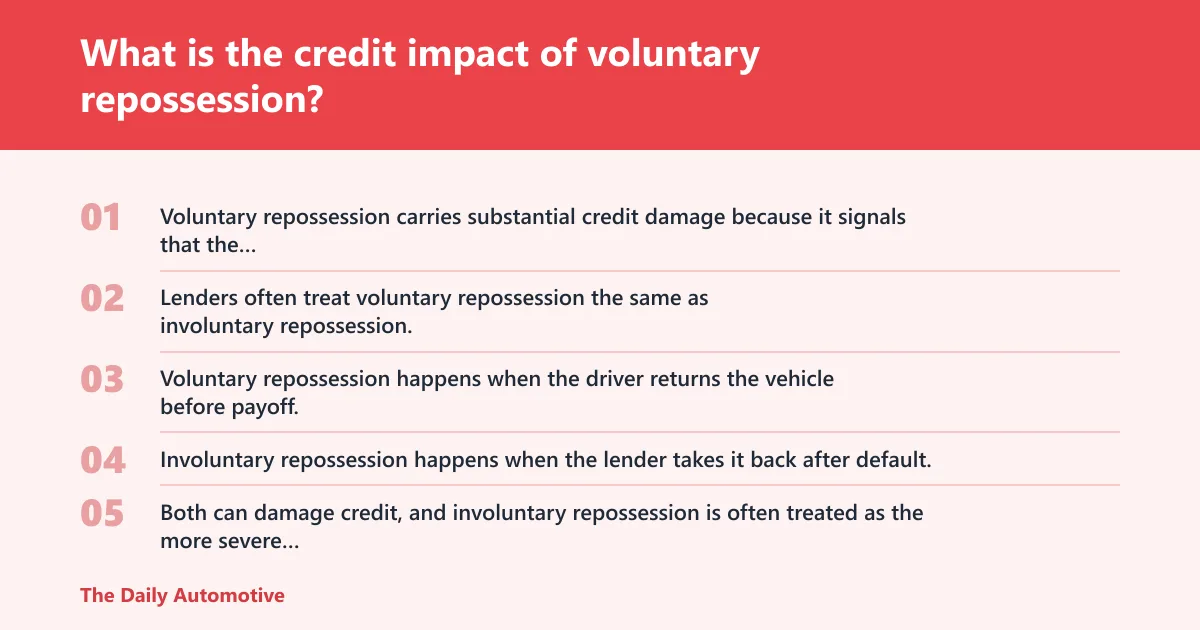
Voluntary repossession carries substantial credit damage because it signals that the borrower gave up the vehicle before the lease or loan was paid as agreed. It is considered derogatory. Lenders often treat voluntary repossession the same as involuntary repossession, which is a major negative mark.
Voluntary repossession versus involuntary repossession
Voluntary repossession happens when the driver returns the vehicle before payoff. Involuntary repossession happens when the lender takes it back after default. Both can damage credit, and involuntary repossession is often treated as the more severe example because it reflects a more serious collection action on the account.
Why repossession is a major negative mark
A repossession suggests the account ended in default rather than a clean closeout. That matters to lenders because it indicates missed obligations and unresolved debt. Even when the driver hands the keys back, the credit file can still show the account as seriously delinquent or repossessed.
How the lender may sell the vehicle and apply proceeds to the balance
The lender may sell the vehicle and apply proceeds to the balance after repossession or surrender. If the sale amount does not cover the remaining debt, the leftover amount can still be owed. That residual balance is another path to negative reporting.
Picture a compact SUV returned early after the lessee moves and can no longer keep up with payments. The lender accepts the vehicle, sells it, and still shows a deficiency because the sale did not cover the remaining contract balance. That is a credit problem, even though the car was physically returned.
Use this lease-end credit-risk checklist before you turn in the car
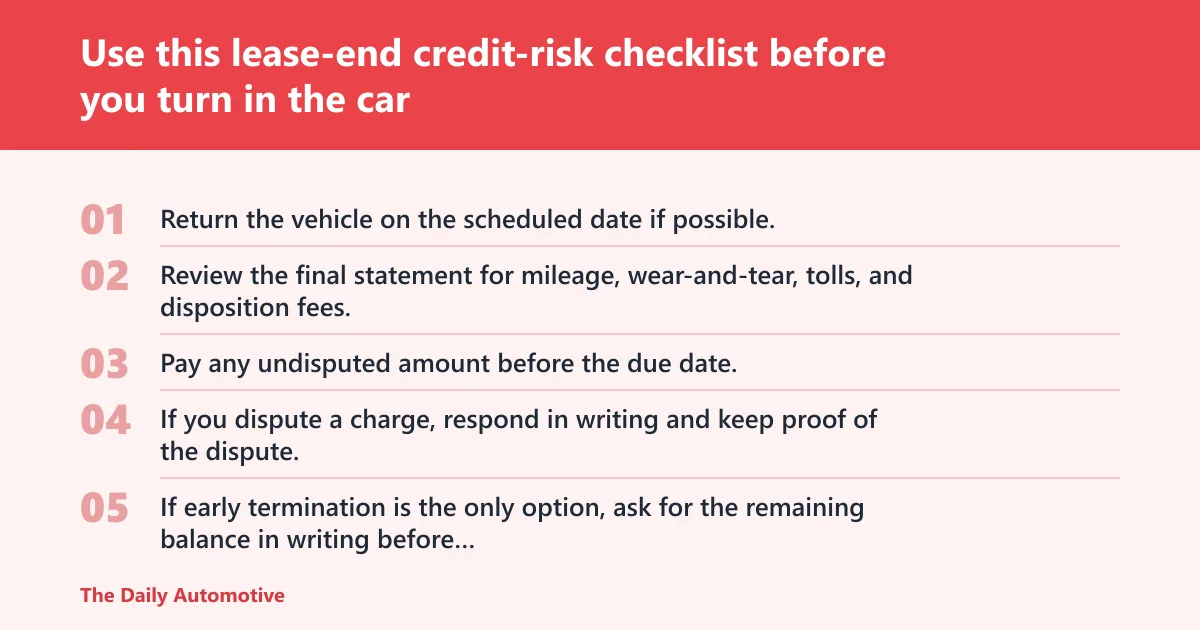
This checklist maps the return scenario to the most likely credit outcome. Start with the return type, then look at the final bill, then check whether any balance remains unpaid. That order matters because a clean return and a damaged account can look similar at first.
| Return scenario | Likely credit outcome | What to watch |
|---|---|---|
| On-time return with no balance due | Usually no direct credit damage; possible small temporary score dip from account closure | Lease closes, credit mix changes, update may appear about a month later |
| On-time return with disputed or unpaid fees | Possible negative reporting if the bill remains unpaid | Excess mileage, wear-and-tear, disposition fee, tolls, final invoice |
| Early return, surrender, or repossession | Derogatory event; substantial credit damage is possible | Remaining payments, deficiency balance, repo reporting language |
| Lease buyout | Depends on whether the buyout is paid in full or financed cleanly | Title transfer, new loan terms, payment history on the new account |
| Returned vehicle with unpaid lease-end balance | Unresolved balance can be reported negatively | Collections, late reporting, deficiency balance |
Decision path for common lease-end situations
- Return the vehicle on the scheduled date if possible.
- Review the final statement for mileage, wear-and-tear, tolls, and disposition fees.
- Pay any undisputed amount before the due date.
- If you dispute a charge, respond in writing and keep proof of the dispute.
- If early termination is the only option, ask for the remaining balance in writing before surrendering the vehicle.
- Compare buyout, return, and transfer options before allowing the account to go delinquent.
Can lease-end wear-and-tear fees hurt your credit?
Yes, if they are unpaid. Wear-and-tear fees do not hurt credit simply because they were assessed. The problem starts when they remain unresolved after the lease ends. An unpaid lease-end balance can be reported negatively, and wear-and-tear charges are a common part of that balance.
When a disputed charge becomes a credit issue
A dispute by itself is not a credit hit. But if the dispute is not resolved and the bill goes unpaid, the account can move toward collections or negative reporting. The safest approach is to keep records of the inspection report, the final invoice, and any written challenge to the amount due.
Does an unpaid lease balance show up on your credit report?
Yes. An unresolved lease balance can be reported negatively if it is not paid after the closeout process. That balance may come from mileage charges, wear-and-tear fees, tolls, disposition fees, or remaining monthly payments after early termination. The unpaid amount is the credit problem, not the turn-in itself.
How credit bureaus may see the account
Credit reporting can show the lease as closed with a balance, sent to collections, or otherwise derogatory depending on how the lessor handles the account. The key issue is whether the balance remains after the final invoice. A paid-in-full lease return is materially different from a lease with a deficiency.
Do you get money back when returning a leased car?
Usually no, not from a standard lease return. A leased vehicle is not the same as a financed car with equity. Most lease returns end with either no money owed or a final bill for excess charges. Refunds are uncommon unless the lessor has overcharged or the contract calls for a specific credit.
Why negative equity is a different issue
Negative equity is more relevant to financed cars than standard lease return. It means the vehicle is worth less than what is owed, which can leave a remaining balance after sale. That is usually a loan problem, not a normal lease-end return issue, though some early termination situations can create a similar shortfall.
Why a financed-car sale is not the same as a lease return
A private sale or dealership sale of a financed car usually does not impact credit by itself. That is not the same as returning a lease. The sale matters because the loan is paid off from the proceeds, and any shortfall becomes a loan balance issue rather than a lease-end closeout.
Frequently asked questions
Does turning in a car lease hurt your credit?
Turning in a car lease does not usually hurt credit when the return is on time and every charge is paid. The return becomes a credit issue only if there are unpaid fees, a deficiency balance, or an early termination that is reported as a surrender or repossession.
Will returning a leased car early count as a repossession?
Often yes. Returning a leased car before payoff can be called a voluntary surrender or repossession, and lenders often treat voluntary repossession the same as involuntary repossession. That can create a major negative mark on the credit report, especially if a deficiency remains after the vehicle is sold.
Products related to this article
Sponsored / affiliate links. As an Amazon Associate I earn from qualifying purchases. I may earn additional commission from eligible campaigns.
 Portable Car Heater Car Heater, Portable Electronic Auto Heater Fan Fast Heating Defrost 12V 120W Car Defrost Defogger, 2 in 1 Heating/Cooling Function 3-Outlet, Plug Adjustable
 Half Car Cover Top, Snow Car Cover for Compact SUV with Cotton Liner, Sunroof & Windshield Cover for Ice and Snow, All Weather Vehicle Body Cover for Sun, Rain, Dust, Fit SUV 178-189 inchs