Engine Capacity Meaning: What Does 2191cc Mean
Ever seen car specs and wondered what all those numbers mean? Like that “2,191cc” next to the engine size? It can seem a bit confusing at first, but it’s actually pretty simple.
This post will break down the Engine Capacity Meaning: What Does 2,191cc Mean? so you can understand it clearly. We’ll go step-by-step to make it easy to grasp. Get ready to learn what that number really tells you about a car’s engine.
Understanding Engine Capacity And Displacement
Engine capacity, often called engine displacement, tells you how much space the engine’s cylinders have. Think of it like the total “breathing room” for the engine’s pistons. It’s a key number for understanding how powerful and efficient an engine can be.
This measurement directly impacts a vehicle’s performance, fuel consumption, and even its emissions. Many car buyers look at this figure to get a general idea of what a car can do. It’s a fundamental concept in automotive engineering that affects the driving experience significantly.
Understanding this helps you make better choices when buying a car or discussing car features.
What Is Engine Capacity Explained
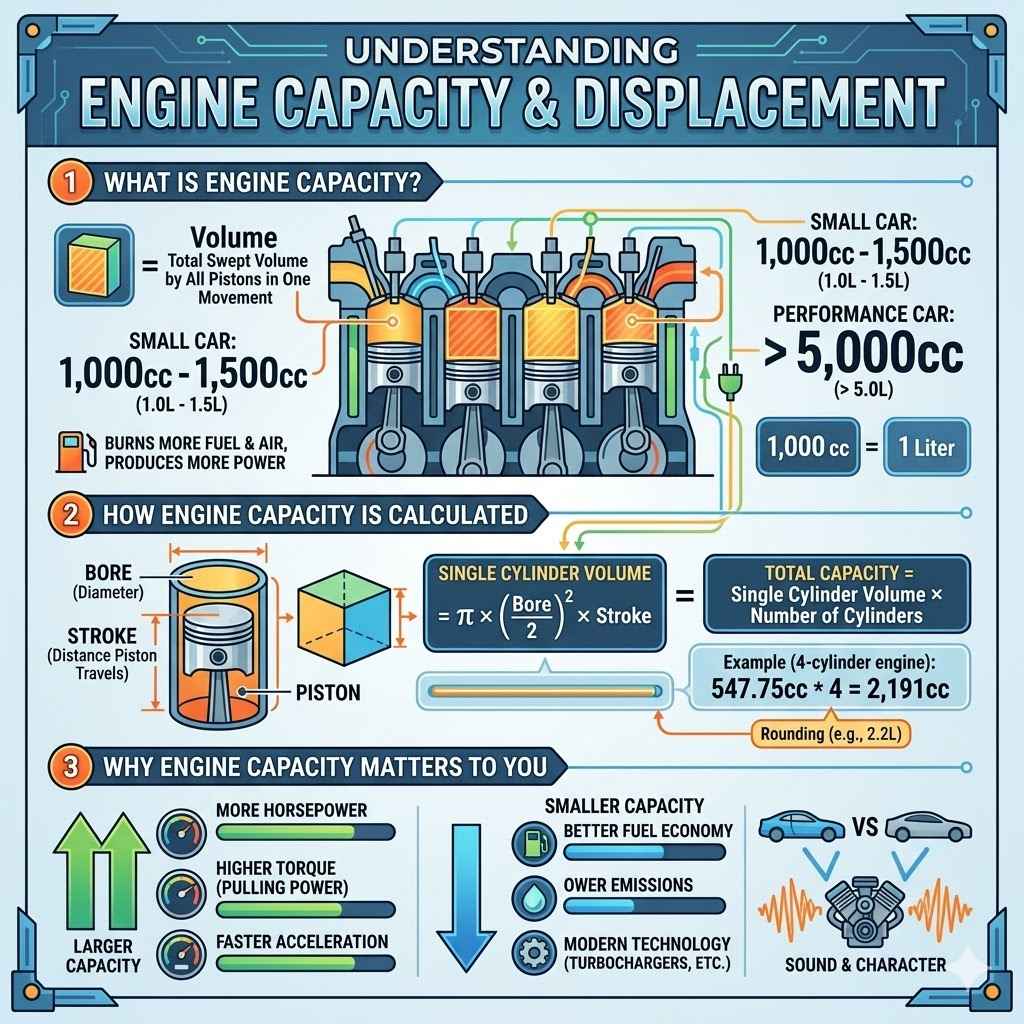
Engine capacity is measured in cubic centimeters (cc) or liters (L). It represents the total volume of all the cylinders in an engine. Imagine each cylinder as a tube where a piston moves up and down.
The capacity is the sum of the volume swept by all these pistons in one movement. A larger engine capacity generally means the engine can burn more fuel and air, which often translates to more power. However, it can also mean it uses more fuel.
This figure is a standard way to compare engines across different vehicles.
For instance, a small city car might have an engine capacity of around 1,000cc to 1,500cc. A mid-size sedan could be in the 1,800cc to 2,500cc range. Performance cars and trucks often have much larger engines, sometimes exceeding 5,000cc or even 6,000cc.
The unit ‘cc’ comes from cubic centimeters, a unit of volume. Sometimes, you’ll see engines described in liters (L). To convert cc to liters, you divide by 1,000.
So, 2,191cc is equal to 2.191 liters. This conversion is common because liters are easier to say and write for larger volumes.
How Engine Capacity Is Calculated
The calculation for engine capacity is quite straightforward. It involves the size of the cylinders and how many cylinders the engine has. The formula uses two main measurements: the bore and the stroke.
The bore is the diameter of a cylinder, and the stroke is the distance the piston travels from its lowest point to its highest point within the cylinder. The volume of a single cylinder is calculated using the area of its base (a circle) multiplied by its height (the stroke). The formula for the volume of a cylinder is pi times the radius squared times the stroke.
The radius is half the bore.
So, for one cylinder, the volume is approximately 3.14159 (bore/2)^2 stroke. Once you have the volume of one cylinder, you multiply it by the total number of cylinders in the engine. This gives you the total engine displacement or capacity.
For example, if an engine has four cylinders, and each cylinder has a calculated volume of 547.75cc, then the total engine capacity would be 547.75cc * 4 = 2,191cc.
Manufacturers often round these numbers for simplicity. So, you might see an engine listed as 2.2 liters instead of 2.191 liters. This simplification helps consumers understand the engine size without needing to do calculations.
The precision of the measurement can also vary slightly depending on the manufacturing tolerances and how the figure is officially stated for marketing or regulatory purposes. However, the core principle of volume swept by the pistons remains the same.
Why Engine Capacity Matters To You
Engine capacity is important because it gives you a good idea of a car’s potential. Engines with larger capacities usually produce more horsepower and torque. This means they can accelerate faster and have more pulling power, which is useful for towing or climbing hills.
If you want a car that feels quick and responsive, a larger engine capacity might be what you’re looking for. It’s a direct indicator of an engine’s fundamental capability.
However, bigger engines often use more fuel. If fuel economy is a top priority for you, you might prefer a car with a smaller engine capacity. This is where modern technology comes into play.
Many smaller engines are now very efficient, sometimes matching or even beating older, larger engines in terms of fuel consumption. Turbochargers and other advancements allow smaller engines to perform like larger ones while using less gas.
The sound of the engine is also sometimes linked to its capacity. Larger engines, especially those with more cylinders, can produce a deeper, more resonant sound. This is a subjective factor but one that many car enthusiasts appreciate.
Ultimately, the engine capacity is one piece of the puzzle when choosing a vehicle that fits your needs and preferences. It’s a tangible measure of the engine’s size and potential output.
Breaking Down 2,191cc
Now let’s focus on what 2,191cc specifically means for a vehicle. This number places the engine in a specific category, often considered a medium-to-large displacement for passenger cars. An engine of 2,191cc offers a balance between performance and efficiency that many drivers find appealing.
It’s large enough to provide brisk acceleration and good power for highway cruising, but not so large that it becomes excessively thirsty for fuel.
Vehicles with engines around this size are typically mid-size sedans, larger SUVs, or performance-oriented compact cars. They are designed for drivers who want more than basic transportation but don’t necessarily need the extreme power of a large V8 or V12 engine. This size is often achieved with 4-cylinder or 6-cylinder engine configurations.
A 4-cylinder engine of 2,191cc would be a relatively large 4-cylinder, meaning each cylinder has a significant volume. A 6-cylinder engine of 2,191cc would mean each cylinder is smaller, typically around 365cc.
This size is a common choice for manufacturers because it hits a sweet spot for many consumer demands. It allows for comfortable driving on highways, confident overtaking, and the ability to handle varying road conditions with ease. It’s a size that signifies a capable engine without the significant fuel costs or environmental impact associated with much larger displacements.
Therefore, when you see 2,191cc, think of a capable, well-rounded engine.
What Kind Of Cars Have This Engine Size
Cars with an engine capacity of 2,191cc are often found in vehicles that aim for a good mix of power, comfort, and reasonable fuel efficiency. You’ll frequently see this engine size in mid-size sedans, which are popular for families and commuters. These cars need enough power to carry passengers and luggage comfortably, especially on long trips or when merging into traffic.
You might also find a 2,191cc engine in a compact or mid-size SUV. These vehicles often benefit from the extra torque and power for carrying heavier loads or for off-road adventures, though their primary use is often on paved roads. The engine size provides enough grunt for hauling groceries, sports equipment, or even a small trailer.
Performance-oriented compact cars sometimes feature engines in this range. Manufacturers might use a turbocharged 2.0-liter engine, for example, that effectively produces power comparable to a naturally aspirated 2.2-liter engine. The 2,191cc figure is a specific measurement that indicates a substantial, capable engine for everyday driving and beyond.
It’s not a tiny commuter engine, nor is it a gas-guzzling monster. It sits in a very practical and popular segment of the automotive market.
Performance Expectations For 2,191cc
When a car has an engine capacity of 2,191cc, you can generally expect solid performance. This size engine is typically capable of producing somewhere between 150 to 200 horsepower, and sometimes more, especially if it’s turbocharged. This means the car will feel responsive when you press the accelerator.
It should be able to accelerate from 0 to 60 miles per hour in a reasonable time, likely between 7 to 9 seconds.
This engine size is well-suited for highway driving. It provides enough power for smooth overtakes and maintaining speed on inclines without the engine struggling. For a mid-size sedan, this means a comfortable and confident driving experience.
For an SUV, it means you can confidently merge onto busy highways or tow a modest load. The torque output, which is the engine’s rotational force, is also usually sufficient for everyday driving needs. Good torque means the car feels strong when starting from a stop or when accelerating at lower speeds.
However, it’s important to remember that other factors also influence performance. The weight of the vehicle, the gearing of the transmission, and whether the engine is turbocharged or naturally aspirated all play a big role. A lighter car with a 2,191cc turbocharged engine will feel much quicker than a heavier car with the same engine size that is not turbocharged.
Nevertheless, 2,191cc suggests a good balance of usable power for most driving situations.
Fuel Efficiency Considerations
Regarding fuel efficiency, a 2,191cc engine typically offers a decent compromise. It won’t be as fuel-efficient as a very small engine, like a 1.0-liter or 1.2-liter unit found in subcompact cars. However, it will generally be more economical than engines with capacities of 3.0 liters or more.
For a mid-size car, you might expect to see fuel economy ratings in the range of 25-30 miles per gallon in mixed driving conditions.
Modern engine technologies have significantly improved the fuel efficiency of engines in this size range. Features like direct fuel injection, variable valve timing, and turbocharging help these engines perform better while consuming less fuel. For example, a 2,191cc turbocharged engine might offer the power of an older 2.5-liter or 2.7-liter engine but achieve better gas mileage.
This makes them a popular choice for drivers who want a bit of power without a significant penalty at the gas pump.
The way you drive also greatly impacts fuel consumption. Aggressive acceleration and frequent hard braking will reduce fuel economy, regardless of engine size. Smooth driving, maintaining steady speeds, and proper tire inflation can help you maximize the miles per gallon your vehicle achieves.
For a 2,191cc engine, aiming for around 28 MPG combined is a realistic expectation in a typical passenger car.
Comparing Engine Capacities
Understanding engine capacity is easier when you compare different sizes. This helps put the 2,191cc figure into perspective. Car manufacturers use various engine sizes to cater to different needs, from small, fuel-sipping city cars to powerful trucks and sports cars.
Each size offers a different balance of power, fuel economy, and cost.
Looking at a table of common engine capacities can be very helpful. You can see how 2,191cc fits in with smaller and larger options. This comparison makes it clear why certain vehicles are designed with specific engine sizes in mind.
It’s a way to understand the trade-offs involved in engine design. We will explore how different capacities perform and what they are typically used for.
Smaller Engine Capacities
Smaller engine capacities, typically ranging from 800cc to 1,600cc, are common in subcompact and compact cars. These engines are designed primarily for fuel efficiency and lower running costs. They are perfect for city driving, where frequent stops and starts mean that lower fuel consumption is a major advantage.
For example, a 1.0-liter (1000cc) engine in a small hatchback is excellent for its gas mileage. It might get upwards of 40 MPG in city driving. However, these engines often lack the power for quick acceleration or comfortable highway cruising, especially when carrying multiple passengers or cargo.
Overtaking on a highway might feel slow, and climbing steep hills could be a challenge. They are budget-friendly in terms of both purchase price and fuel, making them ideal for first-time car buyers or those prioritizing economy above all else.
A 1.5-liter (1500cc) engine is a step up, offering a bit more power while still maintaining good fuel economy. These can be found in larger compact cars and some smaller sedans. They provide a more balanced experience than the very small engines, making them a popular choice for a wide range of drivers.
Larger Engine Capacities
On the other end of the spectrum are larger engine capacities, generally above 3,000cc, commonly found in larger sedans, luxury vehicles, SUVs, trucks, and sports cars. These engines are built for power and performance, offering significant horsepower and torque.
A 3.5-liter (3500cc) engine, often a V6, is a common sight in larger sedans and SUVs. It offers a robust blend of power for acceleration and towing, combined with reasonable comfort for cruising. However, fuel economy will be noticeably lower than smaller engines, often in the 20-25 MPG range for combined driving.
Very large engines, like 5.0-liter (5000cc) V8s found in muscle cars or trucks, are designed for maximum power and towing capacity. These engines provide thrilling acceleration and immense pulling strength. However, they come with the trade-off of significantly higher fuel consumption, often below 15 MPG combined.
They are also more expensive to maintain and purchase due to their size and complexity.
Engine Capacity Comparison Table
Here’s a look at how different engine capacities generally compare:
| Engine Capacity (cc) | Typical Vehicle Type | Primary Focus | Typical MPG (Combined) |
|---|---|---|---|
| 800-1,600cc | Subcompact, Compact Cars | Fuel Efficiency, City Driving | 30-45 MPG |
| 1,700-2,500cc | Compact Sedans, Mid-Size Cars | Balance of Efficiency and Performance | 25-32 MPG |
| 2,191cc | Mid-Size Sedans, Compact SUVs | Good All-Around Performance | 25-30 MPG |
| 2,600-3,500cc | Mid-Size/Large Sedans, SUVs | Power, Comfort, Light Towing | 20-28 MPG |
| 3,600cc+ | Large SUVs, Trucks, Performance Cars | Maximum Power, Heavy Towing | 12-22 MPG |
As you can see from the table, 2,191cc fits comfortably in the middle ground. It’s a size that appeals to a broad range of drivers looking for a capable and well-balanced vehicle. It offers more power and flexibility than smaller engines without the significant fuel costs associated with much larger ones.
This balance is why you see this engine size in so many popular vehicles.
Factors Influencing Engine Performance Beyond Capacity
While engine capacity is a significant factor in determining an engine’s performance, it’s not the only one. Several other elements work together to shape how an engine behaves. These include the number of cylinders, the type of aspiration (natural or forced induction), the engine’s design, and the transmission it’s paired with.
Understanding these can give you a more complete picture of a car’s capabilities.
For example, two cars might have engines with the same 2,191cc capacity, but one could feel much more powerful than the other. This difference often comes down to these other contributing factors. Technology has advanced to the point where a smaller, more advanced engine can sometimes outperform a larger, older design.
It’s important to consider the whole package when evaluating an engine’s performance.
Number Of Cylinders
The number of cylinders an engine has influences its smoothness and power delivery. Common configurations include inline-4 (four cylinders in a row), V6 (six cylinders in a V shape), and V8 (eight cylinders in a V shape). More cylinders generally mean smoother operation because the power strokes are more frequent and evenly spaced.
A 2,191cc engine could be configured in different ways. It might be a relatively large 4-cylinder engine. In this case, each cylinder has a larger volume, meaning it moves more air and fuel with each combustion cycle.
This can sometimes lead to a less refined engine feel, with more vibration compared to an engine with more cylinders. However, modern 4-cylinder engines are often very well-balanced.
Alternatively, a 2,191cc engine could be a smaller V6 engine. This would mean each of the six cylinders has a smaller capacity (around 365cc each). A V6 engine typically runs smoother than a 4-cylinder engine of the same total displacement because the power strokes are closer together.
The V6 might offer better refinement and a more linear power band, while the large 4-cylinder might have a bit more punch in the low to mid-range RPMs, especially if it’s turbocharged.
Forced Induction (Turbocharging And Supercharging)
Forced induction is a technology used to increase an engine’s power output by forcing more air into the combustion chambers. This allows more fuel to be burned, resulting in a more powerful explosion and thus, more power. The two main types are turbocharging and supercharging.
A turbocharged engine uses exhaust gases to spin a turbine, which in turn spins a compressor that forces air into the engine. This can make a smaller engine feel like a much larger one. For example, a 2.0-liter (2000cc) turbocharged engine can often produce the same power and torque as a naturally aspirated 3.0-liter engine.
This is a huge advantage for fuel economy, as the engine is smaller when not under heavy load.
A supercharger is mechanically driven by the engine’s crankshaft, usually via a belt. It provides boost almost instantly, reducing the “turbo lag” that some turbocharged engines experience. Both technologies can significantly enhance the performance of an engine of any capacity.
A 2,191cc engine with turbocharging could easily produce power outputs typically found in much larger engines, offering impressive acceleration and responsiveness.
Real-world example: The Volkswagen Golf GTI has historically used turbocharged engines that are smaller than 2,191cc but produce power comparable to larger, naturally aspirated engines. A 2.0-liter turbocharged engine in a GTI can generate over 200 horsepower and feel very quick, demonstrating the impact of forced induction.
Engine Design And Technology
Beyond just capacity and forced induction, the overall design and technological features of an engine play a crucial role. This includes aspects like valve timing, fuel injection systems, and materials used in construction. Modern engines incorporate numerous innovations to improve performance, efficiency, and emissions.
Variable Valve Timing (VVT) systems, for instance, can adjust when the engine’s valves open and close. This allows the engine to perform optimally across a wider range of engine speeds. Direct fuel injection (DFI) systems inject fuel directly into the combustion chamber, rather than into the intake manifold.
This offers better fuel atomization, more precise fuel control, and improved efficiency. Some engines also use lighter materials for pistons and connecting rods, reducing internal friction and improving responsiveness.
For example, many modern 2.0-liter or 2.2-liter engines utilize technologies like DFI and VVT to achieve impressive horsepower figures while maintaining good fuel economy. This means a 2,191cc engine with these advanced technologies could offer a superior driving experience compared to an older engine of the same size without these features. The integration of these technologies is key to maximizing the potential of any given engine capacity.
Transmission And Drivetrain
The engine’s power is ultimately delivered to the wheels through the transmission and drivetrain. The type of transmission and how it’s programmed can greatly affect how the engine’s power is felt. Modern transmissions are highly sophisticated, aiming to keep the engine in its optimal power band.
Automatic transmissions have evolved from simple 3 or 4-speed units to complex 8, 9, or even 10-speed gearboxes. These extra gears allow the engine to operate at lower RPMs on the highway for better fuel economy, or to quickly downshift for acceleration when needed. Continuously Variable Transmissions (CVTs) offer an even wider range of gear ratios, providing a very smooth and efficient power delivery, though some drivers find them less engaging than traditional automatics or manuals.
A car with a 2,191cc engine paired with a well-programmed modern automatic transmission will feel more responsive and efficient than a car with the same engine and an older, less advanced transmission. The drivetrain configuration (front-wheel drive, rear-wheel drive, or all-wheel drive) also impacts performance and handling. All-wheel drive, for instance, can improve traction and acceleration, especially in challenging conditions.
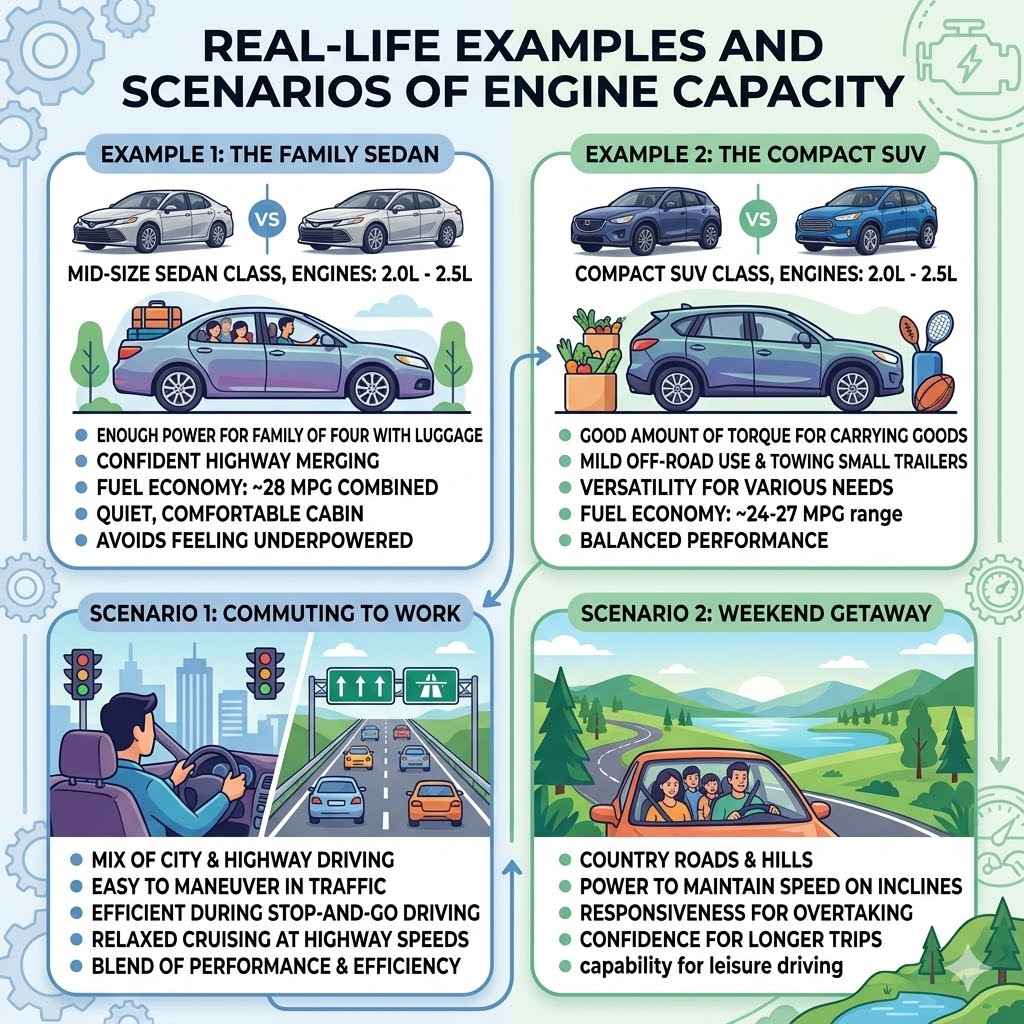
Real-Life Examples And Scenarios
To truly grasp what engine capacity means, let’s look at some real-world examples. Seeing how different engines perform in actual vehicles helps solidify the concepts we’ve discussed. These examples highlight the practical implications of engine size on driving.
Example 1 The Family Sedan
Consider a mid-size family sedan like a Toyota Camry or Honda Accord. Many models in this class offer an engine in the range of 2.0 to 2.5 liters. A 2,191cc engine would be a perfect fit for such a car.
It provides enough power to comfortably carry a family of four with luggage on a road trip. The acceleration is brisk enough for confident highway merging and overtaking.
The fuel economy for such a sedan with a 2,191cc engine might average around 28 MPG combined. This offers a good balance for everyday commuting and longer journeys. The engine noise is usually well-managed, providing a quiet and comfortable cabin experience.
This size engine ensures that the car doesn’t feel underpowered, even with the air conditioning running and the car fully loaded.
If this car were equipped with a smaller 1.5-liter engine, it would likely be more fuel-efficient but might struggle under load or on inclines. If it had a larger 3.5-liter V6, it would offer more power and a smoother feel, but at the expense of significantly higher fuel consumption and potentially a higher purchase price.
Example 2 The Compact SUV
Now, let’s look at a compact SUV, such as a Mazda CX-5 or a Ford Escape. These vehicles often use engines around 2.0 to 2.5 liters as well. A 2,191cc engine in a compact SUV provides a good amount of torque, which is beneficial for carrying groceries, sports equipment, or for mild off-road use.
The performance would allow for easy acceleration when merging onto highways or passing slower vehicles. For those who need to tow a small trailer, like a utility trailer or a couple of jet skis, a 2,191cc engine with adequate torque would be suitable, though not ideal for heavy-duty towing. The fuel economy for a compact SUV of this size might be slightly lower than a sedan, perhaps in the 24-27 MPG range, due to the vehicle’s heavier weight and less aerodynamic shape.
A larger engine in this SUV would offer more power but could significantly decrease fuel economy. A smaller engine might save fuel but could feel strained when the vehicle is loaded or when tackling hilly terrain. The 2,191cc size represents a sweet spot for this category, offering versatility for various family needs.
Scenario 1: Commuting To Work
Imagine your daily commute involves a mix of city streets and highway driving. You need a car that is easy to maneuver in traffic, sips fuel efficiently during stop-and-go driving, and can cruise comfortably at highway speeds. A car with a 2,191cc engine can handle this well.
It has enough power for quick starts at traffic lights and smooth acceleration onto the highway. The engine’s efficiency in this range means your fuel bills won’t be exorbitant for daily driving.
If your commute was primarily stop-and-go city traffic, a smaller engine might be slightly more economical. If it was almost entirely highway driving at constant speeds, a slightly larger engine might not use much more fuel and could offer more relaxed cruising. However, for a mixed commute, 2,191cc provides a good blend of performance and efficiency that makes daily driving pleasant.
Scenario 2: Weekend Getaway
Planning a weekend trip that involves driving on country roads and possibly some hills? A car with a 2,191cc engine is a great choice. It has the power to maintain speed on inclines without the engine feeling overworked.
You’ll have enough responsiveness for overtaking slower vehicles on two-lane roads. Plus, when you reach your destination and park, you won’t feel like you’ve drained your fuel tank just getting there.
This engine size offers a sense of confidence when driving on longer trips. You won’t be worried about the car struggling to keep up with traffic or navigate challenging terrain. It provides a comfortable margin of power for unexpected situations, making the journey more enjoyable and less stressful.
The capacity ensures you have the capability you need for leisure driving.
Frequently Asked Questions
Question: What is the basic definition of engine capacity?
Answer: Engine capacity, also called displacement, is the total volume of all the cylinders in an engine, measured in cubic centimeters (cc) or liters (L). It tells you how much air and fuel the engine can take in with each cycle.
Question: Does a larger engine capacity always mean more power?
Answer: Generally, yes, a larger engine capacity allows an engine to produce more power. However, modern technologies like turbocharging can make smaller engines very powerful, sometimes rivaling larger naturally aspirated engines.
Question: Is 2,191cc considered a large engine?
Answer: 2,191cc is considered a medium to large engine capacity for passenger cars. It offers a good balance of power for performance and reasonable fuel efficiency, fitting well in mid-size sedans and SUVs.
Question: How do I convert cc to liters?
Answer: To convert cubic centimeters (cc) to liters (L), you divide the cc value by 1,000. So, 2,191cc is equal to 2.191 liters.
Question: Which is better for fuel economy a 1.5L or a 2.2L engine?
Answer: Typically, a 1.5L engine will be more fuel-efficient than a 2.2L engine, assuming similar technology and vehicle weight. However, factors like turbocharging and driving habits can influence real-world fuel economy.
Summary
Understanding engine capacity, like the 2,191cc figure, reveals a vehicle’s potential. This size offers a capable balance of power for everyday driving and highway cruising. It fits well in mid-size sedans and SUVs, providing a satisfying performance without excessive fuel consumption.
While other factors matter, capacity remains a key indicator of an engine’s fundamental capabilities and what you can expect from your car.