3 Best Car Emergency Escape Tools in 2026
The 3 best car emergency escape tools in 2026 are a spring-loaded window breaker, a seat-belt cutter with a guarded blade, and a compact two-function tool; choose by reach, one-hand use, and whether multiple drivers need the same backup. A poor pick can waste seconds when belts jam, glass won’t break, or one hand is pinned. This guide ranks the three by real-world escape value and explains which driver should buy each one.
Best overall pick: resqme Original Car Escape Tool


The resqme Original Car Escape Tool is the best all-around pick for most drivers because it stays small enough to keep close, combines a spring-loaded window breaker with a hidden stainless-steel blade, and is easy to carry every day. That matters when a crash leaves only one free hand or turns a larger tool into dead weight.
Why it leads for everyday carry
The resqme is a keychain-sized tool, so it can ride with your keys, clip to a bag, or stay in the cabin without taking up useful space. Buying guides also describe it as a compact escape tool and note that it is marketed as trusted by first responders and many drivers.
That size is its advantage and its tradeoff. A smaller tool is easier to keep close, but it is easier to misplace, easier to drop, and easier to miss if storage is sloppy.
What it does well, and where it can fail
The spring-loaded breaker is the important part here. Brainstamped notes that spring-loaded breakers require zero swing, which helps when the seat belt is locked tight or the cabin is cramped. The hidden blade also keeps the cutter protected until you need it.
Its main weakness is storage discipline. A keychain tool only helps if it is actually on you or mounted where you can grab it. If it lives in a glove box, it may as well be in the trunk.
Quick picks by driving need
Different drivers need different escape priorities. A solo commuter may want the smallest tool that is always close. A family vehicle may need a spare for the second row. Rural and long-haul driving makes access and grip more important than compact size.
| Driving need | Best tool type | Why it fits | Main failure risk |
|---|---|---|---|
| Daily commute | Keychain-size spring-loaded tool | Easy to keep close and easy to carry every day | Loose storage that shifts or gets lost |
| Family vehicle | Two-pack or a fuller escape hammer | Lets more than one driver or seating position have a backup | One tool ends up stored too far away from rear passengers |
| Rural or long-haul driving | Fuller escape tool with a solid grip | Better reach and more controlled handling in a harder crash scenario | Hard-to-grab placement when hands are wet or shaking |
Suppose your sedan has a clean center console and you drive alone most days. A compact spring-loaded tool is the better fit, because it can stay close and deploy with one hand. Now change one detail: the same car is used by two adults and a teenager. A two-pack starts to make more sense.
Best compact backup: Stinger Super Duty Car escape tool
The Stinger Super Duty Car Escape Tool is the pick for tight spaces and awkward reaches. It is a spring-loaded precision tool for tight spaces, with a hardened carbon steel tip, a non-slip rubber grip, and a lanyard loop for better control when the cabin is cramped.
This is the tool to favor when you want one-hand deployment and a firmer hold than a tiny keychain unit can offer. It still has the same basic job as other escape tools, but its shape gives your hand more to work with.
Best two-pack: Amazon Basics SW-835 emergency Escape tool
The Amazon Basics SW-835 Emergency Escape Tool is sold as a two-pack option, which can provide a spare for a second seating position, another driver, or a different vehicle. It is named best overall, and its package format solves a real problem: one tool is only useful where it is stored.
Why a spare matters
Emergency gear fails most often by being out of reach, not by being broken. A second tool gives you a backup if one is misplaced, mounted poorly, or grabbed by a passenger who needs it more than the driver does. That matters in family cars and shared vehicles.
The SW-835 uses a tungsten steel head, a seatbelt cutter, and a protective bracket. Those details matter because the bracket helps control storage, while the cutter and breaker cover the two jobs that matter in a trapped exit.
Storage and access points
The better storage locations are a door pocket or the center console. Those spots keep the tool close and make it easier to find by feel if you are turned sideways or moving in a panic. Door pockets can work well if the tool is secured, not loose.
Do not rely on the glove box. It is too easy to lose access to if the cabin is distorted, and it is slower than a seat-mounted or console-mounted option.
Best fuller tool: Lifehammer Evolution
The Lifehammer Evolution is the better choice when you want a fuller escape tool with a more deliberate swing motion and a mounting bracket for fixed storage. Auto Quarterly includes the LifeHammer Safety Hammer Evolution in its top 10, and Brainstamped lists the Lifehammer Evolution at $25. That puts it in the group of tools drivers buy when they want a more substantial handle and a more traditional hammer form.
When a swing hammer makes sense
A hammer-style escape tool can make sense if you want a larger grip, a more obvious striking end, and a mount that keeps the tool visible and easy to find. It is also a better fit for drivers who prefer a physically larger object over a compact breaker.
The tradeoff is obvious: a swing tool takes more room and usually needs more motion than a spring-loaded breaker. That makes it less ideal in a crushed cabin, especially if you only have one hand free.
Mounting and retention concerns
Any mounted escape tool has to stay put after a crash. Loose storage is a problem because a tool that slides under a seat may as well not be there. A visor mount can be a good option only if the clip fits securely and does not become a projectile in a hard hit.
Sun visor mounting is often the best placement because it can sit close and stay visible, but it is not universal. If the clip is loose, the visor is not the right place.
Escape tool decision table
This table turns the buying choice into a vehicle-layout choice. The right tool is the one you can reach, recognize, and deploy when your posture is awkward and your hands are not steady.
| Scenario | Best escape tool type | Ideal mounting location | Main failure risk |
|---|---|---|---|
| Daily commute | Compact spring-loaded tool | Sun visor if it fits securely, otherwise center console | Tool is hard to find with wet hands |
| Family vehicle | Two-pack or fuller escape hammer | Seatbelt anchor clip or front-seat door pocket | Rear passengers cannot reach the only stored tool |
| Rural or long-haul driving | Fuller escape tool with stronger grip | Center console or secure visor mount | Loose storage shifts out of reach after a rollover |
How should you choose an escape tool?
Choose the tool you can reach with one hand, then make sure it stays in place when the vehicle is upside down. The best model on paper fails if it is buried in a glove box, rattles loose in a door pocket, or is too hard to grip when your hand is wet or shaking.
Spring-loaded breaker or hammer-style tool
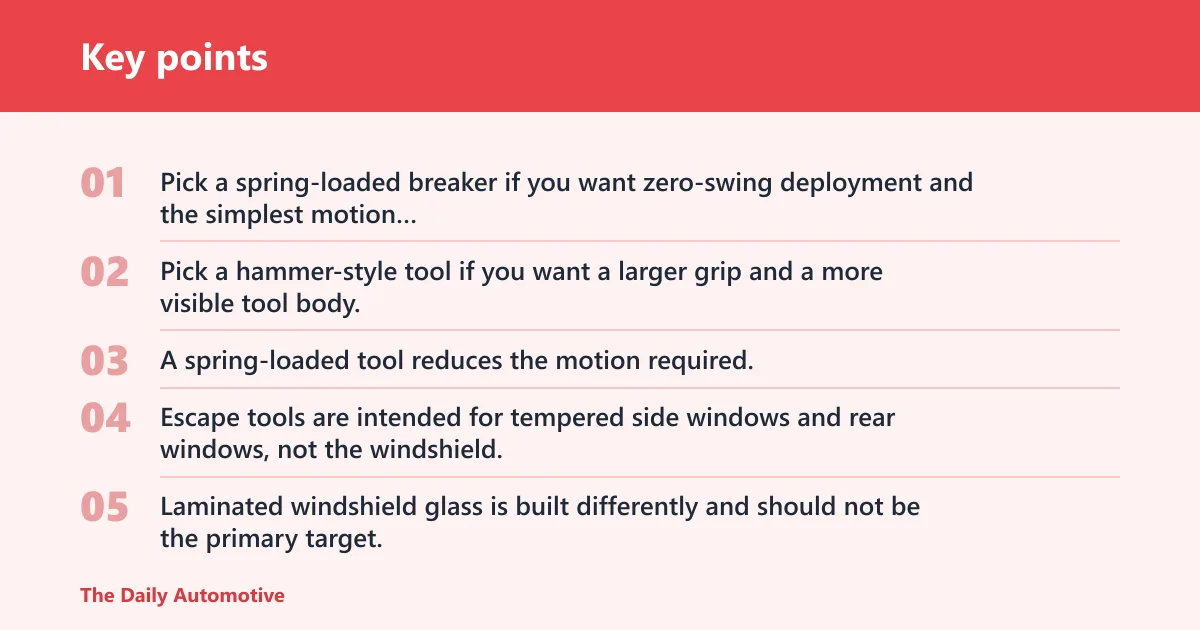
Pick a spring-loaded breaker if you want zero-swing deployment and the simplest motion under stress. Pick a hammer-style tool if you want a larger grip and a more visible tool body, and you have a secure mounting spot close to the driver.
The difference is not about style. It is about force and access. A spring-loaded tool reduces the motion required, while a hammer-style tool asks for more room and a steadier arm.
Glass type and reachability
Escape tools are intended for tempered side windows and rear windows, not the windshield. Laminated windshield glass is built differently and should not be the primary target. Some newer vehicles also use laminated side glass, so the old “break any side window” advice is too simple.
If your vehicle has laminated side glass, the tool choice matters more. A basic breaker may still be useful for other windows, but it may not solve the exact window you want to open.
Mounting locations that stay accessible
Keep the tool close. Sun visor mounting is a strong option if the clip fits your vehicle securely. Door pockets, seatbelt anchor clips, and center consoles can also work if the tool stays fixed and can be found by touch.
Avoid the glove box. Avoid the trunk even more. In a real emergency, either one is too far away.
Picture a winter crash on a rural road, with gloves on and the cabin tilted. A visor-mounted tool that stays put can be reached fast. A loose tool in the glove box forces you to search, then reach, then fumble, which is exactly the kind of delay this gear is meant to avoid.
Frequently asked questions
What is the best car emergency escape tool in 2026?
The best overall pick for most drivers is the resqme Original Car Escape Tool because it is compact, easy to keep close, and combines a spring-loaded window breaker with a seatbelt cutter. If you need a spare for multiple drivers, the Amazon Basics SW-835 is the stronger family-vehicle choice.
Should I choose a spring-loaded window breaker or a hammer-style escape tool?
Choose spring-loaded if you want zero-swing use and easier one-hand deployment. Choose hammer-style if you want a larger grip and a more substantial tool that is easier to see and hold. The right answer depends on whether your priority is compact carry or easier handling.
Where should I mount a car escape tool so I can reach it in a crash?
Mount it close, with the sun visor as a strong option if the clip fits securely. Door pockets, seatbelt anchor clips, and center consoles can also work. Do not put it in the glove box, and never rely on the trunk.
Will a car escape tool break laminated glass or just side windows?
Most escape tools are meant for tempered side windows and rear windows. Laminated windshield glass does not break the same way, and some newer vehicles now use laminated side glass too. That means the tool may work on one window and not another in the same vehicle.
What features should a good car emergency escape tool have besides a seatbelt cutter?
Look for a guarded blade, a reliable window breaker, and a shape you can grip when your hands are wet or shaking. A secure mount matters too. If the tool cannot stay close or slips during use, the extra features do not help much.
Do emergency escape tools work if the car is upside down or submerged?
They can, but only if you can reach them and use them quickly. Upside-down crashes make loose storage worse, which is why visor, console, or other fixed mounting matters. Submerged situations add time pressure, so the tool must be immediately reachable, not stored away from the driver.
Products related to this article
Sponsored / affiliate links. As an Amazon Associate I earn from qualifying purchases. I may earn additional commission from eligible campaigns.