Air Force Decals for Cars: Emblem vs Sticker
Choose chrome emblems if you want a raised, longer-wearing exterior badge; choose vinyl stickers if you want a lower-cost, lighter graphic for smooth surfaces. Pick the wrong material and you can get peeling, faded graphics, or paint damage from poor removal. This guide compares durability, placement, install, removal, and price so you can choose the right Air Force decal for your car.
Air Force decals for cars: the core trade-off


The real decision is not style alone. It is how the piece has to live on the vehicle. Chrome emblems add height, weight, and a more finished badge look. Vinyl stickers sit flatter, cost less, and fit places where a rigid badge would feel bulky or awkward.
That difference changes the rest. Adhesion, wash tolerance, removal risk, and where the piece belongs on the car all follow from the material.
Air Force decals comparison table
| Criterion | Chrome emblem | Vinyl sticker | Best call |
|---|---|---|---|
| Cost | Higher; metal badge with a finished look | Lower; printed or transfer vinyl | Vinyl sticker for budget-first buying |
| Thickness | Raised; the crest insert is listed at 1/8-inch thick PVC, and the wings emblem measures 3.4 x 3.0 x 0.2 inches | Thin, flat graphic on a backing film | Chrome emblem for a dimensional badge |
| Install difficulty | Simple peel-and-stick, but panel alignment matters | Simple application on smooth surfaces | Vinyl sticker for the easiest placement |
| Removal risk | Higher if adhesive is old or surface prep was poor | Usually lower, though residue can still happen | Vinyl sticker for lower removal risk |
| Weather exposure | Built for outdoor conditions | Weatherproof and waterproof vinyl | Either works outdoors if installed correctly |
| Car-wash tolerance | Better on exterior panels when firmly mounted | Depends on edge seal and placement | Chrome emblem for exposed body panels |
| Best placement | Bumper, grille, fender, tailgate | Rear window, side glass, laptop, toolbox | Match the surface to the material |
| Best user type | Buyer who wants a giftable, licensed, long-life badge | Buyer who wants lighter, cheaper graphics and easy placement | Depends on use case |
Cost, thickness, and install difficulty
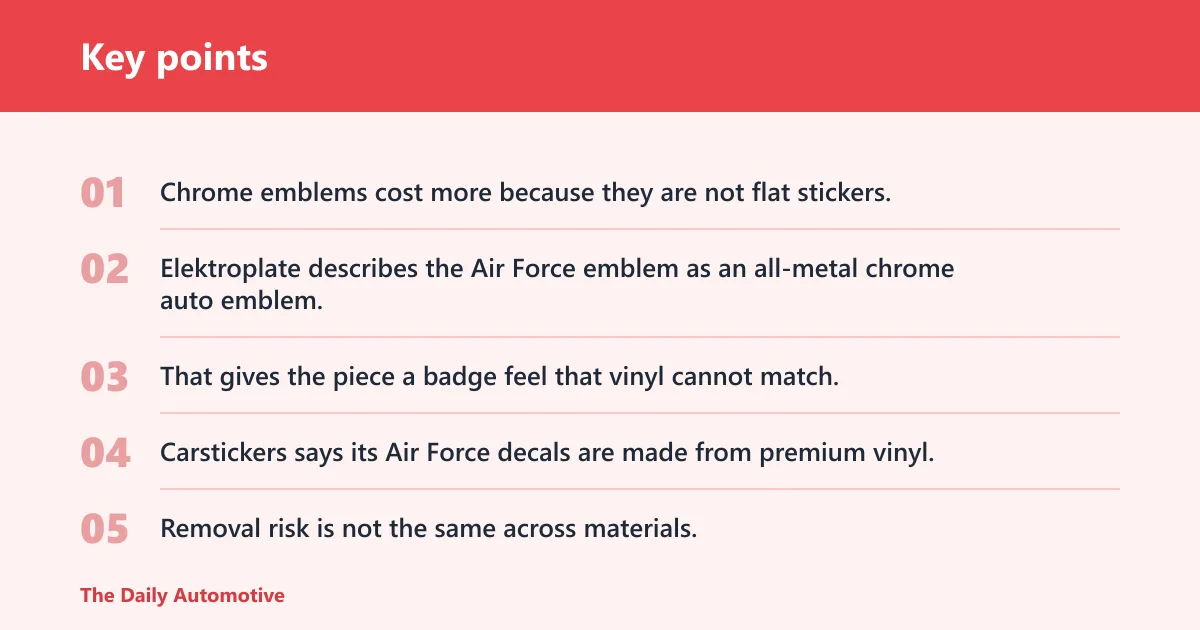
Chrome emblems cost more because they are not flat stickers. Elektroplate describes the Air Force emblem as an all-metal chrome auto emblem, and the crest version uses a full-color domed decal insert with laminated 1/8-inch thick PVC. That gives the piece a badge feel that vinyl cannot match.
Vinyl stickers are the lower-cost route. Carstickers says its Air Force decals are made from premium vinyl, which fits buyers who want a clean graphic without the extra depth or weight of a metal badge.
Removal risk, weather exposure, and wash tolerance
Removal risk is not the same across materials. A chrome emblem uses paint-safe adhesive foam tape, so it is made to mount cleanly, but any adhesive badge can leave residue if it is removed after years of heat, rain, or wash cycles. Vinyl may come off more easily, yet old adhesive can still cling to paint or glass.
For weather exposure, the chrome emblem is designed to withstand harsh outdoor conditions. The same source says its vinyl decals are weatherproof, waterproof, and resistant to fading. That said, exposure still depends on location. A rear window usually treats vinyl better than a front bumper corner that gets blasted by road spray and brushless wash water.
Best placement and best user type
Use a chrome emblem when you want a raised badge on an exterior panel. It suits truck tailgates, SUV liftgates, grille surrounds, and fenders where a flat decal can look undersized. It also makes more sense when the emblem is part of a gift package or a licensed accessory purchase.
Use vinyl when the surface is smooth and the goal is a lighter graphic. Rear windows, side glass, laptops, and toolboxes are common fits. The surface shape matters more than the product name.
When does a chrome emblem make more sense?
Choose a chrome emblem when you want a raised exterior badge that can stay on the vehicle through regular weather exposure. It fits better on larger panels, gives the Air Force mark a more finished look, and usually feels more deliberate on trucks and SUVs than a flat sticker does.
It is also the better pick when the buyer wants a giftable item with licensed branding. Officially licensed U.S. Air Force products often arrive in presentation-friendly packaging, and the metal badge format reads more like an accessory than a simple graphic.
Long-life exterior badge use
The emblem is the stronger choice for long-term use on exterior paint. The same source lists paint-safe adhesive foam tape and outdoor durability, so the part is built for mounting on vehicle bodywork rather than only on glass or plastic accessories.
That does not mean it is permanent. It does mean the mounting method is meant for real car use, not temporary decoration.
Giftable, licensed look for trucks and SUVs
A roughly 3.5-inch crest emblem is sized with larger vehicles in mind. On a truck or SUV, that diameter reads clearly without swallowing the panel. The wings emblem, at 3.4 x 3.0 x 0.2 inches, also fits the scale of a tailgate, door, or fender better than a tiny sticker that gets visually lost.
Say your SUV has a broad liftgate and you want the Air Force mark beside the badge area. A 3.5-inch crest emblem usually looks intentional there, while a small vinyl piece can seem too light for the space.
When does a vinyl sticker make more sense?
Choose a vinyl sticker when you want lower cost, lighter weight, and easier placement on a smooth surface. It is the better call for glass, flat toolbox lids, laptop shells, and other spots where a thick badge would feel awkward or create edge gaps.
Vinyl also wins when you want a quicker layout decision. A flat decal is easier to center on a rear window than a rigid emblem, especially when the vehicle surface curves or narrows.
Lower-cost graphics on smooth surfaces
The same source lists premium vinyl, weatherproof and waterproof construction, and fade resistance. That combination fits a graphic that may live on a rear window, side glass, or a clean toolbox panel rather than on textured trim.
Carstickers also notes no minimum order requirements, so single-item orders are allowed. That matters if the goal is one decal for one vehicle, not a bulk buy.
Print decals versus transfer decals
Printed stickers and transfer decals are not the same. The same source explains transfer decals as background-free vinyl designs with transfer tape. That format is useful when the shape is clean and you want only the graphic to remain after application.
Printed decals work better when color detail matters and the design needs a backing. Transfer decals usually suit simple marks, while printed stickers are easier when the layout is more detailed.
Where should each one go on a vehicle?
Placement should follow the surface, not the logo. Chrome emblems belong where a badge can sit flat and survive weather, while vinyl belongs where the panel is smooth and the graphic does not need depth. That split keeps the installation cleaner and lowers removal headaches later.
Bumper and grille areas
Front bumpers and grille surrounds usually favor the chrome emblem. These spots expose the badge to water, heat, and road grime, so the all-metal construction and paint-safe foam tape matter more than a thin vinyl layer. A rigid badge also looks more balanced in these high-visibility places.
Rear window and side glass
Vinyl is the better fit for rear windows and side glass. A weatherproof, waterproof decal can sit flat, and the lighter material avoids the edge lift that a thick badge can create on glass edges or tight curves.
A common first-timer mistake is putting a metal emblem on glass because the size looks right in the package. The surface may be wrong even if the emblem itself is a good product.
Fender, tailgate, laptop, and toolbox use
Fenders and tailgates can work with either option, but the choice should follow the finish. A painted, flat tailgate area can carry a chrome emblem well. A toolbox lid or laptop shell usually works better with vinyl because it is lighter and easier to position on a smaller field.
Suppose a truck owner wants the Air Force mark on a toolbox lid that gets handled often. Vinyl is usually the safer and simpler route there. The same owner might choose the 3.5-inch crest emblem for the tailgate instead.
How do you install a chrome emblem on a car?
Chrome emblems install with peel-and-stick mounting, but the prep matters. The same source says the emblem uses paint-safe adhesive foam tape, so the surface should be clean, dry, and cool enough for bonding before the badge goes on. Alignment should be set before the tape touches paint.
The goal is a clean bond, not a rushed press. Once the tape grabs, repositioning gets harder.
- Wash the target area and remove road film.
- Dry the panel completely.
- Test-fit the emblem without removing the backing.
- Mark the center line if needed.
- Peel the adhesive foam tape backing.
- Press the emblem firmly in place.
- Leave the badge undisturbed so the adhesive can bond.
Why paint-safe adhesion matters
Paint-safe does not mean damage-proof forever. It means the mounting tape is intended for vehicle paint and is less aggressive than hardware that can scratch or gouge a finish. That matters on leased cars, newer paint, and any panel where clean removal later is part of the plan.
Will a vinyl Air Force decal damage car paint?
A vinyl decal should not damage paint when it is applied to a clean, cured surface and removed properly, but bad prep and poor removal can still cause trouble. The decal itself is not the only variable. Heat, age, and adhesive condition affect how cleanly it comes off.
Paint risk is usually lower with vinyl than with a metal badge that has been on the car for a long time, but not zero. Surface condition matters more than the label on the backing sheet.
Removal risk and residue
Vinyl usually carries less removal risk than a heavier emblem because there is no rigid badge body to pry off. Even so, residue can remain after long exposure, especially on hot panels or where the adhesive was pressed onto wax, dust, or textured trim.
If the goal is the least risky path, choose the flattest option that suits the surface and remove it sooner rather than later.
Which lasts longer, a metal emblem or a vinyl sticker?
Chrome emblems usually last longer on exposed vehicle panels because they are built as all-metal badges and designed to withstand harsh outdoor conditions. Vinyl can also last well, especially when it is weatherproof, waterproof, and fade resistant, but it is still a thinner graphic and more dependent on edge condition.
If the question is years of exterior use on a bumper or tailgate, the emblem usually has the advantage. If the question is a window decal with moderate sun and careful washing, vinyl can still be a solid choice.
Edge lift, UV fade, and wash exposure
Edge lift is a bigger risk for vinyl because the material is thin and exposed edges can catch water or brush contact. UV fade is another concern on printed graphics that spend all day in the sun. Chrome emblems handle those stresses differently because the badge body is physical, not a full-surface print.
That is why the same design can behave differently on two vehicles. A decal on a shaded rear window may look fresh far longer than the same decal on a sun-baked bumper corner.
Are Air Force decals officially licensed?
Many Air Force car accessories are sold as officially licensed U.S. Air Force products, which matters when the buyer wants licensed branding and military insignia use rather than a generic lookalike. Licensing also often shows up in the packaging and presentation of the product.
Licensing does not change installation, but it does affect the product identity. If the goal is a giftable item with approved branding, that detail belongs in the buying decision.
Can I put Air Force decals on windows, laptops, or toolboxes?
Yes, but the material should match the surface. Vinyl stickers are the better fit for windows, laptops, and toolboxes because they are light, flat, and made for smooth surfaces. Chrome emblems are better on exterior body panels where a raised badge can sit securely.
Windows and toolboxes usually accept vinyl well if the surface is clean and flat. Laptops need the same careful prep, plus a dry, oil-free shell so the adhesive bonds properly.
Choose Air Force chrome emblem or Air Force vinyl sticker
Choose the chrome emblem if you want a raised exterior badge, a more giftable licensed look, and a product built for outdoor body-panel use. Choose the vinyl sticker if you want a lighter, cheaper graphic for smooth surfaces such as glass, a laptop, or a toolbox. The right pick depends on placement first.
Choose chrome emblem if…
Choose chrome when the vehicle has a broad exterior panel, you want a dimensional badge, or you expect the piece to stay outdoors through rain and wash cycles. The 3.4 x 3.0 x 0.2-inch wings emblem and the 3.5-inch crest emblem both suit larger bodywork better than a flat decal does.
Choose vinyl sticker if…
Choose vinyl when the surface is smooth, the budget is tighter, or you want easier placement on glass or accessory panels. Carstickers’ premium vinyl, weatherproof, waterproof, fade-resistant decals fit that use case well, especially when a single-item order is all you need.
Frequently asked questions
What is the difference between Air Force chrome emblems and vinyl stickers?
Chrome emblems are raised metal badges with a painted or plated finish and adhesive foam tape mounting. Vinyl stickers are flat graphics made for smooth surfaces. The emblem suits exterior body panels better, while the sticker suits windows, laptops, and toolboxes where low thickness matters more.
Are Air Force car decals weatherproof and car-wash safe?
Some are, but the product type matters. The same source says the emblem is designed for harsh outdoor conditions, while Carstickers says its vinyl decals are weatherproof, waterproof, and fade resistant. Car-wash tolerance still depends on placement, adhesive quality, and whether the edges are fully seated.
What size Air Force emblem fits an SUV or truck?
The listed sizes around 3.4 to 3.5 inches work well for SUVs and trucks because they read clearly on larger panels. The wings emblem measures 3.4 x 3.0 x 0.2 inches, and the crest emblem is 3.5 inches in diameter. Smaller cars may need a more restrained placement.
Products related to this article
Sponsored / affiliate links. As an Amazon Associate I earn from qualifying purchases. I may earn additional commission from eligible campaigns.