Engine Displacement Calculator
Engine displacement is the swept volume of every cylinder, measured from bottom dead center to top dead center. Use π/4 × bore² × stroke × cylinder count with bore and stroke in the same unit, then convert the result to cc or cubic inches. Get the inputs wrong and you can misread stock specs, misorder parts, or set compression and fuel targets around the wrong number. This guide shows you how to enter measurements, convert units, spot bad data, and verify stock or modified displacement.
How is this calculated?
Press Calculate to see the math with your numbers.
What engine displacement means
Engine displacement is the total swept volume of all cylinders from bottom dead center to top dead center. It is the air-fuel volume the pistons move through one full stroke, added across every cylinder, and it is commonly reported as cc, cubic inches, or liters.
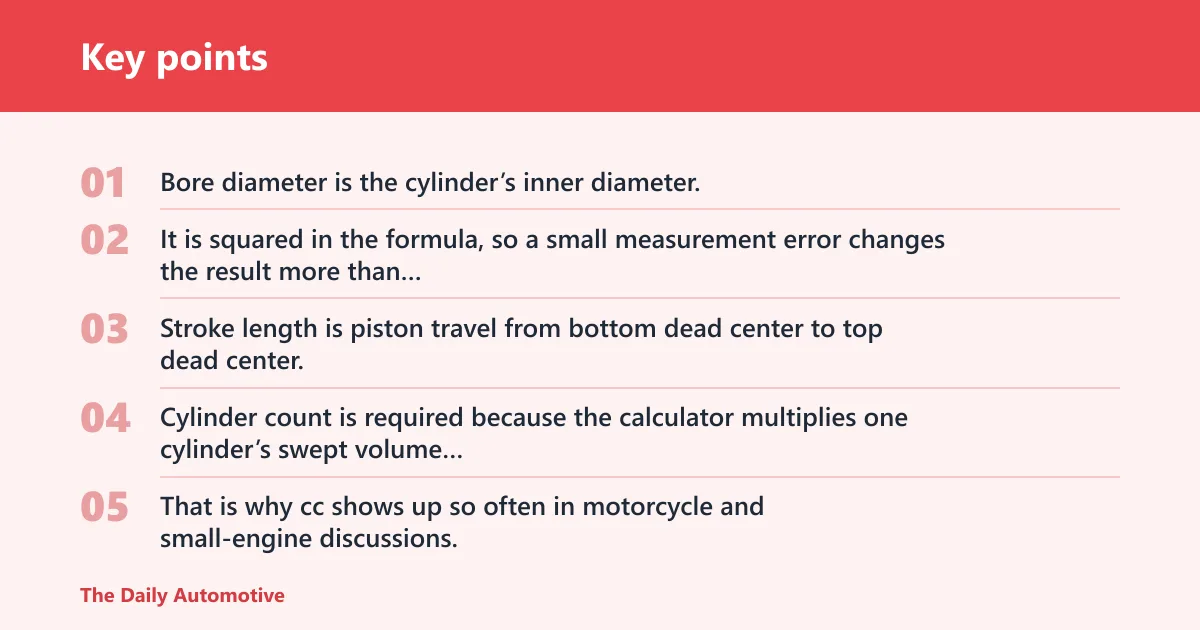
Bore diameter is the cylinder’s inner diameter. It is squared in the formula, so a small measurement error changes the result more than a similar error in stroke. Stroke length is piston travel from bottom dead center to top dead center. Cylinder count is required because the calculator multiplies one cylinder’s swept volume by the number of cylinders.
That is why cc shows up so often in motorcycle and small-engine discussions, while cubic inches and liters are common in passenger-car specs. A typical Formula One race car engine is described as 1600 cc or 1.6 L, which is the same displacement written two ways.
If your build sheet lists an 86.5 mm bore and 86.4 mm stroke for a four-cylinder engine, use those figures in the displacement formula. A calculator should land near the published displacement if the specs are right. If the result is far off, the problem is usually the input, not the formula.
What measurements do you need?
You need bore diameter, stroke length, and cylinder count. Those are the only required inputs in a standard engine displacement calculator. If the tool asks for anything else, it is probably handling a related calculation, such as compression ratio or clearance volume.
Bore diameter
Bore is the cylinder’s inner diameter. Enter it in mm, cm, or inches, but do not mix units with stroke. Because the bore term is squared, a 1 percent error in bore creates a larger error than a 1 percent error in stroke.
Stroke length
Stroke is the piston’s travel from BDC to TDC. Some calculator pages call this cylinder depth, but the useful meaning is the same: the distance the piston moves through one full cycle. Use the same unit as bore, or convert both before you calculate.
Cylinder count
Cylinder count is the number of cylinders in the engine. One-cylinder displacement is not enough for the full engine result. A single-cylinder 500 cc motorcycle engine and a four-cylinder 2.0-liter car both depend on the same multiplier.
Use published specs when the engine is worn
For a fresh build, measured bore and stroke can be useful. For a worn engine, a tape measure is a poor substitute for actual machining data or factory specs. Cylinder wear changes bore, but it does not change the original design displacement. That matters if you are checking parts fitment or verifying a block that has been overbored.
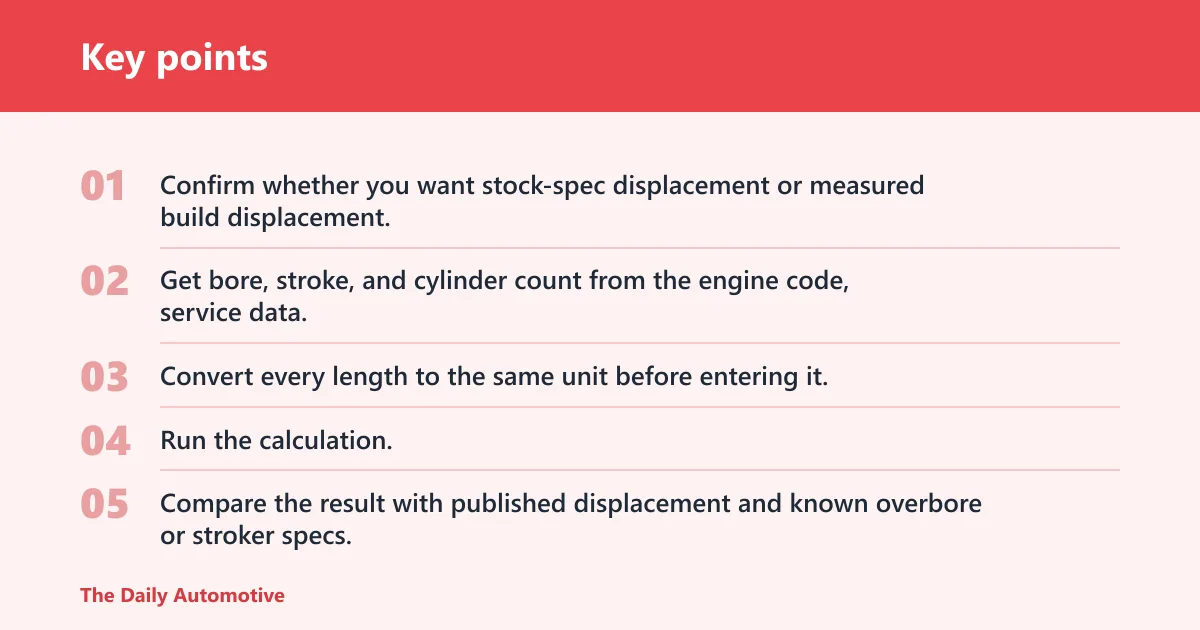
- Confirm whether you want stock-spec displacement or measured build displacement.
- Get bore, stroke, and cylinder count from the engine code, service data, or machine work sheet.
- Convert every length to the same unit before entering it.
- Run the calculation.
- Compare the result with published displacement and known overbore or stroker specs.
How the displacement formula works
The standard formula is V = N × L × π × D² / 4, where N is cylinder count, L is stroke length, and D is bore diameter. This is the same as multiplying the area of one cylinder by its stroke, then multiplying by the number of cylinders. Unit consistency matters the whole way through.
Single-cylinder volume
Think of one cylinder first. The bore gives the circular area, and the stroke gives the height of the swept shape. Because the formula uses bore squared, an input error in diameter can swing the result enough to make a stock engine look like a stroker.
Full-engine volume
Once one cylinder’s swept volume is known, multiply by cylinder count. That is why a four-cylinder engine with identical bore and stroke values will have four times the single-cylinder volume. This is also why an inline-four, V6, and flat-four can all be compared in the same units.
Common input mistakes are easy to spot. Mixed units are the biggest one. If bore is in millimeters and stroke is in inches, the answer will be wrong by a wide margin. Another common issue is using outside piston diameter instead of cylinder bore, which inflates the number.
Suppose a two-stroke small engine lists a 40 mm bore, 39 mm stroke, and one cylinder. The formula still works. The cylinder count is one, so the total displacement is the same as the single-cylinder swept volume. The engine cycle changes; the geometry does not.
How do you calculate engine displacement in cc?
To calculate displacement in cc, use bore and stroke in centimeters so the volume comes out in cubic centimeters. The formula is the same: π/4 × bore² × stroke × cylinder count. Since 1 cc equals 1 cubic centimeter, the result is already in the output unit many motorcycle and small-engine tools use.
Worked cc example
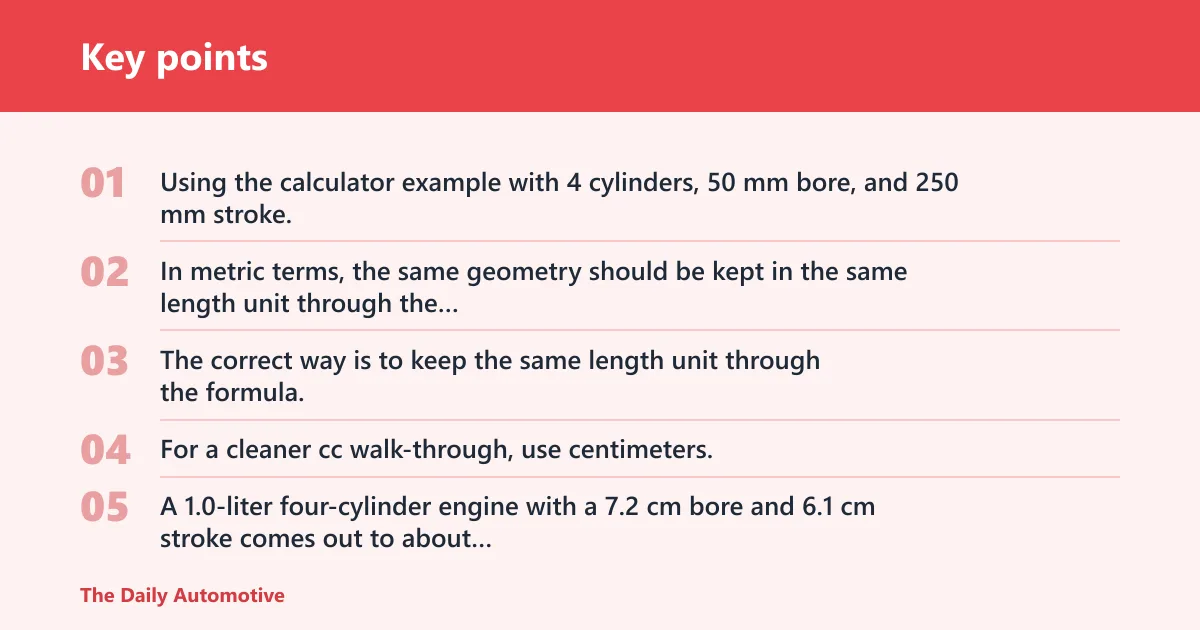
Using the calculator example with 4 cylinders, 50 mm bore, and 250 mm stroke, the result is 119.82 cubic inches. In metric terms, the same geometry should be kept in the same length unit through the formula, then converted to cc if needed. The correct way is to keep the same length unit through the formula, then convert the finished volume to cc if needed.
For a cleaner cc walk-through, use centimeters. A 1.0-liter four-cylinder engine with a 7.2 cm bore and 6.1 cm stroke comes out to about 995 cc when you run the formula, which is one reason displacement badges are often rounded rather than exact.
Common mm and inch input paths
Many calculators accept mm first because motorcycle and small-engine specs are often published that way. U.S. car and truck specs often appear in inches, especially in older service literature. The safe rule is simple: keep bore and stroke in the same unit, then read the output in the unit you need.
| Engine example | Bore | Stroke | Cylinders | Calculated cc | Calculated cu in | Calculated L | Flag |
|---|---|---|---|---|---|---|---|
| Honda GX200-style small engine | 68.0 mm | 54.0 mm | 1 | 196.0 | 11.96 | 0.196 | Stock-spec |
| Yamaha-style 125 cc single | 52.4 mm | 57.9 mm | 1 | 124.8 | 7.61 | 0.125 | Stock-spec |
| Typical 250 cc single | 76.0 mm | 54.5 mm | 1 | 247.1 | 15.08 | 0.247 | Stock-spec |
| Subaru EJ25 | 99.5 mm | 79.0 mm | 4 | 2457.0 | 149.92 | 2.457 | Stock-spec |
| Honda K20 | 86.0 mm | 86.0 mm | 4 | 1998.0 | 121.95 | 1.998 | Stock-spec |
| Ford 5.0 Coyote | 92.2 mm | 92.7 mm | 8 | 4951.0 | 302.00 | 4.951 | Stock-spec |
| GM LS1 | 3.898 in | 3.622 in | 8 | 5667.0 | 345.85 | 5.667 | Stock-spec |
| Small-block Chevy 383 stroker | 4.030 in | 3.750 in | 8 | 6264.0 | 382.00 | 6.264 | Stroked |
| Overbored 2.0 L four | 83.5 mm | 92.8 mm | 4 | 2038.0 | 124.34 | 2.038 | Overbore |
| Reverse-check example | 23.15 mm | 150.0 mm | 2 | 200.0 | 12.20 | 0.200 | Stock-spec |
How do you convert cubic inches to liters?
To convert cubic inches to liters, multiply cubic inches by 0.0163871. That lets you compare U.S. displacement figures with metric engine labels. Liters are often the cleaner output for passenger cars because many global nameplates round to one decimal place, such as 2.0 L or 3.5 L.
Inch-to-liter conversion factor
One cubic inch equals 16.3871 cc, and 1,000 cc equals 1 liter. So the practical conversion is cu in × 0.0163871 = liters. For example, the 119.82 cubic inches from the calculator example works out to about 1.96 liters.
When liters are the cleaner output
Liters are easier to compare when you are reading modern car badges or spec sheets from multiple markets. Cubic inches are still common in classic American V8 discussions. If the calculator can output both, use liters for broad comparison and cubic inches for U.S. parts catalogs.
Engine displacement sanity-check
This table is a quick check, not a parts catalog. It helps catch mixed units, overbores, and strokers before you trust the result. If a calculated value misses the expected class by a wide margin, the input data deserves another look.
How to read the flags
Stock-spec means the dimensions match the commonly published factory geometry. Overbore means the bore is larger than stock. Stroked means the stroke is longer than stock. A mixed build can show both, but the table keeps one main flag so the pattern is easy to scan.
Can you calculate displacement backward?
Yes, but only with caution. If you know displacement, stroke, and cylinder count, you can solve for bore. That is useful when verifying a build sheet, checking whether a short block matches its claimed spec, or spotting a typo in online parts data. It is risky when stroke or cylinder count is uncertain.
The reverse example in the source material uses 2 cylinders, 200 cc displacement, and 150 mm stroke, and it yields a bore diameter of 23.15 mm. That kind of calculation helps when the basic architecture is known but the bore is missing from a listing.
A common first-timer mistake is to reverse-calculate bore from a worn engine without knowing whether the cylinders were honed or overbored. That can make the result look exact when it is only a rough estimate. If the engine has been rebuilt, verified machine-shop dimensions matter more than the original brochure spec.
Reverse math is also useful for mixed-language data sheets. A listing may show displacement in cc and stroke in millimeters, while bore is omitted. Solving backward gives a check number, but it should be compared against service data before parts are ordered.
Frequently asked questions
How is engine displacement calculated?
Engine displacement is calculated by multiplying the area of one cylinder by the stroke and then multiplying by cylinder count. The standard form is π/4 × bore² × stroke × cylinder count. Use the same unit for bore and stroke first, then convert the final volume to cc, cubic inches, or liters.
What is the formula for engine displacement?
The formula shown in many calculators is V = N × L × π × D² / 4. In practical terms, that means cylinder count times stroke times the circular bore area. The same formula appears in inch-based calculators as displacement = π / 4 × b² × s × c.
How do you calculate engine displacement in cc: to calculate displacement?
To calculate displacement in cc, enter bore and stroke in centimeters or convert the final cubic result to cubic centimeters. Since 1 cc equals 1 cm³, the output is direct if the input units are metric. This is the most common output format for motorcycles, scooters, and small engines.
How do you convert engine displacement from cubic inches to liters?
Multiply cubic inches by 0.0163871 to get liters. For example, 261.48 cubic inches converts to about 4.29 liters. This is useful when comparing older U.S. engine specs with modern metric labels, especially when a badge says 2.0 L and a parts catalog lists cubic inches.
What measurements do I need for an engine displacement calculator?
You need bore diameter, stroke length, and cylinder count. Bore and stroke must use the same unit, whether that is mm, cm, or inches. If the engine is worn or modified, published specs or machine-shop measurements are safer than guessing from the outside of the block.
What does cc mean on an engine?
cc means cubic centimeters, which is the volume unit commonly used for engine displacement. It is the swept volume of all cylinders combined. On motorcycles and small engines, cc is often the most familiar way to state displacement, while cars are more often labeled in liters.
Products related to this article
Sponsored / affiliate links. As an Amazon Associate I earn from qualifying purchases. I may earn additional commission from eligible campaigns.