Car Engine Cost: What Replacement Really Costs
A replacement engine typically costs about $4,000 to $12,000 installed, while high-volume economy cars can land closer to about $3,000 and some late-model or V-6/V-8 jobs can exceed about $15,000. A bad quote can leave you paying twice for diagnostics, fluids, gaskets, and labor you never planned for. This guide breaks down what drives car engine cost, what a real installed quote includes, and how to compare repair with replacement.
Car engine cost basics
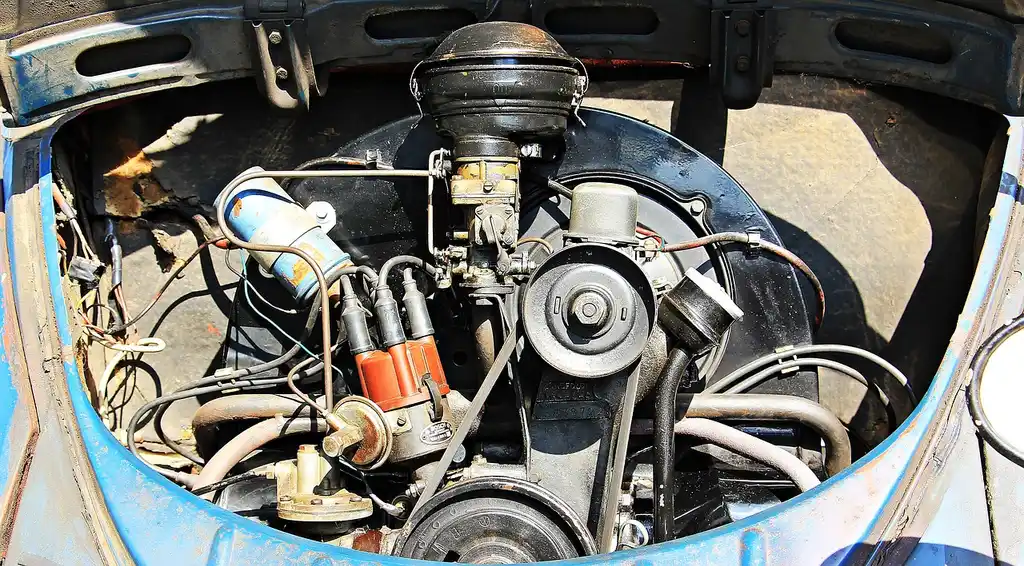
Car engine cost has two different numbers: the engine unit price and the installed replacement price. The first is what the engine itself costs; the second includes labor, removal, refit, diagnostics, fluids, and small parts. The engine price is only part of the total cost, and additional costs may include labor and installation, replacement of related components, and fluids and minor adjustments.
Engine-only price vs installed price
Engine-only pricing can look manageable until the shop quote arrives. Standard engines typically cost $800–$2,500, mid-range engines typically cost $1,500–$4,000, and high-performance engines can cost $3,000–$10,000+. Premium vehicle engines usually cost more, especially when the car needs a specific code, emissions setup, or hybrid hardware match.
Installed pricing is the number that matters for your budget. It captures the swap itself, not just the metal in the crate. That means a bargain engine can still become an expensive repair if the quote leaves out teardown, testing, or the parts that should be replaced while access is open.
Why quotes vary so much
Engine price depends on mileage and testing. A low-mileage, tested unit usually costs more than a higher-mileage unit with no proof of compression, leak-down, or running condition. Condition matters because a used engine can be cheap up front and costly later if it arrives with hidden wear in the cylinder head, crankshaft, pistons, valves, or piston rings.
Vehicle design also changes the bill. A transverse V6 with tight access takes longer than a simple four-cylinder layout. Diesel and hybrid jobs can require extra compatibility checks, different ancillaries, and more labor for removal and refit. Electric vehicles use different major assemblies, so a “motor” quote often covers a very different system than a petrol or diesel engine quote.
What counts as the landed cost
The landed cost is the real out-the-door number. It should include the engine purchase price, diagnostic fee, labor, fluids, mounts, gaskets, ancillaries, tax, and a warranty reserve. If a quote omits one of those buckets, you do not yet have the full cost.
Engine cost worksheet
This worksheet shows how the bill grows after the engine price is added to shop charges. Use it to compare quotes on the same basis. The totals below are example budgets, not fixed market prices, because labor rates, tax, and parts availability change by location and vehicle.
| Line item | Economy car example | Mainstream car example | Premium car example |
|---|---|---|---|
| Engine purchase price | $1,200 used | $2,800 reconditioned | $6,500 new |
| Diagnostic fee | $150 | $175 | $250 |
| Labor | $900 | $1,400 | $2,400 |
| Fluids | $180 | $220 | $320 |
| Mounts | $120 | $220 | $380 |
| Gaskets | $160 | $260 | $450 |
| Ancillaries | $250 | $450 | $900 |
| Tax reserve | $220 | $439 | $938 |
| Warranty reserve | $150 | $250 | $500 |
| Total | $3,230 | $6,214 | $12,638 |
For a quick calculator, add engine price + diagnostic fee + labor + fluids + mounts + gaskets + ancillaries + tax reserve + warranty reserve. If the shop says a worn water pump, thermostat, timing set, or turbo must come off with the engine, move those parts into ancillaries before you compare offers.
- Write down the engine condition: used, reconditioned, low-mileage, tested, or new.
- Confirm the exact engine code, transmission match, and emissions gear.
- Ask for the diagnostic fee before any teardown begins.
- Ask which related parts are included in labor and which are extra.
- Add tax and a warranty reserve so the quote reflects the full landed cost.
What changes the price most?
The biggest price swings come from engine type, condition, vehicle class, and parts availability. Petrol engines are usually simpler to source than diesel or hybrid units, while electric vehicles involve different high-voltage components and compatibility checks. Premium models cost more because the engines are more expensive, the parts take longer to source, and the labor often takes longer.
Petrol, diesel, hybrid, and electric engines
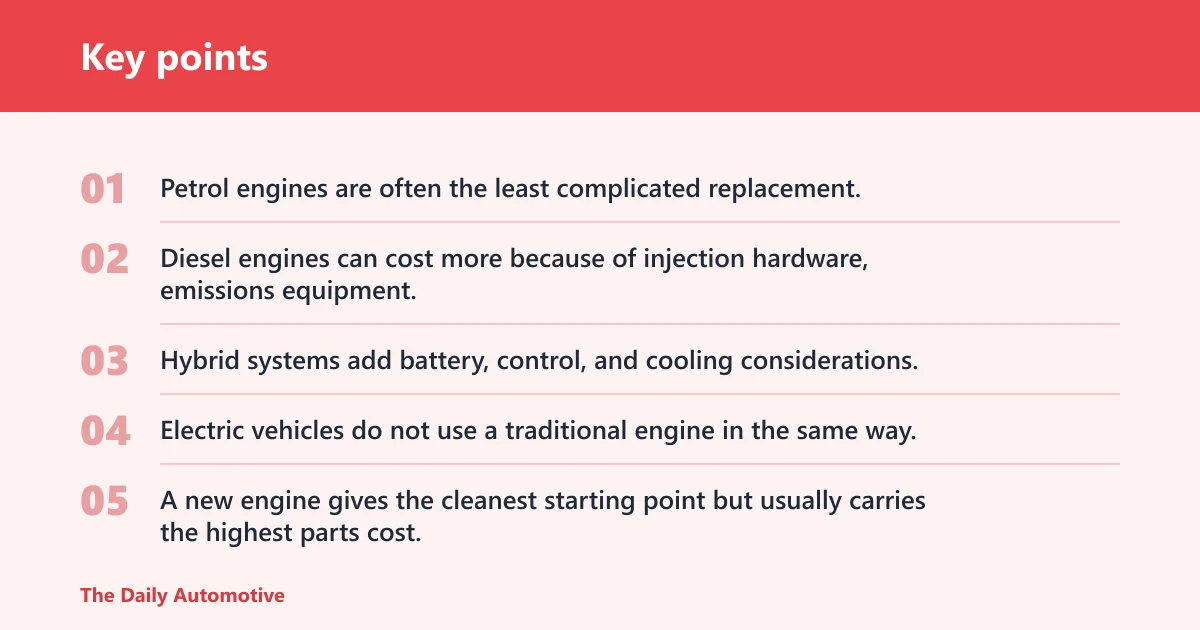
Petrol engines are often the least complicated replacement. Diesel engines can cost more because of injection hardware, emissions equipment, and tighter compatibility rules. Hybrid systems add battery, control, and cooling considerations, and a replacement engine must fit the vehicle’s hybrid architecture. Electric vehicles do not use a traditional engine in the same way, so the major replacement cost often falls on the drive unit or motor system rather than a petrol-style engine.
New, used, reconditioned, low-mileage, and tested units
A new engine gives the cleanest starting point but usually carries the highest parts cost. A used engine can save money, but mileage and test status matter. A reconditioned engine is rebuilt to a defined standard, which often makes the quote easier to judge. Low-mileage and tested units sit between those choices and usually cost more than an untested used engine because seller confidence is backed by inspection or running proof.
Suppose a 10-year-old family saloon needs a replacement after coolant loss ruined the original engine. If the car is otherwise sound, a tested used engine may be the most practical spend. If the car is a late-model premium SUV with strong resale value, a reconditioned or new unit may make more sense because the repair has to protect the car’s value as well as its drivability.
Premium models versus standard cars
Standard cars usually have better parts availability and lower labor risk. Premium vehicles often need model-specific mounts, software matching, and more expensive ancillaries. That is why premium vehicle engines are typically more expensive than standard engines, even when the displacement looks similar on paper.
Model-specific pricing also moves with supply. A common engine code may have many sellers and lower shipping costs. A rare code can force you into a higher unit price, longer wait, or a used engine with less documentation. That is where quotes swing the most.
How much does engine replacement cost?
A full engine replacement usually costs far more than the bare engine price because removal and refit labor can be the largest single line after the unit itself. In the USA, a realistic installed range often starts around $4,000 and can climb past $12,000, with some economy-car jobs lower and some premium or high-output jobs well above that.
Typical quote range for a full swap
FixMyCar reports an average quote of £429.45 for engine replacement booked price, which is a reminder that the installed job is a separate bill from the part itself. A price like that only makes sense when it is treated as the service booking fee or baseline quote, not as the full engine cost. Always ask what the number includes before comparing it to an all-in quote.
Removal and refit labor
Labor changes with access, not just with engine size. A shop may need to disconnect the cooling system, exhaust, intake, wiring, fuel lines, driveline parts, and mounts before the old engine comes out. The refit is just as important, because torque settings, bleeding procedures, and control-module checks can affect whether the car starts and runs correctly.
A common first-timer mistake is comparing two quotes that both say “engine replacement” while one includes removal, refit, fluids, and scan checks and the other does not. That is how a low quote turns into a higher final bill after the car is already apart.
When related parts should be replaced too
Related parts should be replaced when access is already open and the old part’s failure risk is high. Common add-ons include mounts, gaskets, belts, hoses, sensors, alternator brackets, and sometimes the water pump or timing components. If the engine comes out to reach a worn part, the labor savings from replacing nearby wear items at the same time can be substantial.
When can repair cost less?
Repair can cost less when the fault is limited to one component rather than the whole engine. A bad sensor, ignition fault, leaking gasket, clogged injector, or failed accessory may trigger a warning light without meaning the block is finished. A diagnostic test should come first, because replacement is not the right answer for every engine-management light.
Faults that may point to repair rather than replacement
The average engine check cost is £64.57 on FixMyCar, and a car diagnostic test averages £51.66 there. That is a small spend compared with a full engine swap. If the problem is confined to spark plugs, coils, a sensor, or a gasket leak, fixing the fault may be the smarter choice.
The same source reports an average quote of £218.82 for a car engine repair, which shows how far a targeted repair can sit below a replacement bill. Fixes at that level are more plausible when the cylinder head, crankshaft, pistons, valves, and piston rings are still serviceable and compression remains acceptable.
Mileage, compression loss, and internal damage
When compression is low across multiple cylinders, oil consumption is heavy, or the engine knocks and overheats after internal damage, repair can become poor value. A worn cylinder head, cracked block, or damaged crankshaft often pushes the decision toward replacement. High mileage by itself is not the deciding factor; the failure type and the rest of the car’s value matter more.
The same source says an engine carbon clean averages £112.42. That kind of service can help with buildup-related drivability issues, but it will not rescue an engine with deep mechanical wear. Do not let a cleaning service stand in for a proper diagnostic assessment.
How to compare used, reconditioned, and new engines
Warranty length, included components, and testing matter more than seller language. A longer warranty can signal confidence, but only if the coverage matches the engine’s major parts and the installation rules are clear. Always confirm what is covered, what is excluded, and whether ancillaries are included or stripped off.
Warranty length and included components
A good warranty should state the term, the claim process, and the included components. Some warranties cover the long block only. Others extend to ancillaries, sensors, or specific internal parts. Seller confidence is useful, but it does not replace written coverage or proof that the engine was tested.
What to check before buying
Before you pay, ask for the engine code, mileage, test result, compression or leak-down data if available, and photos of the serial stamping. Check for oil sludge, coolant contamination, broken mounts, damaged wiring, and missing ancillaries. If the seller cannot explain the source vehicle or the test method, the cheap price may not be a good price.
- Match the engine code to your vehicle identification and emissions setup.
- Confirm transmission compatibility, especially on hybrid and automatic cars.
- Ask whether the unit is used, tested, reconditioned, or low-mileage.
- Check what comes with the engine: turbo, inlet, sensors, and brackets.
- Read the warranty terms for mileage limits, labor coverage, and exclusions.
Matching the engine to the transmission and vehicle
Compatibility is not optional. Make, model, year, transmission, emissions gear, ECU calibration, and hybrid system details all matter. A good-looking engine that does not match the control unit or transmission can become a paperweight after delivery. That is why the cheapest listing is not always the cheapest usable engine.
Core engine parts and why they matter

The cylinder head seals the top of the engine and houses valves and related passages. The crankshaft converts piston movement into rotation. Spark plugs ignite the air-fuel mixture in petrol engines. Pistons move inside the cylinders, valves control airflow, and piston rings help seal compression and control oil use.
These parts matter because a quote should reflect what failed, not only what the engine looks like from the outside. If the head is warped, the rings are worn, or the crankshaft is damaged, repair costs can rise fast. If those parts are still healthy, a targeted fix may be all you need.
Frequently asked questions
How much does a car engine cost on average?
The average installed bill is higher because labor, fluids, mounts, gaskets, tax, and diagnostics are extra.
How much does a car engine cost to replace?
The spread comes from labor time, engine condition, parts availability, and vehicle-specific compatibility.
How much does a new car engine cost?
A new engine usually sits at the top of the price range because you are paying for the cleanest unit and the least unknown wear. For many cars, the engine price alone can land well above a used or reconditioned unit, and premium vehicle engines are typically more expensive.
How much does a car engine cost to fix?
The same source reports an average quote of £218.82 for a car engine repair, and an engine check averages £64.57. Repair can be much cheaper than replacement when the issue is a gasket, sensor, ignition fault, or accessory rather than deep internal damage.
How much car engine cost in the USA?
In the USA, a realistic installed replacement often falls between $4,000 and $12,000, with high-volume economy cars sometimes lower and late-model premium or performance jobs much higher. Regional labor rates, tax, and engine supply can change the final number a lot.
How much f1 car engine cost
F1 engines are not comparable to road-car engines in price or supply. They are race-specific power units with highly specialized parts, development, and service requirements. There is no sensible consumer-market replacement quote to use as a normal car budget benchmark.
Products related to this article
Sponsored / affiliate links. As an Amazon Associate I earn from qualifying purchases. I may earn additional commission from eligible campaigns.