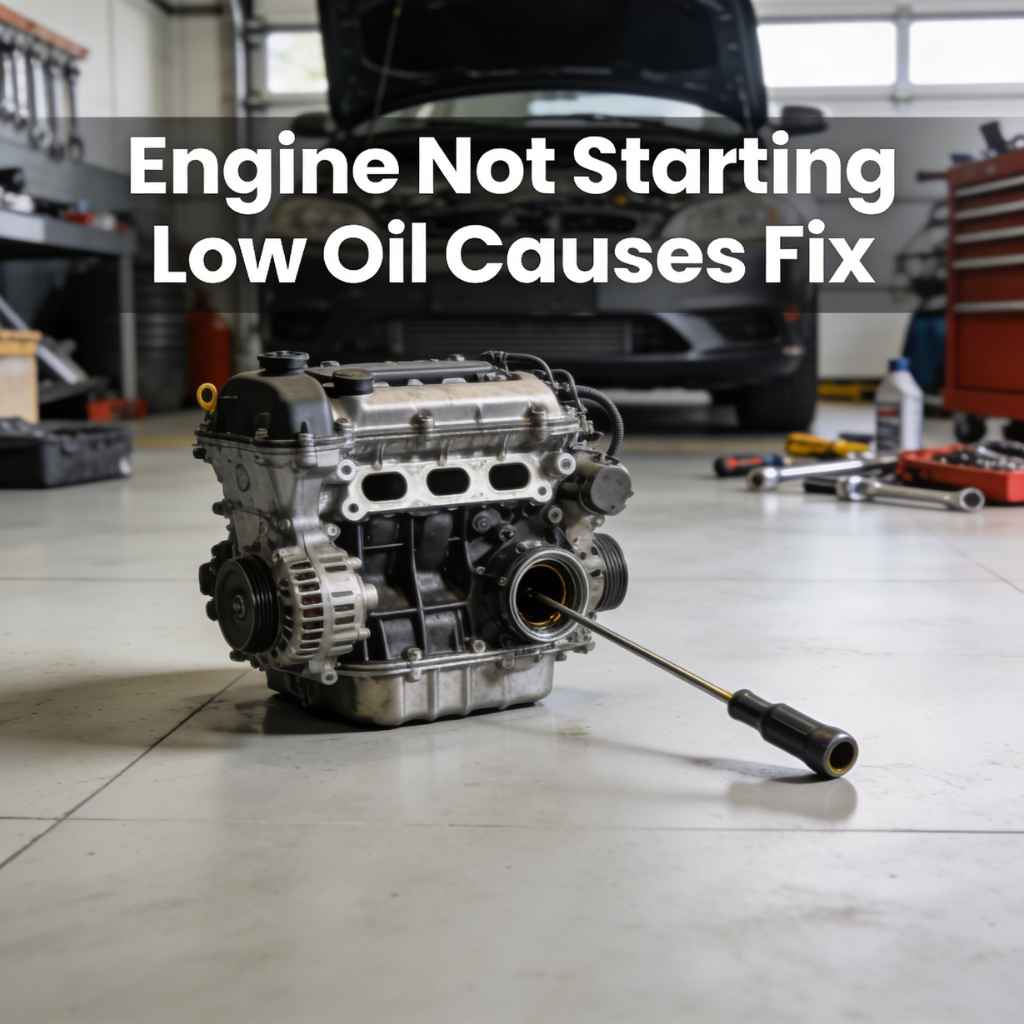
Engine Not Starting Low Oil Causes Fix
It can be super frustrating when your car won’t start. Sometimes, the simplest thing is the problem. If your Engine Not Starting Due to Low Oil Level?
Causes & Fix is what you’re dealing with, don’t worry. It sounds technical, but it’s actually one of the easier fixes. Many people get stuck here because they aren’t sure where to start.
This guide will walk you through it step-by-step. We’ll figure out why your engine is being stubborn and how to get it running again. Let’s see what’s going on and how to fix it.
Why Your Engine Won’t Start Low Oil
When your engine lacks sufficient oil, it can lead to a “no start” situation. Oil is the lifeblood of your engine. It lubricates moving parts, reduces friction, and helps keep things cool.
Without enough oil, key components can seize up or fail to operate correctly, preventing the engine from turning over.
This issue is more common than you might think, especially for newer car owners. Cars can consume oil over time, and sometimes leaks happen without you noticing. If the oil level drops too low, sensors in the engine will detect this critical condition.
Some modern vehicles have sophisticated systems that will prevent the engine from starting to protect it from serious damage. This protective measure is a good thing, even if it’s inconvenient at the moment.
Understanding the role of engine oil is the first step. It’s not just a fluid; it’s essential for the mechanical ballet happening inside your engine. When this ballet is interrupted by a lack of lubrication, the engine can’t perform its core function: starting and running.
This section will explore the primary reasons behind this problem and what you can do about it.
The Critical Role of Engine Oil
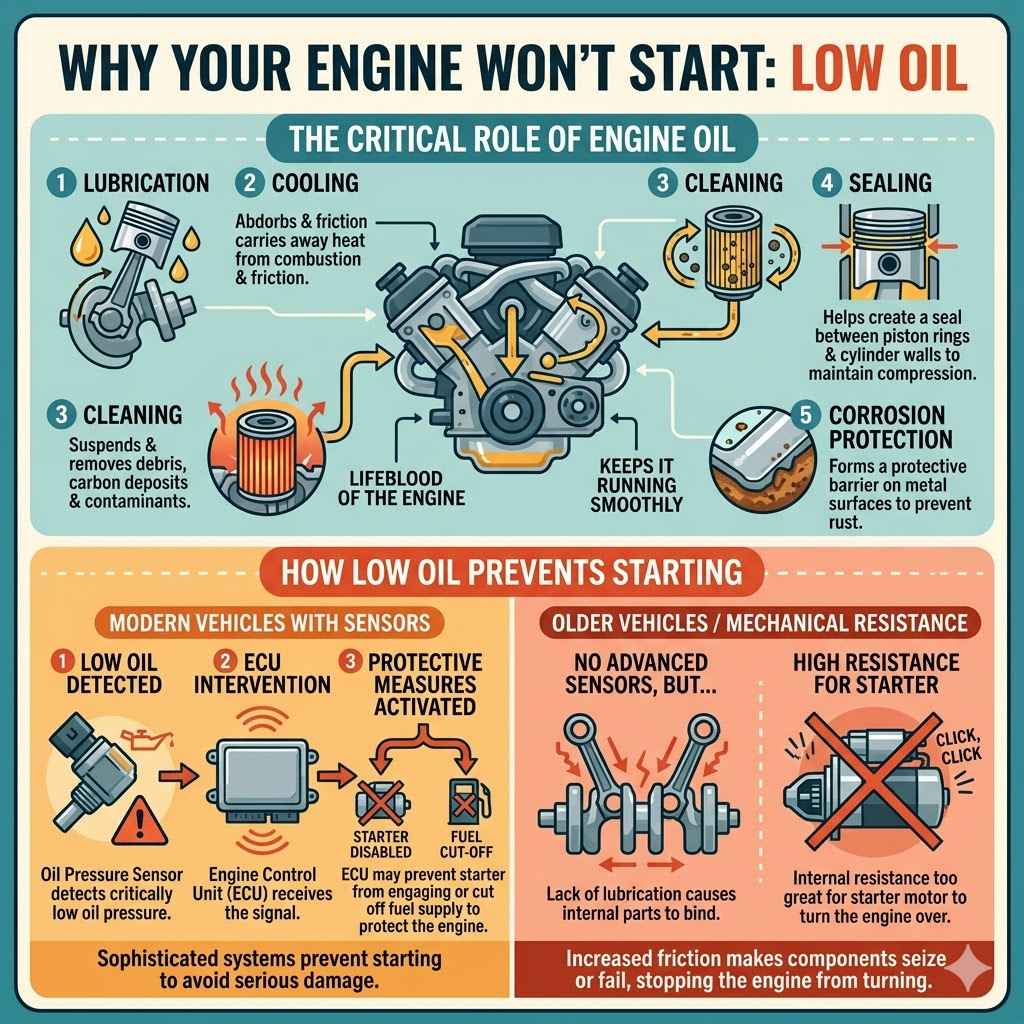
Engine oil plays a multitude of vital roles within an internal combustion engine. Its primary function is lubrication. Tiny metal parts move at incredibly high speeds inside your engine.
Oil forms a thin film between these surfaces, preventing them from grinding against each other. This friction reduction not only stops wear but also generates less heat.
Beyond lubrication, oil also cleans the engine. As it circulates, it picks up small metal particles and dirt that accumulate from normal engine operation. These contaminants are then trapped by the oil filter.
Oil also helps to cool the engine by carrying heat away from critical components like pistons and bearings to the oil pan, where it can dissipate.
Furthermore, oil acts as a sealant. It fills the small gaps between the piston rings and the cylinder walls, helping to maintain compression. Without a proper seal, the engine would lose power.
Finally, oil protects against corrosion. Additives in the oil form a protective layer on metal surfaces, preventing rust and damage.
- Lubrication: Reduces friction between moving engine parts like pistons, crankshaft, and camshaft. This prevents wear and tear.
- Cooling: Absorbs heat generated by combustion and friction and carries it away from hot engine components.
- Cleaning: Suspends and removes debris, carbon deposits, and other contaminants from engine parts, which are then filtered out.
- Sealing: Helps create a seal between piston rings and cylinder walls to maintain compression and prevent blow-by.
- Corrosion Protection: Forms a protective barrier on metal surfaces to prevent rust and other forms of corrosion.
How Low Oil Prevents Starting
When the engine oil level drops below a critical point, several things can happen that prevent the engine from starting. Modern vehicles are equipped with an oil pressure sensor. This sensor constantly monitors the oil pressure.
If the pressure drops too low because there isn’t enough oil, the sensor sends a signal to the engine control unit (ECU).
The ECU, in turn, can trigger various protective measures. One of the most common is to disable the starter motor or cut off fuel to the engine. This is a fail-safe mechanism designed to prevent catastrophic damage.
Imagine trying to run a machine with no lubricant; parts would quickly seize or break. The car’s computer is designed to avoid this outcome.
In older vehicles, you might not have such advanced protective systems. However, the internal engine parts are still at risk. The lack of lubrication can cause parts like the crankshaft and connecting rods to bind.
This resistance can be so great that the starter motor, even if it’s functional, cannot overcome it to turn the engine over. You might hear a clicking sound or no sound at all from the starter.
- Low Oil Pressure Detection: The oil pressure sensor detects that oil pressure has fallen below a safe operating level.
- ECU Intervention: The Engine Control Unit (ECU) receives the low oil pressure signal.
- Protective Measures Activated: The ECU may prevent the starter from engaging or cut off fuel supply to stop the engine from attempting to run.
- Mechanical Resistance (Older Cars): In vehicles without advanced sensors, lack of lubrication can cause internal parts to bind, creating too much resistance for the starter motor.
Common Causes of Low Engine Oil
Several factors can lead to your engine oil level being too low, which is the root cause of the starting issue. It’s important to identify which of these is affecting your vehicle so you can address it properly. Some causes are due to normal wear and tear, while others might indicate a more serious problem.
The most straightforward reason is simply that the oil hasn’t been checked or topped up in a long time. Cars use oil, and over months and thousands of miles, the level can decrease. Another common cause is oil leaks.
These can happen in various places within the engine and its oil delivery system.
Sometimes, the oil can be burned internally, which is a sign of engine wear. Understanding these different scenarios will help you diagnose the problem. Let’s break down these common culprits one by one.
Oil Leaks
Oil leaks are a frequent reason for low engine oil. These leaks occur when the seals or gaskets that are supposed to contain the oil fail. Over time, these rubber or composite seals can become brittle, crack, or shrink, allowing oil to escape the engine’s closed system.
Common places for oil leaks include the oil pan gasket, which seals the bottom of the engine. The valve cover gasket, located at the top of the engine, can also fail, leading to oil seeping out. The oil filter itself can leak if it wasn’t tightened properly during the last oil change or if its gasket is damaged.
Crankshaft seals and camshaft seals are other potential leak points.
A small leak might only cause a gradual drop in oil level over weeks or months. However, a more significant leak can result in a rapid loss of oil, potentially leading to the engine not starting quickly after it occurs. You might notice oil spots on your driveway or garage floor, which is a tell-tale sign of a leak.
- Oil Pan Gasket: This gasket seals the oil pan to the bottom of the engine block.
- Valve Cover Gasket: Located at the top of the engine, it seals the valve cover to the cylinder head.
- Oil Filter Gasket: The rubber ring on the oil filter can degrade or be improperly seated.
- Crankshaft and Camshaft Seals: These seals prevent oil from leaking around the spinning crankshaft and camshaft.
Oil Consumption (Burning Oil)
Sometimes, oil doesn’t leak out of the engine; it gets consumed internally. This is often referred to as “burning oil.” It happens when oil finds its way into the combustion chambers, where it mixes with the fuel-air mixture and is burned during the combustion process. This burning oil then exits through the exhaust system as blue smoke.
The primary reason for oil consumption is wear in the engine’s internal components. Worn piston rings are a very common cause. Piston rings are designed to seal the gap between the piston and the cylinder wall.
If they become worn or lose their tension, oil can seep past them into the combustion chamber. Worn cylinder walls themselves can also allow oil to pass.
Another cause can be worn valve seals. These seals prevent oil from dripping down the valve stems into the combustion chamber. When they degrade, oil can enter the cylinder.
While some oil consumption is normal in older engines, a significant increase often indicates a problem that needs attention. If you notice blue smoke from your exhaust, especially when you accelerate, your car is likely burning oil.
A car that burns oil will gradually lose oil from its crankcase. This can lead to the oil level dropping over time, eventually reaching a point where the engine won’t start. It’s a less obvious problem than a visible leak, as there are no puddles under the car.
The only sign might be the oil warning light or the dipstick showing a low level.
- Worn Piston Rings: The rings that seal the piston to the cylinder wall lose their elasticity or become damaged, allowing oil to pass into the combustion chamber.
- Worn Valve Seals: Seals around the valve stems degrade, letting oil seep down into the cylinders.
- Damaged Cylinder Walls: Scratches or excessive wear on the cylinder walls create pathways for oil to enter the combustion chamber.
- PCV System Issues: A clogged Positive Crankcase Ventilation (PCV) system can create pressure that forces oil into the combustion chamber.
Infrequent Oil Changes and Neglect
Modern engine oils are designed to last for many miles, but they don’t last forever. Over time, oil degrades. It loses its lubricating properties, can become contaminated with sludge and debris, and its viscosity can change.
Neglecting to perform regular oil changes is a major contributor to low oil levels and engine problems.
When oil is not changed at the recommended intervals, it can become thick and sludgy. This sludge can clog oil passages, hindering the flow of oil to critical engine parts. Even if there’s oil in the crankcase, it might not be reaching where it’s needed, leading to the engine sensing low oil pressure.
Sludge can also contribute to wear and tear, which, as mentioned earlier, can lead to oil consumption.
Furthermore, infrequent oil changes mean that the oil filter also becomes saturated with contaminants. A clogged oil filter restricts oil flow and can eventually lead to insufficient oil pressure. Ignoring recommended maintenance schedules is a direct path to premature engine wear and potential starting issues.
- Oil Degradation: Over time, heat and oxidation break down the oil’s chemical structure, reducing its effectiveness.
- Sludge Formation: Old oil can form thick deposits that block oil channels and starve engine parts of lubrication.
- Contaminant Buildup: Dirt, metal particles, and combustion byproducts accumulate in the oil, reducing its lubricating quality.
- Clogged Oil Filter: The filter captures contaminants, but once saturated, it impedes oil flow, similar to sludge.
How to Check Your Engine Oil Level
Checking your engine oil is a fundamental maintenance task that can save you a lot of trouble. It’s a simple process that takes only a few minutes. Knowing how to do this correctly will help you identify if low oil is the reason your car won’t start and how severe the problem is.
You’ll need a clean rag or paper towel and, ideally, a flat, level surface for your car. Checking the oil when the engine is hot can give a slightly different reading than when it’s cold, but for most cars, checking after the engine has been off for a few minutes is standard. This allows the oil to drain back into the oil pan.
Follow these steps carefully. It’s a good habit to check your oil level regularly, not just when there’s a starting problem. This proactive approach can prevent issues before they arise.
Step-by-Step Guide to Checking Oil
First, ensure your car is parked on a level surface. This is crucial for an accurate reading. If the car is on a slope, the oil will pool to one side of the oil pan, giving a false low or high reading.
Next, turn off the engine. Wait for about five to ten minutes. This allows the oil that is circulating in the engine to drip back down into the oil pan.
If you check it immediately after turning off the engine, the reading might be artificially low because oil is still coating the internal parts.
Locate the oil dipstick. It’s usually a brightly colored loop or handle, often yellow, orange, or red, and it will have an oil can symbol on it. Pull the dipstick out completely.
Wipe it clean with a rag or paper towel. Make sure there’s no oil residue left on the dipstick.
Re are typically two marks, often labeled “Add” or “Low” and “Full” or “Max.”
The oil level should be between these two marks. If the oil level is at or below the “Add” or “Low” mark, your engine oil is low. If it’s above the “Full” or “Max” mark, it’s overfilled, which can also cause problems.
You should also look at the color and consistency of the oil. Fresh oil is typically amber and translucent. Dark, black, or sludgy oil indicates it needs changing.
Interpreting the Dipstick Reading
The dipstick is your primary tool for assessing the engine oil level. Understanding what you’re looking at is key. You’ll typically find two markings on the end of the dipstick.
These marks represent the acceptable range for your engine oil. The lower mark signifies the minimum amount of oil needed for the engine to operate safely. If the oil level is at or below this mark, it is considered too low.
The higher mark indicates the maximum recommended oil level. It’s generally not advisable to fill the oil above this line.
When you check the dipstick, the oil film on the end will show you where the current oil level is. If the oil mark is below the lower line, you definitely have an engine not starting due to low oil level situation. If it’s between the two lines, the oil level is likely okay, and the starting problem may be something else.
- Low Mark (Add/Min): If the oil level is at or below this point, the engine is critically low on oil.
- Full Mark (Max/Full): The oil level should ideally be at this mark. Do not exceed it.
- Between Marks: A healthy oil level sits somewhere between the low and full marks.
- Oil Appearance: Light amber and clear is good. Dark, black, or gritty oil needs changing.
Fixing the Engine Not Starting Due to Low Oil Level
If you’ve confirmed that your engine oil level is low and this is why your car won’t start, the fix is generally straightforward. The immediate solution is to add the correct type and amount of engine oil.
However, it’s also important to address the underlying cause of the low oil level. Is it a leak? Is the engine burning oil?
Or has it simply been too long since the last oil change? Simply topping up the oil might get your car started, but if the problem isn’t resolved, it will return.
This section will guide you through the process of adding oil safely and discuss what steps to take next to prevent future occurrences.
Adding Engine Oil
Before you add oil, make sure you have the correct type of oil for your vehicle. Check your car’s owner’s manual for the recommended viscosity (e.g., 5W-30) and oil specification. Using the wrong type of oil can cause damage.
With the engine off and cool, locate the oil fill cap on top of the engine. It usually has the oil can symbol on it. Remove the cap.
You may need a funnel to pour the oil in smoothly and avoid spills.
Start by adding a quart (about a liter) of oil. Pour it in slowly. Replace the oil fill cap.
Wait a few minutes for the oil to drain down into the oil pan.
Now, re-check the oil level using the dipstick. Repeat the process of wiping, reinserting, and pulling out the dipstick to check the level. If it’s still low, add a little more oil at a time, checking the dipstick after each addition.
Be patient and avoid overfilling.
Once the oil level is between the “Add” and “Full” marks on the dipstick, you should be able to start your engine. If the engine still doesn’t start, the low oil may not have been the sole issue, or there might be other damage that occurred before you could address it.
- Consult Owner’s Manual: Identify the correct oil viscosity and type for your vehicle.
- Locate Oil Fill Cap: Find the cap on top of the engine marked with an oil can symbol.
- Add Oil Gradually: Pour in about one quart (one liter) at first, using a funnel if needed.
- Wait and Re-check Dipstick: Allow a few minutes for oil to settle, then check the level.
- Repeat if Necessary: Add small amounts of oil until the level is between the low and full marks.
When to See a Mechanic
While adding oil can resolve an engine not starting due to low oil level problem, it’s crucial to know when professional help is needed. If you add oil and the car still won’t start, there might be other issues at play, or the engine could have sustained damage from running low on oil for too long.
You should also consult a mechanic if you notice persistent oil leaks. A mechanic can identify the exact source of the leak and repair it properly. This often involves replacing gaskets or seals, which can be a more involved repair.
Similarly, if your car is consistently burning a lot of oil, a mechanic can diagnose the cause. This might involve testing the piston rings or valve seals. Ignoring these issues can lead to more expensive repairs down the line, including potential engine failure.
If you are uncomfortable performing any of these checks or repairs yourself, it is always best to seek professional assistance. A qualified mechanic has the tools and expertise to accurately diagnose and fix engine problems.
- Car Still Won’t Start: If adding oil doesn’t solve the starting issue, further diagnosis is needed.
- Persistent Leaks: Visible or suspected oil leaks should be inspected and repaired by a professional.
- Excessive Oil Consumption: Blue smoke from the exhaust or a constantly dropping oil level requires professional attention.
- Unfamiliarity with Repairs: If you’re not comfortable with car maintenance, a mechanic is your best bet.
- Warning Lights Remain On: If the oil pressure light or check engine light stays on after adding oil, seek professional help.
Preventative Maintenance Tips
The best way to avoid an engine not starting due to low oil level is through regular preventative maintenance. This proactive approach keeps your engine running smoothly and prevents unexpected breakdowns.
The most important tip is to follow your car’s recommended maintenance schedule for oil changes. This schedule is outlined in your owner’s manual and typically involves changing the oil and oil filter every 3,000 to 7,500 miles, depending on your car and the type of oil used.
In addition to scheduled oil changes, make it a habit to check your oil level regularly, perhaps once a month or before any long trips. This simple check can alert you to a problem before it becomes severe.
Also, pay attention to any unusual sounds or smells coming from your car. Leaks can sometimes be detected by a burning oil smell or visible spots on the ground. Addressing these signs early can save you from major repairs.
- Regular Oil Changes: Adhere to the oil change schedule specified in your vehicle’s owner’s manual.
- Frequent Oil Level Checks: Make it a habit to check your oil level at least once a month.
- Inspect for Leaks: Look for oil spots under your car and check engine components for signs of wetness.
- Listen to Your Engine: Unusual noises can indicate developing problems that require attention.
- Address Warning Lights Promptly: Don’t ignore the oil pressure or check engine warning lights.
Understanding the Oil Pressure System
The engine oil pressure system is a critical component that ensures oil is delivered effectively throughout the engine. It’s not just about having enough oil; it’s about the oil being pushed with enough force to reach all the necessary parts. When this system falters, it can lead to the engine not starting due to low oil level, or more accurately, due to insufficient oil pressure caused by low oil.
This system works by using an oil pump, driven by the engine itself, to circulate the oil. The oil is drawn from the oil pan, pushed through an oil filter, and then distributed to various engine components through a network of passages and galleries. The pressure generated is essential for lubrication and cooling.
Understanding how this system functions helps clarify why a lack of oil at the pump’s intake can directly translate to the engine refusing to start. The oil pump needs a certain level of oil to draw from. If that level is too low, the pump can suck in air, or simply not draw enough oil, causing a drop in pressure.
The Oil Pump’s Role
The oil pump is the heart of the lubrication system. It’s typically a positive-displacement pump, meaning it moves a fixed amount of fluid with each revolution. This ensures consistent oil flow as long as there is oil to pump.
The pump is usually driven by a gear attached to the crankshaft or camshaft, or by a separate timing chain or belt. As the engine turns, the pump spins, drawing oil from the oil pan through a pickup tube. This tube has a mesh screen on the end to prevent large debris from entering the pump.
Once the oil is drawn in, the pump pushes it out under pressure. This pressurized oil then travels through the oil filter, which removes finer contaminants, and then into the engine’s oil galleries. These galleries are like small highways that direct oil to critical areas such as the main bearings, connecting rod bearings, camshaft bearings, and cylinder walls.
If the oil level in the pan drops too low, the pickup tube may become exposed to air. When the pump sucks in air instead of oil, it can lead to a significant drop or complete loss of oil pressure. This is often accompanied by a loud noise or a sudden silencing of normal engine sounds, and the engine control unit will likely intervene to prevent damage.
- Circulation of Oil: The oil pump is responsible for moving oil from the oil pan to all parts of the engine.
- Pressure Generation: It creates the necessary pressure to force oil through narrow passages and lubricate components effectively.
- Driven by Engine Rotation: The pump’s operation is directly tied to the engine’s turning speed.
- Debris Filtration (Initial): The pickup tube screen provides a basic level of filtration for larger particles.
Oil Pressure Sensor and Warning Lights
Modern vehicles are equipped with an oil pressure sensor, also known as an oil pressure sending unit or switch. This device continuously monitors the oil pressure within the engine and communicates this information to the vehicle’s computer system (ECU).
When the oil pressure drops below a safe threshold, the sensor signals the ECU. The ECU then typically activates a warning light on the dashboard, commonly depicted as a dripping oil can symbol or the words “Oil Pressure Low.” This light is a critical alert that demands immediate attention. Ignoring it can lead to severe and costly engine damage.
In addition to illuminating the warning light, the ECU may also engage safety protocols. As discussed earlier, this can include preventing the engine from starting or even shutting it down if it’s already running. This protective measure is vital for safeguarding the engine from the catastrophic consequences of running without adequate lubrication.
The oil pressure sensor itself is a relatively simple component, often a small electrical switch. However, its function is paramount for engine health and driver awareness. Regularly checking that these warning lights function correctly during your car’s startup sequence is a good practice.
A faulty oil pressure sensor can also lead to false warnings or no warnings at all. If your car has a history of low oil issues, or if you suspect a problem, a mechanic can test the oil pressure sensor and the actual oil pressure using a gauge to ensure accurate diagnosis.
- Monitors Oil Pressure: The sensor’s primary job is to measure the pressure of the oil circulating in the engine.
- Alerts the ECU: It sends information to the vehicle’s computer about the oil pressure status.
- Activates Dashboard Warning Light: When pressure is low, it triggers the oil can symbol on the instrument cluster.
- Initiates Engine Protection Modes: Can prevent starting or shut down the engine to avoid damage.
- Can Fail: Like any component, the sensor can malfunction, leading to inaccurate readings or no warnings.
Engine Not Starting Due to Low Oil Level? Causes & Fix Scenarios
Let’s look at a couple of common situations that can lead to your engine not starting because of low oil. These scenarios help illustrate the practical application of the information we’ve covered.
Scenario 1: The Unexpected No-Start
Maria was getting ready for work and turned the key in her car’s ignition. Instead of the familiar engine rumble, she heard a click, and nothing else. The dashboard lights came on, but the engine wouldn’t even try to turn over.
She hadn’t noticed any problems the day before. After a quick check of her owner’s manual, she found the oil dipstick, pulled it out, and saw that it was completely dry.
This is a classic example of a car that likely lost a significant amount of oil quickly, possibly due to a sudden leak or a component failure, and the car’s safety system prevented it from starting to avoid damage. Maria’s next step would be to add the correct type and amount of oil to see if that resolves the issue.
Scenario 2: The Gradual Decline
John had been noticing his car seemed a little sluggish lately, and occasionally the oil warning light would flicker on for a second or two before going off. He had been meaning to check his oil but kept forgetting. One morning, his car simply refused to start.
The starter motor would crank a few times weakly, but the engine wouldn’t catch. He checked the oil dipstick and found it barely showed any oil.
John’s situation points towards a gradual oil loss, possibly from minor leaks or oil consumption over time, compounded by neglect of regular checks. The weak cranking suggests the starter is trying but facing resistance, and the engine isn’t getting enough oil to run. Adding oil would be his immediate fix, followed by a thorough check for the source of the oil loss.
These scenarios highlight how different patterns of oil loss can lead to the same frustrating outcome. The key is recognizing the symptom (engine not starting) and then performing the necessary checks to pinpoint the cause, which in these cases is low oil.
Statistics on Engine Maintenance and Oil
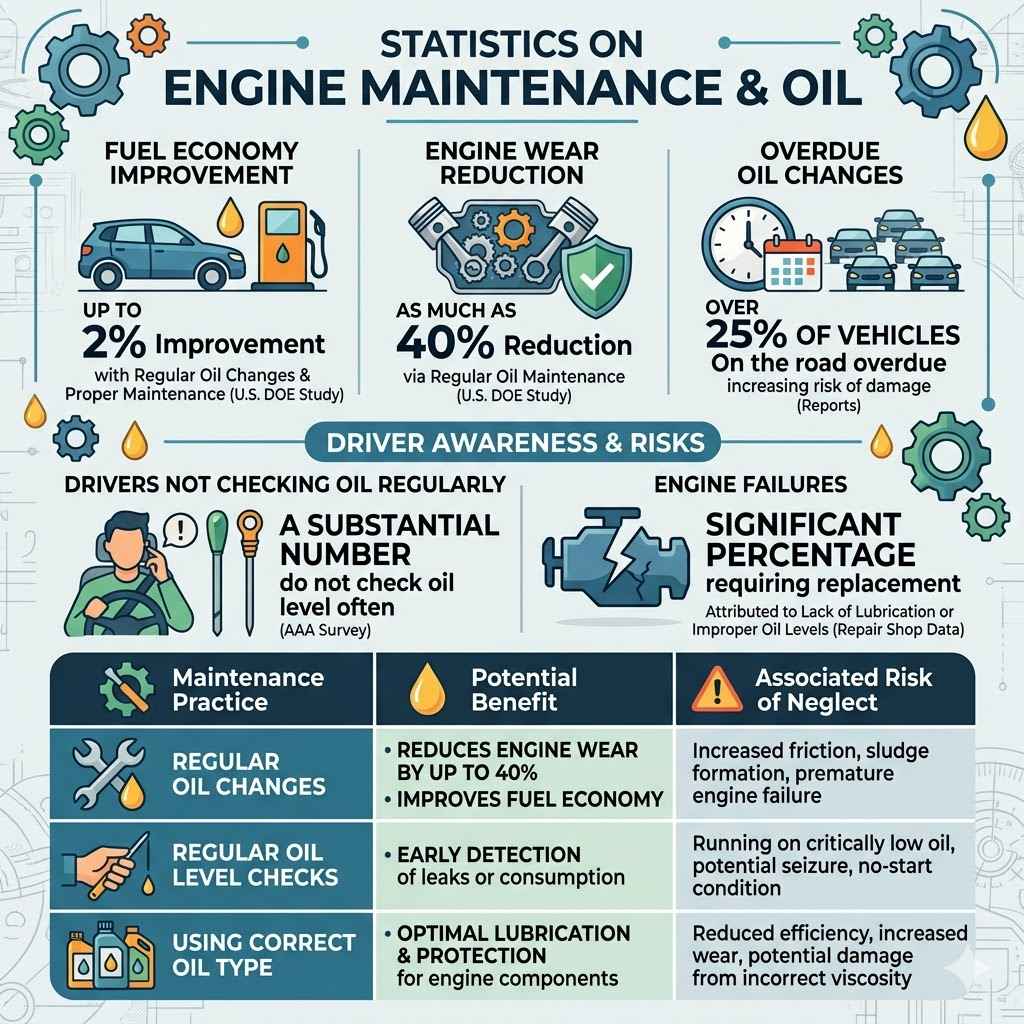
Understanding the impact of engine oil and maintenance can be better grasped with some data. Statistics show how critical this fluid is and how often neglect leads to problems.
According to a study by the U.S. Department of Energy, regular engine oil changes and proper maintenance can improve fuel economy by up to 2% and reduce engine wear by as much as 40%. This demonstrates the direct link between oil maintenance and engine longevity.
Furthermore, data from automotive repair shops indicates that a significant percentage of engine failures, particularly those requiring complete engine replacement, are attributed to lack of lubrication or improper oil levels.
A survey conducted by AAA found that a substantial number of drivers do not check their car’s oil level regularly. This lack of awareness contributes to issues like the engine not starting due to low oil level. For instance, some reports suggest that over 25% of vehicles on the road are overdue for an oil change, increasing the risk of internal engine damage.
| Maintenance Practice | Potential Benefit | Associated Risk of Neglect |
|---|---|---|
| Regular Oil Changes | Reduces engine wear by up to 40%, improves fuel economy | Increased friction, sludge formation, premature engine failure |
| Regular Oil Level Checks | Early detection of leaks or consumption | Running engine on critically low oil, potential seizure, no-start condition |
| Using Correct Oil Type | Optimal lubrication and protection for engine components | Reduced efficiency, increased wear, potential damage from incorrect viscosity |
Frequently Asked Questions
Question: What happens if I ignore the low oil pressure warning light?
Answer: Ignoring the low oil pressure warning light can lead to severe engine damage. Without proper lubrication, metal parts rub against each other, causing excessive heat and wear. This can result in components seizing, leading to catastrophic engine failure, which is very expensive to repair.
Question: Can I start my car with just a quart of oil?
Answer: It is not recommended to start your car if it has only a quart of oil. Many modern cars have sensors that will prevent starting to avoid damage. Even if it does start, running with such low oil can quickly cause irreparable harm to the engine’s internal components.
Question: How often should I check my car’s oil level?
Answer: It’s a good practice to check your car’s oil level at least once a month. You should also check it before any long road trips. This simple habit can help you catch potential problems early.
Question: What is the difference between low oil level and low oil pressure?
Answer: Low oil level means there isn’t enough oil in the engine’s oil pan. Low oil pressure means the oil isn’t being circulated with enough force. While a low oil level often causes low oil pressure, you can also have low oil pressure due to a faulty oil pump or a clogged oil filter, even if the oil level is adequate.
Question: Is it bad to overfill my engine with oil?
Answer: Yes, overfilling your engine with oil can be harmful. Excess oil can aerate, or create foam, which reduces its ability to lubricate properly. It can also increase pressure within the engine, potentially damaging seals and gaskets, and can even cause the engine to misfire or run roughly.
Summary
An engine not starting due to low oil level is a common issue. It happens when the oil that lubricates and protects your engine parts runs too low. This can be caused by leaks, the engine burning oil, or simply not changing the oil often enough.
Checking your dipstick is key to diagnosing this. Adding the correct oil can often get your car running again. However, always address the root cause to prevent future problems and ensure your engine’s health.