Engine Oil for Automatic Car: Top Picks for Optimal Performance
Choose engine oil for an automatic car by matching the owner’s manual viscosity and the required API/ILSAC or ACEA rating first, then pick full synthetic in 0W-20, 5W-30, or the exact grade listed for stop-and-go traffic, heat, and short trips. The wrong oil can raise wear, sludge, and fuel use, and it can shorten seal life and upset lubrication over time. This guide compares top options by viscosity, certification, mileage, climate, and driving pattern.
The best oil is the one that matches the manual first, then the driving pattern. Automatic-car commuting usually means more idling, more heat soak after shutdown, and more short-trip operation, so oil stability matters more than brand advertising.
Best engine oil for automatic cars
That is why a highway-only recommendation can miss the mark. A sedan that spends its week in city traffic may need stronger high-temperature stability and better sludge control than the same model used for long freeway runs.
What oil should you use?
Start with the owner’s manual: it controls the final viscosity grade, the approval list, and any API or ILSAC requirement. If the manual calls for 5W-30, use 5W-30 or an approved equivalent only when the vehicle maker allows it; brand choice comes after spec compliance.
How to read the viscosity grade
SAE grades such as 0W-20, 5W-20, 5W-30, 10W-30, and 10W-40 describe how the oil behaves when cold and when hot. The first number and the “W” matter for low-temperature flow, while the second number reflects hot-running thickness.
That balance matters in an automatic car because cold-start flow helps oil reach parts quickly, while hot thickness helps maintain a protective film in traffic, in summer heat, and after repeated short trips. The wrong grade can be too thin when hot or too thick on cold starts.
A common example is 5W-30, which appears in many manuals. It may be correct for one automatic car and wrong for another, because the approval list and climate target still matter.
How to choose without guessing
- Read the manual for the exact SAE grade.
- Check for API SP, ILSAC GF-6, or another required approval.
- Match the oil to climate: cold winters favor better low-temperature flow.
- Match the oil to driving pattern: short trips and traffic favor stronger synthetic stability.
- Use high-mileage oil only if the engine mileage and symptoms justify it.
Engine oil comparison matrix
This decision table maps automatic-car scenarios to the oil choice that fits the manual, the climate, and the way the car is driven.
| Mileage band | Climate | Driving pattern | Required viscosity | Certification to verify | When to avoid the product |
|---|---|---|---|---|---|
| Under 75,000 miles | Moderate to cold | Daily commuting with short trips | 0W-20 or 5W-20 if the manual lists it | API SP and ILSAC GF-6 | Avoid high-mileage oil unless the engine already consumes oil or seeps |
| Under 75,000 miles | Hot climate | Stop-and-go traffic, long idle time | 5W-30 if specified by the manual | API SP and ILSAC GF-6 | Avoid moving to 10W-30 or 10W-40 unless the manual allows it |
| Over 75,000 miles | Any climate | Mixed commute with oil consumption or seepage | Manual-listed grade, often 5W-30 or 10W-30 where allowed | API SP; GF-6 if listed for the vehicle | Avoid a high-mileage formula if the engine is still tight and shows no leaks or consumption |
| Over 75,000 miles | Cold winters | Frequent short trips | 0W-20 or 5W-20 only if approved | API SP and ILSAC GF-6 | Avoid thickening the oil just because the car is older |
| Any mileage | Severe heat | High-load driving or severe stop-and-go | Manual-specified grade, often synthetic in the listed grade | API SP; any maker approval in the manual | Avoid extended drain intervals if the driving is mostly city traffic or short hops |
If a compact sedan calls for 0W-20, has about a 6-mile commute, and idles in summer traffic, a full-synthetic 0W-20 that meets the maker’s recommended specifications is a common choice. A full synthetic 0W-20 with API SP and ILSAC GF-6 is a better fit than a thicker grade that the manual never approved.
Suppose an older V6 sedan has 110,000 miles and uses a quart between changes. If the manual allows 5W-30 and the oil cap or handbook permits it, a high-mileage 5W-30 can help with seal conditioning and consumption control.
Synthetic vs high-mileage oil
Full synthetic oil uses lab-engineered or highly refined base stocks, so it usually resists heat and oxidation better than conventional oil. High-mileage oil is a different choice: it is aimed at engines over 75,000 miles and adds seal conditioners to help slow leaks and reduce consumption.
When full synthetic makes the most sense
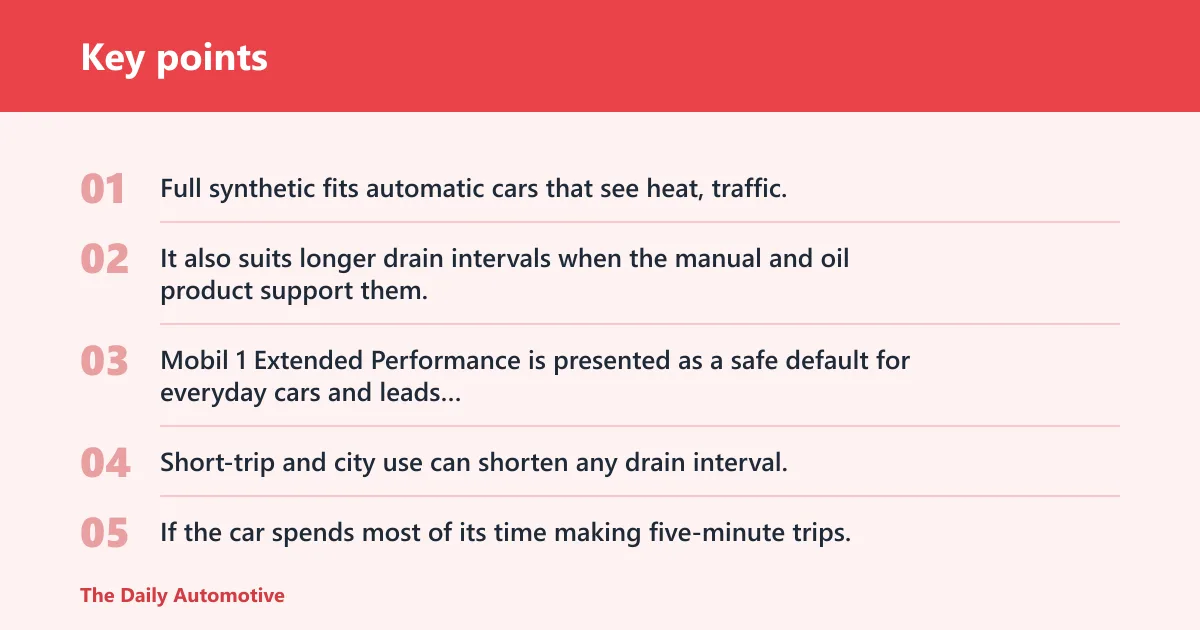
Full synthetic fits automatic cars that see heat, traffic, or short trips because those conditions punish oil more quickly. It also suits longer drain intervals when the manual and oil product support them. Mobil 1 Extended Performance is presented as a safe default for everyday cars and leads 2026 with a 20,000-mile drain interval, but that interval is not universal.
Short-trip and city use can shorten any drain interval. If the car spends most of its time making five-minute trips, the oil may need changing earlier than the package claim suggests, even with a synthetic fill.
When high-mileage oil makes the most sense
High-mileage oil is the better fit once mileage is up, leaks appear, or consumption becomes noticeable. It is not mandatory for every older car, and it is not the right choice for a low-mileage engine that still runs tight and clean.
Its seal conditioners can help reduce seepage around aging seals. That is useful when the issue is slow consumption or damp gasket edges, not when the engine is simply older on the odometer.
When conventional or blend oil still works
Conventional oil can still make sense if the manual allows it and the car sees mild service. A synthetic blend can be a reasonable middle ground in some vehicles. Car and Truck identifies Quaker State 550044965 as a synthetic blend 5W-20 engine oil, which shows how a blend can fit a manual-specified light grade.
The trade-off is simple: the less demanding the use case, the less reason there is to pay for extra synthetic performance. The more heat, traffic, and short-trip use, the more synthetic stability matters.
What do API SP and ILSAC GF-6 mean?
API SP is a commonly used engine-oil standard that focuses on wear, sludge, and LSPI protection in modern gasoline engines. ILSAC GF-6 is tied to fuel economy and timing-chain wear, and it often appears with API SP on bottles aimed at current passenger cars.
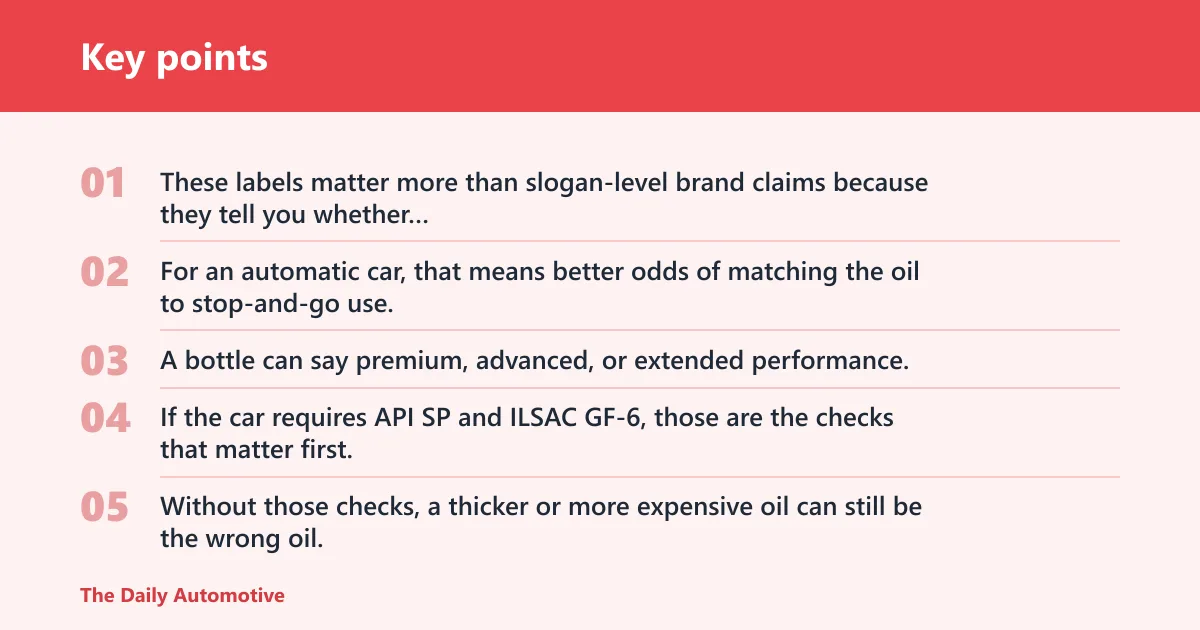
These labels matter more than slogan-level brand claims because they tell you whether the oil is built for modern engine demands. For an automatic car, that means better odds of matching the oil to stop-and-go use, turbo heat, and timing-chain protection requirements.
Why the labels matter more than the bottle front
A bottle can say premium, advanced, or extended performance, but the back label still has to meet the manual. If the car requires API SP and ILSAC GF-6, those are the checks that matter first.
Without those checks, a thicker or more expensive oil can still be the wrong oil.
Top picks for daily driving
These picks are best compared after the manual match is confirmed. The right choice depends on the exact grade and approval list your automatic car needs, not on brand popularity alone.
| Product | Best fit | Key point | Watch for |
|---|---|---|---|
| Mobil 1 Extended Performance | Everyday cars and longer intervals | Up to 20,000-mile drain interval; Triple Action+ Formula | Do not treat the interval as universal in city traffic or short-trip use |
| Pennzoil Ultra Platinum | Modern engines that need cleanliness | GTL base oil technology and deposit-control focus | Confirm the exact viscosity and approval first |
| Castrol EDGE | Drivers who want wear protection in a synthetic | Positioned for performance and protection | Match the grade; do not assume one bottle fits every manual |
| Castrol GTX | Conventional-leaning or value-minded use cases | Car and Truck ranks it as a top pick | Only use it where the manual permits the type and grade |
| Valvoline Advanced Synthetic | Daily drivers needing sludge control | Car and Truck cites 40% better wear protection and deposit control | Verify API SP and the correct viscosity before buying |
Mobil 1 extended performance
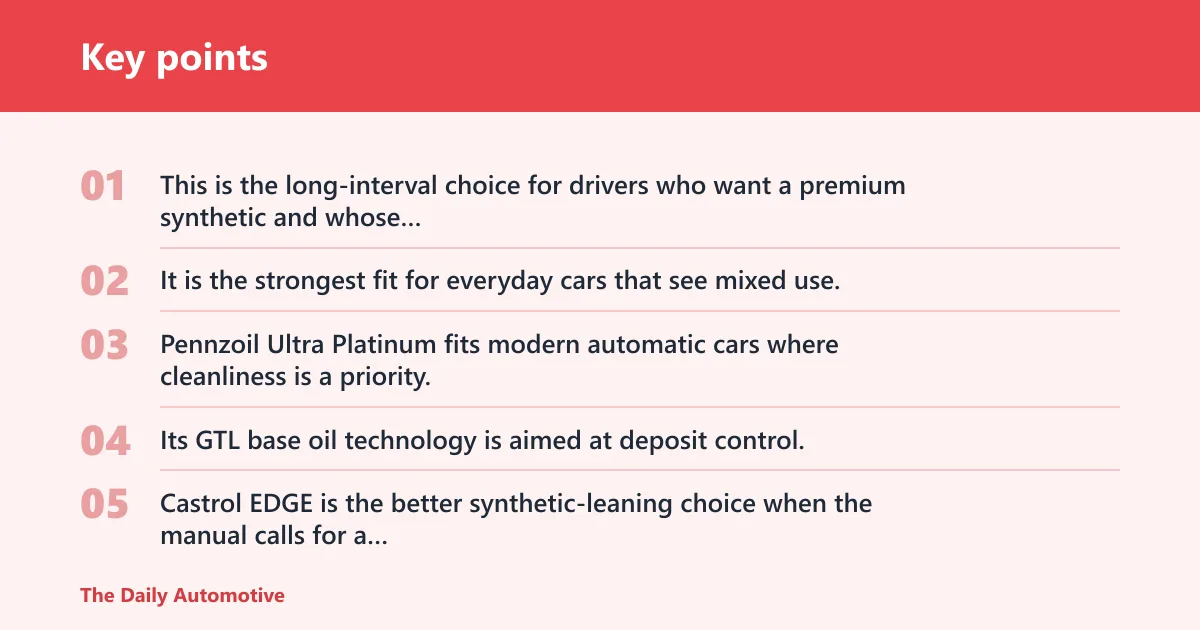
This is the long-interval choice for drivers who want a premium synthetic and whose manual allows the grade. It is the strongest fit for everyday cars that see mixed use, but the service interval still needs to shrink in severe city driving or repeated short trips.
Pennzoil Ultra Platinum
Pennzoil Ultra Platinum fits modern automatic cars where cleanliness is a priority. Its GTL base oil technology is aimed at deposit control, which matters in engines that spend a lot of time at operating temperature and in traffic.
Castrol EDGE and Castrol GTX
Castrol EDGE is the better synthetic-leaning choice when the manual calls for a synthetic and the driver wants wear protection. Castrol GTX sits closer to a conventional or value path, and Car and Truck ranks it as a first top pick, but only if the manual permits that type and grade.
Valvoline Advanced Synthetic
Valvoline Advanced Synthetic is positioned around wear protection, sludge control, and fuel-economy support. That makes it a practical daily-driver option when the car needs API SP and ILSAC GF-6 in a light or mid-weight grade.
Choose synthetic or high-mileage if…
Choose full synthetic if the car sees heat, traffic, or long drain intervals and the manual allows it. Choose high-mileage oil if the engine is over 75,000 miles, consumes oil, or shows seepage. Choose a lighter viscosity only when the manual allows it and cold-start flow matters.
Use full synthetic if the car is driven hard by conditions
Full synthetic is the better fit for stop-and-go commuting, summer heat, turbocharged engines, and repeated short trips. It gives better temperature stability than conventional oil, which matters when automatic-car use keeps oil hot and under stress.
Use high-mileage oil when age shows up as symptoms
High-mileage oil makes sense when mileage is high enough that seals and rings no longer behave like new parts. If the engine is already using oil or leaving damp spots, seal conditioners can help. If the engine is still tight, the extra additives may not add value.
Shorten long intervals in severe service
A long drain interval can be fine for easy driving, but not for every automatic car. Frequent short trips, heavy traffic, and hot idle time can load the oil with fuel and moisture faster than a highway commute would, so the interval should be shortened accordingly.
How often should you change engine oil in an automatic car?
Change oil at the interval in the owner’s manual, then shorten it for severe service such as city traffic, short trips, or extreme heat. Mobil 1 Extended Performance is listed with a 20,000-mile drain interval, but that figure should not be treated as universal for automatic cars that spend most of their time in stop-and-go use.
A sensible interval depends on the oil type, the vehicle maker’s schedule, and the duty cycle. A car used mostly for commuting in traffic will usually need earlier service than a car that accumulates steady highway miles.
What oil grade should I use for a high-mileage automatic car?
Use the viscosity grade in the manual first, then consider a high-mileage formula if the engine has over 75,000 miles or shows leaks or consumption. Do not choose a thicker grade only because the car is older; a high-mileage 5W-30 is only right if the manual allows 5W-30.
For a cold climate, the manual may still call for 0W-20 or 5W-20 even on an older car. In that case, the high-mileage version of that approved grade is the cleaner solution than jumping to a thicker oil without approval.
What engine oil is best for an automatic car?
The best engine oil for an automatic car is the one that matches the manual, the climate, and the driving pattern. For many everyday cars, that means a full synthetic in the specified grade with API SP and, when required, ILSAC GF-6. Brand only matters after those checks are complete.
Can I use 5W-30 in an automatic car?
Yes, if the owner’s manual lists 5W-30 or allows it as an approved alternative. If the manual calls for 0W-20 or 5W-20, do not assume 5W-30 is safe. The right answer depends on the engine design, the approval list, and the climate the car sees.
Is synthetic oil better for automatic cars?
Usually yes, especially for automatic cars that live in heat, traffic, or short trips. Full synthetic oils are better at temperature stability than conventional oil, and that helps modern engines stay cleaner and better protected. If the manual allows synthetic, it is often the stronger daily-driver choice.
Should I use high-mileage oil in an older automatic car?
Use high-mileage oil when the engine is over 75,000 miles and shows the symptoms it is made for, such as seepage or consumption. It is not required for every older car. If the engine is older but still tight and dry, a standard approved synthetic may be the better fit.
What does API SP mean on engine oil?
API SP is the current gasoline-engine standard aimed at wear control, sludge control, and LSPI protection. In plain terms, it tells you the oil was built for modern engine stress, not just basic lubrication. For automatic cars, it is one of the most important labels to verify after viscosity.
Which engine oil gives the best fuel economy and protection?
Look for the manual’s approved lightest grade, then choose an oil carrying API SP and, when required, ILSAC GF-6. That combination usually gives the best mix of fuel economy and protection. In many manuals that means a 0W-20, 5W-20, or 5W-30 full synthetic, not a thicker oil chosen by habit.
Products related to this article
Sponsored / affiliate links. As an Amazon Associate I earn from qualifying purchases. I may earn additional commission from eligible campaigns.