Best Car Engine Oil for High-Mileage Cars: Leak Guide
Pick high-mileage oil only if the engine burns or seeps oil. Otherwise, buy the OEM viscosity in a quality API SP or CK-4 oil, and move up one grade only when the manual allows it. Break that rule and you can make consumption, varnish, or cold-start wear worse. This guide shows how I sort oil choice by burning, seepage, sludge, and climate.
This guide is part of our Transmission problems and fixes series.
How to choose high-mileage oil without guessing
Start with the owner’s manual and the factory viscosity spec. Mileage alone does not decide it. I have seen a 140,000-mile engine stay on the same grade it used at 40,000 miles because it was clean and dry, while a lower-mileage engine with seepage or oil use needed a high-mileage formula.
Sort the problem first
Burning oil, seepage, sludge, and cold-start drag point to different oils. Burning and seepage can justify a high-mileage formula with seal conditioners and leak reduction. Sludge points to detergent strength and shorter intervals. Cold-weather starting points to a lower winter grade, not just a thicker hot grade.
When mileage matters, symptoms matter more. High-mileage oil is generally recommended at 75,000 miles, but that is a marketing threshold, not a repair order. A clean, dry engine can stay on standard oil if the spec fits. A worn engine may need a different viscosity before that mileage.
According to Motor Oil for Cars – How To Pick The Right Engine Oil — Oil viscosity is represented by numbers like 10W-30.
What does high-mileage motor oil actually change?
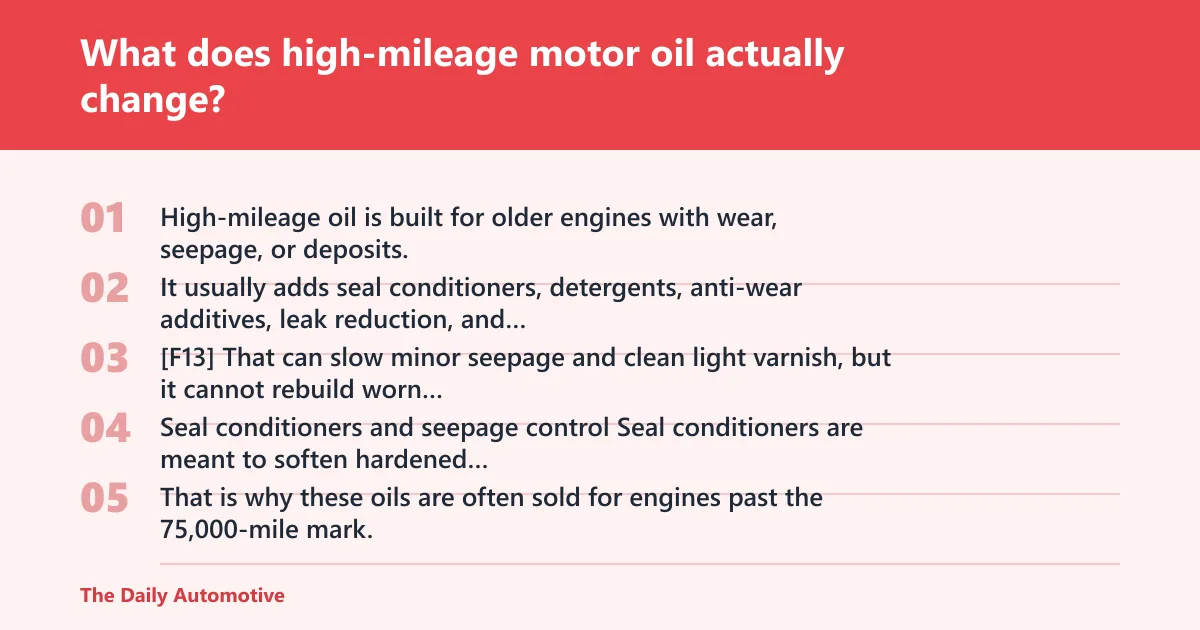
High-mileage oil is built for older engines with wear, seepage, or deposits. It usually adds seal conditioners, detergents, anti-wear additives, leak reduction, and sludge control. That can slow minor seepage and clean light varnish, but it cannot rebuild worn parts or fix a broken seal.
Seal conditioners and seepage control
Seal conditioners are meant to soften hardened seals and trim slow leaks around valve covers, cam seals, and similar spots. That is why these oils are often sold for engines past the 75,000-mile mark. They can help with dampness and small drips. They do not stop a torn gasket or a cracked housing.
Detergents, anti-wear additives, and sludge control
Detergents help keep ring lands, lifters, and oil passages cleaner. Anti-wear additives help protect parts under load. In an engine with short-trip use or long gaps between changes, that matters more than the number on the odometer. A dirty engine usually needs cleaner oil and shorter intervals, not just thicker oil.

Which viscosity is best for a high-mileage engine?
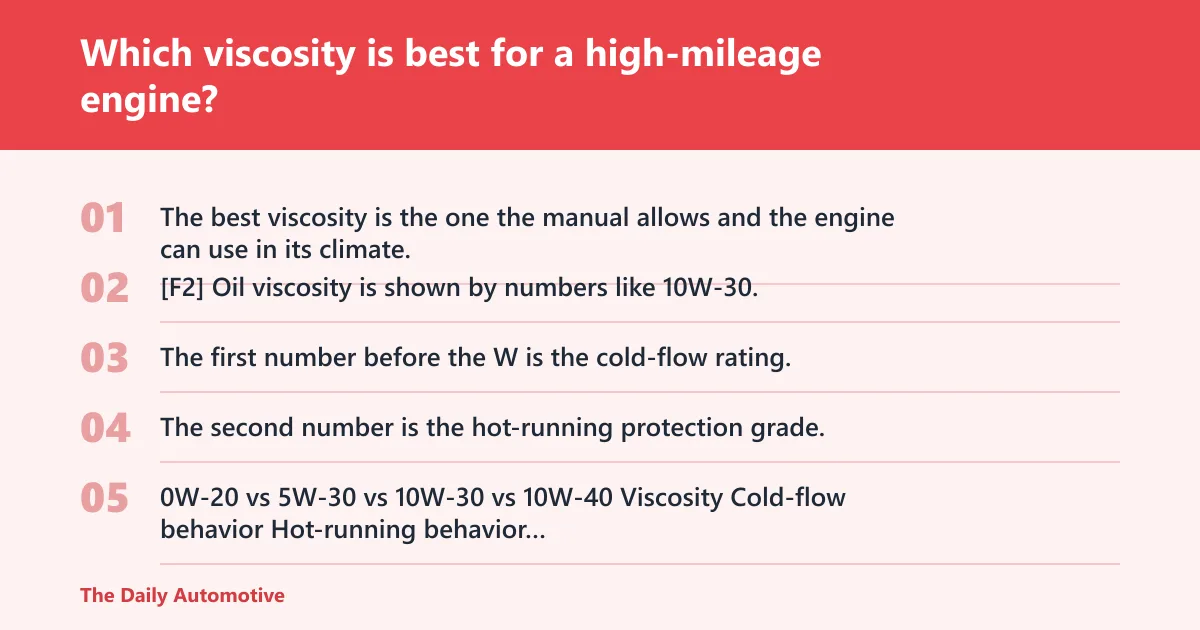
The best viscosity is the one the manual allows and the engine can use in its climate. Oil viscosity is shown by numbers like 10W-30. The first number before the W is the cold-flow rating. The second number is the hot-running protection grade.
0W-20 vs 5W-30 vs 10W-30 vs 10W-40
| Viscosity | Cold-flow behavior | Hot-running behavior | Typical use in older engines |
|---|---|---|---|
| 0W-20 | Best cold-start flow | Lightest of these grades | Modern engines that call for 0W-20; not a blanket fix for wear |
| 5W-30 | Good winter flow | Middle-ground protection | Common choice when the manual allows a wider band and seepage is mild |
| 10W-30 | Slower cold flow than 5W-30 | Similar hot grade to 5W-30 | Often used in warmer weather or older engines that want a little more body |
| 10W-40 | Slower cold flow | Thicker at temperature | Sometimes used in worn, hot-running, or towing use when the manual permits it |
Lower winter numbers improve cold-start flow. Higher second numbers support hot-running protection. That tradeoff matters. A thicker oil may quiet a worn engine or slow seepage, but it can also delay lubrication on a cold start. In winter, that penalty can matter more than leak reduction.
When thicker oil helps, and when it can hurt
Thicker oil can help when an older engine has hot idle noise, mild consumption, or light seepage. It can hurt when winter mornings are cold or when the engine already specifies a light grade. If the manual says 0W-20, moving to 10W-40 without approval is usually the wrong move.
What standards should you look for on the bottle?
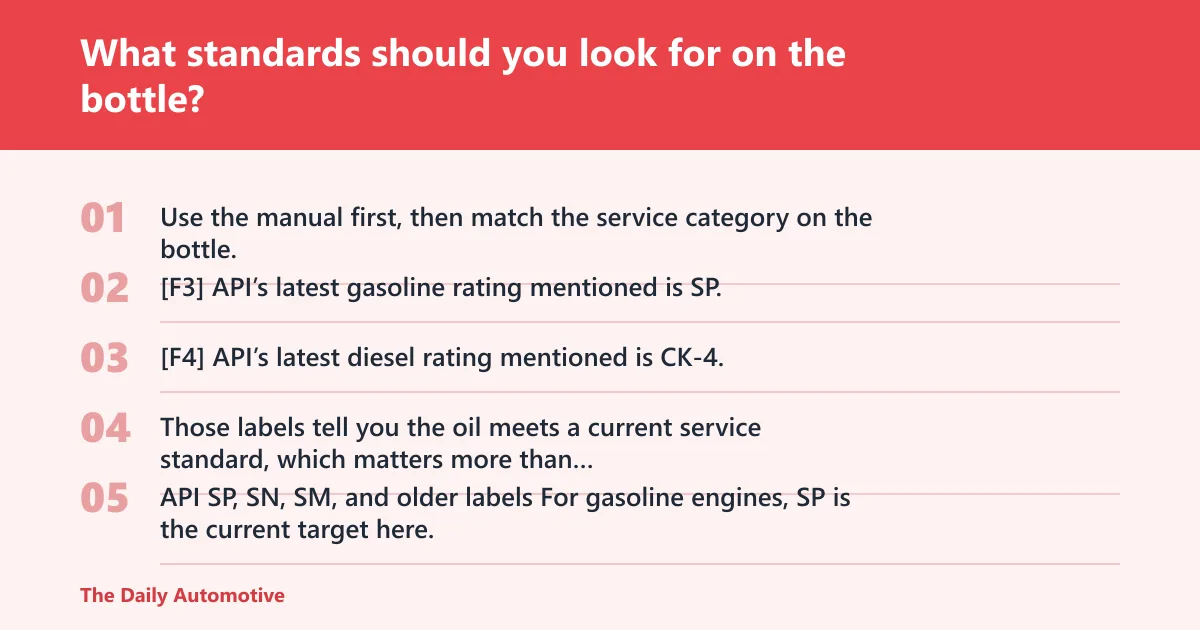
Use the manual first, then match the service category on the bottle. API’s latest gasoline rating mentioned is SP. API’s latest diesel rating mentioned is CK-4. Those labels tell you the oil meets a current service standard, which matters more than marketing copy.
API SP, SN, SM, and older labels
For gasoline engines, SP is the current target here. SN and SM are older gasoline categories that may still appear on shelves, but a bottle carrying API SP gives a clearer current baseline for modern gasoline engines. Older labels such as SL and SJ can still appear on the market, but they are not the first pick.
ILSAC GF-6 and Resource Conserving for gasoline engines
For many passenger cars, ILSAC GF-6 is a current benchmark on high-mileage synthetics. Resource Conserving is a fuel-economy lab-test designation often found on modern passenger-car oils. Popular Mechanics says oils can be labeled Energy Conserving or Resource Conserving. Those marks matter most when the manual calls for a light passenger-car oil.
What to look for on diesel and light-truck oils
Light-truck, towing, and diesel use need their own review. API CK-4 is the current diesel rating mentioned here. Older diesel labels such as CJ-4, CI-4, CH-4, and FA-4 may also appear, but the bottle should still match the engine family and the OEM spec. Passenger-car fuel-economy labels do not automatically fit heavy-duty use.
Should I use synthetic oil in an older car?
Synthetic oil makes sense in many older engines because it flows better in cold weather and can carry 0W ratings. Conventional oil still has a place when the engine is simple, the climate is mild, and the manual calls for it. The right choice depends on use, not age alone.
Cold-flow and deposit control differences
Synthetic oil usually stands up better to heat and short trips, and it resists deposits better than basic conventional oil. That is useful in a high-mileage engine that sees winter starts, turbo heat, or stop-and-go use. Conventional oil remains a valid standard new-car oil and is still sold under current API ratings.
Why many high-mileage engines do better on synthetic
Older engines often do better with cleaner base stock, steadier viscosity, and stronger cold flow. That can matter in engines with long service history, small oil passages, or turbochargers. If the manual allows it, synthetic high-mileage oil is often the safer long-term pick than jumping to a thicker conventional oil.
One-page decision matrix for symptom, engine, climate, and viscosity
Use this as a working guide, not a substitute for the manual. The correct oil still starts with OEM viscosity and service category. Then match the real problem. Burning, seepage, sludge, towing, and winter starts do not call for the same oil.
| Symptom | Engine type | Climate/use | OEM viscosity | Recommended oil category | Service label to seek |
|---|---|---|---|---|---|
| Oil burning | Gasoline, non-turbo | Mild to warm | 5W-30 | High-mileage synthetic with seal conditioners | API SP; GF-6 if listed |
| Oil burning | Turbo gasoline | Hot, hard use | 0W-20 or 5W-30 | Synthetic high-mileage, stay within OEM grade | API SP; GF-6 where applicable |
| Seepage | Gasoline or light-truck | Any climate | 5W-30 or 10W-30 | High-mileage oil aimed at leak reduction | API SP or current diesel label if applicable |
| Sludge | Gasoline, older maintenance history | Short trips, heat | OEM grade | Synthetic with strong detergency; shorter intervals | API SP; GF-6 |
| Towing | Diesel or light-truck | Hot load, long climbs | 5W-40 if allowed | Heavy-duty synthetic | API CK-4 |
| Short-trip winter use | Gasoline | Cold climate | 0W-20 or 5W-30 | Synthetic for faster cold flow | API SP; Resource Conserving if listed |
When oil will not fix the problem
Oil cannot cure mechanical failure. If the engine has worn valve seals, external leaks, PCV faults, compression loss, or ring wear, the oil may only cover the symptoms for a while. A bottle change is not a substitute for diagnosis. That is where many owners waste money.
Short checklist for when to test instead of top off again
- Check for blue smoke after idle or deceleration.
- Inspect spark plugs for oil fouling.
- Look at the PCV valve and related hoses.
- Inspect valve covers, oil pan, and filter area for wetness.
- Test compression or leakdown if consumption is severe.
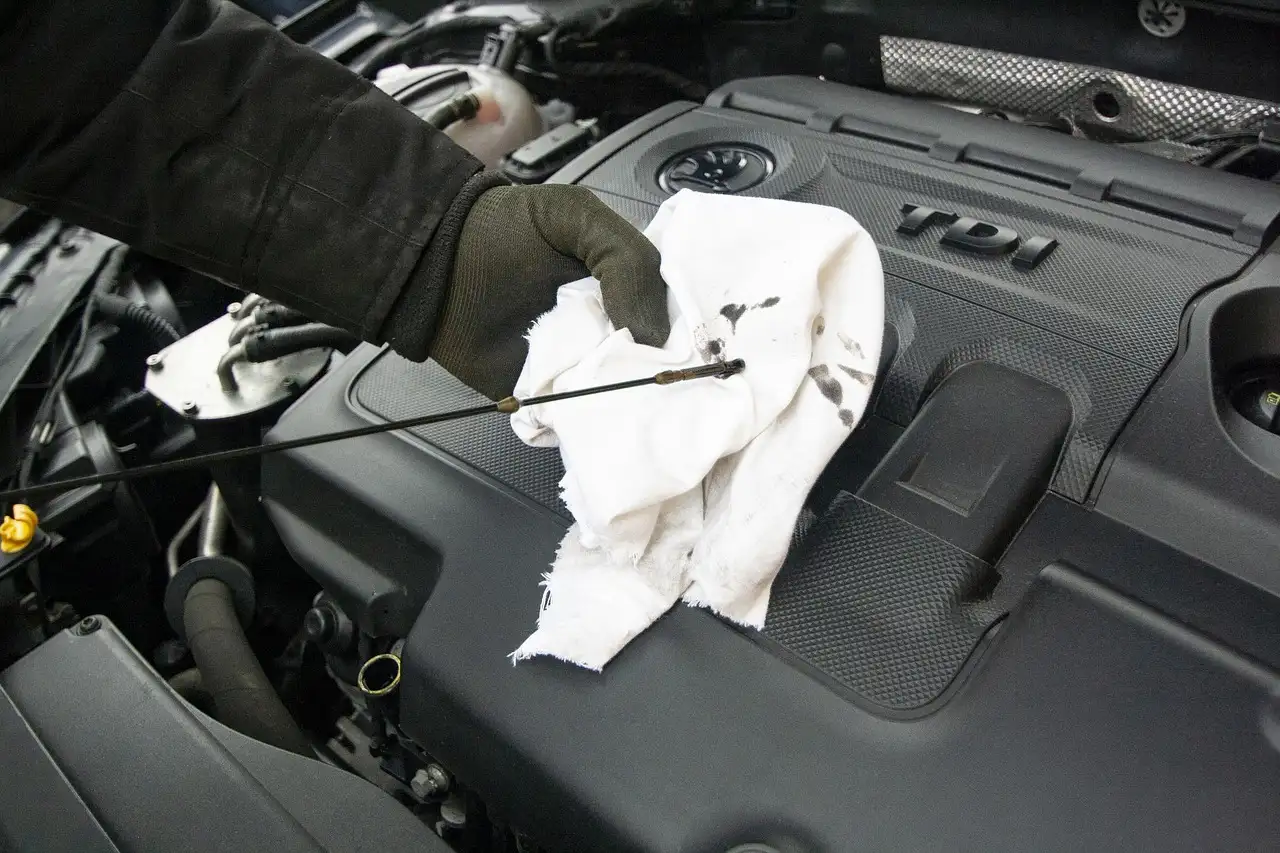
- Watch the dipstick over a few hundred to about a thousand miles, not just after one trip.
Product examples by use case
Product choice should follow the symptom and viscosity, not the badge on the bottle. Mobil 1 Extended Performance High Mileage comes in 5W-20 and 5W-30 and claims up to a 20,000-mile drain interval. That fits owners who want a long-drain synthetic for a gasoline engine that still stays within those grades.
Mobil Full Synthetic High Mileage is offered in 0W-20 and claims up to a 7,500-mile interval. That fits a newer high-mileage engine that calls for a light passenger-car oil and needs strong cold flow. Shell Rotella T6 is listed as a 5W-40 oil and is positioned for diesel and heavy-duty trucks. That makes sense for towing, hauling, and many light-truck diesel applications.
Oil filters matter too. A tired engine with blow-by or sludge history deserves a quality filter and sensible intervals, not a cheap filter and long-drain hopes. For older cars, shorter intervals often cost less than chasing a consumption problem with frequent top-offs.
What is the best motor oil for high-mileage cars?
The best motor oil for high-mileage cars is the oil that matches the symptom, the manual, and the engine family. For a clean engine, that often means OEM viscosity in API SP or CK-4 as applicable. For seepage, burning, or sludge, a high-mileage synthetic with the right grade is usually the better fit.
Frequently asked questions
Is high-mileage oil worth the extra cost?
It is worth the extra cost when the engine has seepage, light oil use, or mild deposits. It is usually not worth paying extra if the engine stays clean, dry, and within spec on standard oil. The mileage number alone does not justify it.
Should I use synthetic oil in an older car?
Yes, if the manual allows it and the car sees cold starts, heat, short trips, or turbo use. Synthetic oil usually flows better in cold weather and resists deposits better than conventional oil. Older engines with sludge or seasonal weather swings often benefit the most.
What viscosity oil should I use for a high-mileage engine?
Use the viscosity listed in the owner’s manual first. If the manual allows a range, choose the grade that fits the climate and symptom. A light winter grade helps cold starts, while a higher hot grade can help hot-running protection and mild seepage.
Does high-mileage oil help stop oil leaks?
It can help slow minor seepage by conditioning hardened seals. It will not stop a torn gasket, cracked housing, or loose drain plug. If the leak leaves visible drips or a fast loss of oil, the repair is mechanical, not chemical.
What standards should I look for on the oil bottle?
For gasoline engines, look for API SP first, and ILSAC GF-6 or Resource Conserving where the manual calls for a passenger-car oil. For diesel use, look for API CK-4 or the specific diesel category your engine requires. The bottle should match the manual before anything else.
When should you start using high-mileage oil?
High-mileage oil is generally marketed for engines with higher mileage, but symptoms matter more than the odometer. Start when seepage, mild consumption, or deposit history appears, provided the oil grade still matches the manual. Mileage by itself is only a rough guide.
Products related to this article
Sponsored / affiliate links. As an Amazon Associate I earn from qualifying purchases. I may earn additional commission from eligible campaigns.