Are Car Sound Processors Worth It? Yes, in the Right Setup
Yes, if your car’s factory tuning is the bottleneck, a DSP is often worth it; if speaker placement or power is the problem, spend there first. Bad tuning can make the stereo flatter, harsher, and harder to fix than the stock system. This guide breaks down what a DSP changes, when it pays off, and when it is the wrong upgrade.
Verdict
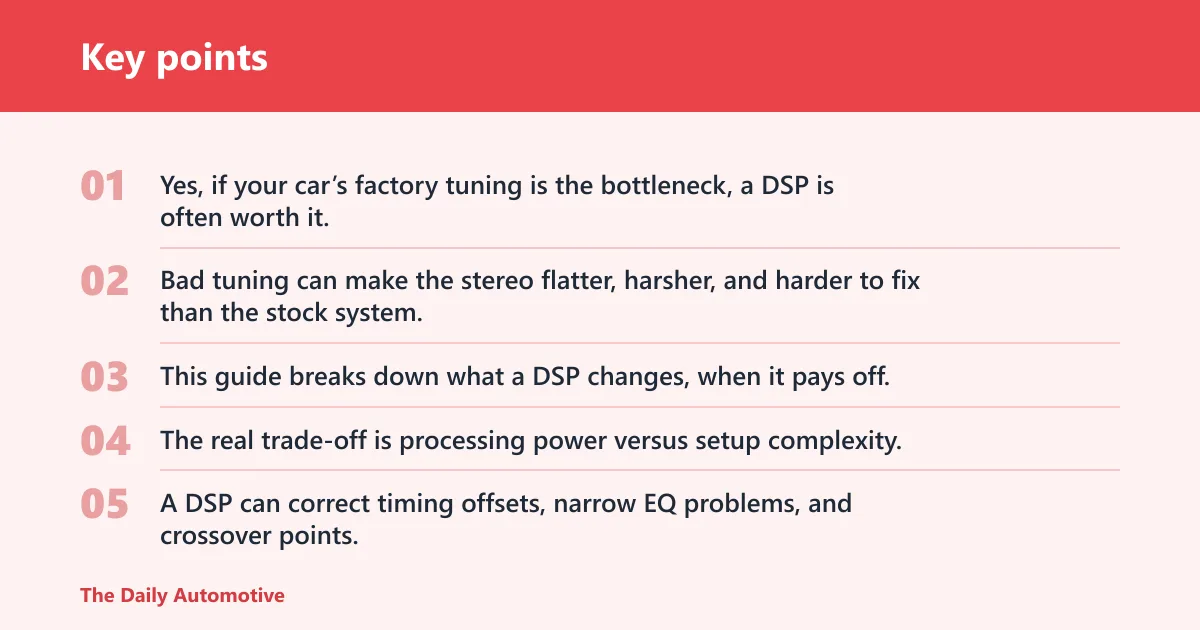

The real trade-off is processing power versus setup complexity. A DSP can correct timing offsets, narrow EQ problems, and crossover points, but that only helps when the speakers, amplifier, and factory integration can carry the change. If the system still has weak drivers, poor fitment, or clipping, processing alone will not deliver clean sound.
Specs at a glance
| Product | Best for | Key detail from the listing | Price | Honest drawback |
|---|---|---|---|---|
| Audison Bit One HD Digital Processor | Complex full-system tuning | 13 channels; supports high-level and low-level inputs; eight preset memory slots | $1,599.99 | Cost is high, and a processor this capable still needs careful tuning time |
| Stetsom STX 2436 Bluetooth DSP PRO | Budget DSP control | Bluetooth app control; works with factory or aftermarket stereos; graphic EQ, crossover, and limiter tools | $84.99 | It is a lower-cost unit, so check the manufacturer’s listing for your model’s input and channel needs |
| AudioControl D-6.1200 DSP Car Audio Amplifier | All-in-one amp and processing | 6-channel, 1200W DSP amp; AccuBASS; 30-band equalizer; OEM and aftermarket integration; selectable crossovers | $799.99 | Combines two jobs in one chassis, so flexibility depends on how your system is laid out |
Sound processor matrix
This matrix judges the upgrade by the problem it solves, not by brand hype. A DSP is most valuable when the factory head unit is shaping the signal badly, when an active system needs channel-level correction, or when you are building a tuned front stage and sub setup.
| Scenario | Expected benefit | Tuning difficulty | Total cost range | DSP now or later? |
|---|---|---|---|---|
| Stock factory system | Can fix factory EQ curves, loudness processing, and weak imaging if the rest of the system is already competent | Medium to high | $85 to $1,600 plus install and tuning | Usually later, after confirming the system is not limited by speaker quality or amp power |
| Speaker-only upgrade | Improves clarity and tonal balance, but only if the new speakers fit the car and the factory tuning is not fighting them | Medium | $85 to $1,600 plus speaker and install cost | Often later, unless the factory signal is already aggressive or uneven |
| Amplifier-only upgrade | Raises headroom, reduces clipping risk, and can improve signal-to-noise when the gain staging is right | Medium | $800 to $1,800 plus amp and install cost | Often after amp power is sorted, unless the factory signal needs correction first |
| Bass-focused build | Helps manage subwoofer crossover points, phase, and level matching; useful if the bass is uneven or boomy | Medium | $85 to $1,600 plus sub and amp cost | Sometimes later; a sub with proper low-pass filtering may solve the main issue first |
| Full SQ build | Strongest case for time alignment, parametric equalization, and active crossover control across the system | High | $800 to $2,500 plus speakers, amp, sub, install, and tuning | Now, if the build will be measured and tuned properly |
Who it
A DSP is for drivers who want clearer vocals, steadier imaging, and cleaner tonal balance than a factory head unit often delivers. It also fits owners of OEM audio systems with fixed EQ curves, loudness processing, or premium-package quirks that leave the sound bright, thin, or bass-shy.
It makes the most sense when the rest of the chain can support it. That means speakers with the right sensitivity and fitment, enough amplifier RMS power, and a plan to verify the result with an RTA and measurement microphone rather than by ear alone.
Suppose a sedan has factory speakers that distort early, a head unit that keeps the mids recessed, and a dash that loads the left side more than the right. A DSP can help with timing and tone, but the speakers still need to be good enough to hold the correction.
What does a DSP do?
A car audio DSP gives you control over time alignment, parametric EQ, crossovers, and often channel routing. It can take a factory or aftermarket signal, split it into useful bands, and let you correct what the head unit or OEM audio system changed before the signal reaches the speakers or amplifier.
Time alignment and channel control
Time alignment delays closer speakers so sound reaches the listener more evenly. That can pull the vocal image toward the center and make the front stage easier to place, especially in cars where the driver sits much closer to the left door than the right.
Channel count matters because more channels give you more control over active front stages, rear fill, and subwoofer routing. A 13-channel unit like the Audison can suit complex builds, while simpler systems may only need a few channels and basic crossover control.
Parametric EQ and crossover setup
Parametric equalization lets you target specific peaks and dips instead of applying broad tone changes. That matters when factory processing leaves a harsh upper midrange, a hollow vocal band, or a bass hump that masks detail.
Crossover networks matter just as much. High-pass filters protect small speakers from deep bass they cannot handle, low-pass filters keep subwoofers from playing too high, and slope options affect how sharply each driver hands off to the next one.
Factory head unit integration and signal correction
A factory head unit may include fixed EQ curves, factory loudness processing, chime retention, and phone integration that you do not want to lose. A DSP can often work around those limits, but it cannot erase every OEM integration constraint, and not every vehicle accepts every interface path.
OEM audio systems can also use odd speaker impedance, different tuning by trim level, or premium-package amplifiers that change the signal before it reaches the doors. That is why the same DSP decision can make sense in one vehicle and be the wrong first move in another.
What works
A DSP can make a clear difference when the system already has decent speakers and clean amplification but the tonal balance is wrong. That is the point where time alignment, crossovers, and EQ usually produce audible gains in clarity and imaging rather than small cosmetic changes.
It also works well in factory-retention builds. If you want to keep chimes, phone prompts, steering-wheel controls, or a premium OEM interface, a processor can sit in the signal path without forcing a full head-unit swap.
Better speakers and clean amplification still matter. A DSP cannot turn weak drivers into strong ones, and it cannot hide a bad installation that rattles, leaks air, or clips early.
Measurement matters
An RTA and measurement microphone help verify whether the response curve is actually improving. A frequency sweep can show if the correction is flattening a peak, cleaning up a dip, or creating a new problem somewhere else in the band.
Without measurement, it is easy to chase louder bass or brighter treble and miss the real issue. That is especially true in cars with reflective glass, seat absorption, and uneven left-right path lengths.
What does not?
A DSP will not fix weak speakers, poor fitment, or underpowered amplification by itself. If the speaker cone is small, the basket is loose in the door, or the amp is clipping, processing can only polish the wrong source material.
It also will not cure every factory system. Some OEM audio systems build heavy equalization and amp behavior into the signal path, and some vehicles tie audio functions to safety or convenience features that must stay intact.
Failure points to watch
- Weak speakers: low sensitivity or a narrow frequency response can limit output even after correction.
- Bad fitment: if the speaker does not seal or mount correctly, imaging and midbass suffer.
- Poor gain staging: an amplifier set too hot can raise hiss and distortion.
- Signal clipping: a DSP cannot fully rescue a clipped source signal.
- Wrong crossover points: bad high-pass or low-pass settings can strain speakers and subwoofers.
A common first-timer mistake is adding a DSP to a system with thin factory door speakers and expecting full midbass. The processor may clean up the curve, but the weak driver still cannot move enough air to make bass hit hard.
Do you need a DSP first?
Not always. The right order depends on what is broken first: speaker quality, amp power, factory EQ, or bass integration. In many vehicles, speakers come before DSP if the current drivers are poor; in others, factory processing is so heavy that correction belongs earlier.
Speakers before DSP
Start with speakers when the current ones are the main limitation. If sensitivity is low, frequency response is uneven, or the factory speaker size and mounting depth are causing fitment compromises, a DSP will not solve those physical limits.
Amplifier before DSP
Start with an amplifier when the system lacks clean RMS power. A better amp can improve headroom and lower distortion, especially when gain staging and signal-to-noise are set correctly. A DSP with pass-through or built-in amplifier compatibility can come later.
Bass builds and active systems
Bass-focused builds can change the order. If the subwoofer is the weak link, a low-pass filter, phase adjustment, and level matching may matter more than a full front-stage processor right away. Active systems, though, often benefit from DSP sooner because each channel can be tuned separately.
Alternatives
Before buying a processor, check whether the real fix is a speaker swap, an amplifier, or a subwoofer. The best upgrade order changes by vehicle, by the factory head unit, and by the listener goal.

The Stetsom STX 2436 Bluetooth DSP PRO is the budget option if you want processor functions without spending flagship money. Its Bluetooth app control, graphic EQ, crossover, limiter tools, and compatibility with factory or aftermarket stereos make it a practical entry point, but you should confirm input and channel needs against the manufacturer’s listing before planning a full install.

The AudioControl D-6.1200 makes sense when you want amplification and DSP in one chassis. Based on the published details, it combines a 6-channel, 1200W DSP amp with AccuBASS, a 30-band equalizer, selectable crossovers, and OEM or aftermarket integration. The trade-off is flexibility: one box can simplify wiring, but it also fixes the amp-and-processor layout in place.
The Audison Bit One HD is the strongest fit for complex tuning jobs. Its 13-channel layout, support for high-level and low-level inputs, and eight preset memory slots point to a system built for detailed integration. The drawback is obvious: it is expensive, and that level of control only pays off if the installer is ready to tune carefully.
Should you buy it?
Buy a DSP if your current system already has decent speakers and enough power, but the sound still feels uneven, harsh, or poorly centered. That is where time alignment, EQ, and crossovers can change the result in a way a simple speaker swap cannot.
Skip it for now if the real problem is a weak speaker set, missing amplifier headroom, or a factory system that still needs basic hardware correction first. The smartest path is usually speakers, then amp, then DSP, unless the vehicle’s OEM processing is the clear bottleneck.
Hidden costs matter too. A proper DSP setup can add tuning time, installation labor, and measurement tools, including an RTA and measurement microphone. If the build will not be measured, the value drops fast.
Frequently asked questions
Are car sound processors worth it?
They are worth it when factory tuning is the main problem and the rest of the system can support correction. If the issue is weak speakers, poor mounting, or not enough clean amplifier power, the money usually goes farther elsewhere first. For a well-built system, the payoff is clearer vocals, cleaner imaging, and better tonal balance.
What does a car audio DSP do?
A DSP adjusts time alignment, parametric EQ, and crossover points so each speaker gets the right signal. It can also help integrate factory head units by correcting fixed EQ curves, loudness processing, and other OEM signal shaping. In a tuned system, it is the tool that makes the rest of the hardware work together.
Do I need a DSP for my car audio system?
Not every system needs one. If the stereo sounds fine, the speakers fit well, and the amplifier has enough clean output, a DSP may add complexity without a big gain. It becomes far more useful when the factory signal is heavily processed or when you want active tuning and measurement-based setup.
Will a DSP improve factory speakers?
It can improve them, but only to a point. A DSP can clean up factory EQ mistakes and make the sound less harsh or hollow, yet it cannot change the speaker’s sensitivity, cone quality, or fitment. If the factory speakers are the bottleneck, a DSP should come after they are replaced.
How much does a digital sound processor for car audio cost?
Prices vary widely. In this set, the budget processor is $84.99, the all-in-one DSP amp is $799.99, and the higher-channel processor is $1,599.99. The true cost also includes installation, tuning time, and possibly an RTA and measurement microphone for verification.
Do I need a DSP or a new amplifier first?
Choose the amplifier first when the system is running out of clean power or clipping early. Choose the DSP first when the signal already has enough headroom but the factory tuning is the problem. In many builds, the better answer is amp first, then DSP, because clean power makes tuning more useful.
Can a DSP fix poor factory tuning?
Yes, often. It can correct a bad factory EQ curve, reduce excessive loudness shaping, and clean up channel timing. But it cannot fix every OEM limitation, especially if the vehicle uses odd impedance, locked integration features, or speakers that are too weak to handle the corrected signal.
Products related to this article
Sponsored / affiliate links. As an Amazon Associate I earn from qualifying purchases. I may earn additional commission from eligible campaigns.