Ford Code B1352 Ignition Key Circuit: The Mechanic-Level Fix Guide
You pull the key out of the ignition, and the door chime keeps dinging. Or worse, the truck won’t start and the dash lights up like a Christmas tree. A quick scan reveals Ford code B1352: ignition key circuit failure. Most parts stores will sell you an ignition switch and hope it sticks. That’s often the wrong move.
This code has a reputation for being vague, but the circuit is actually simple. The Body Control Module (BCM) monitors a single signal wire that tells it whether the key is sitting in the ignition cylinder. When that signal is missing, shorted, or intermittent, B1352 sets. This guide covers the exact wire-level tests to pinpoint the fault, the parts that actually fail, and the temporary workaround to get you home tonight.

ANCEL
ANCEL AD310 Classic Enhanced Universal OBD II…
- CEL Doctor: The ANCEL AD310 is one of the best-selling OBD II scanners on the market and is recommended by Scotty Kilmer, a YouTub…
- Sturdy and Compact: Equipped with a 2.5 foot cable made of very thick, flexible insulation. It is important to have a sturdy scann…
- Accurate Fast and Easy to Use: The AD310 scanner can help you or your mechanic understand if your car is in good condition, provid…
You’ll walk away knowing exactly which component to replace and which tests prove it, without throwing parts at the problem.
What Does Ford Code B1352 Mean?
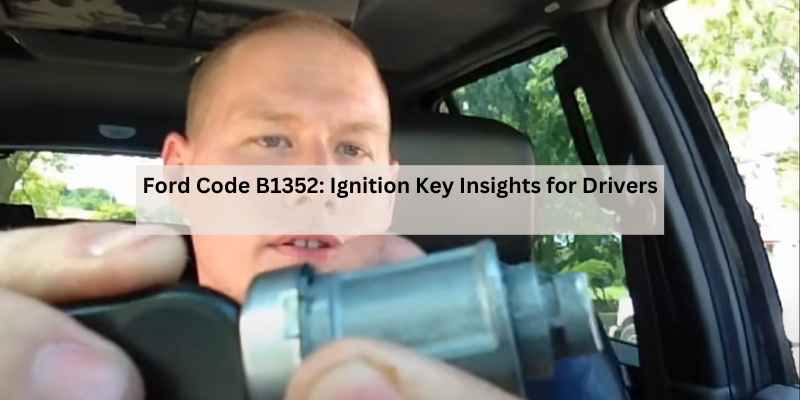
B1352 is a body code, not an engine code. It specifically points to the ignition key-in circuit. The BCM expects to see a ground signal from the key-in switch when the key is in the cylinder. That switch is usually a small plunger inside the ignition lock housing. When you insert the key, the plunger closes, grounding the circuit. The BCM sees that ground and knows the key is present.
The code sets when the BCM doesn’t see that ground signal when it should, or sees it when it shouldn’t. The failure isn’t always the switch itself. The wiring harness between the ignition cylinder and the BCM, the connector pins, and even the door chime module can cause the same code.
Symptoms of the B1352 Ignition Key-In Circuit Failure
Symptoms vary depending on which wire or component has failed. Common ones include:
- Door chime rings continuously with the door open and key removed.
- Chime doesn’t ring at all when the key is left in the ignition with the door open.
- Headlights stay on after you remove the key, or don’t turn off automatically.
- Intermittent no-start condition, especially on models with the keyless entry pad.
- Battery drains overnight because the BCM thinks the key is still in the ignition.
- Warning chime sounds while driving with the key in the run position.
Some drivers report the radio staying on after the key is removed. That’s the BCM keeping the accessory relay powered because it still sees the key-in signal.
Root Causes of B1352 (Ranked by Likelihood)
You can save a lot of money by testing before buying. Here’s what actually fails, from most to least common.
Faulty Door Chime Module
This is the surprising one. The door chime module isn’t just a speaker. On many Ford models, the key-in signal passes through the chime module before reaching the BCM. The module acts as a relay or buffer. When its internal circuitry fails, the ground signal from the ignition switch never gets to the BCM. The result is B1352, even though the ignition switch itself is perfectly fine.
The chime module is usually located under the dash, near the steering column or the fuse box. It’s a small plastic box with a connector. Many owners have fixed B1352 by replacing this module, not the ignition switch.
Wiring and Connector Issues
Corroded pins, broken wires, and stretched connectors are common culprits in older vehicles. The wiring harness near the steering column flexes every time you tilt the wheel or adjust the column. Over time, the insulation cracks and the wire breaks inside. Connector terminals lose their tension, causing intermittent contact that sets the code.
Pay close attention to the harness where it rubs against the steering column bracket. Chafing here is a known issue on F-150s and Mustangs from the mid-2000s.
Ignition Switch Failure
The key-in switch itself can wear out. The small plunger mechanism gets sticky or fails to make contact. This is less common than the chime module issue, but it does happen. The ignition lock cylinder and the electrical switch are separate parts on most Fords. You can replace the electrical switch without touching the lock cylinder.
BCM or Instrument Cluster Problems
The BCM itself can fail, but it’s the last thing to suspect. The BCM receives the key-in signal and also communicates with the instrument cluster. A failed cluster can cause communication errors that set B1352 as a secondary code. If the cluster is dead or flickering, suspect it before replacing the BCM. BCM failures are rare and expensive.
Tools You’ll Need for Diagnosis
You don’t need a dealer-level scan tool for this one. A basic setup works:
- Digital multimeter with continuity and resistance settings.
- OBD2 scanner that reads body codes, not just engine codes. A basic model like the ANCEL AD310 reads and clears generic powertrain codes, but for B1352 you’ll need a scanner that accesses body control module data. Many auto parts stores will read body codes for free.
- Wiring diagram for your specific year and model. The factory service manual is best, but a good Chilton or Haynes manual works.
- Test light or a 12V power probe.
- Small pick set for releasing connector terminals.
The AD310 is handy for clearing the code after you finish the repair and confirming no other engine codes are hiding. It’s a solid basic scanner, though it won’t read the BCM directly. For that, you’ll use the multimeter.
How to Diagnose B1352 (Step-by-Step)
Work through these steps in order. Each one eliminates a potential cause.
Step 1: Scan and Record All Codes
Write down every code, not just B1352. Look for other body codes like B1342 (ECU is faulty) or U codes that point to communication issues. If you see U codes, address those first. A network issue can cause false body codes. Clear the codes and see if B1352 comes back immediately or only after a specific action, like removing the key.
Step 2: Test the Key-In Circuit with a Multimeter
Find the key-in wire at the BCM connector. The wire color varies by model, but it’s often a light blue or green with a tracer. Consult your wiring diagram. Set your multimeter to continuity. Disconnect the BCM connector. With the key out of the ignition, you should have no continuity to ground. Insert the key and you should have continuity to ground. If the reading stays the same with the key in and out, the switch or its wiring is the problem.
If you see no continuity at all with the key in, the circuit is open. Trace the wire back toward the ignition switch and chime module.
Step 3: Isolate the Chime Module vs. the Ignition Switch
This is the key step. Unplug the door chime module. Test the wire from the ignition switch side of the module connector. With the key in, you should see continuity to ground. If you do, the ignition switch is fine. The fault is the chime module or the wiring between the module and the BCM.
If you don’t see continuity at the chime module connector, the problem is the ignition switch or the wiring between the switch and the module. Test the wire directly at the ignition switch connector to confirm.
Step 4: Inspect Wiring and Connectors
Visually inspect the harness from the ignition switch to the chime module and BCM. Look for cracked insulation, broken wires, and corroded terminals. Gently pull on the wires to see if any are stretched or broken internally. Check the connector pins for signs of overheating or green corrosion. Use contact cleaner and a small pick to clean the terminals.
How to Fix B1352 (Permanent and Temporary Solutions)
Once you’ve isolated the failed component, the fix is straightforward.
- Faulty chime module: Replace it. It’s a plug-and-play unit on most models. Remove the old module, install the new one, and reconnect the harness.
- Faulty ignition switch: Replace the electrical switch portion, not the whole lock cylinder. It’s usually held in with a small screw or clip. Disconnect the battery first.
- Wiring damage: Solder and heat-shrink any broken wires. Replace damaged terminals. Wrap the repaired area with quality electrical tape and secure the harness away from moving parts.
- Corroded connector: Replace the terminal or the entire connector if it’s badly damaged. Dielectric grease on the new terminals prevents future corrosion.
Temporary fix to get moving: If you’re stranded and just need the truck to start, unplug the door chime module. The BCM will lose the key-in signal, which may set the code, but the vehicle will usually start and run normally. The chime will stop, and the lights may not auto-off. This is a diagnostic bypass, not a permanent repair.
B1352 on Popular Ford Models (F-150, Mustang, Escape)
The diagnosis is the same, but the parts locations differ.
Ford F-150: The chime module on 2026-2026 models is often behind the glove box or under the dash near the blower motor. The ignition switch is on the lower steering column. Wiring chafing near the column tilt mechanism is a common cause.
Ford Mustang: On 2026-2026 models, the chime module is part of the Smart Junction Box (SJB), which is the BCM. In this case, the code often points to the ignition switch or the wiring to the SJB. A failed SJB is possible but less common.
Ford Escape: The chime module on 2026-2026 models is a separate unit under the dash, driver’s side, near the fuse panel. The key-in switch is part of the ignition lock cylinder. Replacing the lock cylinder is more involved, so test the wiring first.
B1352 vs. Anti-Theft (PATS) System: What You Need to Know
B1352 does not directly trigger the PATS (Passive Anti-Theft System). PATS uses a transponder chip in the key and a receiver ring around the ignition cylinder. If the key isn’t recognized, PATS disables the starter and fuel injectors. B1352 is a body code about the key’s physical presence, not its electronic ID.
However, a failing ignition switch can cause both issues. If the key-in switch fails, it can sometimes affect the PATS receiver wiring in the same harness. If you have a no-start condition along with B1352, check for PATS codes. A flashing theft light on the dash indicates a PATS problem. B1352 alone won’t prevent the engine from starting.
If you’re dealing with a no-start and a key issue, check our guide on unlocking your F-150 for related troubleshooting steps.
Estimated Repair Costs for B1352
Costs depend on the failed part and whether you DIY.
| Component | Part Cost (USD) | Labor Cost (Shop) | DIY Difficulty |
|---|---|---|---|
| Door chime module | $30 – $80 | $100 – $150 | Easy |
| Ignition switch (electrical) | $40 – $120 | $150 – $250 | Moderate |
| Ignition lock cylinder (mechanical) | $60 – $150 | $200 – $300 | Moderate |
| Wiring repair (per wire) | $5 – $20 | $100 – $200 | Hard |
| BCM replacement | $200 – $500 | $300 – $500 | Hard (needs programming) |
These are ballpark figures. Prices vary by region and parts source. A BCM replacement also requires programming to match your vehicle’s VIN, which often means a dealer visit or a specialty locksmith. In our experience, the chime module is the cheapest and most common fix, so start there.
Frequently Asked Questions
Can I drive my car with a B1352 code?
Yes, usually. The vehicle will start and drive normally in most cases. The main issue is the door chime, lights, and a potential parasitic battery drain. If the key-in circuit is stuck closed, the BCM may keep systems powered, draining the battery overnight. If the circuit is open, you lose the chime warning but the car runs fine.
Will B1352 cause a no-start condition?
Not by itself. B1352 is a body code and doesn’t disable the starter or fuel system. If you have a no-start, look for PATS codes or other powertrain codes. The ignition switch replacement can fix both if the physical switch is failing, but the code itself isn’t the cause of a no-start.
Where is the door chime module located?
It varies by model. Common locations are under the driver’s side dash, behind the glove box, or near the fuse box. On some newer Fords, the chime is integrated into the BCM or instrument cluster. Check your service manual for the exact location. The module is a small black box with a multi-pin connector.
Can a bad battery cause B1352?
Low voltage can cause a variety of false codes, including body codes. If your battery is weak or the terminals are corroded, the BCM may not operate correctly. Check battery voltage and clean the terminals before diving into component testing. A healthy battery should read 12.6 volts at rest.
Is B1352 the same as B1352-00 or B1352-20?
The base code is the same. The suffix indicates the specific failure mode. For example, B1352-00 might mean the circuit is shorted to ground, while B1352-20 could indicate a signal fault. The diagnostic steps are the same, but the exact test results will point you to the right fix. Write down the full code with suffix before clearing it.
Related Ford Body Codes
If you’re working through body codes, a few often appear alongside B1352:
- B1342: ECU is faulty. This is a general internal BCM failure code.
- B1359: Ignition run/start circuit failure. This points to the run/start power feed.
- B1600: PATS ignition key transponder signal not received.
- B1681: PATS transceiver signal not received.
These codes share wiring and connector locations. If you see any of them with B1352, inspect the harness and connectors at the ignition switch first. A single damaged connector can set multiple codes.
For other engine-related issues on your Ford, you might find our guides on P0012 code or P1132 code useful. They cover similar diagnostic logic for different systems.
What to Do Now: A Straightforward Plan
Here’s the short version of what you should do today:
- Scan the vehicle and write down every code, including any suffix numbers.
- Test the key-in circuit at the BCM connector with a multimeter. Confirm the ground signal changes when the key is inserted.
- Unplug the chime module and test the wire from the ignition switch to the module. This isolates the failed component.
- Inspect the wiring harness for chafing, corrosion, and broken wires before buying any parts.
- Replace the chime module if the ignition switch tests good. It’s the cheapest and most common fix.
- Use dielectric grease on all repaired connectors to prevent future corrosion.
- Clear the code with an OBD2 scanner and verify the chime works correctly with the key in and out.
B1352 is rarely a catastrophic failure. It’s a wiring and connector problem at heart. With a multimeter and a bit of patience, you’ll have it fixed for under $50 instead of paying a shop $400 to replace parts that weren’t broken.
Products related to this article
Sponsored / affiliate links. As an Amazon Associate I earn from qualifying purchases. I may earn additional commission from eligible campaigns.