How Long Does a BMW Battery Last? 5-7 Year Lifespan
A BMW battery usually lasts around 5 to 7 years, but short trips, frequent start-stop use, heat, and a replacement that is not registered can shorten that window to less than that. Ignore early warning signs, and you can end up stranded, with charging faults or weak stop-start operation. This guide explains BMW-specific battery life, failure signs, and the next step when yours is aging.
How long does a BMW battery last?



A BMW 12V battery often lasts about a few to several years in real use. The common 5–7 year answer fits only when the car gets regular drives, charges correctly, and avoids severe heat. Age matters, but condition matters more. A battery can be old and still pass, or look fine and fail under load.
BMW’s electrical management changes the answer compared with a basic sedan. BMW’s Intelligent Battery Sensor tracks battery state and adjusts charging based on driving patterns, which helps when the battery gets enough charging time between starts. BMW also claims a 6-year average battery life, which fits the middle of the range rather than the edges.
That said, 5–7 years is too optimistic for cars that sit often, make repeated short trips, or live in hot climates. A battery can also age faster if it is replaced without registration, because the car may keep using charging logic meant for the old battery.
What kind of battery does your BMW use?
Many BMWs use AGM batteries, while some older or lower-load applications use flooded lead-acid batteries. AGM is sealed and maintenance-free, and it handles the higher electrical load from start-stop systems, comfort electronics, and long accessory use better.
Typical lifespan matters here. AGM batteries are listed with a typical lifespan of 4–7 years, while flooded lead-acid batteries are listed with a typical lifespan of 2–4 years. Premium AGM batteries can exceed 5 years with proper maintenance, but that is not automatic.
Do not treat AGM as a guarantee. It resists cycling better than a basic flooded battery, but it still dislikes chronic undercharging, heat, and storage drain.
Why BMW charging systems change battery life
BMW’s charging strategy is smarter than a fixed-output system. The Intelligent Battery Sensor tracks battery state and adjusts charging based on driving patterns. That helps reduce unnecessary charging stress, but it also means a battery used mostly for brief trips may never recover fully.
Charging voltage matters too. Basic alternators operate at 13.8–14.4V, while smart charging can run at 13.2–15.5V. Too little charging leaves the battery underfed. Too much can speed wear. Either problem shortens battery life, especially in cars with frequent electrical loads.
A battery can therefore fail without a dramatic alternator fault. It may simply spend too much time partially charged.
What short trips, storage, and parasitic drain do to battery life
Short trips shorten BMW battery life because the battery gives up starting power before the alternator has time to refill it. A string of 5-minute errands, especially with headlights, defrosters, heated seats, and infotainment running, keeps the battery in a low state of charge. That is hard on AGM and even harder on flooded batteries.
Storage creates another problem. Modern modules draw current even when the car is off, and parasitic drain can add up quickly. A 5 mA parasitic draw can kill a battery in 3 weeks. If a BMW sits at an airport lot or in a garage for long periods, battery maintenance becomes part of ownership, not an afterthought.
Picture a 3-year-old BMW that only gets used on school runs of two miles each. The battery may still crank the car one day and fail the next, because the car has lived in a constant partial-charge state.
How heat and cold change BMW battery life
Heat speeds chemical aging inside the battery. In hot weather, the battery may lose capacity faster even if it still starts the car for now. Cold does the opposite in the moment, it reduces available capacity and exposes weak batteries that seemed fine in mild weather.
That is why the same BMW battery may feel healthy in October and struggle in January. Cold-cranking performance drops when reserve capacity is already low, so a marginal battery often shows its weakness on the first cold start of the season.
A hot garage and an engine bay that bakes the battery for years can be as damaging as harsh winters. The car may not care about the calendar. The battery does.
What are signs a BMW battery is going bad?
A failing BMW battery often shows slow cranking, repeated low-voltage faults, stop-start disablement, comfort-access issues, and warning messages that seem unrelated at first. It may still start the car some mornings, then struggle after a short drive or overnight sit. Those are classic signs that capacity, not just age, is the problem.
BMW owners often notice behavior before a dead no-start. The car may disable auto start-stop, throw electrical warnings, or act oddly with keyless entry and other convenience features. That happens because modern BMW systems are sensitive to voltage stability, not just minimum starting voltage.
Reduced cold-cranking performance is another clue. A battery that once spun the engine cleanly may now sound slower, especially after sitting. That does not prove failure by itself, but it is enough to test the battery immediately.
How to test a BMW battery before it fails
A load tester checks how the battery behaves under demand, not just at rest. It looks at voltage and cold-cranking amp behavior together. A healthy 600CCA battery should maintain 9.6V+ after 15 seconds at 50% load. If it cannot hold up under load, the battery may be near the end even if resting voltage looks acceptable.
Conductance testers are common in dealer diagnostics. They are quick and useful for screening, but they can miss early sulfation or give a better-looking result than a true load test would. That is why a battery can test “good” and still fail once the BMW asks for real current.
Voltage alone is not enough. A battery can show a decent static voltage and still collapse under starter demand or repeated accessory use.
How to read the result
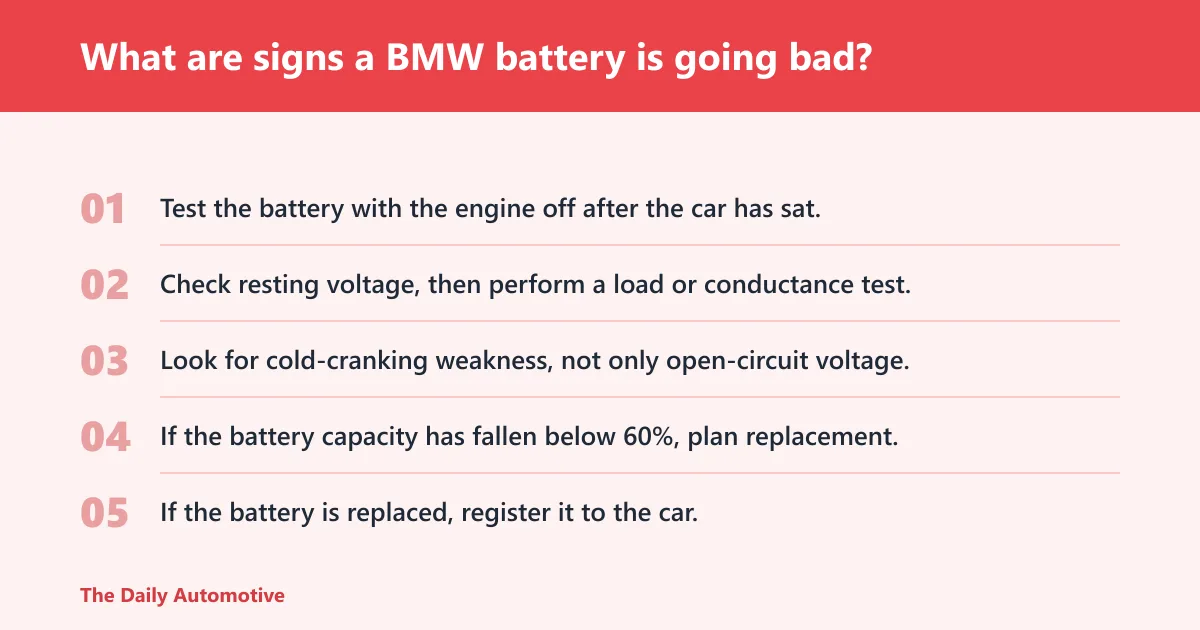
- Test the battery with the engine off after the car has sat.
- Check resting voltage, then perform a load or conductance test.
- Look for cold-cranking weakness, not only open-circuit voltage.
- If the battery capacity has fallen below 60%, plan replacement.
- If the battery is replaced, register it to the car.

BMW battery decision table: keep driving, test now, register after replacement, or replace now
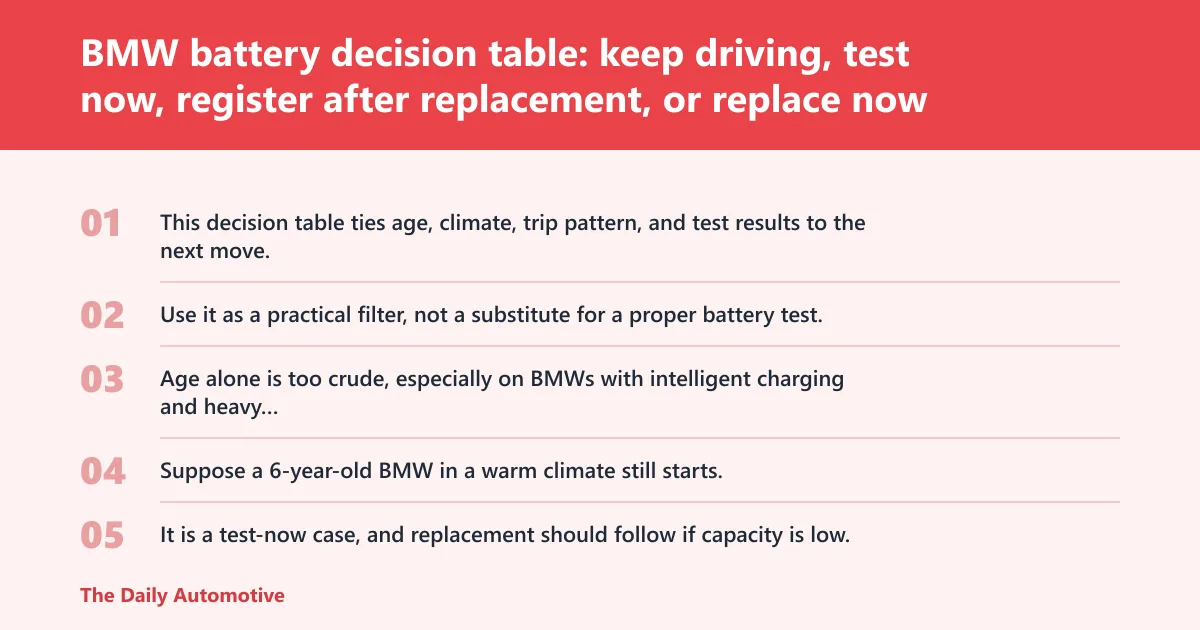
This decision table ties age, climate, trip pattern, and test results to the next move. Use it as a practical filter, not a substitute for a proper battery test. Age alone is too crude, especially on BMWs with intelligent charging and heavy electrical loads.
| Age | Climate | Trip pattern | Test result or symptom | Action |
|---|---|---|---|---|
| Under 3 years | Mild | Regular longer drives | No warnings, normal crank, passes load test | Keep driving |
| 3–5 years | Hot or very cold | Frequent short trips or storage | Auto start-stop disabled, slower crank, or weak test margin | Test now |
| 4–7 years | Any | Replacement battery installed | New battery fitted but not coded to the car | Register after replacement |
| 5 years or older | Hot climate | Short trips, lots of parking, or known parasitic draw | Low capacity, failed load test, or repeat low-voltage faults | Replace immediately |
| Any age | Any | Sits for weeks at a time | Battery drains quickly when parked | Test now |
Suppose a 6-year-old BMW in a warm climate still starts, but stop-start is disabled and the battery only barely passes a conductance check. That is not a “watch and wait” case. It is a test-now case, and replacement should follow if capacity is low.
When should you replace a BMW battery?
Replace the battery immediately if it fails load testing, drops below 60% capacity, or leaves the car with repeat low-voltage faults. A battery that repeatedly needs jump-starts is not borderline. It is already hurting reliability and may be stressing the charging system.
If the battery is older than 5 years and the car lives in heat, replacement is often the prudent move even before a total failure. The goal is not to squeeze every last month out of a weak battery. It is to avoid no-starts, fault codes, and module complaints.
Why BMW batteries need coding or registration
BMW battery registration tells the car a new battery has been installed. The vehicle then adjusts charging strategy for the fresh battery rather than continuing to treat it like the old one. That matters because the charging system is managed, not passive.
If registration is skipped, the car may overcharge or undercharge the replacement battery depending on what it thinks is still installed. That can shorten the new battery’s life. Registration is especially important on BMWs with battery management systems, because the software is part of the charging loop.
Some shops call this coding, some call it registration. The practical point is the same: the battery change should be recorded in the car after replacement.
How much does it cost to replace a BMW battery?
BMW battery replacement cost depends on battery type, labor, and whether registration is included. Dealer replacement usually costs more because the battery may be pricier and the job often includes registration, diagnostics, and labor tied to BMW software procedures. Independent shops may charge less, but registration should still be part of the work.
The battery itself is only part of the bill. AGM batteries cost more than flooded lead-acid batteries, and BMW-specific programming can add labor time. Cars with trunk-mounted batteries, tight access, or diagnostic follow-up will usually cost more than a simple swap in a basic car.
Do not compare only parts price. A cheaper battery that is not registered correctly can become the expensive option later.
How long should a BMW battery last in hot weather?
In hot weather, a BMW battery should often be expected to last less time than the usual 5–7-year target. Heat speeds aging, so a battery in a hot climate may need replacement closer to the lower end of the range, especially if the car makes short trips or sits in the sun often.
The main issue is not one hot day. It is cumulative thermal stress over months and years. Batteries in hot regions often age out before they visibly fail, which is why testing should begin earlier than many owners expect.
Does short-trip driving shorten BMW battery life?
Yes. Short-trip driving is one of the fastest ways to shorten BMW battery life because the starter draw is high, the alternator recovery time is short, and the battery stays in a low state of charge. BMW’s energy management can help, but it cannot fully correct a pattern of constant shallow charging.
If a BMW mostly does school runs, errands, and stop-and-go traffic, a battery maintainer during parking periods may help. A battery can still fail early even when the car is driven daily, if each drive is too short to restore the charge properly.
Does an AGM battery last longer in a BMW?
Usually, yes, but only in the right setting. AGM batteries are sealed, maintenance-free, and better suited to the higher electrical loads common in BMWs. Their typical lifespan is 4–7 years, which is longer than flooded lead-acid batteries at 2–4 years. That advantage depends on charging and use, not luck.
AGM is not a cure-all. A poorly charged AGM battery, one exposed to heat, or one left unregistered after replacement can still fail early. Its strength is better cycle tolerance and a better fit for modern electrical demand.
Frequently asked questions
How long does a BMW battery last?
A BMW battery usually lasts 5–7 years in favorable conditions, but that range is not guaranteed. Mild climate, longer drives, proper charging, and correct battery registration all help. Short trips, heat, storage, and repeated low-voltage events can reduce the lifespan to around 4 years or so.
Can a BMW battery last 7 years?
Yes, a BMW battery can last 7 years, especially if it is an AGM battery, the car is driven regularly, and the climate is mild. That said, age alone is not enough. A battery should still be tested as it approaches that point, because capacity can fade before complete failure.
What are signs a BMW battery is going bad?
Common signs include slow cranking, stop-start being disabled, low-voltage warnings, comfort-access problems, and other electrical faults. A battery may also pass a basic voltage check while still failing under load. If those symptoms appear, a load test is more useful than guessing based on age.
Why do BMW batteries need coding or registration?
BMW battery registration tells the car the battery has been replaced, so charging logic can adjust to the new unit. Without it, the car may keep using settings meant for the old battery, which can shorten the new battery’s life. This step matters on many BMWs with battery management systems.
How much does it cost to replace a BMW battery?
Cost depends on battery type, labor, and whether registration is included. Dealer service usually costs more than an independent shop because programming, diagnostics, and BMW-specific procedures are often bundled in. AGM batteries also cost more than flooded lead-acid batteries, so the final bill can vary widely.
Does short-trip driving shorten BMW battery life?
Yes. Short trips leave too little time for the alternator to refill what starting and accessory use removed. In a BMW, that can mean chronic undercharging, more stop-start disablement, and earlier battery replacement. Regular longer drives or a maintainer during storage help reduce the damage.
Products related to this article
Sponsored / affiliate links. As an Amazon Associate I earn from qualifying purchases. I may earn additional commission from eligible campaigns.